Health
Is ARVC a German Shorthaired Pointer disease?
No. It is documented mainly in Boxers. GSPs have heart problems on their health list, but not this specific condition.

Quick answer
Is ARVC a German Shorthaired Pointer disease?
No. It is documented mainly in Boxers. GSPs have heart problems on their health list, but not this specific condition.
The honest answer first: this is not a condition recorded as a German Shorthaired Pointer problem. The reason owners search it anyway is that the symptom that leads them here, a fit dog dropping mid-run, is very real.
Owners whose GSP has fainted, wobbled or dropped during exercise, and owners told at a routine check that their dog has an irregular heartbeat. Both groups need a rhythm answer; neither is likely to get an ARVC diagnosis.
This guide is not medical advice. If your dog shows pain, sudden behavior change, or worsening symptoms, consult a licensed veterinarian.
Some links may be affiliate links. We may earn a commission at no extra cost to you. We only suggest products we believe are helpful for dog owners.
We research and check what we publish, but we do not warrant that any figure, date, price, or statement is accurate, complete, or current, and we accept no liability for any loss, cost, injury, or other harm arising from the use of this site. Use it as one reference among several. You remain responsible for your own decisions and for your dog's care - confirm anything that matters with a licensed veterinarian or another qualified professional before you act on it. Full disclaimer.
ARVC replaces working heart muscle with fat and scar, creating an unstable electrical surface that produces extra beats and, at worst, a rhythm that cannot pump blood. It is a recognised disease of Boxers. It is not a documented German Shorthaired Pointer condition, but owners of collapsing pointers reasonably end up reading about it.
Rare to absent as a specific diagnosis in German Shorthaired Pointers. Heart problems as a category are common enough to sit on the breed's documented list, so the useful expectation is that a collapsing or arrhythmic GSP will end up with some diagnosis, but very probably not this one.
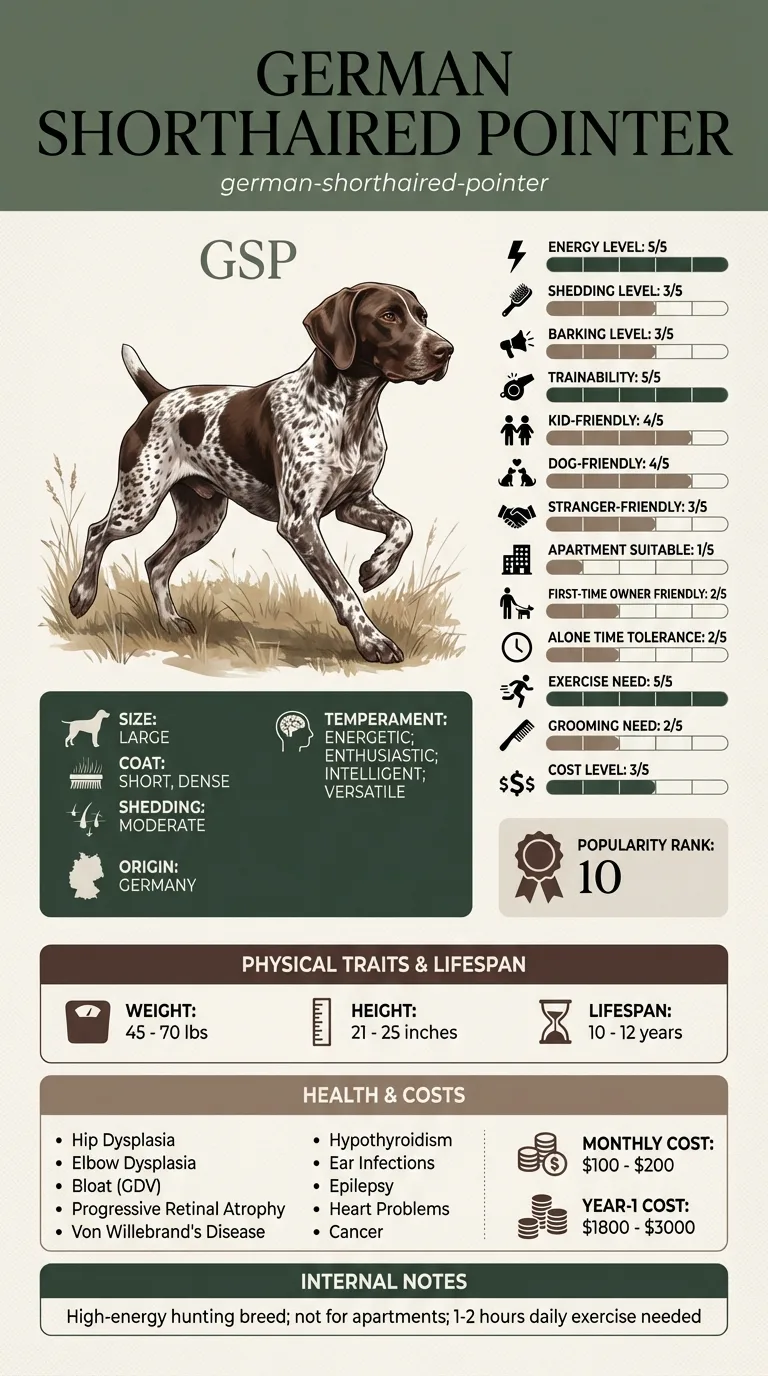
There is no known genetic driver for ARVC in the German Shorthaired Pointer, and honesty about that matters more than filling the space. What the breed does bring is a physiology that hides cardiac trouble: an animal bred in Germany as a versatile gundog, rated at the top of the scale for both energy and exercise need, with the temperament to keep working past the point where a problem would otherwise show. A 45 to 70 pound dog at full gallop also generates a cardiac workload that unmasks marginal rhythms.
The conditions that expose rhythm problems in this breed are the ordinary conditions of its life. Long, fast work in warm weather, back-to-back weekends in season, and the adrenaline of the first cast all raise heart rate and oxygen demand. Dehydration and electrolyte loss on a long day add to it. None of these cause heart disease, but they are reliably the moments when a hidden one becomes visible.
Book an appointment promptly for any collapse or faint, however brief, and for exercise intolerance that is genuinely new rather than seasonal. Treat it as an emergency, going straight to a clinic, if your dog collapses and does not fully recover within a minute or two, if the gums are pale, grey or blue, if breathing is laboured at rest, if the belly is swelling, or if collapse repeats the same day. Sudden collapse in a large dog is one of those situations where the cost of an unnecessary emergency visit is far lower than the cost of guessing wrong.
See all German Shorthaired Pointer health problems, which breeds are prone to arrhythmogenic right ventricular cardiomyopathy arvc, or the full German Shorthaired Pointer breed guide for temperament, exercise needs and ownership costs.
A first opinion and initial listen happen within days. A multi-day rhythm recording plus an ultrasound, usually with a cardiologist, typically takes two to four weeks to arrange and interpret. If nothing is found, expect your vet to widen the search to metabolic and neurological causes rather than to declare the dog fine.
In most cases, success is a confident exclusion: a documented normal rhythm and a normal heart scan, so that the investigation moves to the causes that are actually likely in this breed. Where a genuine cardiac problem is found, success is a named diagnosis, a clear exercise ceiling, and a monitoring interval you both stick to.
The breed's documented health list includes heart problems as a category, alongside hip and elbow dysplasia, bloat, progressive retinal atrophy, von Willebrand's disease, hypothyroidism, ear infections, epilepsy and cancer. It does not single out ARVC, and no reputable screening scheme asks GSP breeders to test for it.
That distinction is worth holding onto, because the danger of a breed-specific label is that it narrows the search too early. A pointer that collapses is far more likely to be dealing with heat, a metabolic problem, a seizure disorder, or one of the several other cardiac conditions that fall under the breed's heart problems heading than to have a Boxer disease.
What carries over from ARVC is the investigative approach rather than the diagnosis. Any dog with unexplained collapse or an irregular pulse deserves the same sequence: listen properly, record the rhythm over hours rather than seconds, image the heart, and rule out the non-cardiac causes at the same time.
A high-drive gundog is close to the worst possible patient for a subtle heart problem. Everything about how the breed works masks the early signs.

Bracken, six, went down for perhaps three seconds while running a stubble field in August, got up, and finished the day. His owner had read about ARVC that evening and arrived at the clinic convinced the dog had a fatal Boxer disease. The vet listened, found a normal rhythm, and fitted a recorder for three days rather than reassuring him on the strength of one exam. The recording covered two runs and a night. It showed nothing abnormal. The heart scan was normal too. What the history did show was that the field was cut stubble in full sun, that Bracken had been working for fifty minutes, and that there had been no water since the truck. The diagnosis was heat and overexertion. The plan was earlier starts, water carried, and enforced breaks. He has not gone down again in two seasons.
Key takeaway: The rare disease was worth excluding properly rather than dismissing, and the recording did that. But the answer was the common one, and in a breed this willing, heat and overexertion should always be near the top of the list.
It is not listed among the breed's documented conditions and is not part of any GSP screening scheme. The disease is closely tied to the Boxer. Heart problems in general do appear on the breed's health list, which is a different and broader statement.
In this breed, heat and overexertion come first, particularly in a dog worked hard in warm weather. Seizure disorders are also documented in GSPs. Cardiac causes are further down the list but are the ones nobody can afford to skip, so all three get investigated together.
A consulting-room listen catches only what happens in those seconds. Intermittent rhythm problems need a recording worn over a day or more so the heart is captured during real exercise and rest. Your vet will pair that with an ultrasound to look at the muscle itself.
Follow your vet's instruction, but the usual advice while collapse is unexplained is to cut back to lead exercise. That is hard on a breed needing one to two hours a day, and it is temporary, but a dog that faints at full gallop can injure itself badly.
No. Many dogs have a normal rhythm variation tied to breathing that speeds up on the in-breath and slows on the out-breath. Your vet can usually tell that apart from a pathological rhythm at the exam, and will record the heart if there is doubt.
Heart problems sit on the breed's documented list, so asking a breeder about cardiac history and screening in the line is reasonable. Ask what was tested and by whom rather than accepting a general assurance that the line is healthy.
No. It is documented mainly in Boxers. GSPs have heart problems on their health list, but not this specific condition.
A true faint, where the dog goes limp and recovers within seconds. That warrants an appointment straight away rather than a wait-and-see.
An ultrasound plus a multi-day rhythm recording is a significant one-off cost, usually with a specialist. Ask for the package price rather than paying step by step.
Sometimes, and only on a cardiologist's advice. It depends entirely on what the rhythm is doing under exertion, which is what the recording is for.
A one-page prep sheet for this condition: the signs, the questions to ask, what to get priced. Unlocks here.
You get: Vet visit prep sheet
No spam. One-click unsubscribe. See our privacy policy.
See a sample page before you decide.
Early access list
The free prep sheet covers the same-day warning signs, a symptom log and the questions to ask. We are considering a fuller kit that adds a cost worksheet for the usual tests and treatments (US price ranges with their sources) and a plain-English guide to ways of covering the bill. It is not built yet; this list tells us whether it is worth building.
One email, no spam, unsubscribe anytime. Information only, not veterinary advice.