Health
What does a luxating patella look like in a dog?
A brief hind-leg skip: the dog holds the leg up for two or three strides, then puts it down and carries on normally with no apparent pain.

Quick answer
What does a luxating patella look like in a dog?
A brief hind-leg skip: the dog holds the leg up for two or three strides, then puts it down and carries on normally with no apparent pain.
The hallmark is a skip: the dog hops for two or three strides with one hind leg held up, then drops it and carries on as if nothing occurred.
Owners who have seen that skip and want to know whether it matters, and people trying to work out why their dog's intermittent hind-leg lameness keeps disappearing before the appointment.
This guide is not medical advice. If your dog shows pain, sudden behavior change, or worsening symptoms, consult a licensed veterinarian.
Some links may be affiliate links. We may earn a commission at no extra cost to you. We only suggest products we believe are helpful for dog owners.
We research and check what we publish, but we do not warrant that any figure, date, price, or statement is accurate, complete, or current, and we accept no liability for any loss, cost, injury, or other harm arising from the use of this site. Use it as one reference among several. You remain responsible for your own decisions and for your dog's care - confirm anything that matters with a licensed veterinarian or another qualified professional before you act on it. Full disclaimer.
Patellar luxation is displacement of the kneecap out of the groove it should slide within, producing the characteristic brief hind-leg skip. It is predominantly a small-breed condition and is absent from the German Shorthaired Pointer's documented health list. Where it does occur in a large athletic dog it is more often associated with underlying bony misalignment, it damages cartilage faster because of the load involved, and it frequently sits alongside cruciate ligament disease rather than existing on its own.
Kneecap luxation is among the most frequently diagnosed orthopaedic conditions in small dogs and among the less common ones in large sporting breeds. A German Shorthaired Pointer with an intermittent hind-leg skip is statistically more likely to have a cruciate problem, a hip problem or a foot injury. That does not exclude the kneecap, but it does mean the diagnosis should be made by examination rather than by pattern-matching the skip.
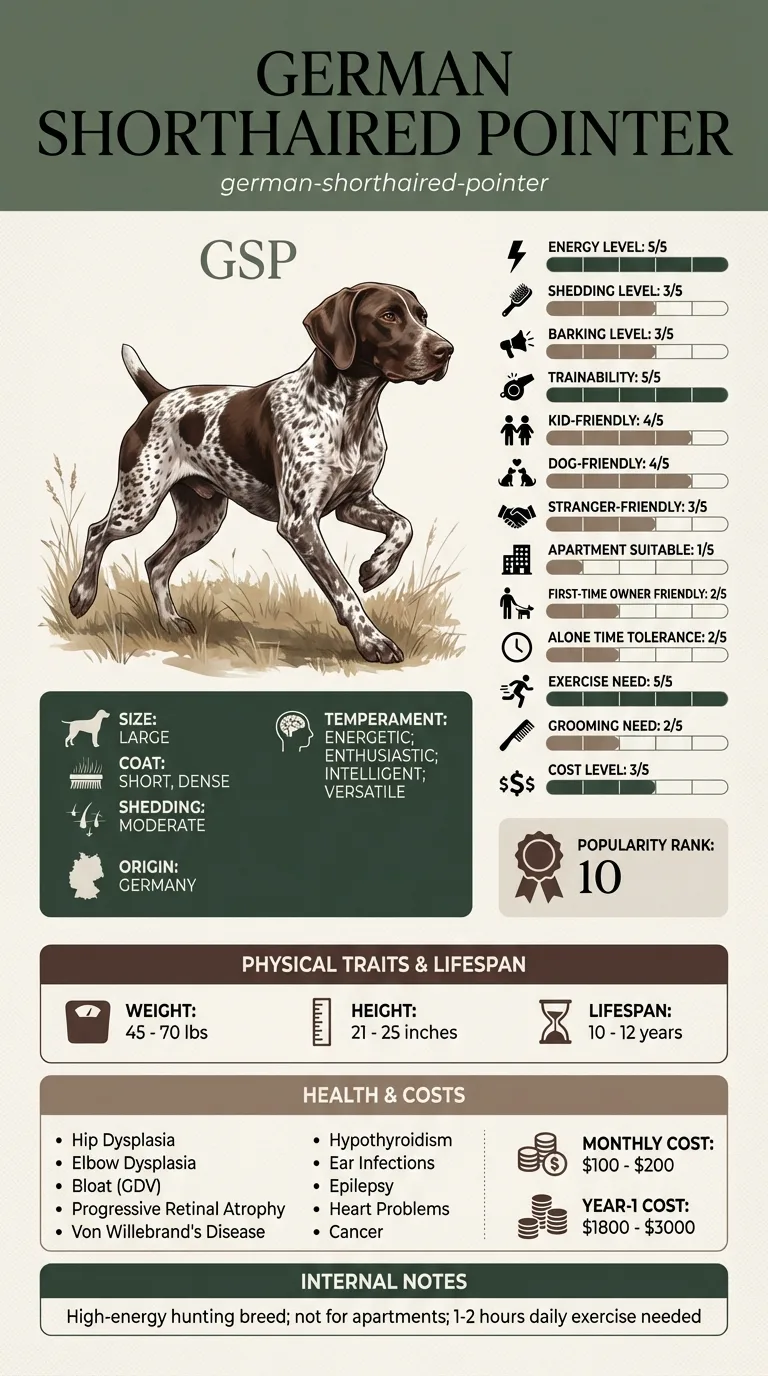
The German Shorthaired Pointer's build works against this diagnosis. It is a straight-limbed, correctly proportioned dog of 21 to 25 inches without the angular limb conformation that predisposes small breeds, and kneecap problems are absent from its documented health issues. What the breed contributes is force. A 45 to 70 pound dog rated five out of five for energy and exercise need, working one to two hours daily, applies far more load through the knee than a small companion dog, so a mild anatomical fault that would remain silent in a lapdog can become clinically important here.
Activity pattern is the main environmental factor. Games involving hard pivoting, frisbee catching and sudden reversals load the knee laterally in a way straight-line running does not. Repeated jumping down from tailgates does the same. Slippery indoor flooring causes splayed slips that torque the joint. Periods of enforced rest, ironically, contribute too: thigh muscle is lost quickly and regained slowly, and a dog returning to full activity with reduced musculature has less passive support holding the kneecap in track.
Seek prompt assessment for a dog that cannot bear weight on a hind leg, for a knee that is visibly swollen, or for a leg that remains held up rather than dropping back into use, since these suggest something more than a transient luxation. Book within days for a skip that is becoming more frequent, for lameness that persists between episodes, or for visible loss of muscle bulk over one thigh, which indicates chronic avoidance. Book routinely to have an occasional skip examined and graded, so you have a baseline. Do not give human anti-inflammatory medication, several of which are seriously toxic to dogs.
See all German Shorthaired Pointer health problems, which breeds are prone to luxating patellas, or the full German Shorthaired Pointer breed guide for temperament, exercise needs and ownership costs.
Conservative management shows its effect over eight to twelve weeks as muscle builds, not in a fortnight. Where surgery is undertaken, recovery typically runs eight to sixteen weeks with structured rehabilitation, and returning a working dog to full field fitness generally takes longer than returning a pet to normal life. Low-grade cases that are simply monitored need an annual re-examination to confirm nothing has progressed.
For a mild case, success is a dog that skips occasionally and never develops lameness between episodes, with good muscle and a stable weight. After surgery it is a dog that returns to work with a normal gait and symmetrical thigh muscle. Success does not necessarily mean the skip never recurs, and a rare skip in an otherwise sound, comfortable, well-muscled dog is not a failure of management.
The skip is the most recognisable sign in canine orthopaedics and it is worth understanding mechanically. When the kneecap slips out of its groove, the knee cannot straighten, so the dog carries the leg. A few strides later, the muscle relaxes enough for the kneecap to pop back, the leg works normally again, and the dog resumes without any apparent concern.
That is why owners so often describe the problem as intermittent and mild, and why it so often fails to appear during an examination. The dog is genuinely fine between episodes.
But the skip is not exclusive to a slipping kneecap. A partially torn cruciate ligament can produce a similar-looking intermittent hitch, and so can hip pain, a foot injury or a lodged grass seed between the toes. In a breed rated five out of five for exercise need and worked through rough cover, the mundane explanations deserve serious consideration first.
The distinction matters because the trajectories differ completely. A mild kneecap that slips occasionally may never progress. A partially torn cruciate almost always tears fully, and it usually does so during exactly the kind of hard turning this breed does for fun.
The same diagnosis carries different implications depending on the size and shape of the dog.

If you think your GSP has luxating patellas, the plan is three steps: write down what you have seen and when it started, book a veterinary appointment rather than waiting for the next flare, and take video of the behaviour or symptom before you go — the thing you are worried about rarely happens in the consulting room. Screening in the parents covers hip dysplasia, elbow dysplasia, bloat (gdv).
What the vet visit should produce is a diagnosis and a written plan, not just reassurance: what is being ruled out, what the monitoring interval is, and which signs mean you come back sooner. Ask what the treatment costs across a year rather than per visit, because that is the number that decides whether you are managing this condition or reacting to it.
Between appointments, keep a short log — dates, what you saw, what changed. It is the single most useful thing an owner brings to a follow-up, and for luxating patellas it is often what separates a clear pattern from a guess.
Lasse's GSP, Runa, developed a hind-leg skip that appeared perhaps twice a week. He read about kneecaps, watched a dozen videos, and became convinced. At the appointment the vet manipulated both knees, found them entirely stable, and then spent four minutes going through Runa's feet. Between two toes on the left hind, under a small crust, was a grass awn. A second, older one had already tracked further in and needed sedation to retrieve. The skip stopped that week and did not return. Lasse now goes through all four feet after every session in cover, which takes about a minute. He still thinks the skip looked exactly like the videos.
Key takeaway: In a dog that works in cover, check the feet before you diagnose the joint. Grass seeds are the great imitator of hind-limb lameness in sporting breeds.
It is uncommon and does not appear among the breed's documented health issues, which are led by hip and elbow dysplasia. Individual dogs can be affected, and it is a legitimate diagnosis when found, but a skipping hind leg in a GSP should prompt a broad examination rather than an assumption about the kneecap.
By hand, largely. A kneecap that can be pushed out of its groove and pops back is felt directly during manipulation. Cruciate instability is assessed with specific tests that detect abnormal forward movement of the tibia, often alongside joint swelling and thickening on the inside of the knee. Both examinations are quick and neither requires imaging to begin.
Low-grade luxation causing rare episodes in a comfortable dog is often monitored rather than operated on, with attention to keeping the dog lean and well muscled. What changes the calculation is increasing frequency, developing lameness between episodes, muscle loss on that side, or evidence that the cartilage is being damaged.
Strong thigh musculature genuinely helps stabilise the joint and is a core part of conservative management, but it cannot deepen a shallow groove or correct bony misalignment. Treat rehabilitation as something that improves function within the anatomy the dog has, not as an alternative to surgery where surgery is genuinely indicated.
Kneecap luxation has a recognised heritable component in the breeds where it is common, and affected dogs are generally not recommended for breeding. In a breed where it is unusual, an individual case may be developmental or related to injury, but the breeding advice remains the same.
Steady, consistent, straight-line work on even ground builds supportive muscle without the twisting that provokes episodes. Swimming is excellent. What to reduce is sharp pivoting, jumping, and games that involve sudden direction changes, which are unfortunately most of the games a GSP enjoys most.
A brief hind-leg skip: the dog holds the leg up for two or three strides, then puts it down and carries on normally with no apparent pain.
No. It is a small-breed condition and does not appear on the GSP's documented health list, which is led by hip and elbow dysplasia.
Yes. A partially torn cruciate ligament, hip pain or a grass seed between the toes can all look similar, and a partial cruciate tear tends to progress to a full one.
Considerably. Lower body weight reduces the force acting through a poorly tracking kneecap on every stride, and it is the change owners control most directly.
Swap sharp-turning games such as chase and frisbee for straight-line retrieves, swimming and scent work until the knee has been properly examined.
A one-page prep sheet for this condition: the signs, the questions to ask, what to get priced. Unlocks here.
You get: Vet visit prep sheet
No spam. One-click unsubscribe. See our privacy policy.
Preview page 1 before you decide.