Health
What is reverse sneezing in a Chihuahua?
Violent snorting inhalations with the neck extended, lasting seconds, ending abruptly with a completely normal dog. Common in small breeds and usually harmless.

Quick answer
What is reverse sneezing in a Chihuahua?
Violent snorting inhalations with the neck extended, lasting seconds, ending abruptly with a completely normal dog. Common in small breeds and usually harmless.
Four noises, four locations. A snort on the way in is the nose and throat. A honk on the way out is the windpipe. A snore is soft tissue vibrating during sleep. A high whistling squeak on inhalation is the one that means go now.
Owners of a Chihuahua that makes a frightening sound the vet has never heard, owners trying to work out whether nightly snoring matters, and anyone who has watched their dog freeze, extend its neck and snort violently for twenty seconds and assumed it was choking.
This guide is not medical advice. If your dog shows pain, sudden behavior change, or worsening symptoms, consult a licensed veterinarian.
Some links may be affiliate links. We may earn a commission at no extra cost to you. We only suggest products we believe are helpful for dog owners.
We research and check what we publish, but we do not warrant that any figure, date, price, or statement is accurate, complete, or current, and we accept no liability for any loss, cost, injury, or other harm arising from the use of this site. Use it as one reference among several. You remain responsible for your own decisions and for your dog's care - confirm anything that matters with a licensed veterinarian or another qualified professional before you act on it. Full disclaimer.
Noisy breathing in a Chihuahua is not one condition but a set of distinct sounds arising from distinct structures. Reverse sneezing comes from the back of the nose and is usually benign. A dry honk comes from a flattening windpipe, which is the breed's documented airway problem. Snoring comes from relaxed throat tissue during sleep. Stridor, a whistle on inhalation at rest, indicates significant upper airway narrowing and is urgent. Sorting the sound is most of the diagnosis.
Reverse sneezing is very common in small breeds and most Chihuahua owners will see it. Snoring is common and usually unremarkable. Tracheal honking is common enough that collapsing trachea sits on the breed's documented health list, typically appearing in middle age. Stridor at rest is uncommon and, when genuinely present, always significant.
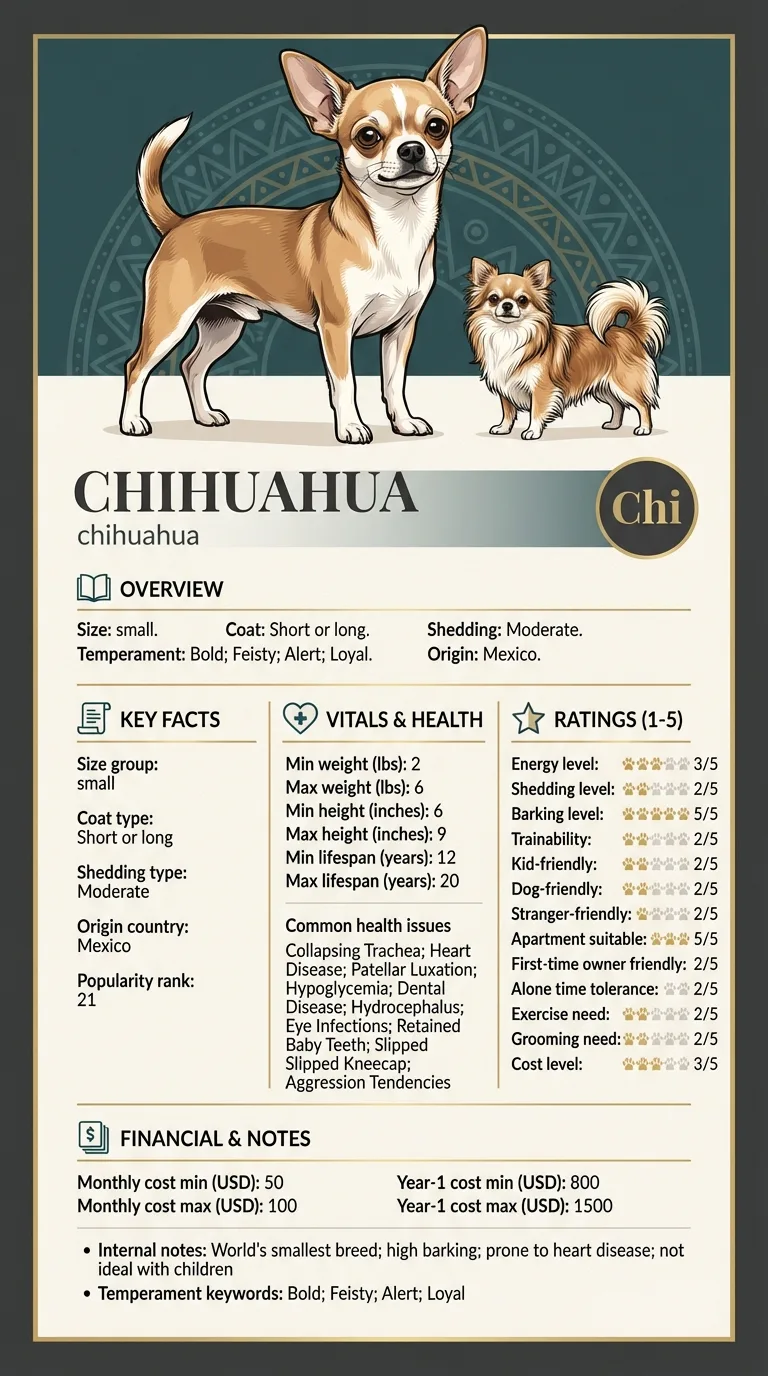
Two features of the Chihuahua explain most of its noises. The first is a narrow windpipe with a documented tendency to collapse, which produces the honk during any period of fast airflow and is the single most important airway diagnosis in the breed. The second is temperament: with the highest barking level on the scale and a bold, alert disposition, a Chihuahua spends far more of its day breathing forcefully than a placid breed does, and each of those arousal bouts is an opportunity for noise. The moderately shortened muzzle of the apple-headed type plays a part in reverse sneezing, but not the major obstructive role seen in genuinely flat-faced breeds.
Irritants at nose height matter, and a Chihuahua's nose is six to nine inches off the floor, in the layer where carpet powder, dust, and freshly applied cleaning sprays concentrate. Household aerosols, scented plug-ins and cigarette smoke all provoke reverse sneezing. A neck collar on a dog that lunges is a direct mechanical cause of honking. Weight is a quiet contributor to snoring, since even a few extra ounces around a tiny throat narrow the airway. Sleeping arrangements matter too, since a dog burrowed under a duvet on its back is set up to snore.
Go to an emergency clinic immediately for a high whistling noise on inhalation at rest, for breathing effort that does not settle within a minute of calm, for blue, grey or brick-red gums, or for collapse. Book an appointment, with your videos, for a honk that has become daily rather than occasional, for reverse sneezing episodes that are lengthening or accompanied by nasal discharge or blood, for noisy breathing that is new in an older dog, and for snoring that has begun to occur while the dog is awake. Never assume a sound is harmless simply because the dog seems fine between episodes.
See all Chihuahua health problems, which breeds are prone to brachycephalic obstructive airway syndrome boas, or the full Chihuahua breed guide for temperament, exercise needs and ownership costs.
Environmental changes act quickly: removing collar pressure and floor-level aerosols often reduces episodes within a fortnight. Arousal training takes six to twelve weeks to show a real change in frequency. Reverse sneezing tends to persist for life at a low rate and that is acceptable. Tracheal collapse does not reverse, so the honest expectation is fewer and milder episodes rather than silence, with slow progression over years punctuated by better and worse periods.
Success is knowing which noise your dog is making and what it means, having a video library that lets your vet assess it properly, and seeing episode counts fall as collar pressure, irritants, weight and arousal come under control. It is not a permanently silent dog. Most Chihuahuas will reverse sneeze occasionally and many will snore, and neither of those needs fixing.
The reverse sneeze is the one that frightens owners most and matters least. The dog stops, extends its neck, plants its elbows and makes a series of violent snorting inhalations, as though it is trying to inhale its own nose. It typically lasts five to thirty seconds and ends as abruptly as it started, with the dog immediately normal. It comes from irritation at the back of the nose causing spasm of the soft palate, and in most dogs it is benign. Small breeds do it more than large ones.
The tracheal honk is different in direction and quality. It is dry, repetitive, forced outward and genuinely does resemble a goose. It shows up during excitement, exertion, drinking, heat, or a pull on a neck collar, and it points at the windpipe, which is where the Chihuahua's documented airway problem lives.
Snoring is a sleeping noise made by soft tissue vibrating in a relaxed throat. It is common, is worse in dogs sleeping on their backs or overweight, and is usually unremarkable. What makes snoring worth reporting is change: new snoring in a dog that never snored, or snoring loud enough to wake the dog itself.
Stridor is the serious one. It is a high, whistling, musical squeak on breathing in, present at rest rather than only during excitement, and it indicates significant narrowing in the upper airway. Stridor in a dog that is also struggling is an emergency.

Your phone is the most useful diagnostic tool you own for this problem, because the noise almost never happens in the consulting room.
If you think your Chi has brachycephalic obstructive airway syndrome (boas), the plan is three steps: write down what you have seen and when it started, book a veterinary appointment rather than waiting for the next flare, and take video of the behaviour or symptom before you go — the thing you are worried about rarely happens in the consulting room. Screening in the parents covers collapsing trachea, heart disease, patellar luxation.
What the vet visit should produce is a diagnosis and a written plan, not just reassurance: what is being ruled out, what the monitoring interval is, and which signs mean you come back sooner. Ask what the treatment costs across a year rather than per visit, because that is the number that decides whether you are managing this condition or reacting to it.
Between appointments, keep a short log — dates, what you saw, what changed. It is the single most useful thing an owner brings to a follow-up, and for brachycephalic obstructive airway syndrome (boas) it is often what separates a clear pattern from a guess.
Mateo brought his 4-pound Chihuahua Barrio to a clinic in Malaga three times over four months for what he described as choking fits. Each time Barrio sat placidly on the table breathing normally, and each time Mateo left without an answer. On the fourth visit he brought a video. The first thirty seconds were unusable, because Mateo had been saying it's okay, it's okay directly into the microphone throughout. The second clip, taken silently on his wife's phone, showed everything: Barrio freezing at the water bowl, elbows planted, neck extended, making rapid snorting inhalations for about fifteen seconds and then walking away wagging. That was reverse sneezing, not choking, and the trigger was drinking too fast. A wider shallow bowl reduced it substantially. On the same clip the vet also noticed a brief dry honk as Barrio walked off, which prompted the tracheal radiographs that found the real underlying issue.
Key takeaway: Four appointments produced nothing and one silent video produced two diagnoses. The single most useful instruction for an owner in this situation is to film the episode and then say nothing at all while filming.
Usually not. It is a spasm of the soft palate triggered by irritation at the back of the nose, it is common in small breeds, and dogs are entirely normal the moment it stops. It becomes worth investigating if episodes are frequent, are getting longer, are accompanied by nasal discharge or bleeding, or start suddenly in an older dog that never did it before.
Most end on their own within half a minute and the best thing you can do is stay calm, since an anxious owner tends to make an aroused dog worse. Some owners find gently stroking the throat or briefly covering the nostrils to encourage a swallow helps. Do not put fingers in the mouth or restrain the dog forcefully, and never attempt this if you are unsure the dog is not actually choking.
Snoring is soft tissue vibrating in a relaxed throat, and volume has little to do with body size. Sleeping position matters, and a Chihuahua that burrows under a blanket and sleeps on its back will snore more. Body weight matters too, since even a few extra ounces of tissue around the throat narrows the space. New or worsening snoring in a previously quiet dog is worth mentioning.
Stridor is a high-pitched musical whistle heard as the dog breathes in, and unlike a honk or a snort it is present at rest rather than only during excitement. It indicates that air is being forced through a significantly narrowed upper airway. A Chihuahua with stridor and any sign of effort, distress or gum colour change should be taken to an emergency clinic rather than booked in.
Not by itself, and airway syndrome of the flat-faced type is not documented in this breed anyway. A Chihuahua's muzzle is short compared with a terrier's, not effectively absent as in a Pug's. Persistent noisy breathing in this breed more often points to the windpipe, to weight, or to something local such as a nasal problem, and it is investigated on that basis.
Yes, which is why frequency logs are useful. Occasional excitement-related honking that becomes daily, or reverse sneezing that lengthens from ten seconds to a minute, or snoring that turns into noise while awake, are all trends worth reporting. A single episode is often nothing; a changing pattern is information.
Violent snorting inhalations with the neck extended, lasting seconds, ending abruptly with a completely normal dog. Common in small breeds and usually harmless.
A dry repetitive honk on excitement, exertion or collar pressure points to a collapsing windpipe, which is documented in this breed.
A high whistling squeak on breathing in that is present at rest, especially with visible effort or changed gum colour. Go immediately.
Film it, include the seconds before and after, stay quiet yourself, and caption the context. Video beats any description.
Usually not on its own. What matters is change: new snoring, or snoring that spreads into waking hours, deserves an appointment.
A one-page prep sheet for this condition: the signs, the questions to ask, what to get priced. Unlocks here.
You get: Vet visit prep sheet
No spam. One-click unsubscribe. See our privacy policy.
Preview page 1 before you decide.