Health
What exactly is a gastropexy?
A surgical attachment of the stomach wall to the abdominal wall, so the stomach can no longer rotate. It is permanent once healed.

Quick answer
What exactly is a gastropexy?
A surgical attachment of the stomach wall to the abdominal wall, so the stomach can no longer rotate. It is permanent once healed.
There is one operation that can take a documented breed killer and make it very unlikely. Most GSP owners have never had it explained to them properly.
Owners of puppies and young adults deciding whether to add a preventive procedure to a neuter, owners whose breeder mentioned a bloat case in the line, and owners weighing an elective surgery against a risk that may never arrive.
This guide is not medical advice. If your dog shows pain, sudden behavior change, or worsening symptoms, consult a licensed veterinarian.
Some links may be affiliate links. We may earn a commission at no extra cost to you. We only suggest products we believe are helpful for dog owners.
We research and check what we publish, but we do not warrant that any figure, date, price, or statement is accurate, complete, or current, and we accept no liability for any loss, cost, injury, or other harm arising from the use of this site. Use it as one reference among several. You remain responsible for your own decisions and for your dog's care - confirm anything that matters with a licensed veterinarian or another qualified professional before you act on it. Full disclaimer.
Stomach torsion is the rotation of a gas-filled stomach within the abdomen, sealing it at both ends and cutting its blood supply. It appears on the German Shorthaired Pointer's documented health list. Unlike almost every other condition in this breed, there is a surgical procedure that can be done in advance to prevent the dangerous half of it.
Bloat is listed among the German Shorthaired Pointer's typical health problems. Lifetime risk in deep-chested large breeds is far higher than in the general dog population, and it rises with age, which makes it a condition that a middle-aged dog's owner should think about rather than one confined to puppies.
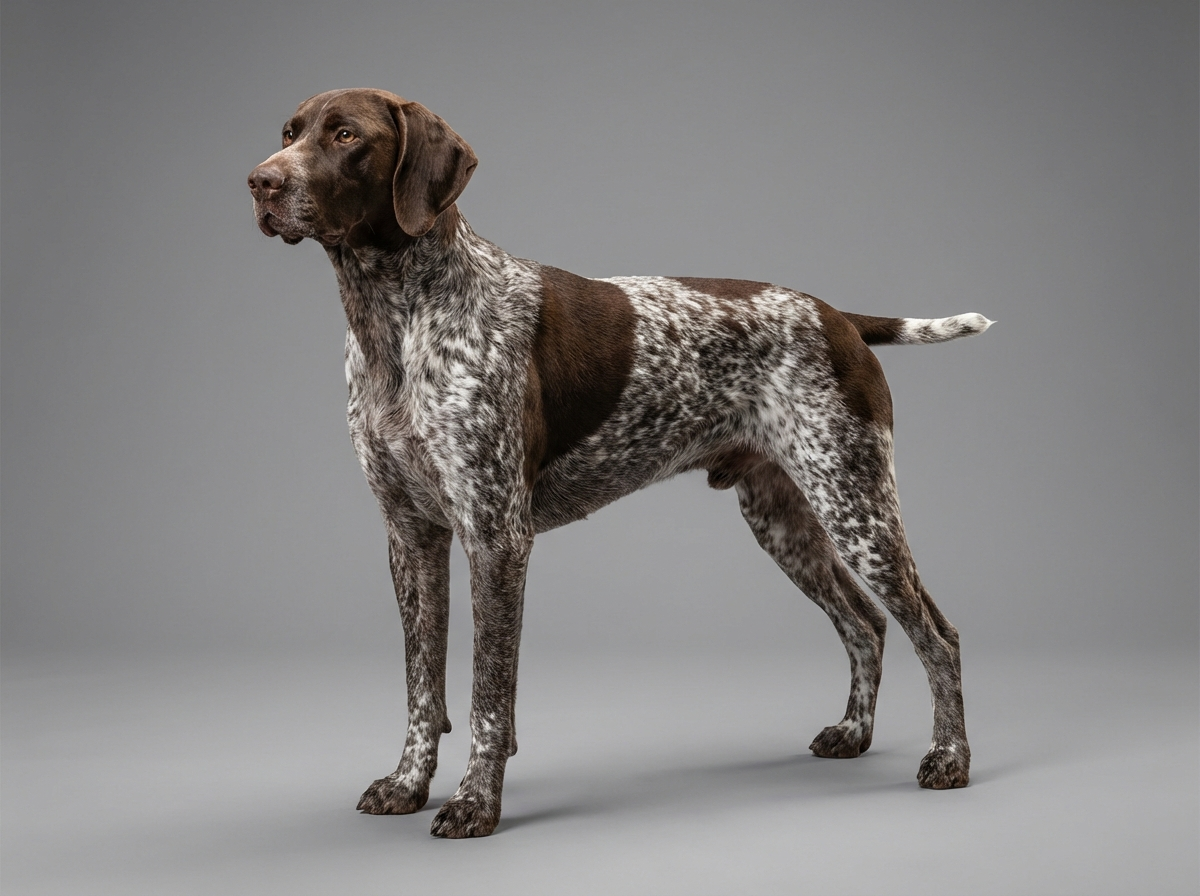
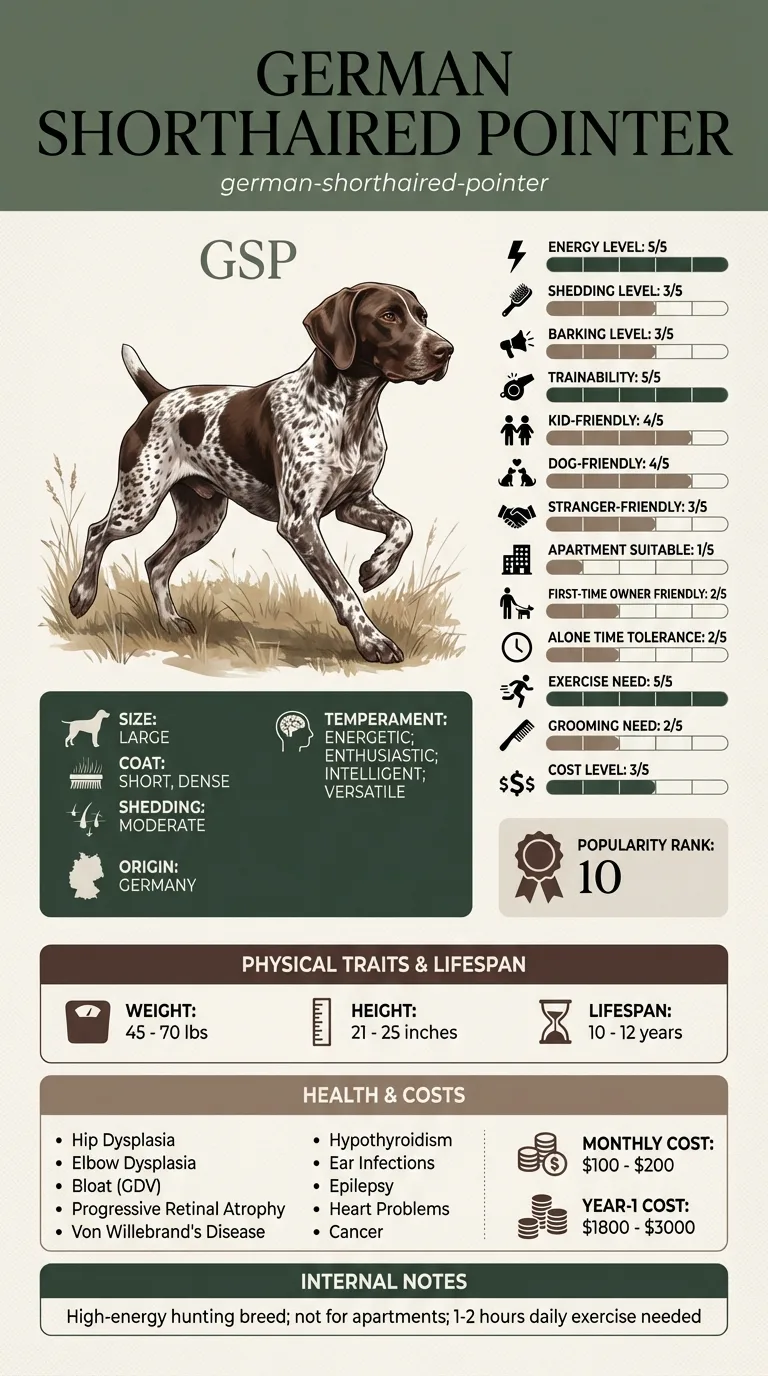
Chest shape is the mechanism. The German Shorthaired Pointer was developed in Germany as a versatile gundog and carries the deep, relatively narrow ribcage that gives a galloping dog its lung volume. The consequence is a tall abdominal space in which a distended stomach has room to swing and rotate. Weight matters too: at 45 to 70 pounds the breed sits in the size band where bloat risk climbs. A first-degree relative with a bloat history raises an individual dog's risk further, independent of build.
The manageable factors are feeding pattern, eating speed and stress. One big meal a day, a bowl bolted in ninety seconds, competition with other dogs at feeding time and a chaotic, high-arousal environment around food all feature in the risk picture. Raised feeders, once widely recommended, have been associated with increased risk in large breeds and are best discussed with your vet rather than assumed to help.
Book a normal appointment to discuss elective gastropexy, ideally before your dog's neuter is scheduled, and bring the family history if you have it. Separately, know the emergency picture: go straight to a clinic, without delay and without trying anything at home, if your dog is retching repeatedly and producing nothing, has a hard and swelling abdomen, cannot get comfortable, is drooling and pacing, or has pale gums with a weak rapid pulse. A twisted stomach is fatal within hours and there is no version of this that can safely wait until morning.
See all German Shorthaired Pointer health problems, which breeds are prone to bloat gdv, or the full German Shorthaired Pointer breed guide for temperament, exercise needs and ownership costs.
An elective gastropexy is a single procedure with roughly two weeks of restricted exercise afterwards, or less if done laparoscopically. The protection is permanent once the attachment has healed. Do not expect any change in the dog's behaviour, appetite or working ability afterwards; a healthy dog goes back to full work.
Nothing happening. Success in this topic is invisible by definition: a dog that lives out a ten to twelve year life without a twist, an owner who made a considered decision rather than a fearful one, and feeding habits that stayed sensible long after the surgery was forgotten.
The canine stomach is held in place loosely. It is anchored at the oesophagus above and at the duodenum below, and in between it hangs on soft attachments that let it expand after a meal. In a barrel-chested breed there is not much room for it to move. In a deep, narrow-chested one there is a great deal.
When gas accumulates, the stomach inflates and effectively floats within the abdomen. The heavier, food-filled part swings, and the whole organ can pivot around its fixed points, most often rotating clockwise through anywhere from ninety to over two hundred and seventy degrees. Both openings twist shut. Nothing escapes, so gas produced inside keeps accumulating, and the pressure climbs.
The damage follows from the pressure rather than from the gas. A swollen stomach compresses the vein that carries blood back to the heart from the whole rear half of the body, so cardiac output collapses. At the same time the stomach's own blood vessels are twisted, so its wall begins to die. The spleen, attached along the stomach's outer curve, is often dragged round with it and can lose its blood supply too. This is why a dog can look merely uncomfortable at the start and be in profound shock ninety minutes later.
A gastropexy is a surgical tacking of the stomach wall to the inside of the abdominal wall. Scar tissue forms a permanent attachment. It is a well-established procedure and the honest limits of it are worth knowing.

Rye and Tarn came from the same litter and went to friends who hunted together. The breeder mentioned, unprompted, that the dam's brother had bloated at six and survived surgery. One owner asked her vet about gastropexy; the other decided the risk sounded small and the surgery unnecessary. Rye had the procedure added to his neuter at fourteen months. It added a modest amount to the bill and about ten days of extra restriction. Nothing else changed. At seven, Tarn bloated on an October evening. He reached surgery in time and recovered, and a gastropexy was performed during that operation, but the emergency cost several thousand dollars and four days in hospital. His owner's remark afterwards was that he had paid for the same surgery, just at the worst possible moment and with a much sicker dog.
Key takeaway: Both dogs ended up with a gastropexy. The only real variable was whether it was scheduled or forced, and a breeder's honest mention of one relative was the piece of information that separated them.
It is not a universal recommendation, but bloat is on the breed's documented health list and the GSP has the deep-chested build associated with it, so it is a legitimate conversation for every owner. Family history, your dog's individual build and your distance from an emergency clinic all weigh into it.
Most often at neutering, in a young adult, so the dog goes under anaesthetic once. It can be done at any age, but adding it to an already-planned procedure is what makes the maths favourable.
The advice has reversed over the years and research has associated raised feeders with increased rather than decreased risk in large breeds. There is no strong reason to raise a healthy GSP's bowl, and reasonable grounds not to. Ask your own vet if your dog has a swallowing problem.
Yes, and it is one of the more robust risk factors. A first-degree relative that bloated raises a dog's own risk meaningfully. It is a fair question to ask a breeder, and the answer should be specific rather than reassuring.
Studies have associated anxious and highly reactive temperaments with higher bloat risk, and calm ones with lower. It is not a reason to panic about a keen gundog, but a dog that is frantic and stressed around food or in kennels is not helping itself.
Not entirely. Sensible feeding practice still reduces gas accumulation and discomfort, and a pexied dog can still get into trouble. What changes is that the specific catastrophic event, the twist, has been largely taken off the table.
A surgical attachment of the stomach wall to the abdominal wall, so the stomach can no longer rotate. It is permanent once healed.
Worth discussing with your vet in every case, given the breed's deep chest and bloat's place on its documented health list. Family history is the strongest individual argument.
A modest addition compared with a standalone surgery, and a small fraction of an emergency GDV. Ask your practice for the combined quote.
Typically about two weeks of restricted exercise, shorter for a laparoscopic procedure. Plan mental enrichment in advance for a breed this active.
A one-page prep sheet for this condition: the signs, the questions to ask, what to get priced. Unlocks here.
You get: Vet visit prep sheet
No spam. One-click unsubscribe. See our privacy policy.
Preview page 1 before you decide.