DogBreedCompass
← Back to breed profile

Heart Problems in German Shorthaired Pointers: The Congenital Side

Quick answer

What is the main danger of a congenital outflow narrowing in a GSP?

Sudden cardiac death during intense exertion, caused by an oxygen-starved thickened ventricle falling into a chaotic rhythm. Severity determines how real that risk is for a given dog.

A congenital narrowing does not get worse with age the way most heart disease does. It is fully formed by the time the dog stops growing, and then it simply is what it is.

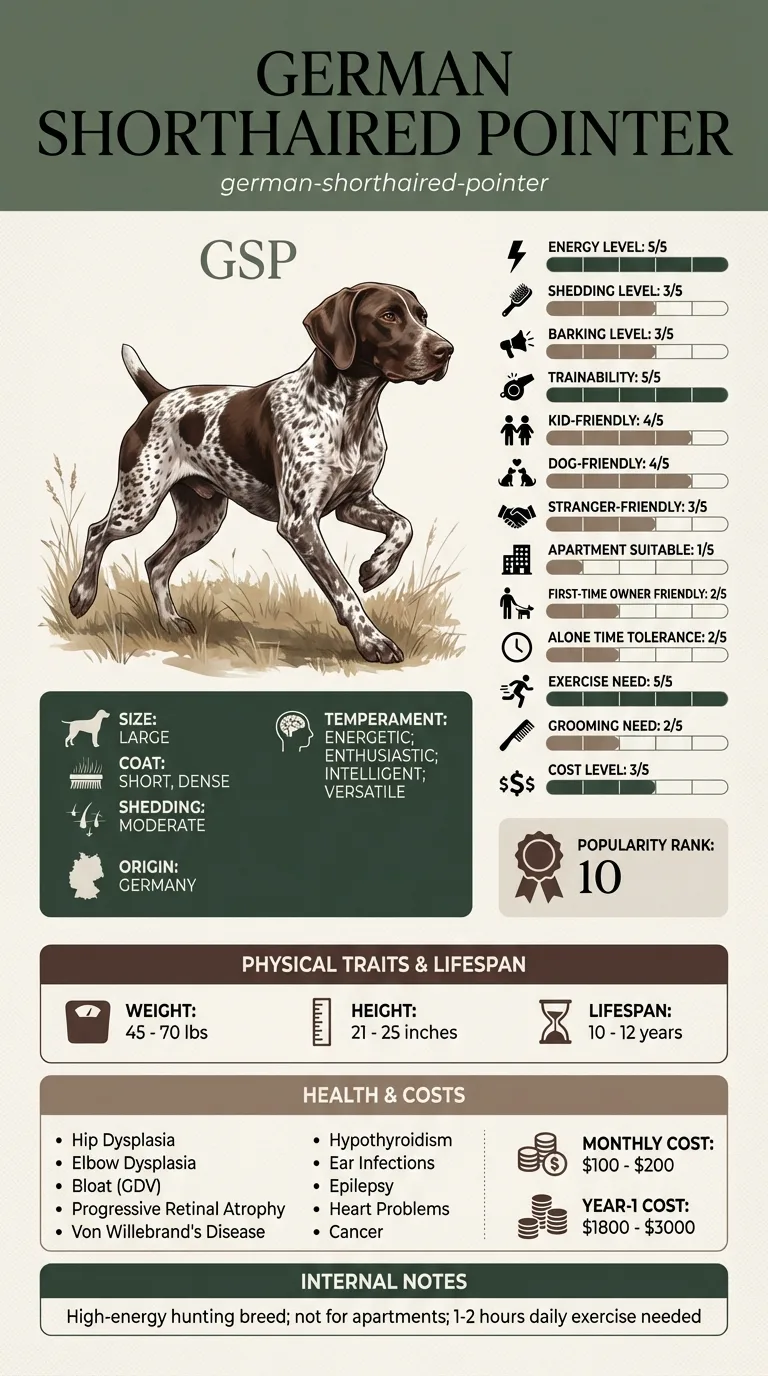
Heart Problems in German Shorthaired Pointers: The Congenital Side infographic

Puppy buyers reading breeder health paperwork, owners of a young dog whose murmur was heard high on the left side, and anyone weighing whether a structurally abnormal heart rules out the hunting or sport career they had planned.

Important reminder

This guide is not medical advice. If your dog shows pain, sudden behavior change, or worsening symptoms, consult a licensed veterinarian.

Some links may be affiliate links. We may earn a commission at no extra cost to you. We only suggest products we believe are helpful for dog owners.

What this problem looks like

Congenital heart problems in German Shorthaired Pointers are structural abnormalities present from birth, most notably a fibrous narrowing below the aortic valve that forces the left ventricle to work against resistance. The narrowing itself is fixed once growth finishes, but the thickened muscle it produces creates a real risk of dangerous rhythms during hard exertion. Heart muscle disease sits alongside it on the breed's documented concern list as the adult-onset counterpart.

Common triggers

  • Maximal exertion such as a flushing sprint or a long retrieve, which is when oxygen demand outstrips supply in a thickened ventricle
  • Growth between eight weeks and six months, when a previously quiet defect becomes audible
  • Anaesthesia, which lowers blood pressure and is poorly tolerated by an obstructed outflow tract
  • High ambient temperature, which raises heart rate and compounds the workload
  • Breeding decisions made without specialist cardiac clearance on both parents

Outflow narrowing is far from universal in German Shorthaired Pointers, and most puppies with a murmur at eight weeks turn out to have nothing structural. It matters out of proportion to its frequency because it is one of the few canine cardiac conditions that can kill a young, fit, apparently healthy dog with no warning, and because it is preventable at the breeding level rather than only manageable at the patient level.

Why this happens

Breed factors

The German Shorthaired Pointer carries heart problems on its documented health list, and congenital outflow narrowing is over-represented in medium-to-large sporting and working breeds generally. Breed athleticism then converts a structural problem into a lethal one: a dog rated five out of five for both energy and exercise need will voluntarily push itself to the exact effort level that endangers an obstructed heart, and its enthusiasm gives no warning. A breed developed in Germany for sustained all-day work simply does not self-limit the way a lower-drive dog might.

Environment factors

There is no environmental cause of a congenital defect, but the environment governs whether it becomes an event. Off-leash sprinting, retrieving games, hot weather, competitive field trials and unsupervised play with other high-drive dogs all push toward maximal effort. Anaesthesia for routine procedures is another environmental exposure that carries added risk. Choosing a puppy without seeing cardiac clearance paperwork is, in practical terms, the earliest environmental decision an owner makes.

What you can do at home (once it is not an emergency)

When to talk to your vet

Any fainting or collapse during or just after exercise in a young German Shorthaired Pointer is an emergency and needs assessment the same day, even if the dog stands up looking normal within seconds. Treat sudden weakness, staggering, blue or grey gums, or laboured breathing at rest the same way. Arrange a prompt but non-emergency appointment for a murmur heard high on the left chest, a murmur that is louder than at the previous visit, or any planned anaesthetic in a dog with a known murmur. Persistent murmurs beyond four months of age should be imaged rather than monitored indefinitely.

At home, alongside your vet's plan

  • Before buying, request dated cardiac clearance certificates for both parents issued by a veterinary cardiologist, and keep copies in your own records.
  • Book a deliberate heart recheck at four to six months for any puppy whose murmur was noted at the first visit, rather than waiting for the next vaccination.
  • If a defect is confirmed, manage arousal at the door and the gate, because the flat-out burst that follows a doorbell is a maximal effort your dog chooses without thinking.
  • Use a long line rather than full off-leash freedom while severity is being established, so intensity stays under your control instead of your dog's.
  • Tell every vet, kennel and dog walker about the diagnosis in writing, particularly ahead of any anaesthetic procedure.

See all German Shorthaired Pointer health problems, which breeds are prone to heart problems, or the full German Shorthaired Pointer breed guide for temperament, exercise needs and ownership costs.

What to expect, and how you know it is working

Severity is usually settled with one echocardiogram once the dog is mature enough for accurate measurement, often around six months. Because the narrowing itself does not progress after growth stops, the picture is comparatively stable thereafter, with rechecks yearly or as advised. Decisions about intervention, if any, are typically made in the first year rather than deferred.

For a mild case, success looks like a normal life with a note in the file and an avoided breeding decision. For a moderate or severe case, success is a dog that lives a full span within a firm intensity ceiling, kept mentally satisfied by low-effort work, with no collapse episodes. Success explicitly does not include the narrowing resolving, because it will not.

A narrow doorway the heart has to push through

Picture the aorta as the single door every beat of blood leaves by. In subvalvular aortic stenosis a ridge or ring of fibrous tissue sits just below that door, narrowing it. The left ventricle has to generate far more pressure to force the same volume through a smaller opening.

Over months and years the ventricle wall thickens in response, the way any muscle does under load. Thicker muscle needs more oxygen but has a harder time getting blood into itself, which sets up the central danger: during hard exertion the muscle can outrun its own supply, and an oxygen-starved ventricle is prone to sudden, chaotic rhythms.

That is why this condition carries a risk of sudden death during exercise, and why it matters enormously in a breed rated five out of five for exercise need. A dog that is happy, bright and apparently thriving can be in genuine danger during the exact activity the breed exists for.

The severity spectrum is wide. Mild narrowing may never cause a problem in a normal pet life. Severe narrowing changes everything about how the dog can be kept.

How a congenital defect actually surfaces

These conditions are found by listening, not by watching. The dog rarely tells you anything until something dramatic happens.

Heart Problems in German Shorthaired Pointers: The Congenital Side - How a congenital defect actually surfaces
  • A murmur at the left base, heard high on the chest near the shoulder rather than low behind the elbow. Location is the single most informative clue a general practice can give you.
  • A murmur that appears or grows louder between the puppy visit and six months, tracking the puppy's rising cardiac output as it grows toward 45 to 70 pounds.
  • Weak or delayed femoral pulses felt in the groin, which some vets check specifically when a left-base murmur is present.
  • An unexplained fainting episode during or just after intense exercise in an otherwise healthy young dog. This is a red flag, not a curiosity.
  • An incidental finding on pre-anaesthetic assessment before neutering, which is where a fair number of quiet cases are caught.
  • A breeder's cardiac clearance paperwork, or its absence, which is the only way to know anything before you take a puppy home.

The clearance certificate that changed a litter choice

Priya had deposits down on two GSP litters and planned to pick whichever puppy suited her first. She asked both breeders the same question in writing: could she see the cardiologist's cardiac examination certificates for the sire and dam. One breeder sent scans within an hour, dated and signed, plus hip and elbow results. The other replied that the line had never had a problem and that no one asks for that. Priya withdrew from the second litter. Two years later her dog, Falk, has been through three annual exams with nothing recorded on his heart. She has no way of knowing whether the other litter would have been fine, and she is comfortable with that.

Key takeaway: The most effective intervention against congenital heart disease happens before you own the dog. Ask for dated specialist certificates in writing, and treat a refusal as an answer.

Frequently asked questions

Is subvalvular aortic stenosis inherited?

A heritable component is well established in the breeds where it is common, which is precisely why cardiac clearance by a specialist is part of responsible breeding programmes. A dog diagnosed with an outflow narrowing should not be bred, and neither should close relatives be bred without their own clearances.

Can it be fixed with surgery?

Interventional options exist and are performed at referral centres, but they are not routine, not universally recommended, and outcomes vary with the anatomy of the individual dog. For many dogs the plan is medication to reduce cardiac workload plus firm exercise limits rather than a procedure. This is a specialist decision.

My GSP puppy has a murmur but the breeder says it will go away. Is that true?

It may be. Genuinely innocent puppy murmurs usually resolve by around four months. The honest test is time and a recheck at four to six months, not reassurance. A murmur heard high on the left side that persists or intensifies as the puppy grows should be imaged rather than waited out.

Does a mild narrowing mean my dog cannot be a hunting dog?

Mild cases sometimes tolerate normal activity, but the judgement has to come from someone who has measured the pressure gradient across the narrowing. The severity, not the diagnosis, sets the exercise ceiling. Do not extrapolate from another owner's dog with the same diagnosis.

What is the difference between this and cardiomyopathy?

A congenital narrowing is a plumbing obstruction present from birth that forces the muscle to thicken. Cardiomyopathy is a primary disease of the muscle itself, usually appearing in adulthood, where the walls thin and the chambers stretch instead. They produce opposite-looking hearts on an ultrasound and are managed differently.

Is there a genetic test for it?

No single reliable DNA test settles it in most breeds, which is why clearance is done by echocardiographic examination rather than a cheek swab. Ask breeders for a specialist cardiac examination result on both parents, dated, rather than a general statement that the line is healthy.

Quick answers

View more answers
Health

What is the main danger of a congenital outflow narrowing in a GSP?

Sudden cardiac death during intense exertion, caused by an oxygen-starved thickened ventricle falling into a chaotic rhythm. Severity determines how real that risk is for a given dog.

Health

Where should I ask my vet to listen for this?

High on the left side of the chest near the shoulder. A murmur loudest at that spot in a young dog points toward the outflow tract rather than the mitral valve.

Health

Should a GSP with a congenital heart defect be bred?

No. These defects carry a heritable component, and breeding an affected dog passes elevated risk to the next generation regardless of how well the individual dog copes.

Costs

What should I ask a breeder about heart health?

Ask for dated echocardiographic cardiac clearance on both parents from a veterinary cardiologist. A general assurance about healthy lines is not a clearance.

Training

Can I still do obedience or scent sports with an affected dog?

Low-intensity sports such as scent work and tracking are often possible where sprinting and agility are not. Confirm the ceiling with the cardiologist who measured the narrowing.

Related DogBreedCompass guides

  • heart conditions in German Shorthaired PointersOwners need the broader map of cardiac categories in the breed.
  • understanding GSP heart murmursMurmur location and grading are the entry point to a congenital diagnosis.
  • cardiomyopathy in GSPsMuscle disease is the contrasting adult-onset cardiac diagnosis.
  • exercise-induced collapse in GSPsExertional collapse has cardiac and neuromuscular causes that must be separated.
  • German Shorthaired Pointer breed profileProspective buyers assessing breeder paperwork want the full breed profile.

Bring the right questions to the vet

A one-page prep sheet for this condition: the signs, the questions to ask, what to get priced. Unlocks here.

You get: Vet visit prep sheet

No spam. One-click unsubscribe. See our privacy policy.

Preview page 1 before you decide.

Related guides