Health
How do I tell if my GSP is overweight?
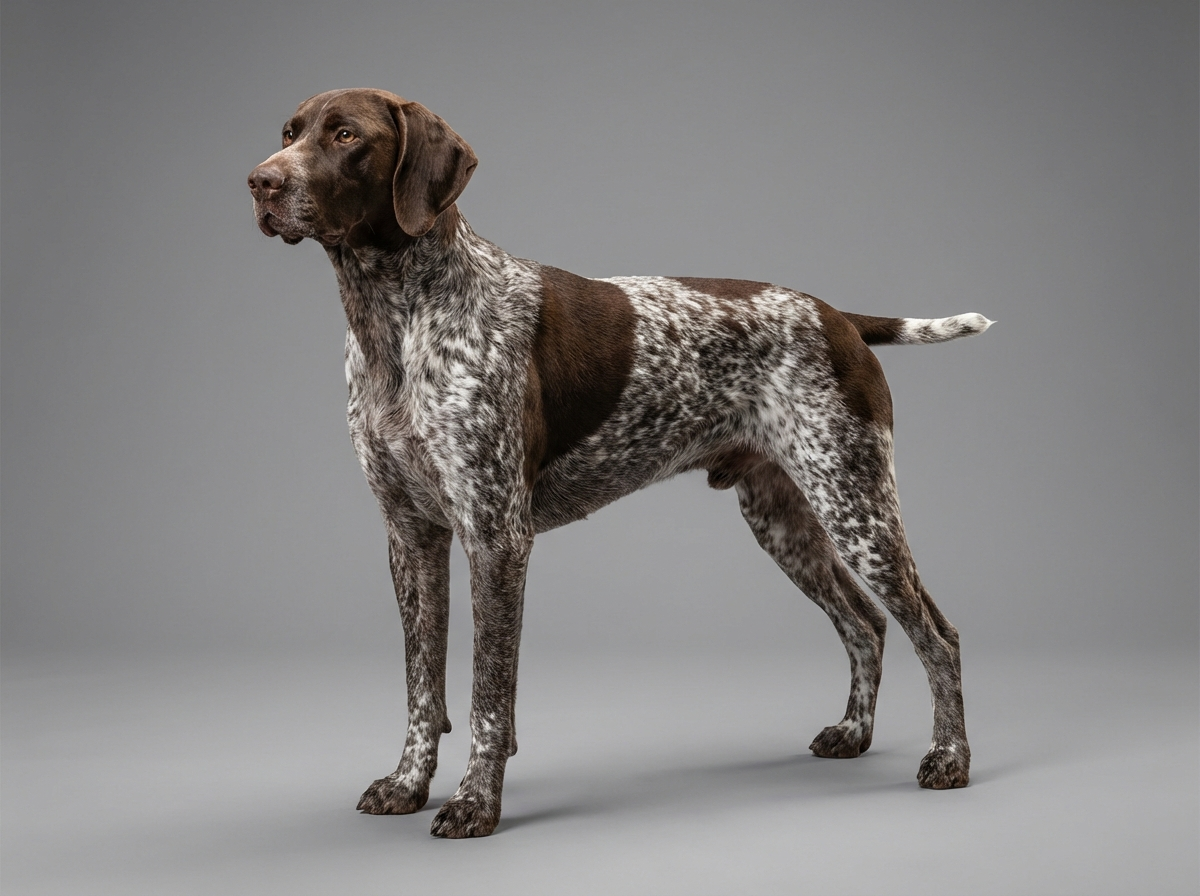
Feel rather than look. Ribs should be easy to find with light fingertip pressure, with a visible waist from above and an upward tuck of the belly from the side.

Quick answer
How do I tell if my GSP is overweight?
Feel rather than look. Ribs should be easy to find with light fingertip pressure, with a visible waist from above and an upward tuck of the belly from the side.
This is a breed that will happily do two hours. Most of them are offered forty minutes and fed as though they did the two.
Owners whose dog has quietly gained weight since being neutered or since the end of the hunting season, and people who genuinely cannot see the gain because a short-coated athletic dog still looks impressive.
This guide is not medical advice. If your dog shows pain, sudden behavior change, or worsening symptoms, consult a licensed veterinarian.
Some links may be affiliate links. We may earn a commission at no extra cost to you. We only suggest products we believe are helpful for dog owners.
We research and check what we publish, but we do not warrant that any figure, date, price, or statement is accurate, complete, or current, and we accept no liability for any loss, cost, injury, or other harm arising from the use of this site. Use it as one reference among several. You remain responsible for your own decisions and for your dog's care - confirm anything that matters with a licensed veterinarian or another qualified professional before you act on it. Full disclaimer.
Excess weight in a German Shorthaired Pointer is usually a mismatch between a breed requirement that has not changed and an exercise supply that has. It develops slowly, hides well under a tight athletic coat, and does its damage quietly, principally by accelerating the joint disease that heads this breed's documented health list. It is also among the most reversible problems in the whole of canine medicine, requiring measurement and consistency rather than anything clever.
Overweight dogs are common across all breeds and the German Shorthaired Pointer is no exception, despite its athletic reputation. The pattern in this breed is distinctive: gain tends to arrive in a middle-aged dog whose owner's circumstances have changed, or in a seasonal working dog during the long summer gap. It is rarely a dog that was never exercised, and more often one whose exercise quietly halved.
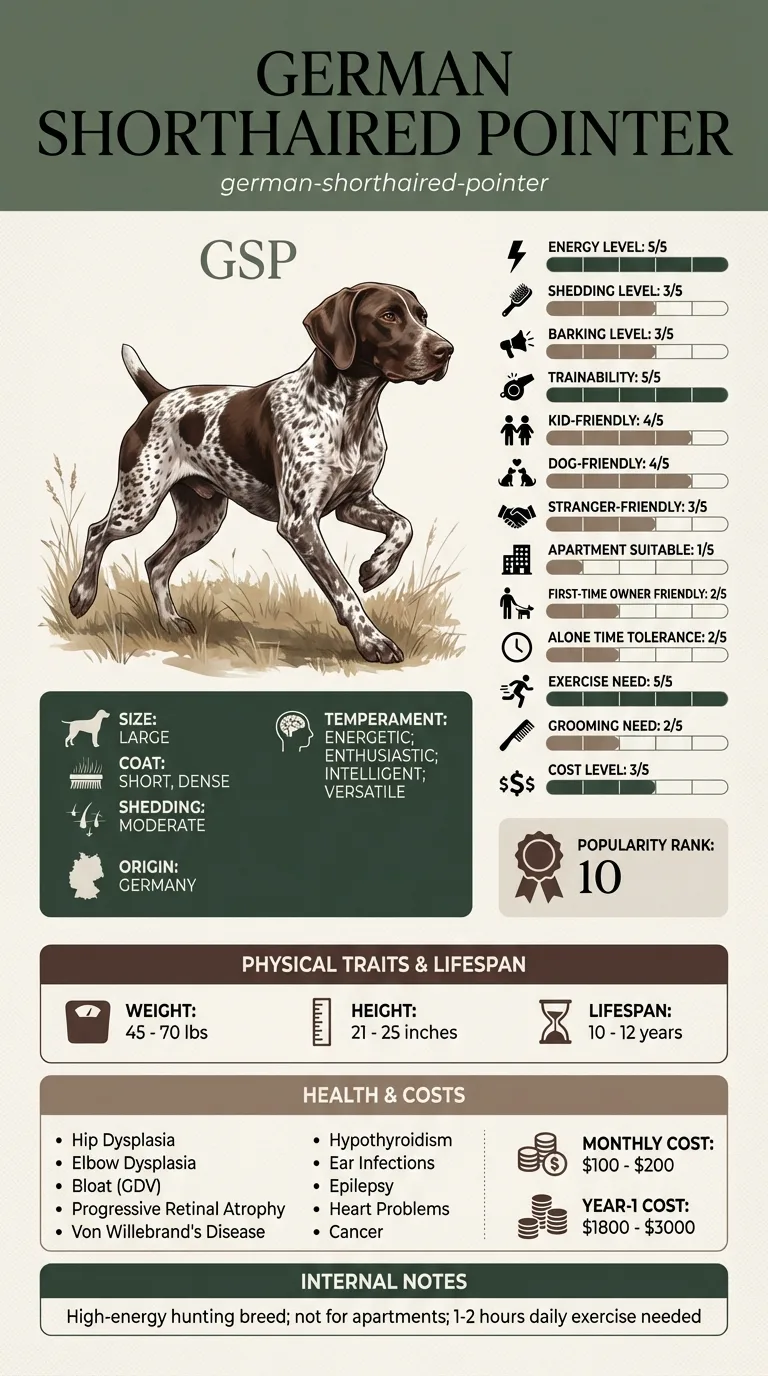
The breed's requirements are unusually demanding and unusually specific. An exercise-need rating of five out of five with a stated one to two hours daily, combined with an apartment suitability of one out of five, describes a dog whose energy budget is difficult to satisfy in most modern households. Trainability rated five out of five means these dogs are trained heavily and rewarded heavily, which is a large hidden calorie stream. The short, dense coat and moderate shedding conceal gain by keeping the dog looking sleek. And because hip and elbow dysplasia lead the documented health list, excess weight has a more damaging destination here than in a structurally sound breed.
Household routine is the whole story. A change in the owner's work pattern, a house move to a smaller garden, a winter of bad weather, or an injury to the owner rather than the dog all cut exercise without any decision being made. Multi-person households produce double feeding. Seasonal working dogs experience a dramatic annual swing in workload with no corresponding change in the bowl. Cold weather and dark evenings reliably shorten walks for several months a year, which is why many dogs gain in a predictable annual cycle.
Book an appointment rather than starting a diet on your own if your dog has gained weight without any change in food or exercise, since hypothyroidism is documented in this breed and other endocrine conditions can cause the same picture. Seek prompt advice for weight gain alongside lethargy, coat thinning, cold intolerance, increased thirst or a pot-bellied appearance. Ask your vet to set a target weight and a rate of loss rather than guessing, and to advise whether a therapeutic weight-management diet is appropriate. Also seek advice before increasing exercise substantially in an overweight, unconditioned or older dog, particularly in warm weather.
See all German Shorthaired Pointer health problems, which breeds are prone to obesity, or the full German Shorthaired Pointer breed guide for temperament, exercise needs and ownership costs.
Safe loss runs at roughly one to two percent of body weight per week, so a GSP that needs to lose ten pounds should expect three to six months rather than a few weeks. Body condition change becomes noticeable to an owner at around the six to eight week mark. Once at target, the maintenance ration will be lower than the pre-diet ration permanently, which is the part owners most often get wrong.
Success is ribs easily palpable under light pressure, a clear waist and abdominal tuck, and a maintained monthly record showing a stable weight rather than a slow climb. Functionally it looks like a dog that recovers faster after exercise and moves more easily, which owners usually notice before the scale impresses them. It is not a number on the scale, since the healthy range for this breed spans twenty-five pounds.
Owners are famously poor judges of their own dog's condition, and a German Shorthaired Pointer presents a specific version of the problem.
The short, dense coat means there is no fluff hiding anything, which sounds like it should help. In practice it means the dog still looks smooth, athletic and glossy while carrying real excess, because there is no ruffled coat to read as untidy. A muscular, tight-skinned breed reads as fit even when it is not.
Gradual gain compounds it. A pound a month is invisible day to day and substantial across a year, and you see your dog every day.
The fix is to stop looking and start feeling. Run your fingertips flat along the ribcage with light pressure, the way you would over your own knuckles. In a lean GSP the ribs are easy to find with almost no pressure and have only a thin covering. If you have to press to find them, your dog is carrying too much. Then look from directly above for a waist behind the ribs, and from the side for the upward tuck of the abdomen. Do this monthly and write down what you found.
Almost nobody deliberately overfeeds. The surplus arrives from places that do not feel like feeding.

If you think your GSP has obesity, the plan is three steps: write down what you have seen and when it started, book a veterinary appointment rather than waiting for the next flare, and take video of the behaviour or symptom before you go — the thing you are worried about rarely happens in the consulting room. Screening in the parents covers hip dysplasia, elbow dysplasia, bloat (gdv).
What the vet visit should produce is a diagnosis and a written plan, not just reassurance: what is being ruled out, what the monitoring interval is, and which signs mean you come back sooner. Ask what the treatment costs across a year rather than per visit, because that is the number that decides whether you are managing this condition or reacting to it.
Between appointments, keep a short log — dates, what you saw, what changed. It is the single most useful thing an owner brings to a follow-up, and for obesity it is often what separates a clear pattern from a guess.
Emeric hunted his GSP, Ferro, hard from October to January and walked him for half an hour a day the rest of the year. The food never changed. Ferro weighed 64 pounds at his third annual check and 68 at his fifth. Emeric knew the numbers and did not think much of them, because Ferro looked magnificent and out-worked every other dog on the shoot. At six, Ferro started struggling on the second morning of a two-day shoot. Radiographs showed moderate hip arthritis, which had almost certainly been developing for years, and the first instruction was to take nine pounds off him. It took nineteen weeks, a kitchen scale and a summer routine of morning scent work instead of a short walk. Emeric's summary was that he had spent five years feeding a hunting dog for a job it only did for four months.
Key takeaway: For a seasonal working dog, the bowl has to change when the season does. The gain that matters is not dramatic, and it does its damage to joints that were already vulnerable.
The breed range is roughly 45 to 70 pounds at 21 to 25 inches, which is wide because it spans small females and large males. Body condition matters far more than the number. A 62 pound dog can be lean or overweight depending on its frame, so use ribs, waist and tuck as your measure and use the scale to track direction.
The breed record specifies one to two hours daily, and that is genuine physical work rather than a stroll. Importantly, this is not primarily a weight-management prescription: it is a behavioural requirement. An under-exercised GSP tends to develop destructiveness and vocalisation long before it develops a weight problem.
Not inevitable, but it is predictable, and it should be planned for rather than discovered. Energy requirement falls after neutering while appetite frequently does not, so a portion reduction at the time of the procedure, followed by monthly body condition checks, prevents the drift that otherwise takes about a year to become obvious.
Slowly. Around one to two percent of body weight per week is a commonly used guide, which for a GSP means roughly half to one and a half pounds a week. Faster loss risks muscle rather than fat, and in an athletic breed preserving muscle is the whole point. Expect a meaningful reduction to take three to six months.
Feeding substantially less of a standard food risks shorting the dog on protein and micronutrients. Therapeutic weight-management diets are formulated for reduced calories with maintained nutrition and increased satiety, which also matters practically because a hungry, driven dog is a counter-surfing, bin-raiding dog. Discuss which approach suits your dog with your vet.
Because hip and elbow dysplasia head the German Shorthaired Pointer's documented health list, and body weight is the strongest modifiable factor in how early and how severely joint disease becomes painful. Excess weight also raises cardiac workload and reduces heat tolerance, both of which matter in a hard-working breed.
Feel rather than look. Ribs should be easy to find with light fingertip pressure, with a visible waist from above and an upward tuck of the belly from the side.
One to two hours of genuine daily work. This is a behavioural requirement as much as a physical one, and an under-exercised GSP becomes destructive before it becomes fat.
Yes, on a kitchen scale. Scooping introduces significant error that compounds twice daily, and it is the most common hidden source of surplus calories.
Take the training allowance out of the daily meal ration rather than adding it on top, and use small pieces. Volume of rewards matters more than size to the dog.
Over a lifetime, substantially. Delaying and reducing joint disease avoids years of pain management and rehabilitation on top of typical costs of 100 to 200 dollars monthly.
A one-page prep sheet for this condition: the signs, the questions to ask, what to get priced. Unlocks here.
You get: Vet visit prep sheet
No spam. One-click unsubscribe. See our privacy policy.
Preview page 1 before you decide.