Health
Which tooth breaks most often in a GSP?
The upper fourth premolar, the large shearing tooth at the back of the upper jaw. It is the one owners never see and the one hard chews destroy.

Quick answer
Which tooth breaks most often in a GSP?
The upper fourth premolar, the large shearing tooth at the back of the upper jaw. It is the one owners never see and the one hard chews destroy.
Most owners are watching for brown tartar. In a working pointer the tooth that costs you money is more often a clean-looking one with a chip off the side of it.
Owners of adult dogs who have never looked properly at the back teeth, owners who have been told their dog needs a dental and want to know why it is not just a clean, and anyone whose dog chews stones, sticks or antlers.
This guide is not medical advice. If your dog shows pain, sudden behavior change, or worsening symptoms, consult a licensed veterinarian.
Some links may be affiliate links. We may earn a commission at no extra cost to you. We only suggest products we believe are helpful for dog owners.
We research and check what we publish, but we do not warrant that any figure, date, price, or statement is accurate, complete, or current, and we accept no liability for any loss, cost, injury, or other harm arising from the use of this site. Use it as one reference among several. You remain responsible for your own decisions and for your dog's care - confirm anything that matters with a licensed veterinarian or another qualified professional before you act on it. Full disclaimer.
Dental problems in this breed split into gum disease, a slow bacterial destruction of the tissues holding teeth in place, and mechanical damage, chiefly fractures of the large shearing teeth at the back of the mouth. The second is the one most often missed, because dogs keep eating and the affected teeth are out of sight.
Gum disease is extremely common across all dogs by middle age, though it is not listed among the German Shorthaired Pointer's documented health issues and the breed's clean muzzle and well-spaced teeth are structurally favourable. Tooth fractures are a hazard of how this particular breed is used rather than of what it inherits, and they are frequent in dogs given hard chews.
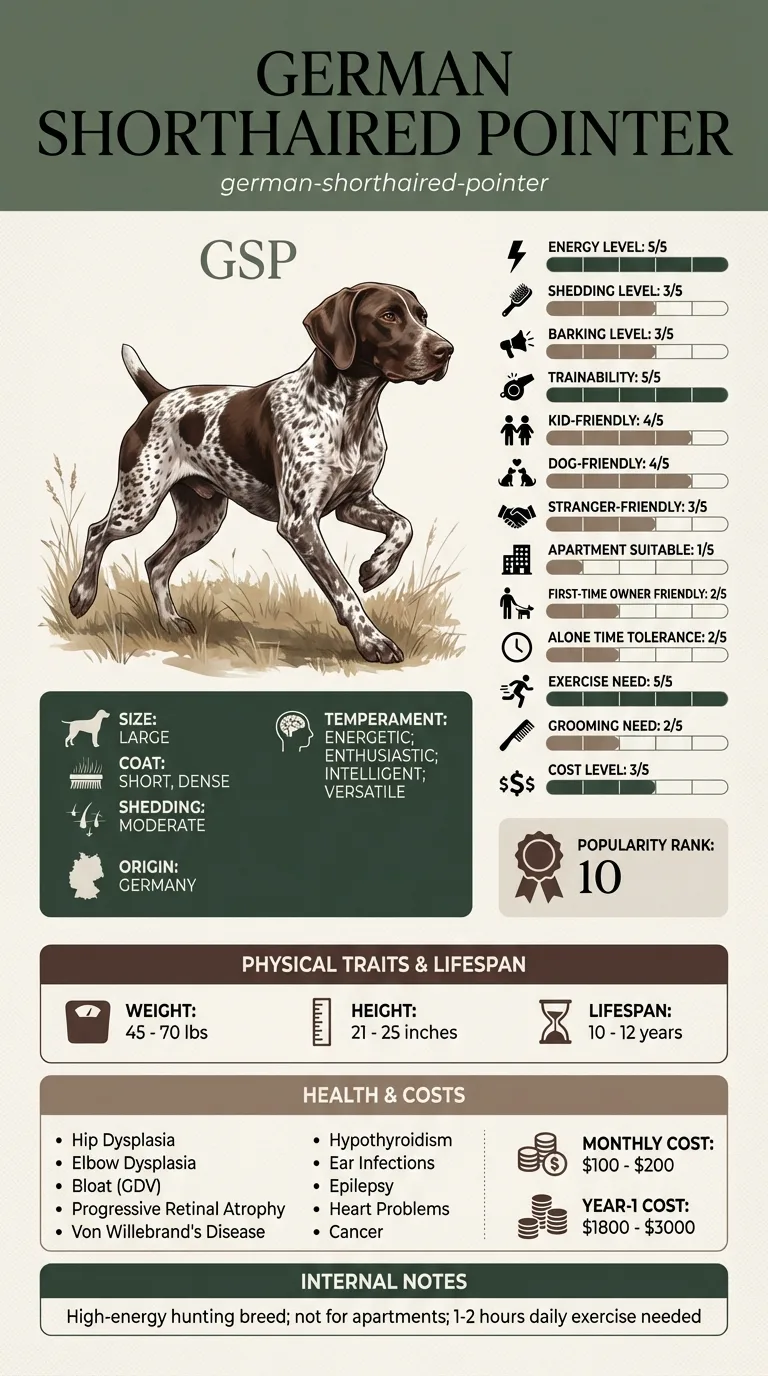
The German Shorthaired Pointer's mouth is a working tool. Developed in Germany as a versatile gundog expected to retrieve on land and in water, it carries things habitually and enthusiastically, and many will apply that enthusiasm to sticks, stones and whatever is offered as a chew. Its head conformation is an advantage: a long muzzle with normally spaced teeth avoids the crowding and misalignment that drive gum disease in short-faced breeds. The other relevant breed fact is not about teeth at all: von Willebrand's disease is documented in the GSP, which matters when extractions leave open sockets.
What is available to chew is the dominant factor. Households that supply antlers, hooves and dense nylon chews see fractures; those that supply chews with some give do not. Retrieving from frozen or stony ground adds impact. Beyond that, the environmental variable is simply routine: daily brushing genuinely slows plaque, and almost nobody sustains it, which is why professional intervals matter so much.
Book an appointment for a visible chip or fracture on any tooth, for a tooth that looks discoloured or grey, for persistent bad breath, for bleeding gums, or for a dog that has started chewing on one side. Go promptly, within a day or two, for a firm swelling below the eye or along the jaw, for a draining sore on the face, for a dog that will not let its mouth be touched at all, or for a dog that has stopped eating entirely. A facial swelling from an abscessed tooth root is an established infection and should not wait for a routine slot.
See all German Shorthaired Pointer health problems, which breeds are prone to dental issues, or the full German Shorthaired Pointer breed guide for temperament, exercise needs and ownership costs.
A dental with radiographs and extractions is a single day procedure, with most dogs eating softened food the same evening and back to normal within a week to ten days. Gum disease is managed rather than cured: expect professional intervals every one to three years depending on your dog and your brushing, with home care determining which end of that range you sit at.
A mouth with no fractured or painful teeth, gums that do not bleed, and breath that is unremarkable. Success also shows in the dog: owners very often report that a dog treated for long-standing dental disease becomes brighter and more playful afterwards, which reveals how much discomfort it had been quietly carrying.
The upper fourth premolar, the carnassial, is the largest tooth in a dog's upper jaw and sits well back where an owner never looks. It is the tooth dogs use to crack and shear, and it is the one that most often sustains a slab fracture, where a flake of the outer surface breaks away and exposes the sensitive interior.
The cause is almost always something too hard for a tooth to be doing: antlers, bones, hooves, nylon chews that do not flex, stones, and the ice-hard frozen ground a retrieving dog scrabbles at. A German Shorthaired Pointer is built to carry game, and many will happily carry and chew anything else offered to them.
The reason these go undiagnosed for months is that dogs almost never stop eating. A fractured tooth with exposed pulp is genuinely painful, but a dog will chew on the other side and continue behaving normally, and the fracture is on the outer face of a tooth at the back of the mouth. Owners are looking at the front teeth, which look fine.
What you may notice instead is subtle: chewing on one side, dropping food, a reluctance to take a hard retrieve, a swelling below the eye if the root has abscessed, or simply a dog that has become slightly less enthusiastic about its mouth being touched.
Owners often expect something like a hygienist appointment. It is closer to oral surgery, which explains both the anaesthetic and the cost.

Tam had been given a split antler as a puppy and loved it. At four his owner noticed he had started turning his head slightly to chew, and had stopped taking the hard rubber retrieving dummy with much enthusiasm. He was eating well and his front teeth looked immaculate. At his annual check the vet lifted his upper lip on the right and found a slab fracture of the upper fourth premolar with the pulp exposed and discoloured. Radiographs under anaesthetic showed bone loss at the root tip: the tooth had been infected for a long time. It was surgically extracted. Because of the breed's documented bleeding disorder, his clotting had been checked beforehand and the socket was watched carefully. Ten days later he was taking retrieves with both enthusiasm and a straight head. His owner threw the antlers away and now checks his back teeth on the first of every month.
Key takeaway: The head tilt while chewing was the symptom, and it had been visible for the best part of a year. A dog with a broken tooth does not stop eating; it changes how it eats, and that is a much quieter thing to notice.
Dental disease is not among the breed's documented health issues, and a GSP's clean, well-proportioned muzzle with normally spaced teeth is a structural advantage over crowded short-faced breeds. What the breed does have is a mouth used for work, which raises the risk of mechanical damage.
They are a common cause of slab fractures. A reasonable rule is that if you would not want to be hit on the knee with it, it is too hard for a dog's tooth. Chews that flex or give slightly under a thumbnail are a safer category, and supervision matters regardless.
Possibly. Tartar visible at the front says little about pocket depth at the back or about root health under the gum. A conscious examination at an annual check is a screen, not an assessment, and a vet who recommends radiographs is not upselling.
It removes visible tartar and leaves the disease below the gumline untouched, which is where the problem is. It also cannot include radiographs or probing. It makes teeth look better while giving owners false reassurance, and most veterinary bodies advise against it.
Daily, briefly, with a dog toothpaste, focusing on the outer surfaces where plaque accumulates. Build it up over weeks with the dog's head still and rewards for tolerance. Anything less than every other day has limited effect, which is the honest position.
The exposed pulp becomes infected, the infection travels down the root, and an abscess forms at the tip, sometimes breaking out as a swelling or draining tract below the eye. It is painful throughout, and the longer it is left the more bone is lost around the root.
The upper fourth premolar, the large shearing tooth at the back of the upper jaw. It is the one owners never see and the one hard chews destroy.
Almost never. They chew on the other side and behave normally, which is why fractures go unnoticed for months.
Because the disease is below the gumline and needs probing and radiographs to assess. Awake cleaning only addresses the part that does not matter.
A scale and polish with radiographs is a moderate cost; extractions raise it substantially depending on how many and which teeth. Ask for a range before the day.
A one-page prep sheet for this condition: the signs, the questions to ask, what to get priced. Unlocks here.
You get: Vet visit prep sheet
No spam. One-click unsubscribe. See our privacy policy.
Preview page 1 before you decide.