Costs
German Shorthaired Pointer cost in Honolulu
About $195–$375/month, $2,850–$4,850 for year one — the highest this site tracks, with a real cargo-transport and bloat-risk factor specific to this breed's size.

See German Shorthaired Pointer price across all cities →
Quick answer
German Shorthaired Pointer cost in Honolulu
About $195–$375/month, $2,850–$4,850 for year one — the highest this site tracks, with a real cargo-transport and bloat-risk factor specific to this breed's size.
A German Shorthaired Pointer in Honolulu costs about $195–$375 a month, with the first year around $2,850–$4,850 — the highest this site tracks, with a real, specific travel consideration given this breed's size and documented bloat risk.
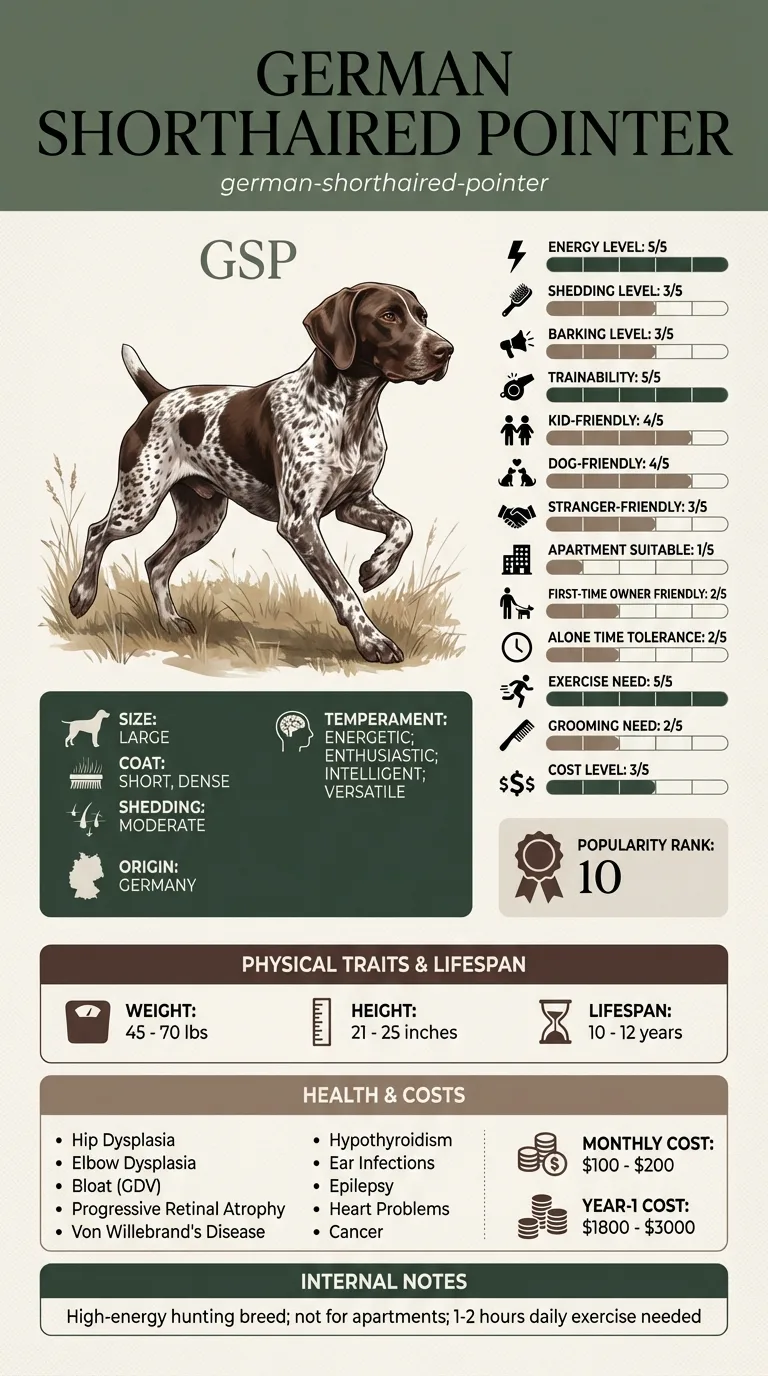
Bloat is a sudden emergency risk given this breed's deep chest, and long-haul air travel stress is a real, specific factor worth planning around. Hip and elbow dysplasia are the separate, ongoing joint risks worth budgeting real, recurring vet attention for.
These figures reflect Honolulu's shipping-driven, highest-in-market pricing, with genuine cargo-transport logistics priced in given this breed's real size and documented bloat risk.
Estimate · source: estimation · confidence: medium · updated 2026-10-06 · not a quote
| Item | Cost range |
|---|---|
Import requirements (titer testing, microchip, paperwork) Covers Hawaii's rabies-free entry requirements; costs rise substantially if quarantine becomes necessary due to a missed step. | $200 - $600 |
Cargo-hold airline transport A genuinely necessary cost given this breed's real size, which puts it outside typical in-cabin carrier limits. | $250 - $550 |
One-time setup (initial vet visit, spay/neuter, gear) Covers the first exam, vaccinations, spay/neuter if needed, and gear sized for this breed's large adult weight — priced at Honolulu's top-tier rates. | $485 - $825 |
| Item | Cost range |
|---|---|
Food Among the highest food costs this site tracks for a large, active breed, driven by shipping costs from the mainland. | $95 - $150 |
Each range starts from a national baseline for this breed's size class and is then adjusted for local cost of living and veterinary pricing. The baselines, and the source each one came from, are listed on our sources page (dataset 2026.09). Two inputs, the purchase price and the emergency reserve, have no published national figure we could verify, so we leave them to you rather than invent them.
These are planning estimates, not quotes. Your own numbers will move with the individual dog, your vet and your insurer. Build a budget with your own figures.
For a German Shorthaired Pointer in Honolulu, insurance is especially worth taking seriously given this breed's extensive documented health risks combined with the highest general and emergency-care pricing this site tracks.
This breed's real bloat and joint statistics make insurance a near-necessity here — buy before a diagnosis, not after, since pre-existing conditions won't be covered.
Self-insuring is reasonable only for a household that's already earmarked real, substantial savings specifically sized for Honolulu's premium pricing.
Honolulu's costs run higher than anywhere else this site tracks, so the pre-arrival planning around cargo transport and this breed's bloat risk is worth as much attention as the ongoing budget.
Hawaii's entry requirements exist because the islands remain rabies-free, and any dog arriving from the mainland needs advance microchipping, specific vaccination timing and blood titer testing well before travel, with a mandatory quarantine at the owner's expense as the fallback for anyone who skips the planning. Full current requirements are worth confirming directly with Hawaii's Department of Agriculture before booking anything.
What's specific to this breed within that process: its real adult weight, 45 to 70 pounds, puts it well outside typical in-cabin carrier limits, meaning cargo-hold transport is the realistic option for most owners. Combined with this breed's documented bloat risk, a genuine concern during the stress and pre-flight fasting window of a long-haul flight, discussing feeding timing and stress management with a vet before booking is worth doing rather than assuming any large dog handles the trip the same way.
Honolulu is, by a wide margin, the highest cost-of-living city this site tracks, with shipping costs from the mainland pushing up food, supply and vet pricing across nearly every category, a real, compounding factor given this breed's already substantial food needs.

A family relocating to Honolulu with their German Shorthaired Pointer scheduled a pre-flight consultation with their vet specifically to discuss the dog's real bloat risk before booking cargo transport, having read enough about the condition to take it seriously. The vet recommended a lighter meal well ahead of departure and a specific feeding schedule for the arrival day, precautions the family wouldn't have thought to ask about on their own. The flight went smoothly, and the family credits the proactive planning with avoiding what could have been a genuinely serious complication.
Key takeaway: In Honolulu specifically, this breed's real bloat risk deserves a genuine pre-flight conversation with a vet, not just standard airline paperwork.
About $195–$375, the highest this site tracks, driven by Hawaii's shipping-dependent pricing across food, supplies and vet care.
Roughly $2,850–$4,850, including import requirements, the initial vet exam, spay/neuter if needed, and gear on top of ongoing monthly costs.
Generally not — its real adult weight, 45 to 70 pounds, puts it well outside in-cabin carrier limits, meaning cargo-hold transport is the realistic option for most owners.
Worth real caution — the stress and pre-flight fasting window of a long-haul flight is a genuine factor for a breed with this documented bloat risk, worth discussing feeding timing with a vet before booking.
Especially worth pricing out given this breed's extensive documented health risks and Honolulu's genuinely high emergency-care pricing, bought while the dog is young and before anything is on record.
Around $1,350 covers a typical significant vet visit in this market, reflecting Honolulu's genuinely elevated pricing across the board.
About $195–$375/month, $2,850–$4,850 for year one — the highest this site tracks, with a real cargo-transport and bloat-risk factor specific to this breed's size.
This guide is not medical advice. If your dog shows pain, sudden behavior change, or worsening symptoms, consult a licensed veterinarian.
Some links may be affiliate links. We may earn a commission at no extra cost to you. We only suggest products we believe are helpful for dog owners.
We research and check what we publish, but we do not warrant that any figure, date, price, or statement is accurate, complete, or current, and we accept no liability for any loss, cost, injury, or other harm arising from the use of this site. Use it as one reference among several. You remain responsible for your own decisions and for your dog's care - confirm anything that matters with a licensed veterinarian or another qualified professional before you act on it. Full disclaimer.
One sheet with every line item, the emergency fund and when insurance pays off - unlocks on this page.
You get: 12-month budget sheet
No spam. One-click unsubscribe. See our privacy policy.
See a sample page before you decide.