Health
What is the single most specific sign?
Repeated retching that produces nothing, in a dog that cannot settle. That combination alone justifies an emergency drive.

Quick answer
What is the single most specific sign?
Repeated retching that produces nothing, in a dog that cannot settle. That combination alone justifies an emergency drive.
There is no home treatment for this, no position to hold the dog in, no product that helps and no reason to wait for morning. The only correct response to suspected GDV is the fastest possible drive to a clinic that can operate, and a phone call made from the car.
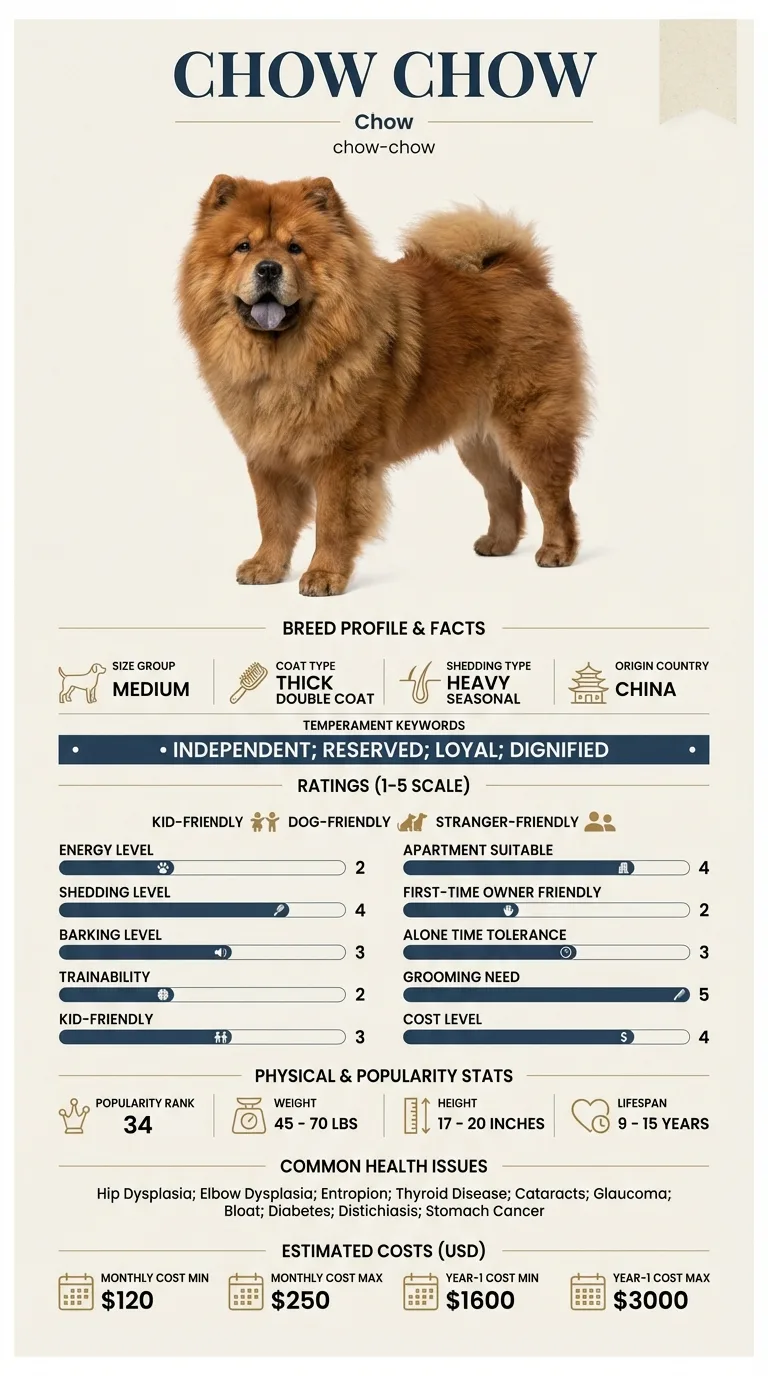
Every Chow Chow owner needs this information before they need it, because the decision has to be made in minutes by someone frightened at ten at night. It falls hardest on owners of deep-chested individuals, older dogs, and households where the dog is fed one large meal a day.
This guide is not medical advice. If your dog shows pain, sudden behavior change, or worsening symptoms, consult a licensed veterinarian.
Some links may be affiliate links. We may earn a commission at no extra cost to you. We only suggest products we believe are helpful for dog owners.
We research and check what we publish, but we do not warrant that any figure, date, price, or statement is accurate, complete, or current, and we accept no liability for any loss, cost, injury, or other harm arising from the use of this site. Use it as one reference among several. You remain responsible for your own decisions and for your dog's care - confirm anything that matters with a licensed veterinarian or another qualified professional before you act on it. Full disclaimer.
GDV is gas distension of the stomach followed by rotation, which traps the gas, strangles the stomach's own blood supply and obstructs the major vein returning blood to the heart. The dog develops a rigid swollen abdomen, retches without producing anything, and slides into shock. It is documented in the Chow Chow and is fatal without emergency surgery.
GDV is uncommon in any individual dog's lifetime but far from rare across a breed, and bloat is listed among the Chow Chow's documented conditions. Most Chows will never experience it. The reason every owner of the breed should know the signs cold is that the ones who do experience it have a survival curve that depends almost entirely on the speed of the owner's response.
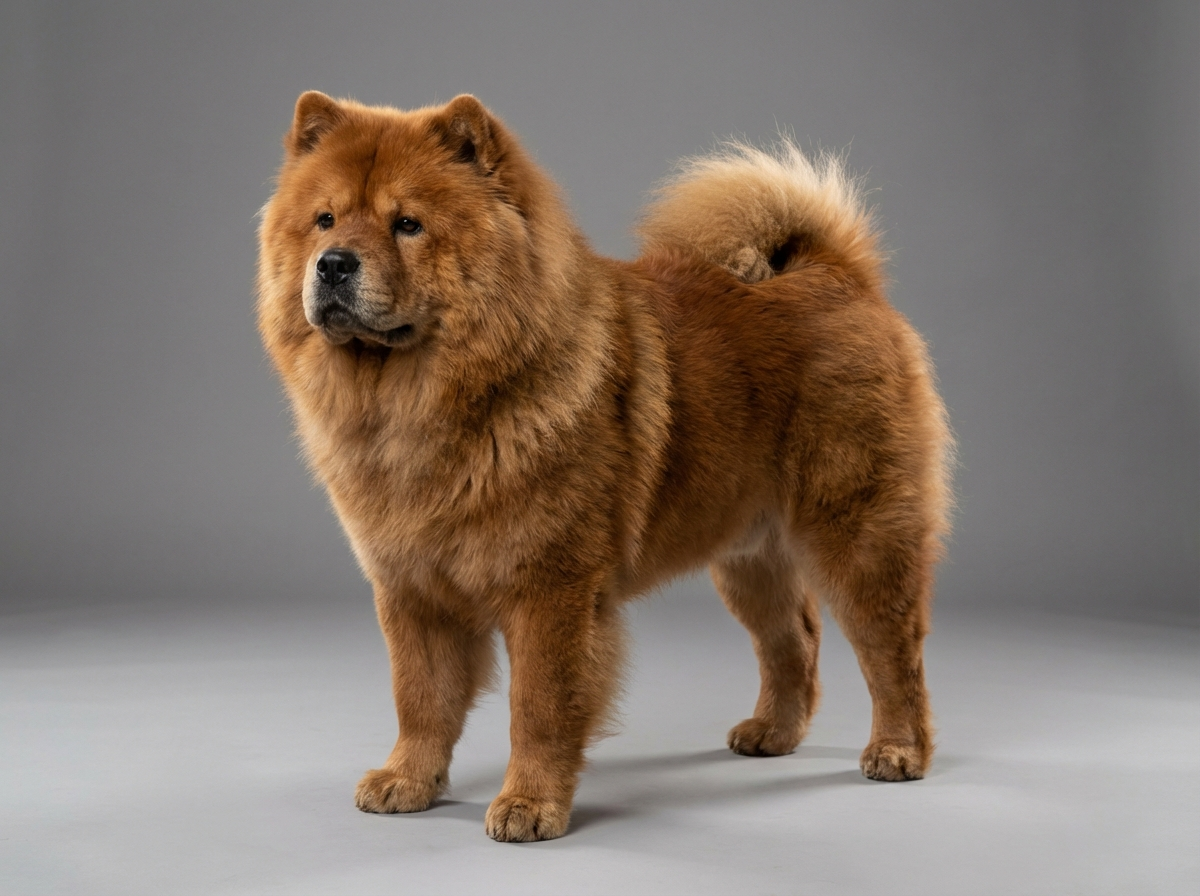
The mechanism is mechanical and conformational rather than metabolic. A relatively deep chest gives the stomach more room to move and rotate on its ligamentous attachments, and Chow Chows vary considerably in chest depth. Beyond conformation, the breed's contribution is largely to detection. A thick double coat visually flattens abdominal distension. Heavily pigmented gums and tongue undermine the standard shock assessment. And an independent, dignified temperament means the dog quietly removes itself rather than making a scene, so the first hour can pass without anyone noticing.
How and when the dog is fed carries most of the modifiable risk. One large daily meal, competitive fast eating in a multi-dog house, exercise or excitement close to a meal, and a large drink taken all at once after activity are all associated with increased risk. Because the Chow's exercise requirement is low, owners sometimes compress the day's activity into a single burst that lands near mealtime, which is exactly the pattern to avoid.
This is an emergency page, so the triage is simple. Go immediately, phoning ahead from the car, for repeated unproductive retching, a tight or swollen abdomen, heavy drooling with restlessness, pacing that will not settle, weakness or collapse, or a dog standing with its elbows out and neck extended. Do not wait to see whether it settles. Do not give food, water or anything by mouth. Book a non-urgent appointment to discuss preventive gastropexy if your dog is deep-chested or is due to be anaesthetised for another reason, since the two procedures can often be combined.
See all Chow Chow health problems, which breeds are prone to bloat gastric dilatation volvulusgdv, or the full Chow Chow breed guide for temperament, exercise needs and ownership costs.
From the first signs, you have hours rather than days. Dogs that reach surgery promptly and without stomach wall death have a good chance of survival; delay and complications worsen that sharply. Hospitalisation after surgery is typically two to five days, with heart rhythm monitoring because arrhythmias are a common post-operative complication. Full recovery at home takes six to eight weeks.
Survival with an intact stomach and a gastropexy in place is the best available outcome, and it means the dog is very unlikely to twist again, though gas distension can still occur. Success is not the absence of the event - you cannot reliably prevent GDV - but the presence of a household that recognised it inside the first hour and had already decided where to drive.
The classic picture is a dog that is restless and cannot settle, retching repeatedly without bringing anything up, drooling heavily, and developing a tight, drum-like swelling behind the ribs. It progresses over roughly one to several hours from unease to collapse.
Two features of the Chow Chow interfere with recognising it. The first is the coat. A thick double coat with dense undercoat visually smooths the outline of the abdomen, so distension that would be obvious on a short-coated dog can be missed entirely. You have to put your hands under the coat and feel the abdominal wall, comparing left and right behind the last rib. Learn what normal feels like now.
The second is pigment. Owners are taught to check gum colour for shock, and a Chow's heavily pigmented gums may make that reading impossible. Do not use pale gums as your trigger for acting. Use the behaviour: unproductive retching plus restlessness plus a distended belly is enough on its own.
The breed's temperament removes a third warning. An independent, undemonstrative dog in pain often goes and lies somewhere quiet rather than seeking help, so the first sign may simply be a dog that has taken itself off to another room.

Everything that improves survival in GDV is about time to theatre. Decide in advance which clinic you would go to and how long it takes to get there.
If you think your Chow has bloat (gastric dilatation-volvulus/gdv), the plan is three steps: write down what you have seen and when it started, book a veterinary appointment rather than waiting for the next flare, and take video of the behaviour or symptom before you go — the thing you are worried about rarely happens in the consulting room. Screening in the parents covers hip dysplasia, elbow dysplasia, entropion.
What the vet visit should produce is a diagnosis and a written plan, not just reassurance: what is being ruled out, what the monitoring interval is, and which signs mean you come back sooner. Ask what the treatment costs across a year rather than per visit, because that is the number that decides whether you are managing this condition or reacting to it.
Between appointments, keep a short log — dates, what you saw, what changed. It is the single most useful thing an owner brings to a follow-up, and for bloat (gastric dilatation-volvulus/gdv) it is often what separates a clear pattern from a guess.
Xiao was six, deep through the chest, and had eaten his usual evening meal at seven. At around nine his owner, Terrence, noticed he had gone to lie in the spare room, which was unlike him but not alarming on its own. When Terrence went to check, Xiao was standing with his front legs braced apart, drooling onto the carpet, and heaved twice without producing anything. Terrence pushed his hands into the coat behind the ribs and felt a hard, tight curve on the left side that had never been there before. He did not check the gums, because he had learned years earlier that Xiao's were solid black. He phoned the emergency hospital from the driveway and used the words his vet had given him at a routine check the previous year. The drive took twenty-two minutes. Xiao was in theatre within the hour, the stomach was untwisted before any of the wall had died, and he came home four days later with a gastropexy.
Key takeaway: The households that survive GDV are the ones where the decision was made before the night it happened. Know how your dog's belly feels normally, know that black gums will not warn you, and know exactly which clinic you are driving to.
Bloat appears in the breed's documented health conditions, so yes, it belongs on a Chow owner's list. Risk within the breed varies by individual conformation, and a deeper-chested dog carries more of it than a shallower one.
No, and you should not try. The two look similar early on and only the second is immediately life-threatening, but distinguishing them requires an X-ray. Treat every suspected case as the surgical version until a vet says otherwise.
The dog goes through the whole motion of vomiting - hunching, heaving, extending the neck - and nothing comes up, or only a small amount of frothy saliva. Repeated over ten or twenty minutes, it is one of the most specific signs of GDV there is.
Untreated, dogs commonly deteriorate over a few hours and death is the usual outcome. Survival is closely tied to how quickly the stomach is decompressed and untwisted. This is why the correct response is to leave now rather than to observe for an hour.
Stabilisation with intravenous fluids and decompression, then surgery to untwist the stomach, assess whether any of the stomach wall or spleen has died, and usually to tack the stomach to the body wall to prevent recurrence. It is major abdominal surgery with intensive aftercare.
Emergency GDV surgery with hospitalisation is one of the most expensive events in dog ownership, commonly running from a low four-figure sum into several thousand dollars depending on complications. In a breed already rated expensive to keep, this is a strong argument for insurance taken out early.
Repeated retching that produces nothing, in a dog that cannot settle. That combination alone justifies an emergency drive.
Often not reliably, because this breed is heavily pigmented. Do not wait for pale gums - act on the behaviour and the belly.
No. There is nothing safe to do at home, and every minute spent trying reduces the dog's chance of surviving surgery.
Usually yes under accident and illness cover, provided the policy predates the episode. Given the size of the bill, it is worth confirming your cover now rather than later.
A one-page prep sheet for this condition: the signs, the questions to ask, what to get priced. Unlocks here.
You get: Vet visit prep sheet
No spam. One-click unsubscribe. See our privacy policy.
Preview page 1 before you decide.