Health
What is the highest-risk moment?
The period just after the breathing tube is removed, when a short-muzzled dog has to manage its own airway while still sedated.

Quick answer
What is the highest-risk moment?
The period just after the breathing tube is removed, when a short-muzzled dog has to manage its own airway while still sedated.
The riskiest part of a Chow Chow's anaesthetic is rarely the drug. It is the twenty minutes at the end, when the tube comes out, a short-muzzled dog with a dense coat has to breathe and thermoregulate on its own, and a reserved, low-trainability breed wakes up surrounded by strangers.
This concerns any Chow owner facing a neuter, a dental, an eyelid correction or an orthopaedic procedure - which covers most of the breed at some point, since entropion, distichiasis and joint disease are all documented in the Chow. It is hardest for owners of older dogs and of dogs that already find handling stressful.
This guide is not medical advice. If your dog shows pain, sudden behavior change, or worsening symptoms, consult a licensed veterinarian.
Some links may be affiliate links. We may earn a commission at no extra cost to you. We only suggest products we believe are helpful for dog owners.
We research and check what we publish, but we do not warrant that any figure, date, price, or statement is accurate, complete, or current, and we accept no liability for any loss, cost, injury, or other harm arising from the use of this site. Use it as one reference among several. You remain responsible for your own decisions and for your dog's care - confirm anything that matters with a licensed veterinarian or another qualified professional before you act on it. Full disclaimer.
Anaesthetic risk in the Chow Chow is best understood as a handling and physiology problem rather than a pharmacology one. Airway shape, coat density, a stoic and stranger-reserved temperament and a documented tendency towards thyroid disease all shift where the danger sits, and almost all of it falls in the pre-med and recovery phases rather than during the procedure itself.
Serious anaesthetic complications are rare across all dogs and most Chows go through several procedures uneventfully. The reason to plan carefully is not that problems are likely, but that the ones this breed is set up for - airway obstruction and overheating during recovery - move quickly and are far easier to prevent than to rescue.
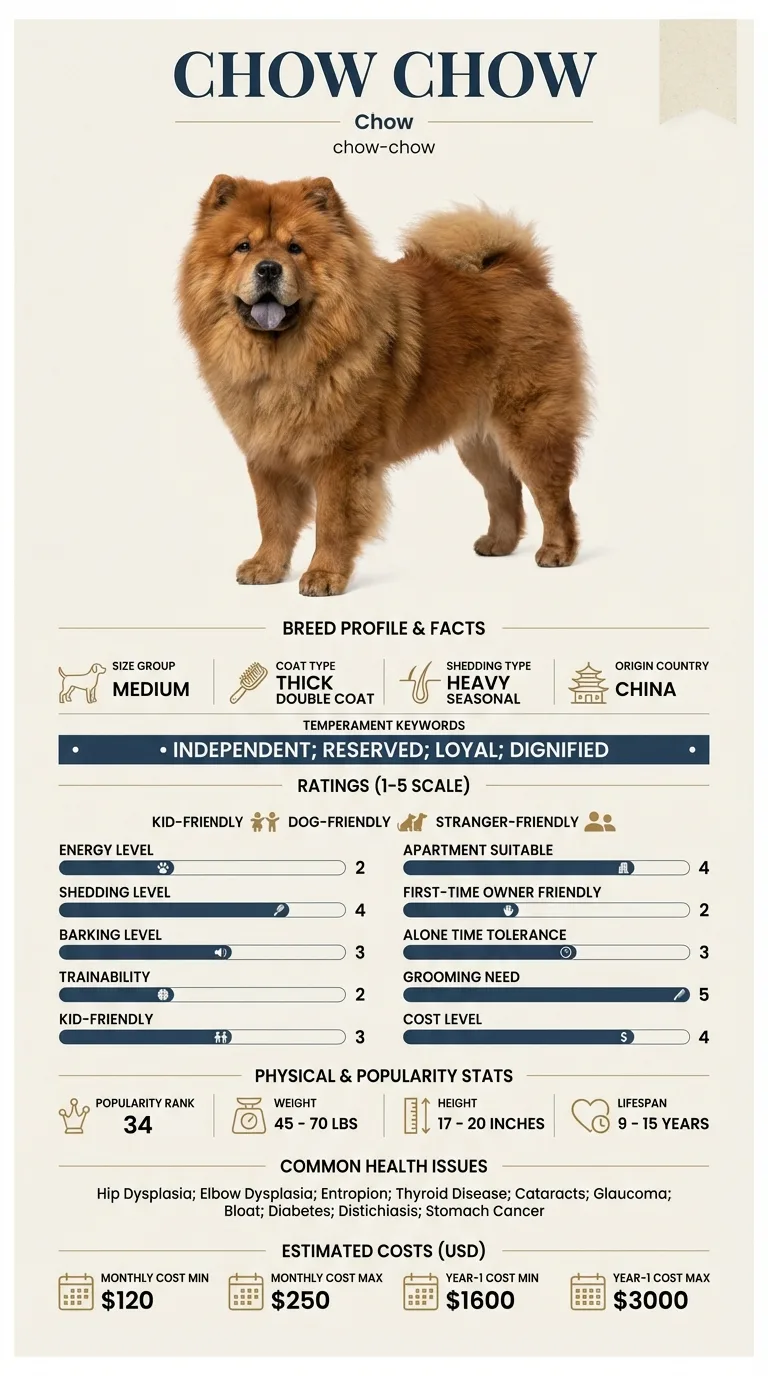
Three breed features drive it. The Chow's muzzle is short and broad relative to a typical medium breed, so the margin for airway swelling after intubation is narrower. The double coat, built for a cold climate, slows heat loss at exactly the point in recovery when a warmed dog needs to shed it, in a breed already noted for poor heat tolerance. And the breed's independent, reserved character combined with low trainability makes conscious handling harder, which can mean more restraint, more stress and more sedation than a compliant dog would need. Documented thyroid disease adds a fourth factor when it is present and untreated.
Practice factors matter more than home ones here. Recovery ward temperature, whether a nurse stays with the patient, the time of day the procedure is booked and how long the dog waits in a kennel before induction all affect outcomes. At home, the temperature of the room the dog comes back to, the presence of stairs it will try to climb while still groggy, and whether children are around a disoriented dog are the variables you can actually set.
Raise concerns at the pre-operative appointment, when there is still time to change the plan. After the dog comes home, phone the same day for lethargy that deepens rather than lifts, refusal to drink, a swollen or discharging wound, or vomiting more than once. Treat as an immediate emergency any noisy or laboured breathing, blue or grey tinge to the tongue, collapse, or a dog that cannot settle and is panting hard in a cool room - post-anaesthetic airway obstruction and overheating both worsen fast, and in this breed they can occur together.
See all Chow Chow health problems, which breeds are prone to anesthesia sensitivity, or the full Chow Chow breed guide for temperament, exercise needs and ownership costs.
Most dogs are fully awake within a few hours and back to normal behaviour within one to three days for a routine procedure. Orthopaedic and eyelid surgeries have longer restrictions measured in weeks. Cooperative-care preparation is the slow part: allow six to eight weeks of short sessions to build genuine tolerance rather than grudging compliance.
A good outcome is an uneventful recovery you barely notice, which is unsatisfying to read but is the point. Concretely: a dog that breathes quietly on waking, comes home at a normal temperature, and can be handled by the veterinary team without heavy restraint. The measure of success is how boring the day turned out to be.
Under anaesthesia the airway is protected by a tube and the dog's temperature and oxygen are being watched continuously. The picture changes at extubation. A Chow Chow has a comparatively short, broad muzzle, so there is less airway to work with than in a long-nosed breed, and soft tissue that has been irritated by a tube can swell. A dog that is still sedated, lying flat and breathing through a partly obstructed airway is in the highest-risk part of the whole procedure.
The coat compounds it. Anaesthesia removes a dog's ability to regulate its own temperature, so warming devices are used in theatre. A Chow with a thick double coat can then overshoot in the other direction during recovery, especially in a warm ward, and this is a breed that handles heat badly to begin with.
Ask your practice directly how recovery is staffed. Specifically: will someone be sitting with the dog rather than checking periodically, will the head be positioned to keep the airway open, and is a temperature check part of the recovery routine rather than only the pre-op checks.

A pre-operative appointment is a conversation, not a form. These are the points that specifically change the plan for a Chow rather than for a dog in general.
If you think your Chow has anesthesia sensitivity, the plan is three steps: write down what you have seen and when it started, book a veterinary appointment rather than waiting for the next flare, and take video of the behaviour or symptom before you go — the thing you are worried about rarely happens in the consulting room. Screening in the parents covers hip dysplasia, elbow dysplasia, entropion.
What the vet visit should produce is a diagnosis and a written plan, not just reassurance: what is being ruled out, what the monitoring interval is, and which signs mean you come back sooner. Ask what the treatment costs across a year rather than per visit, because that is the number that decides whether you are managing this condition or reacting to it.
Between appointments, keep a short log — dates, what you saw, what changed. It is the single most useful thing an owner brings to a follow-up, and for anesthesia sensitivity it is often what separates a clear pattern from a guess.
Kenji was a seven-year-old Chow with a rolled lower eyelid on one side that had been rubbing for months, and a mouth his vet described as overdue. His owner, Ruth, had been putting both off because she was frightened of anaesthesia. At the pre-op appointment she raised it directly. The vet ran bloods including thyroid, which came back normal, booked Kenji as the first case of the morning, and combined the eyelid correction with the dental so he only went under once. Ruth was told to expect a phone call at extubation rather than at discharge. Kenji recovered in a cool kennel with a nurse present, went home at four in the afternoon and slept in the hallway with the back door open. He was eating properly by the next evening. Ruth's main regret was the eleven months she spent worrying instead of asking.
Key takeaway: The questions that change a Chow's anaesthetic outcome are asked before the day, not on it. Scheduling, thyroid status, recovery staffing and handling tolerance are all decided in advance, and all of them are things an owner can influence.
There is no established breed-wide drug sensitivity in the Chow comparable to the well-documented issues in some other breeds. Treat claims of an inherent sensitivity with caution and focus your attention instead on airway management, temperature and recovery supervision, which are where the breed genuinely differs.
Yes, and it is worth asking specifically about thyroid and, in older dogs, kidney and liver values. Thyroid disease and diabetes are both documented in this breed, and both change anaesthetic planning if present.
Start weeks ahead, not the day before. A muzzle the dog is genuinely comfortable wearing, and tolerance of being touched on the neck and forelimb, reduce the amount of restraint needed and therefore the amount of stress and drug required. Tell the practice honestly how your dog behaves so they plan for it.
It cuts both ways. It slows heat loss during a procedure, which can be helpful, and then slows heat loss during recovery in a warm ward, which is not. It also means clipping takes longer and surgical site preparation is more involved. None of this is dangerous in itself, but it should be part of the plan.
Often yes, and for a breed where entropion and distichiasis are both documented that can be sensible, since it means one anaesthetic instead of two. The trade-off is a longer procedure. Ask your vet to weigh the two explicitly rather than assuming either answer.
Noisy breathing, restlessness that does not settle, panting that continues in a cool room, refusal to drink after twelve hours, or a dog that will not lie down comfortably. Keep the recovery room cool and quiet and check the dog rather than leaving it alone to sleep it off.
The period just after the breathing tube is removed, when a short-muzzled dog has to manage its own airway while still sedated.
It can make visual assessment of gum colour unreliable, so mention it. Instrument monitoring covers this, but the team should know not to rely on eyeballing it.
Yes. A heat-sensitive, densely coated dog recovering from anaesthesia should come home to a cool, ventilated, quiet room.
Monitoring, fluids and staffed recovery are a meaningful share of any surgical quote, and in a breed already rated as expensive to keep it is worth budgeting for properly rather than shopping on price.
A one-page prep sheet for this condition: the signs, the questions to ask, what to get priced. Unlocks here.
You get: Vet visit prep sheet
No spam. One-click unsubscribe. See our privacy policy.
Preview page 1 before you decide.