Health
Can I trust breed hip dysplasia rankings?
Treat them as rough context only. Voluntary submission, differing scoring systems and small samples all distort them, and rankings often compare incompatible measurements.

Quick answer
Can I trust breed hip dysplasia rankings?
Treat them as rough context only. Voluntary submission, differing scoring systems and small samples all distort them, and rankings often compare incompatible measurements.
A breed percentage tells you almost nothing about the puppy in front of you. The parents' individual scores tell you a great deal.
Prospective buyers comparing breeds on health statistics, and owners of a diagnosed Chow trying to work out whether their breeder should have known.
This guide is not medical advice. If your dog shows pain, sudden behavior change, or worsening symptoms, consult a licensed veterinarian.
Some links may be affiliate links. We may earn a commission at no extra cost to you. We only suggest products we believe are helpful for dog owners.
We research and check what we publish, but we do not warrant that any figure, date, price, or statement is accurate, complete, or current, and we accept no liability for any loss, cost, injury, or other harm arising from the use of this site. Use it as one reference among several. You remain responsible for your own decisions and for your dog's care - confirm anything that matters with a licensed veterinarian or another qualified professional before you act on it. Full disclaimer.
Prevalence is a statistics problem dressed as a health problem. Owners want to know how likely their Chow Chow is to develop hip dysplasia, and the honest answer is that breed-level percentages are too distorted by voluntary reporting to answer that for an individual. The information that does help sits in the parents' certificates and the breeder's records.
Hip dysplasia is documented as a Chow Chow health issue, which is the reliable part. The unreliable part is any specific percentage attached to it. Screening registries capture a self-selected slice of each breed, so published rates are best treated as a floor rather than a measurement.
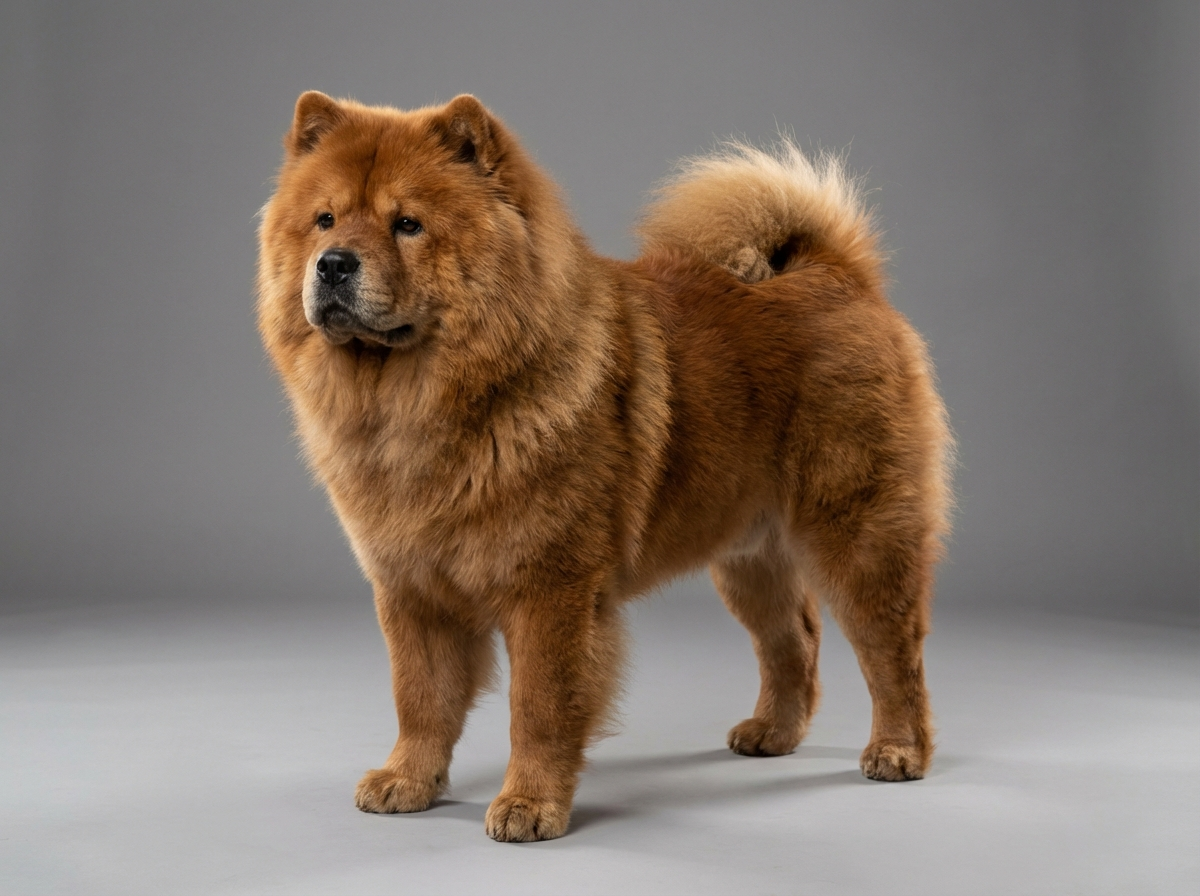
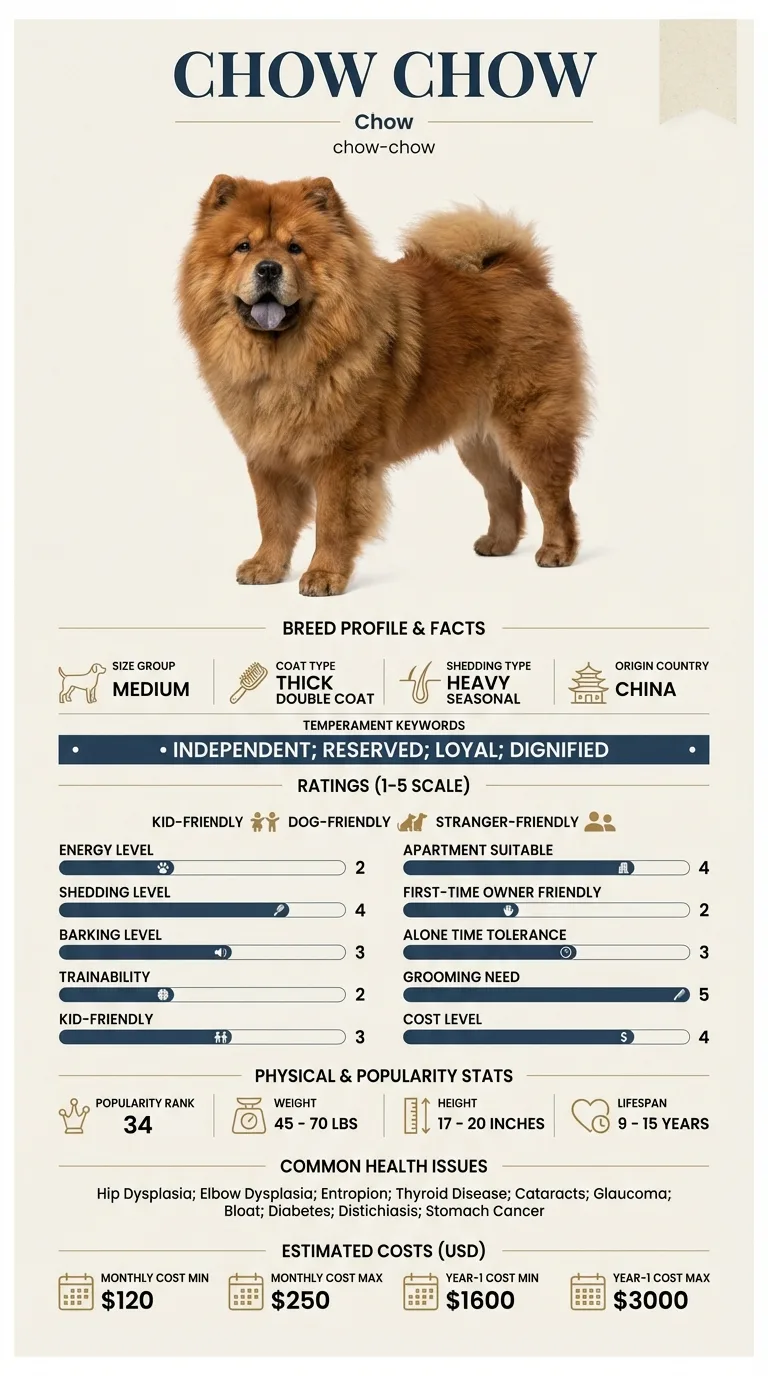
The Chow's physical build gives screening real relevance. This is a compact, heavily boned dog carrying 45 to 70 pounds on a 17 to 20 inch frame, with a distinctive short-strided rear action and limited hind-limb angulation. That construction concentrates force through the hip and reduces the joint's range of comfortable movement, which is why both hip and elbow dysplasia appear on the documented health list. Popularity matters too: at rank 34 the breed has a large enough population for meaningful screening but not the enormous submission volumes that make some registry statistics reasonably stable.
Outside genetics, the variables are growth rate and early loading. A puppy grown fast on rich food, exercised hard before growth plates close, or allowed to jump repeatedly onto hard flooring can convert marginal hips into painful ones. That is why breeder guidance to new owners is a legitimate part of the prevalence picture: two puppies from the same litter can end up in different places depending on the first year of their lives.
Screening questions are not urgent, but signs are. Book an appointment if your Chow bunny hops on stairs, rises from hard floors in two stages, sits with a hind leg out to the side, or has visibly narrowed his rear stance. Seek same-day care for sudden inability to bear weight on a hind limb, which usually indicates an acute injury such as a cruciate rupture rather than chronic dysplasia, and for any sudden weakness or incoordination in both hind legs, which points at the spine. If you are considering breeding, discuss which screening scheme and what age with your vet before booking radiographs, since sedation and positioning determine whether the result is usable.
See all Chow Chow health problems, which breeds are prone to hip dysplasia prevalence, or the full Chow Chow breed guide for temperament, exercise needs and ownership costs.
Gathering proper screening information from a breeder takes a few days of correspondence, not months, and if it takes longer than that you have learned something. If you are screening your own dog, expect a single sedated appointment plus two to six weeks for a registry result depending on the scheme.
Success is walking into a purchase knowing both parents' actual scores, the scheme used, and what the guarantee covers, while accepting that you have improved your odds rather than removed a risk.
None of this means screening is worthless. It means the useful output of screening is an individual dog's result, not a breed's average, and the two get confused constantly.
Ask to see hip results for both parents, in the form of a certificate with the dog's registration number on it, not a verbal assurance. Then ask the harder question: what were the grandparents' results, and what happened to the puppies from the previous litter of this pairing. A breeder who tracks outcomes and will tell you about the ones that went badly is showing you the thing the certificate cannot.
Ask about elbows too. Elbow dysplasia is documented in the Chow alongside hips, and a breeder screening only hips is doing half the job. While you are there, ask about eyes and thyroid, because entropion, distichiasis, cataracts, glaucoma and thyroid disease are all on this breed's documented list.
Ask what the breeder feeds growing puppies and what activity guidance they give new owners. Growth rate and early loading genuinely affect how a marginal hip develops, so a breeder who says nothing about it has less influence over outcomes than one who does.
Finally, ask what happens if the puppy is diagnosed. A written health guarantee that specifies hips, and specifies what the breeder will actually do, separates people who take responsibility from people who take deposits.

Nadia contacted four Chow breeders. Three sent friendly replies describing their lines as healthy. One sent photographs of hip and elbow certificates for both parents, with registration numbers, and a note saying that a puppy from the previous pairing had been diagnosed with mild dysplasia at three and that she was still in touch with the owner. Nadia nearly ruled that breeder out. Then she realised the other three had told her nothing she could check, and this one had volunteered the worst fact in her possession. She bought from the fourth breeder, followed the growth and exercise guidance that came with the puppy, and kept the certificates in the same folder as the vaccination record. Her dog is six and comfortable. She still cannot know whether the certificates caused that.
Key takeaway: Verifiable documents and a breeder willing to name a bad outcome are worth more than any published breed percentage, and more than four assurances you cannot check.
No honest single figure exists, because every published rate comes from voluntary screening with unknown selection bias. What is reliably documented is that hip dysplasia is one of the breed's recognised health issues, which is enough to justify screening parents rather than trusting an average.
Yes. It is not exclusively a large-breed problem, and several small and brachycephalic breeds show high rates in screening data. Body size affects how much the fault hurts, not whether the fault occurs.
No. Hip dysplasia is polygenic and influenced by growth and environment, so clear parents shift the odds without removing the risk. Screening reduces probability; it does not issue guarantees, and any breeder promising one is overselling.
Routinely, no. It matters if you intend to breed, if you want a baseline before a demanding activity, or if there are any signs. Screening a comfortable pet dog usually changes nothing about how you manage him.
They measure different things. A distraction-based method assesses joint laxity and can be done young, while extended-hip grading assesses conformation and arthritis and is usually done later. Many serious breeders use both. What matters is that the same scheme is used consistently when you compare dogs.
It is an unknown, not a bad bet. You lose the screening information and gain a dog whose current joint function you can observe directly. Ask the rescue for a vet assessment of hip comfort and gait before adoption, and budget for the possibility.
Treat them as rough context only. Voluntary submission, differing scoring systems and small samples all distort them, and rankings often compare incompatible measurements.
For certificates on both parents with registration numbers, grandparent results, outcomes from previous litters, and what the written health guarantee covers.
No. They improve the odds. Hip dysplasia is polygenic and affected by growth rate and early exercise as well as genetics.
Yes. Elbow dysplasia is documented in the Chow Chow alongside hips, and a breeder screening only hips is covering half the risk.
A one-page prep sheet for this condition: the signs, the questions to ask, what to get priced. Unlocks here.
You get: Vet visit prep sheet
No spam. One-click unsubscribe. See our privacy policy.
Preview page 1 before you decide.