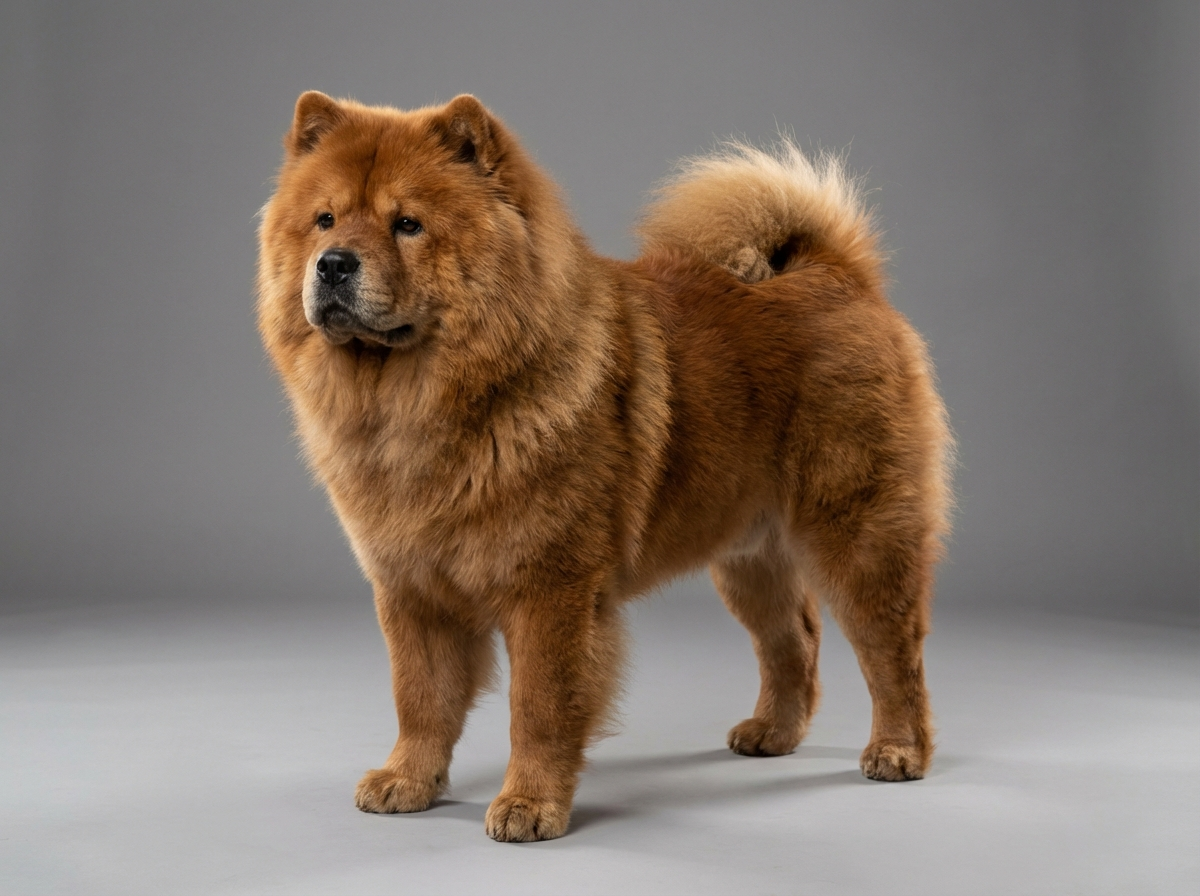
Health
When does a luxating patella need surgery?
When the dog is lame between episodes, the grade has progressed, thigh muscle is thinning, or the cruciate ligament has started to loosen.

Quick answer
When does a luxating patella need surgery?
When the dog is lame between episodes, the grade has progressed, thigh muscle is thinning, or the cruciate ligament has started to loosen.
Surgery corrects the mechanics of the knee. The eight weeks afterwards decide whether that correction holds, and in this breed those eight weeks are the hard part.
Owners weighing up a surgical estimate for a diagnosed kneecap problem, and owners already booked in who are trying to work out how to confine an independent, strong-willed dog for two months.
This guide is not medical advice. If your dog shows pain, sudden behavior change, or worsening symptoms, consult a licensed veterinarian.
Some links may be affiliate links. We may earn a commission at no extra cost to you. We only suggest products we believe are helpful for dog owners.
We research and check what we publish, but we do not warrant that any figure, date, price, or statement is accurate, complete, or current, and we accept no liability for any loss, cost, injury, or other harm arising from the use of this site. Use it as one reference among several. You remain responsible for your own decisions and for your dog's care - confirm anything that matters with a licensed veterinarian or another qualified professional before you act on it. Full disclaimer.
Patellar luxation surgery aims to make the kneecap track correctly by deepening its groove and realigning the pull of the thigh muscles. It is a well-established procedure with good outcomes, and the decisive variable is not the operation but the recovery. For a heavy, independent breed, managing eight weeks of genuine restriction is the part most likely to determine the result.
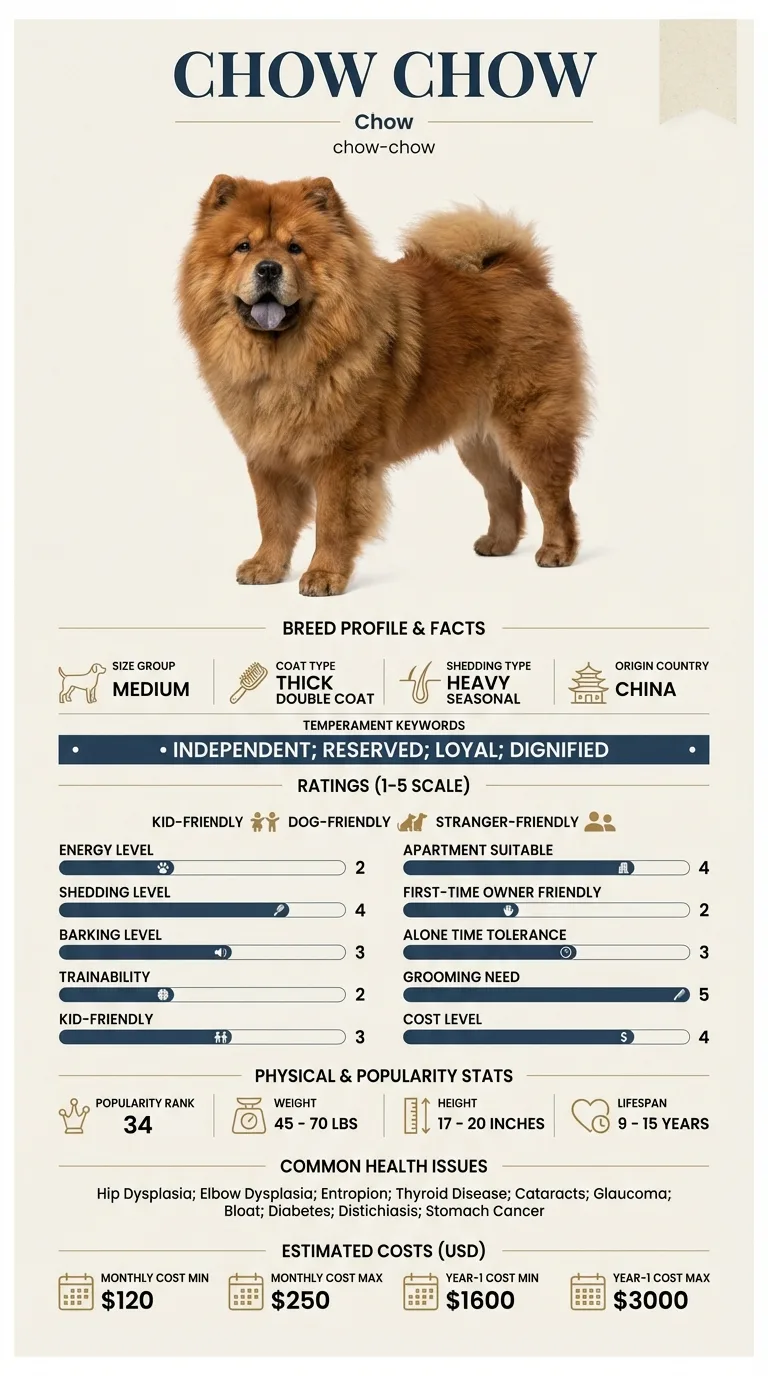
Patellar luxation is not among the ten documented Chow Chow health issues and is most associated with small breeds. Where it does occur in this breed it tends to matter more, because 45 to 70 pounds of body weight applies far greater force through an unstable knee than the same condition does in a terrier.
Two features of the Chow shape the surgical picture. The first is the breed's comparatively straight rear assembly, which alters the alignment of the pull across the knee and can make surgical correction more demanding than in a dog with typical angulation. The second is mass: at 45 to 70 pounds on a 17 to 20 inch frame, this dog loads the repair site harder than the small breeds in which the procedure was refined, which raises the stakes on implant stability and on activity restriction. Temperament adds a third dimension, since a dog rated 2 out of 5 for trainability cannot be asked politely to be careful.
The home decides the outcome more than the operating theatre does. Slippery floors are the leading cause of post-operative setbacks, because a single scrabbling slide can load a healing transposition badly. Stairs, furniture and unsupervised gardens all provide opportunities for the one bad movement that undoes the repair. Multi-dog households add unpredictable collisions. And a warm climate matters in an unexpected way, since a clipped, dense-coated dog confined indoors in summer still needs a cool surface to lie on while restricted.
Contact the surgical team the same day for any wound that is swollen, hot, weeping or opening, for a dog who suddenly stops using the leg after having been using it, for a sudden increase in pain, or for a fever or dullness after the first forty-eight hours. Those can indicate implant failure or infection, and both are better addressed early. Go immediately if your dog will not bear weight at all after a fall or a slip during recovery, since a re-luxation or an implant break needs prompt imaging. Never give human anti-inflammatory medication alongside prescribed pain relief, as the combination is dangerous, and never adjust prescribed doses on your own.
See all Chow Chow health problems, which breeds are prone to patellar luxation, or the full Chow Chow breed guide for temperament, exercise needs and ownership costs.
Expect a hospital stay of one to two nights, six to eight weeks of strict confinement, and a further four to six weeks of gradually increasing lead walks. Radiographic rechecks usually fall at around six weeks. Full return to normal activity is commonly around three to four months, and rehabilitation continues past that.
Success is a knee where the kneecap stays in its groove, a dog who bears weight evenly, and thigh muscle that has rebuilt to match the other side. Some arthritic change in the joint over the following years is expected rather than a sign that the surgery failed.
One of these on its own is a discussion. Two or three together usually means the conservative route has done what it can, particularly in a dog carrying 45 to 70 pounds through the joint.
Corrective surgery usually combines several elements: deepening the groove the kneecap should sit in, moving the attachment point of the patellar tendon so the pull is aligned, and tightening or releasing the soft tissue on either side. A pin or wire often holds the transposed bone fragment while it heals. All of that healing happens in the first six to eight weeks, and it happens correctly only if the dog does not jump, twist, slip or run.
This is where the Chow's temperament becomes clinically relevant. A breed rated 2 out of 5 for trainability and famously independent does not accept being told what to do, and cannot be reasoned with about a pin in his tibia. Confinement has to be structural rather than instructional: a pen or a closed room with grip on the floor, a lead for every toilet trip including in your own garden, and no unsupervised access to stairs or furniture for the full period. Owners who rely on the dog choosing to be sensible generally end up back at the surgeon.
The upside is that this breed's low exercise need, rated 2 out of 5, makes confinement less psychologically brutal than it would be for a working dog. A Chow does not need to run for its mental health. It does need occupation, and food-based enrichment, scent games in a small area and short training sessions fill the gap perfectly well.

If you think your Chow has patellar luxation, the plan is three steps: write down what you have seen and when it started, book a veterinary appointment rather than waiting for the next flare, and take video of the behaviour or symptom before you go — the thing you are worried about rarely happens in the consulting room. Screening in the parents covers hip dysplasia, elbow dysplasia, entropion.
What the vet visit should produce is a diagnosis and a written plan, not just reassurance: what is being ruled out, what the monitoring interval is, and which signs mean you come back sooner. Ask what the treatment costs across a year rather than per visit, because that is the number that decides whether you are managing this condition or reacting to it.
Between appointments, keep a short log — dates, what you saw, what changed. It is the single most useful thing an owner brings to a follow-up, and for patellar luxation it is often what separates a clear pattern from a guess.
Shiro was four, sixty-one pounds, and had gone from an occasional skip to a persistent limp over about a year. His left knee had progressed from grade II to grade III between two examinations, and the surgeon measured a two centimetre difference in thigh circumference between his hind legs. His owner Delphine's biggest worry was not the surgery but the recovery, because Shiro had never in his life done anything he did not want to do. Her solution was environmental. She set up a pen in the dining room over a rubber mat, moved his bed onto it two weeks before the operation so it was familiar, and bought six food puzzles. Shiro was lead-walked to a single spot in the garden and back for eight weeks. He was, Delphine reports, deeply unimpressed and entirely uninjured. His six-week radiographs were clean, his thigh measurements matched by month five, and he has not skipped since.
Key takeaway: You cannot train a Chow into being careful for eight weeks. You can build a room he cannot be careless in, and set it up before the surgery rather than after.
It depends on the dog rather than the grade. A grade II Chow who is lame between episodes, losing thigh muscle, or showing early cruciate instability is a strong candidate. A grade II who skips twice a month and is otherwise sound often does well on weight control and rehabilitation for years.
Six to eight weeks of strict confinement is typical, followed by four to six weeks of gradually increasing controlled walking. Most dogs are using the leg within days but that early comfort is misleading, and it is the main reason owners relax restrictions too soon.
Implant loosening or breakage, re-luxation, infection, and delayed healing at the bone transposition site are the recognised complications. Most are associated with too much activity too early, which is why the confinement protocol is not negotiable rather than cautious.
Usually not. Operating on both simultaneously leaves the dog with no sound leg to weight-bear on during recovery, which is particularly problematic in a heavy dog. Staged surgery some months apart is the more common approach, though the surgeon decides based on the individual.
A structured programme substantially improves the outcome. Muscle lost before surgery does not return by itself, and quadriceps strength is what keeps the corrected kneecap tracking properly. Ask about rehabilitation before the surgery, not after, so it can be scheduled.
The area will be clipped, which on a double coat can take months to regrow properly and sometimes returns with a different texture. Keep the site dry, check it daily by parting the surrounding coat, and be alert to moisture trapped against skin, which invites infection in a breed already prone to skin problems under a heavy coat.
The early signs are set out in the sections above, and they are the reason to book a veterinary appointment rather than wait. Patellar Luxation in Chows is diagnosed by a vet, not from a symptom list, and the sooner it is on record the more options remain open.
When the dog is lame between episodes, the grade has progressed, thigh muscle is thinning, or the cruciate ligament has started to loosen.
Six to eight weeks strictly, then four to six weeks of controlled walking. He will feel better long before the bone has healed.
Usually not, because a heavy dog needs one sound leg to stand on. Staged surgeries months apart are more common.
With structure, not obedience: a pen, grip on floors, a lead for every toilet trip, and food-based enrichment instead of exercise.
A one-page prep sheet for this condition: the signs, the questions to ask, what to get priced. Unlocks here.
You get: Vet visit prep sheet
No spam. One-click unsubscribe. See our privacy policy.
Preview page 1 before you decide.