Behavior
Is my hungry Chow Chow just being manipulative?
Not necessarily. Persistent hunger on an adequate portion can reflect genuine appetite-regulation biology rather than a learned behavior.

Quick answer
Is my hungry Chow Chow just being manipulative?
Not necessarily. Persistent hunger on an adequate portion can reflect genuine appetite-regulation biology rather than a learned behavior.
A dog who is rated low for energy and exercise need should, in theory, be an easy dog to keep at a healthy weight. Some Chows still gain steadily despite portions that look reasonable, and appetite biology may be a bigger part of that than feeding mistakes.
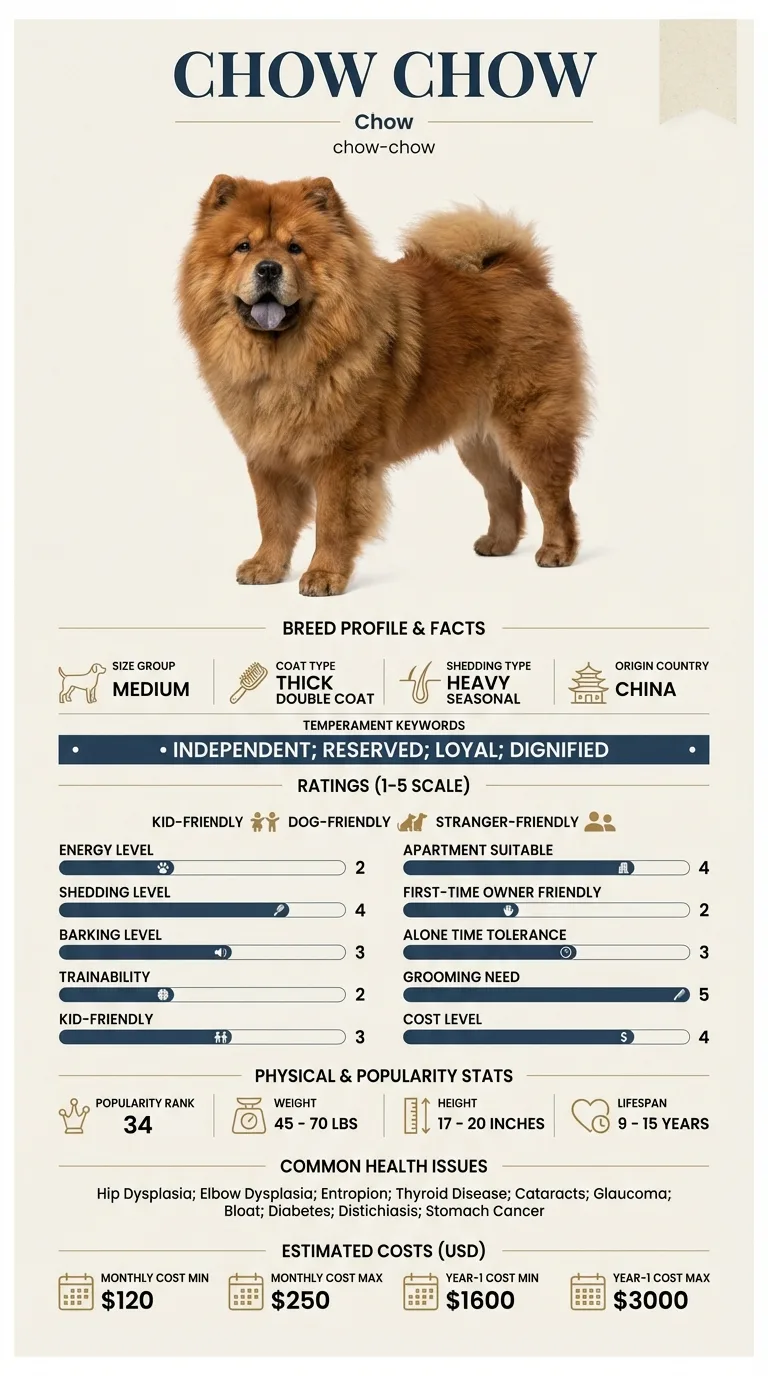
Owners who feed careful, measured portions and still watch the number on the scale climb, and anyone assuming that because their dog is not begging constantly, appetite cannot be the underlying driver.
This guide is not medical advice. If your dog shows pain, sudden behavior change, or worsening symptoms, consult a licensed veterinarian.
Some links may be affiliate links. We may earn a commission at no extra cost to you. We only suggest products we believe are helpful for dog owners.
We research and check what we publish, but we do not warrant that any figure, date, price, or statement is accurate, complete, or current, and we accept no liability for any loss, cost, injury, or other harm arising from the use of this site. Use it as one reference among several. You remain responsible for your own decisions and for your dog's care - confirm anything that matters with a licensed veterinarian or another qualified professional before you act on it. Full disclaimer.
This is about the biology of hunger itself rather than feeding habits or hidden weight gain. Genetic variants that dial up appetite and dial down the feeling of fullness after eating have been documented in some breeds, and research extending this work to other breeds raises the possibility, though not a confirmed diagnosis, that some Chow Chows carry a similarly elevated drive to eat.
The specific gene variants involved are most robustly documented in Labrador and Flat-Coated Retrievers. Research into similar appetite-regulating variants across other breeds is ongoing, and confirmed prevalence data specific to the Chow Chow is not well established.
If a Chow Chow carries an appetite-regulating variant similar to those studied in other breeds, the practical effect is a stronger drive to eat and a weaker fullness signal after a meal. Layered onto a breed rated 2 out of 5 for both energy and exercise need, which limits how much extra intake can be burned off through activity, this combination makes portion control the primary tool available rather than one option among several.
Household feeding culture matters enormously here. Free-feeding, inconsistent portions, and treats given in response to begging all reinforce a strong appetite drive rather than counteracting it, regardless of whether the underlying cause is genetic or learned.
Talk to a vet if your dog is gaining weight despite measured portions that match standard guidelines, since this is exactly the pattern that points toward either an elevated appetite drive or an underlying condition like thyroid disease that needs to be ruled out.
A dog with a genuinely elevated drive to eat needs one of two things to stay lean: a smaller portion than a bag guideline suggests, or enough activity to burn off the extra intake. The Chow Chow is rated 2 out of 5 for both energy and exercise need, which removes the second option almost entirely for most households.
That leaves portion control as the only real lever, which is a much harder ask for a dog whose hunger signaling is working against a restricted meal than for a dog who is simply overfed out of habit. Measuring food precisely, resisting a dog who genuinely seems to want more, and ignoring an insistent appetite as evidence that a portion must be too small all become higher-stakes decisions in this scenario.
Recognizing that the hunger itself may be the harder problem, not the discipline around feeding it, changes how an owner and a vet approach the plan.

See all Chow Chow health problems, which breeds are prone to genetic predisposition to obesity, or the full Chow Chow breed guide for temperament, exercise needs and ownership costs.
A stable feeding routine typically takes four to eight weeks of consistent measurement before weight trends level off.
Success is a dog maintained at a healthy weight through consistent portion control, not a dog who stops acting hungry, since the underlying drive itself is unlikely to disappear.
None of this means every hungry-acting Chow carries a confirmed mutation, since breed-specific confirmation in the Chow Chow is far less established than in Labradors. What it does mean is that persistent hunger in a dog who is not underfed can have a biological basis rather than being purely a training or willpower failure on the owner's part.
Mochi's owner Hannah followed the feeding guide on his food bag exactly and still watched him gain steadily over a year, all while Mochi acted as though every meal left him unsatisfied. Assuming the portion was wrong, Hannah increased it twice, and the weight gain only accelerated. A vet visit ruled out thyroid disease through bloodwork and instead suggested the issue was appetite drive rather than portion size. Hannah switched to a higher-fiber weight-management food, weighed every meal precisely, and stopped increasing portions in response to Mochi's behavior at the bowl. His weight stabilized within about two months, though Hannah noted he never stopped acting like he wanted more at mealtime, which she came to accept as simply how he was built rather than a problem to solve.
Key takeaway: A dog who always seems hungry is not necessarily underfed. Sometimes the correct response is holding the line on portion size rather than treating persistent hunger as proof more food is needed.
Appetite-regulating gene variants are most robustly documented in Labrador and Flat-Coated Retrievers. Research has expanded to other breeds, but confirmation specific to the Chow Chow is much less established, so treat this as a plausible contributing factor rather than a proven diagnosis.
A strong clue is a dog who stays visibly hungry and food-focused on a portion that matches veterinary guidelines for his weight and activity level, rather than one who only wants extra because he has learned that begging works.
Panels testing for the specific appetite-related variant exist and are increasingly offered by veterinary genetic testing services, though interpretation for a breed without strong confirmed association should be discussed with your vet.
It can, but the Chow Chow's low rated exercise need and energy level mean this lever is weaker here than in a naturally active breed, putting more weight on portion control instead.
No. Free-feeding a dog with a strong appetite drive removes the only real control an owner has and is one of the more reliable ways to accelerate weight gain in this scenario.
Higher-fiber, higher-volume foods formulated for weight management can increase a sense of fullness on fewer calories, which is worth discussing with your vet rather than simply reducing a standard food's portion further.
Not necessarily. Persistent hunger on an adequate portion can reflect genuine appetite-regulation biology rather than a learned behavior.
Use a kitchen scale rather than a scoop, and weigh food based on your vet's recommended calorie target for your dog's ideal weight.
Often yes, since a food designed for higher satiety per calorie can make portion restriction considerably easier to maintain long term.
No, but it means careful, measured feeding matters more for this dog than it would for one without an elevated appetite drive.
Yes, structured mealtime routines and ignoring begging consistently can reduce food-seeking behavior even when the underlying drive has a biological component.
A one-page prep sheet for this condition: the signs, the questions to ask, what to get priced. Unlocks here.
You get: Vet visit prep sheet
No spam. One-click unsubscribe. See our privacy policy.
Preview page 1 before you decide.