Behavior
How do I know if my Chow really has separation anxiety?
Film the first thirty minutes alone. Genuine panic starts immediately, targets exits and comes with heavy panting and drooling. Boredom starts later and targets interesting objects.

Quick answer
How do I know if my Chow really has separation anxiety?
Film the first thirty minutes alone. Genuine panic starts immediately, targets exits and comes with heavy panting and drooling. Boredom starts later and targets interesting objects.
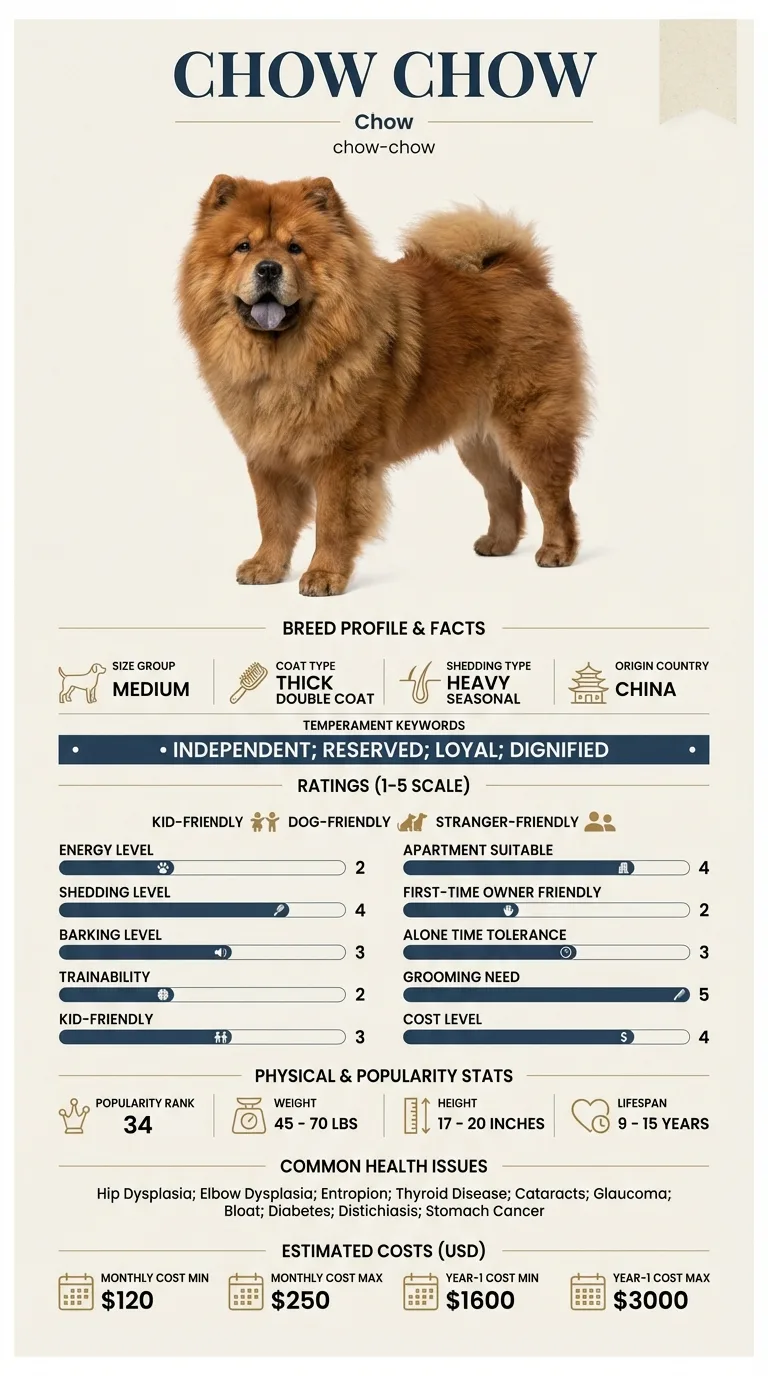
This breed's alone-time tolerance is rated 3 out of 5, and independence is one of its four defining temperament words. That does not make panic impossible, but it makes it less likely than the alternatives.
Owners returning to damage, complaints about barking, or accidents from a house-trained dog, and anyone about to return to an office after a period of working from home.
This guide is not medical advice. If your dog shows pain, sudden behavior change, or worsening symptoms, consult a licensed veterinarian.
Some links may be affiliate links. We may earn a commission at no extra cost to you. We only suggest products we believe are helpful for dog owners.
We research and check what we publish, but we do not warrant that any figure, date, price, or statement is accurate, complete, or current, and we accept no liability for any loss, cost, injury, or other harm arising from the use of this site. Use it as one reference among several. You remain responsible for your own decisions and for your dog's care - confirm anything that matters with a licensed veterinarian or another qualified professional before you act on it. Full disclaimer.
Separation anxiety is a panic response to being left, distinct from boredom, territorial reactivity and physical discomfort even though all four produce similar evidence when you walk back through the door. In the Chow Chow, an independent breed with moderate alone-time tolerance, the alternatives are statistically more likely, and distinguishing them is the essential first step because the treatments differ completely.
The Chow's alone-time tolerance is rated 3 out of 5, which is middling rather than poor, and the breed's temperament is described as independent, reserved, loyal and dignified. True separation panic is therefore less characteristic here than in breeds bred for constant human proximity, though it certainly occurs, particularly after rehoming.
The Chow's temperament profile cuts both ways. Independence and a dignified reserve, two of the four temperament keywords for the breed, give many individuals genuine comfort in their own company, and an alone-time tolerance of 3 out of 5 reflects that. The same traits, however, mean a Chow in real distress may not display it in the demonstrative way owners expect, and a dog that stares at a wall or refuses to eat when left can be read as sulking rather than suffering. Low stranger friendliness at 2 out of 5 and a barking level of 3 out of 5 make territorial vocalisation a common alternative explanation, particularly in flats and terraced housing.
Temperature is the most underrated factor in this breed. A room that is pleasant for a person is often too warm for a double-coated dog with nowhere cool to lie, and the resulting pacing and panting is misread as emotional distress. Housing type matters too: a Chow in a block of flats hears far more footsteps, doors and deliveries than one in a detached house, and a guarding breed responds to every one. Long unbroken absences without a toilet opportunity compound everything, since discomfort makes settling impossible regardless of temperament.
This is the condition on this breed's list where a qualified professional is most clearly worth the money, and the choice of professional matters. For confirmed separation anxiety, look for someone who specialises in it and works by systematic desensitisation to absence, measured in seconds and minutes rather than by leaving the dog to cope. For boredom or territorial barking, a general force-free trainer is appropriate and the plan will look completely different. Avoid anyone proposing punishment, correction devices or flooding, all of which worsen genuine anxiety and damage trust with a breed rated 2 out of 5 for trainability that does not forgive easily.
Involve a vet before assuming a behaviour cause in three situations: a behaviour change that appeared suddenly in an adult dog, any sign of pain or reluctance to move, and house soiling in a previously clean dog, since increased urination can indicate diabetes or kidney disease, both relevant in this breed. Seek same-day care if your dog has injured itself trying to escape, has broken teeth or torn nails on a door or crate, or has been left in a hot room and is panting frantically, unsteady or vomiting, which is a heat emergency requiring immediate cooling and veterinary attention. For genuine separation anxiety, ask about referral to a veterinary behaviourist, since medication alongside a behaviour plan is sometimes appropriate and is prescribed rather than bought.
See all Chow Chow health problems, which breeds are prone to separation anxiety, or the full Chow Chow breed guide for temperament, exercise needs and ownership costs.
Boredom and environmental problems often improve within one to two weeks of changing occupation and temperature. Territorial barking takes four to eight weeks of management and training. Genuine separation anxiety is measured in months, with progress made in very small increments of absence, and setbacks are a normal part of the process rather than a sign of failure.
Success is a dog who settles within ten to fifteen minutes of your leaving and sleeps for most of the absence, verified on camera rather than inferred from an undamaged house. For a severe case, an honest interim success is a dog who can be left for twenty minutes calmly when he previously could not manage two.
Thirty minutes of footage will usually distinguish the four common explanations. Guessing from a chewed skirting board reliably will not.
The first is under-occupation rather than distress. A Chow's exercise need is rated 2 out of 5, which is genuinely low, but mental occupation is a separate requirement and it is not met by a walk. A dog left with nothing to do for eight hours has a long time to find something, and an independent, self-directed breed is well equipped to do exactly that. The footage shows a relaxed dog making its own entertainment.
The second is territorial reaction. This breed is rated 2 out of 5 for stranger friendliness and 3 out of 5 for barking, and Chows have a long history as guardians. A dog barking at the postman, at footsteps in the corridor of a block of flats, or at deliveries is doing a job rather than falling apart, and the footage shows a dog alert and oriented toward a sound rather than distressed.
The third is physical discomfort, and heat is the standard offender. A Chow shut in a sunny room with no access to cool flooring will pant, pace and vocalise, and none of that is emotional. Documented hip and elbow dysplasia can produce a similar picture in an older dog who cannot get comfortable on the surface available.
Genuine separation anxiety does occur in Chows, particularly in rehomed adults who have lost a household once already. When it does, it needs a behaviour plan rather than more exercise, and often veterinary involvement alongside it.

Wei's owner Franco returned to the office in April and started finding scratched paintwork by the back door and a wet patch on the rug. A neighbour mentioned barking. Franco booked a behaviourist assuming separation anxiety. The behaviourist asked for footage first. Wei slept soundly from nine until about one o'clock. At one, the sun came round onto the south-facing window of the room he was shut in. He woke, panted, paced, tried the back door and barked at nothing in particular for the rest of the afternoon. The fix was a blackout blind, a fan on a timer and access to the hall tiles. Wei now sleeps through until Franco gets home. The behaviourist declined to take on the case, which Franco describes as the most useful appointment he has ever paid for.
Key takeaway: In a double-coated, heat-intolerant breed, check the room before you diagnose the dog. A camera and a thermometer cost less than a behaviour programme.
They can, but the breed's profile makes it less likely than in velcro breeds. Alone-time tolerance is rated 3 out of 5 and independence is a core temperament trait, so a Chow left alone is often genuinely untroubled. Rehomed adults are the group most likely to develop true separation distress.
Most adult Chows manage four to six hours comfortably given a toilet opportunity, a cool place to lie and something to do. What matters more than the number is whether the environment is right, since a hot room shortens that tolerance dramatically.
Rarely, and in this breed it can make things worse. A dog with true separation anxiety is distressed by the absence of its person, not by solitude, so a companion does not address it. The Chow's dog friendliness is rated 2 out of 5, so adding a second dog risks creating a conflict problem alongside the original one.
For a genuinely panicking dog, confinement usually intensifies the panic and can cause injury as the dog tries to escape. For a bored dog with a well-conditioned crate, it can prevent damage. That difference is exactly why the camera comes before the crate.
No. It cannot work, because the dog cannot connect a consequence to something that happened hours earlier, and it damages the relationship with a breed that is not naturally forgiving. It also worsens genuine anxiety by making returns unpredictable and threatening.
It helps a bored dog and does almost nothing for a panicking one. Exhausting a dog with true separation anxiety does not remove the trigger, and in a breed with an exercise need of 2 out of 5 it is difficult to tire a Chow physically anyway. Mental occupation is the more productive lever here.
Film the first thirty minutes alone. Genuine panic starts immediately, targets exits and comes with heavy panting and drooling. Boredom starts later and targets interesting objects.
Less than most breeds. Alone-time tolerance is rated 3 out of 5 and independence is a defining trait. Rehomed adults are the higher-risk group.
Usually not, and this breed's dog friendliness is rated 2 out of 5, so it risks adding a second problem rather than solving the first.
Very possibly. A heat-intolerant, double-coated dog in a warm room pants, paces and vocalises, and that looks exactly like anxiety on camera.
Behaviour changes often start with pain. The prep sheet for this page covers what to rule out, and what to ask.
You get: Vet visit prep sheet
No spam. One-click unsubscribe. See our privacy policy.
Preview page 1 before you decide.