Behavior
Which is the better overall choice?
The Chow Chow for smaller homes and lower activity needs; the Corso needs an experienced owner with space and time for real exercise.

Quick answer
Which is the better overall choice?
The Chow Chow for smaller homes and lower activity needs; the Corso needs an experienced owner with space and time for real exercise.
Cane Corso or Chow Chow? On paper they differ most on grooming need, and on the scales Cane Corso is the heavier at 90–110 lbs. Here is how the two compare on everything that shapes an ordinary week.
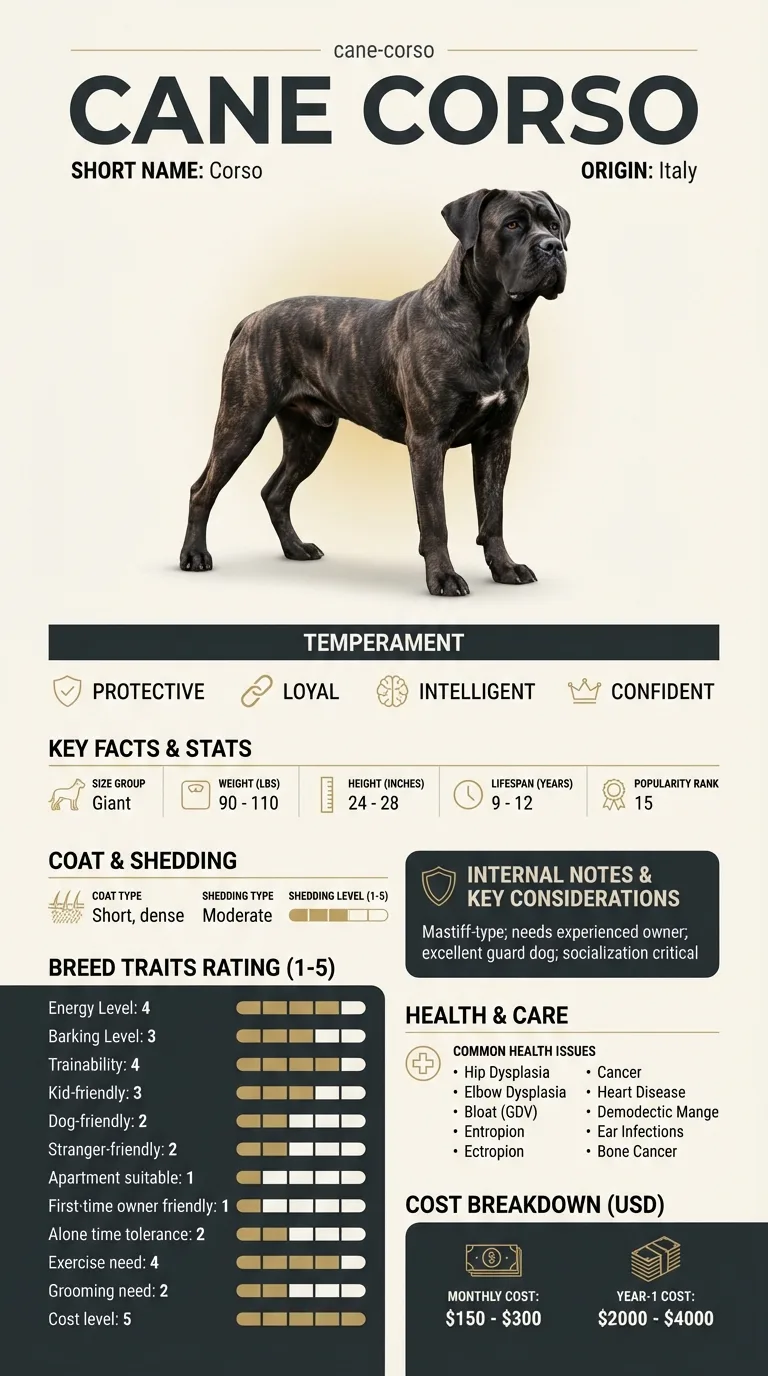
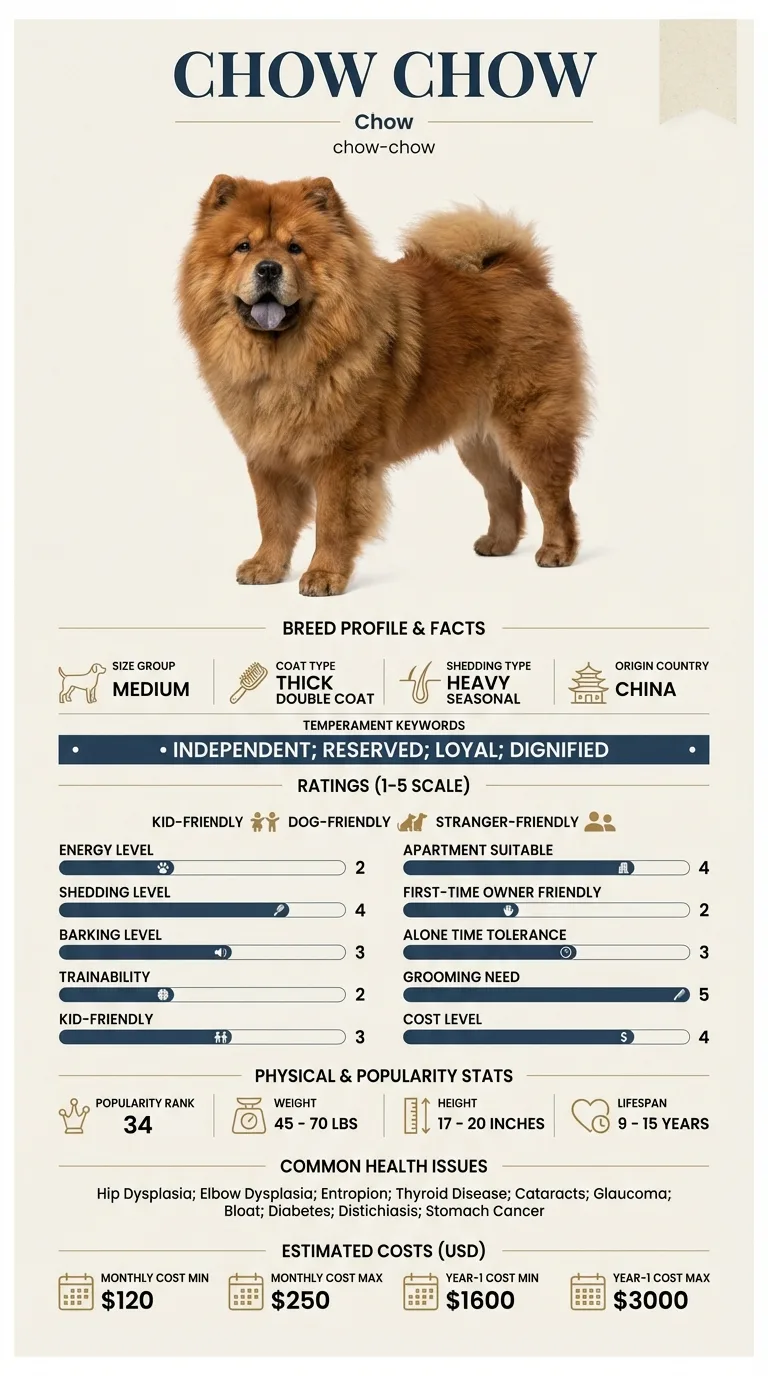
This is for someone already down to Cane Corso and Chow Chow and deciding between them. For this pair the decision usually turns on grooming need and apartment suitability, so those are covered first and in most detail. Anyone choosing from a flat has a clear answer here: Chow Chow rates 4/5 against 1/5. Breed history is left out; what follows is what you will actually live with.
Between Cane Corso and Chow Chow, grooming need is what separates them, and Chow Chow is the lower-effort dog of the two to keep.
Choose Cane Corso if you do not want a standing grooming appointment, shedding is a problem in your house and you want a dog that picks up training quickly.
Choose Chow Chow if you are in a flat or a smaller home, your walking routine is modest and the dog will be alone during the working day.
| Feature | cane corso | chow chow | Winner |
|---|---|---|---|
| Size class | giant | medium | Equal |
| Weight | 90–110 lbs | 45–70 lbs | Equal |
| Height | 24–28 in | 17–20 in | Equal |
| Lifespan | 9–12 years | 9–15 years | chow chow |
| Exercise need | High (4/5) | Low (2/5) | chow chow |
| Grooming need | Low (2/5) | Very high (5/5) | cane corso |
| Shedding | Moderate (3/5) | High (4/5) | cane corso |
| Energy level | High (4/5) | Low (2/5) | Equal |
| Barking | Moderate (3/5) | Moderate (3/5) | Equal |
| Apartment suitability | Very low (1/5) | High (4/5) | chow chow |
| Good for first-time owners | Very low (1/5) | Low (2/5) | chow chow |
| Tolerates being alone | Low (2/5) | Moderate (3/5) | chow chow |
| Trainability | High (4/5) | Low (2/5) | cane corso |
| Good with kids | Moderate (3/5) | Moderate (3/5) | Equal |
| Good with other dogs | Low (2/5) | Low (2/5) | Equal |
| Friendly to strangers | Low (2/5) | Low (2/5) | Equal |
| Cost level | Very high (5/5) | High (4/5) | chow chow |
| Coat | Short, dense | Thick double coat | Equal |
| Origin | Italy | China | Equal |
| Typical monthly cost | $150–$300 | $120–$250 | Equal |
| Typical first-year cost | $2,000–$4,000 | $1,600–$3,000 | Equal |
The Corso is a giant breed at 90-110 lbs and 24-28 inches; the Chow Chow is medium-sized at 45-70 lbs and 17-20 inches. The Chow's weight range actually creeps close to the Corso's lower bound in its largest individuals, but on average the Corso still runs close to double the Chow's mass, on a taller frame. A Chow's thick coat also makes it look bulkier than its actual body underneath, which can be misleading at a glance.
The Corso needs meaningfully more exercise, rated high (4/5) against the Chow's low (2/5). Chow Chows are famously reserved and low-drive for their size, content with modest daily walks, while the Corso's guardian-breed instincts call for structured, regular activity to stay well-balanced. A short daily walk genuinely satisfies most Chows, which is a much easier bar to clear than the sustained daily output a Corso is bred to want.
This is a sharp reversal from most Corso comparisons: the Chow Chow needs far more grooming, a very high 5/5 against the Corso's low 2/5, and sheds more too, high (4/5) versus moderate (3/5). That thick double coat is famous for a reason — regular, serious brushing is close to mandatory, especially during seasonal blowouts, and many owners bring in a professional groomer several times a year to keep it under control.
The Chow is the better apartment fit, high (4/5) against the Corso's very low (1/5), and also handles being alone somewhat better, moderate (3/5) versus low (2/5). Both breeds tie on barking at moderate (3/5), so noise isn't the differentiator here — space and exercise needs are, and a Chow's more self-contained, independent temperament makes solo stretches at home easier for it to handle.
The Corso rates far more trainable, high (4/5) against the Chow's low (2/5) — Chow Chows have a well-earned reputation for independence and aloofness that shows up directly in that number. Neither breed suits a first-time owner well: very low (1/5) for the Corso, low (2/5) for the Chow, both needing confident, experienced handling. A Chow that doesn't see the point of a command will often simply ignore it, regardless of how the request is phrased.
These two tie across the board — moderate (3/5) with kids, low (2/5) with other dogs, and low (2/5) with strangers. Their temperament descriptions overlap too: both are reserved, independent, and loyal rather than naturally outgoing. Early socialization matters for both breeds if you expect them to handle visitors comfortably, and neither is the type to warm up quickly to someone new without repeated, positive exposure.
The Chow Chow's lifespan tops out higher, 9-15 years against the Corso's 9-12, though both start at the same floor. Their health lists overlap more than most pairs on this site — hip dysplasia, elbow dysplasia, entropion, and bloat all appear on both — reflecting two solidly built breeds with real joint and structural risk. The Chow's list adds diabetes and several eye conditions the Corso doesn't carry.
The Corso costs somewhat more: very high (5/5) against the Chow's high (4/5), $150-300 monthly versus $120-250, and $2,000-4,000 in year one against $1,600-3,000. The Chow's heavy grooming needs narrow what would otherwise be a wider gap based on size alone, since professional grooming appointments for that coat add up meaningfully across a full year of ownership, especially if you're not doing much of the brushing yourself.
Cane Corso weighs 90–110 lbs and lives 9–12 years; Chow Chow weighs 45–70 lbs and lives 9–15 years. The two diverge most on grooming need, apartment suitability and exercise need and 2 other rated axes. They are level on barking, good with other dogs and good with kids, so those cannot decide it. The comparison marks an easier option only where one exists. Facts like weight and country of origin are not scored. Both dogs are rated from the same dataset, which is what makes the numbers comparable with each other even though any individual dog sits somewhere inside its breed's range.

Meaningfully bigger on average — 90-110 lbs and 24-28 inches for the Corso against 45-70 lbs and 17-20 inches for the Chow, though the largest Chows approach the Corso's lower weight bound.
The Chow Chow, by a lot — a very high 5/5 against the Corso's low 2/5. That thick double coat needs regular, serious brushing.
Neither scores well — the Corso rates a very low 1/5 for first-time owners, the Chow a low 2/5. Both are independent, reserved breeds that do better with experienced handlers.
The Chow Chow, clearly — high (4/5) versus the Corso's very low (1/5), thanks to lower exercise needs, though its heavy shedding is worth planning for indoors.
The Chow Chow, at $120-250 monthly and $1,600-3,000 in year one, against $150-300 and $2,000-4,000 for the Corso.
More than most pairs — hip dysplasia, elbow dysplasia, entropion, and bloat all appear on both lists. The Chow's list additionally includes diabetes and several eye conditions the Corso doesn't share.
The Chow Chow, with a higher ceiling — up to 15 years against the Corso's 12, though both share the same 9-year floor.
The Chow Chow for smaller homes and lower activity needs; the Corso needs an experienced owner with space and time for real exercise.
The Chow Chow, at $120-250 versus the Corso's $150-300.
The Cane Corso, rated 4/5 against the Chow's 2/5.
The Chow Chow, with a ceiling of 15 years against the Corso's 12.
Secure checkout on Stripe. We never see your card.
7-day money-back guarantee. Instant access.
Health information here is general and is not veterinary advice. If your dog shows pain, sudden behaviour change, or worsening symptoms, consult a licensed veterinarian.
Some links on this site are affiliate links. We may earn a commission at no extra cost to you, and we only suggest products we believe are helpful for dog owners.
We research and check what we publish, but we do not warrant that any figure, date, price, or statement is accurate, complete, or current, and we accept no liability for any loss, cost, injury, or other harm arising from the use of this site. Use it as one reference among several. You remain responsible for your own decisions and for your dog's care - confirm anything that matters with a licensed veterinarian or another qualified professional before you act on it. Full disclaimer.
Match your lifestyle to the right dog.
Take quizNot sure which breed is right for you? Take our 2-minute quiz to find out.
Take the quiz