Costs
What is the single most useful thing I can do before bloat happens?
Save the address and phone number of your nearest twenty-four hour clinic in your phone today, and know the route. Searching for one at 2am costs the time that matters most.

Quick answer
What is the single most useful thing I can do before bloat happens?
Save the address and phone number of your nearest twenty-four hour clinic in your phone today, and know the route. Searching for one at 2am costs the time that matters most.
Every other health problem in this breed gives you time to research, get a second opinion and save up. This one gives you about two hours.
Every owner of a deep-chested sporting dog, but especially those without insurance or an emergency fund, and those who have never worked out in advance which clinic is open at three in the morning and what they are prepared to spend.
This guide is not medical advice. If your dog shows pain, sudden behavior change, or worsening symptoms, consult a licensed veterinarian.
Some links may be affiliate links. We may earn a commission at no extra cost to you. We only suggest products we believe are helpful for dog owners.
We research and check what we publish, but we do not warrant that any figure, date, price, or statement is accurate, complete, or current, and we accept no liability for any loss, cost, injury, or other harm arising from the use of this site. Use it as one reference among several. You remain responsible for your own decisions and for your dog's care - confirm anything that matters with a licensed veterinarian or another qualified professional before you act on it. Full disclaimer.
Gastric dilatation-volvulus is a distended stomach that has rotated on its own axis, sealing both ends and cutting off its blood supply. It appears on the German Shorthaired Pointer's documented health list. Untreated it is fatal within hours, and treated it is one of the most expensive emergencies in small animal practice.
Bloat is listed among the German Shorthaired Pointer's typical health issues, which places it firmly in the category of things owners should plan for rather than hope to avoid. Deep-chested breeds carry markedly higher lifetime risk than the general dog population, and risk climbs with age.
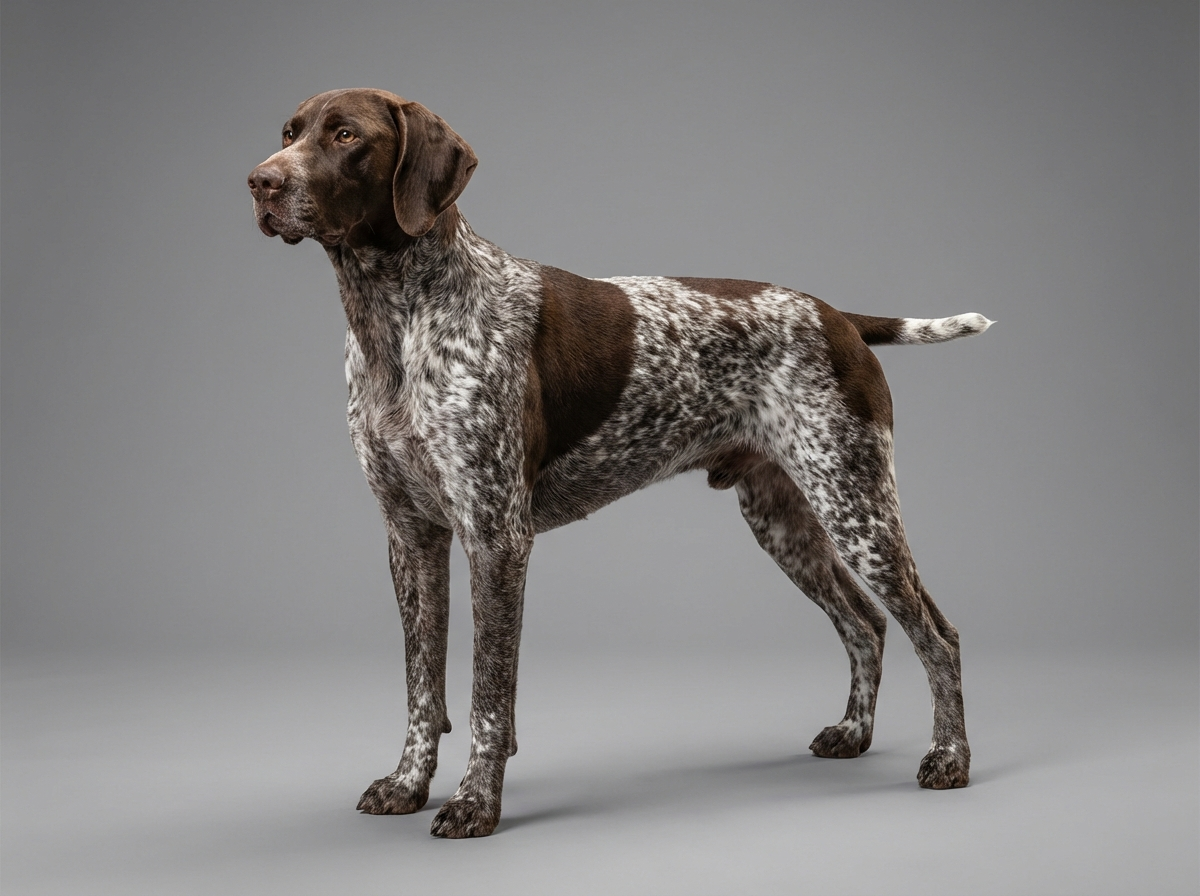
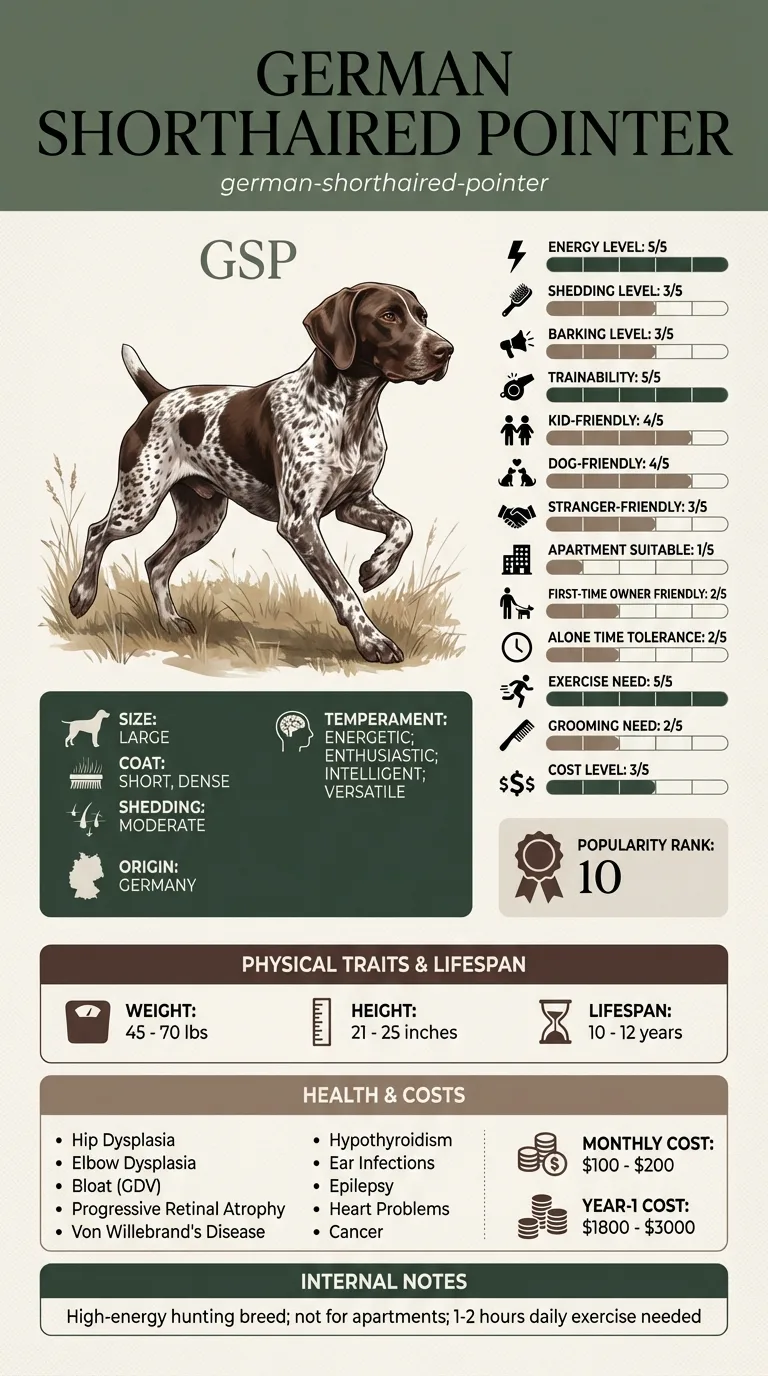
Conformation is the driver. The German Shorthaired Pointer's deep, comparatively narrow chest, developed to house the lung capacity a versatile gundog needs, leaves the stomach suspended in a tall space with room to rotate. Size adds to it: at 45 to 70 pounds this is squarely within the weight range where bloat risk is elevated. The breed's exercise requirement, at the top of the scale, means most GSPs are regularly doing hard work within hours of eating, which is the classic setup.
The controllable factors sit around the food bowl and the truck. Feeding one large meal a day, feeding immediately before or after work, competitive gulping in a multi-dog household, and letting a hot dog drink its fill at once all raise risk. The other environmental factor is purely logistical: how far you live from an emergency clinic, and whether you know the route, changes outcomes as much as anything medical.
This condition has no non-urgent version. Drive to an emergency clinic immediately, calling from the road so they can prepare, if your dog is retching repeatedly without bringing anything up, has a swollen or drum-tight abdomen behind the ribs, is restless and unable to settle, is drooling heavily, stands with elbows out and neck extended, or has pale gums and a fast weak pulse. Unproductive retching in a deep-chested dog should be treated as gastric dilatation-volvulus until a vet proves otherwise. Do not wait to see whether it passes, do not try to make the dog vomit, and do not delay for a morning appointment.
See all German Shorthaired Pointer health problems, which breeds are prone to bloat gastric dilatation volvulusgdv, or the full German Shorthaired Pointer breed guide for temperament, exercise needs and ownership costs.
From the first unproductive retch, the useful window is measured in a small number of hours. Surgery itself takes one to three hours, and hospitalisation typically runs two to four days with heart rhythm monitoring, since arrhythmias commonly follow. Recovery at home means two weeks of restricted exercise and a gradual return to normal feeding.
A dog that reaches surgery before its stomach wall is damaged, comes home with a gastropexy in place, and returns to full work within a month. On the owner's side, success is having already answered the money question and the clinic question long before the night it mattered.
The range is wide because the condition is not one procedure. A dog caught early with a simple twist and no tissue damage sits at the bottom of the range; a dog that arrives in shock and needs part of its stomach or its spleen removed sits at the top.
Bloat is a disease of shape. The German Shorthaired Pointer is a 45 to 70 pound dog standing 21 to 25 inches, built deep through the chest and comparatively narrow through the ribs, because that shape gives the lung capacity a dog needs to gallop for an hour. The same shape leaves the stomach hanging in a tall, narrow space, slung on ligaments that allow it to swing.
When the stomach fills with gas it expands, becomes buoyant, and can rotate. Once it rotates, both ends are closed off: nothing goes in, nothing comes out, and the gas already inside has nowhere to go. The stomach keeps swelling, presses on the large veins returning blood to the heart, and the dog goes into circulatory shock while its stomach wall begins to die from lack of blood supply.
That sequence is why the clock matters so much. Every part of it worsens the next. A dog treated in the first hour or two often has an entirely salvageable stomach; a dog treated after five or six hours frequently does not, and that difference is exactly what separates a fifteen-hundred-dollar outcome from a seventy-five-hundred-dollar one.

Dax started pacing at nine on a Sunday evening, about ninety minutes after his evening meal and an off-lead run. He tried to be sick three times and brought up nothing but foam. His owner had read about bloat when she got him and had the emergency clinic saved under a single contact. She called from the car. They were expecting the dog when she pulled in twenty-five minutes later. Radiographs confirmed the twist, he went to surgery within the hour, and the stomach wall was healthy enough that nothing needed removing. A gastropexy was performed at the same time. The final bill came to just over two thousand dollars, against a quoted worst case of six. He was home in forty-eight hours and hunting five weeks later. The vet's comment afterwards was that the difference was not the surgery, which was routine, but that Dax had arrived while there was still something entirely healthy to fix.
Key takeaway: The single decision that shaped both the outcome and the bill was made months earlier, when his owner saved an emergency number she hoped never to use. On the night itself, all she had to do was drive.
Commonly quoted ranges run from around fifteen hundred dollars for a straightforward case caught early to seventy-five hundred or more where stomach tissue or the spleen must be removed and intensive care runs several days. Geography and whether it is an out-of-hours emergency service both move the figure substantially.
Bloat is one of the clearest arguments for it. It is a documented breed condition, it strikes without warning, and the bill arrives all at once. Check that the policy has no exclusion for gastric dilatation and that the annual limit is high enough to absorb a full surgical case.
It is a surgery that tacks the stomach to the abdominal wall so it cannot rotate. Done electively, often alongside neutering, it costs a fraction of an emergency and dramatically reduces the risk of the life-threatening twist. Discuss whether it fits your dog with your vet.
Say so immediately and plainly at the clinic rather than delaying the visit. Many practices can discuss payment plans, charity funding or a reduced treatment plan, and some can only do that if asked early. Waiting to see whether it settles removes every option including the affordable ones.
A gastropexy performed during the surgery makes a repeat twist very unlikely, which is why it is done as standard. The dog can still bloat with gas, so the same feeding and exercise precautions continue afterwards.
Good for dogs that reach surgery promptly, and considerably worse for dogs that arrive already in shock with dead tissue. This is one of the few emergencies where the owner's response time is a genuine variable in the outcome.
Save the address and phone number of your nearest twenty-four hour clinic in your phone today, and know the route. Searching for one at 2am costs the time that matters most.
Immediately. Bloat is measured in hours, not days, and the tissue damage that drives both the cost and the risk accumulates the whole time.
Most comprehensive policies do, provided the condition was not pre-existing. Read the exclusions and the annual limit before you need them.
No. There is no home treatment for a twisted stomach, and attempts to relieve it waste the only resource that matters. Drive.
A one-page prep sheet for this condition: the signs, the questions to ask, what to get priced. Unlocks here.
You get: Vet visit prep sheet
No spam. One-click unsubscribe. See our privacy policy.
Preview page 1 before you decide.