Health
Is ARVC a Chow Chow breed risk?
No. It is not among the conditions documented for this breed. Collapse in a Chow is far more often explained by heat, airway limitation or thyroid disease.

Quick answer
Is ARVC a Chow Chow breed risk?
No. It is not among the conditions documented for this breed. Collapse in a Chow is far more often explained by heat, airway limitation or thyroid disease.
If your Chow Chow has collapsed, ARVC is a reasonable thing to have read about and an unlikely thing to be dealing with. The more useful question is which of the several far more common explanations for collapse in this particular breed your vet should rule out first.

This page is for owners who have searched a frightening symptom and landed on a frightening diagnosis. It is for anyone whose Chow has fainted, wobbled or dropped after exertion, and who wants to walk into the consultation with the right questions rather than the scariest ones.
This guide is not medical advice. If your dog shows pain, sudden behavior change, or worsening symptoms, consult a licensed veterinarian.
Some links may be affiliate links. We may earn a commission at no extra cost to you. We only suggest products we believe are helpful for dog owners.
We research and check what we publish, but we do not warrant that any figure, date, price, or statement is accurate, complete, or current, and we accept no liability for any loss, cost, injury, or other harm arising from the use of this site. Use it as one reference among several. You remain responsible for your own decisions and for your dog's care - confirm anything that matters with a licensed veterinarian or another qualified professional before you act on it. Full disclaimer.
ARVC is a heart muscle disease that produces dangerous rhythm abnormalities and, in severe cases, fainting or sudden death. It is a recognised inherited condition in the Boxer and a small number of other breeds, and it is not part of the Chow Chow's documented health profile. For a Chow owner the useful content here is how collapse should actually be investigated in this breed.
ARVC is uncommon overall and, in the Chow specifically, there is no documented breed association at all. Collapse and fainting, on the other hand, are things Chow owners do encounter, and in this breed they far more often trace back to temperature, airway or metabolic causes than to primary heart muscle disease.
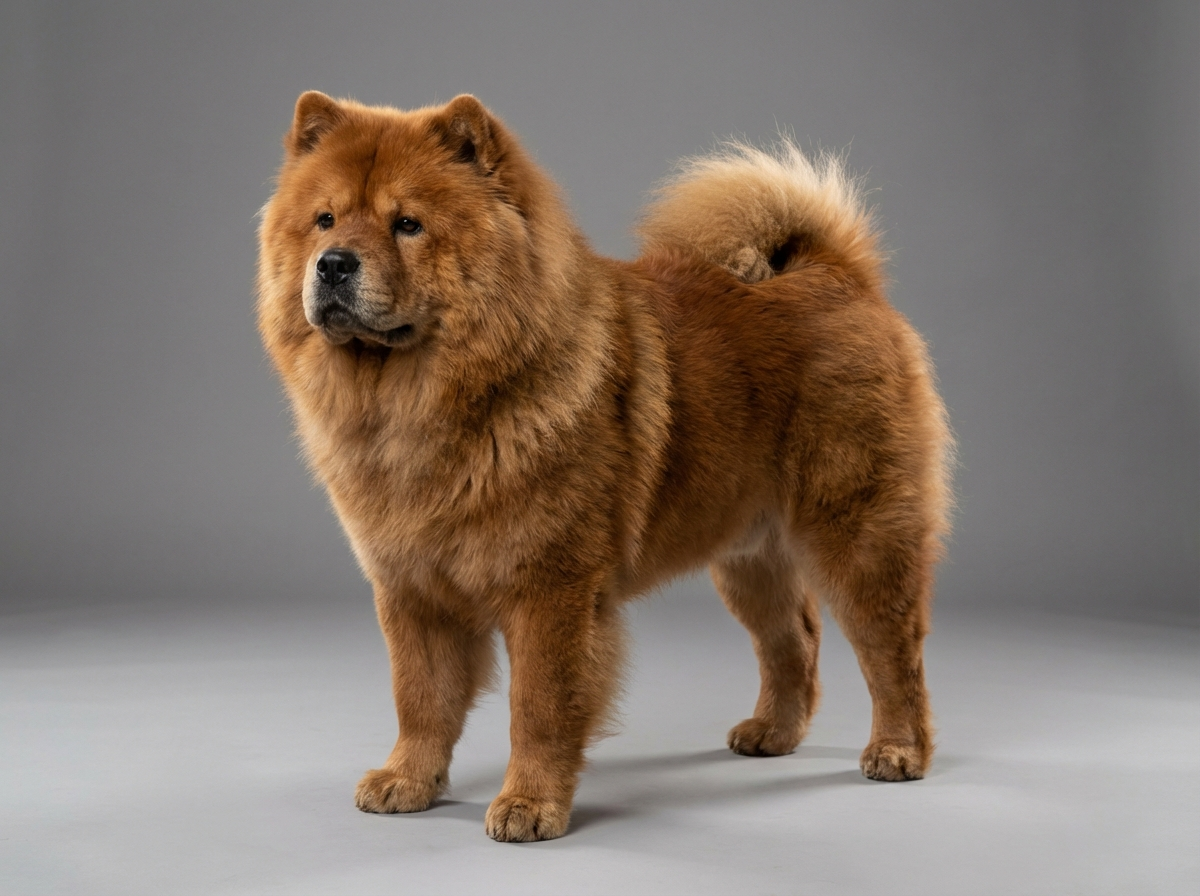
The honest answer is that the Chow Chow's build points away from this diagnosis and towards others. This is a medium dog of roughly forty-five to seventy pounds carrying an insulating double coat designed for cold, with a short broad muzzle and a naturally low exercise requirement. That combination makes exertional collapse a thermal and respiratory event far more often than a cardiac one. The breed's documented conditions - joint disease, eye and eyelid problems, thyroid disease, bloat, diabetes and stomach cancer - contain nothing that predisposes to right ventricular muscle disease.
Ambient temperature and humidity are the dominant environmental factors. A Chow that copes fine with a thirty-minute walk in April can be in trouble on the same route in July. Midday walks, hot cars, garden time without shade, and warm indoor rooms with poor airflow all raise the baseline. Excitement is the other variable: a reserved breed meeting unfamiliar visitors experiences a genuine physiological surge, and in a dog with any airway limitation that surge is where trouble shows.
Book an appointment after any episode of fainting, staggering or unexplained weakness, even if the dog seems entirely normal afterwards. Go immediately for repeated collapses in a short period, a dog that does not fully return to normal within a couple of minutes, collapse accompanied by laboured breathing or a blue or grey tongue, or any collapse in a hot dog - heat collapse is a life-threatening emergency and cooling must begin on the way. Also treat as urgent any episode with a distended abdomen or unproductive retching, because bloat is documented in this breed and can present as sudden weakness.
See all Chow Chow health problems, which breeds are prone to arrhythmogenic right ventricular cardiomyopathy arvc, or the full Chow Chow breed guide for temperament, exercise needs and ownership costs.
An initial assessment happens in one visit. If a rhythm problem is suspected, a twenty-four hour recording plus interpretation typically adds one to two weeks. If the answer turns out to be heat, fitness or thyroid, you may have a clear direction within days. Expect the diagnostic path to be a process of subtraction rather than a single answer arriving at the first appointment.
Success is knowing the cause rather than fearing the worst one. For most Chows that means a management plan around temperature, weight and airway, and a return to normal short daily walks in cool conditions. If a genuine rhythm disorder is found, success shifts to controlled monitoring under a cardiologist - which is a very different life, but a manageable one that begins with getting the diagnosis right.
ARVC is a specific structural disease of heart muscle with a known genetic basis in the Boxer. Diagnosis rests on demonstrating a characteristic pattern of abnormal beats, usually over twenty-four hours of continuous recording, alongside imaging of the heart. It is not diagnosed on a stethoscope, and it is not diagnosed on breed alone.
The Chow Chow's documented health profile is dominated by joint disease, eyelid and eye conditions, thyroid disease, bloat, diabetes and stomach cancer. Heart muscle disease does not feature. That does not make a cardiac cause impossible in an individual dog - any breed can develop rhythm disturbance, and dogs are individuals rather than statistics - but it does mean a rare breed-specific cardiomyopathy should not be the first hypothesis.
The practical consequence is about sequencing. A dog that collapses deserves a proper cardiac assessment, but it also deserves a temperature check, a blood glucose reading, a thyroid panel and an honest look at the circumstances of the episode. In a Chow, that context frequently explains the collapse without any heart disease being involved.

Before reaching for a rare cardiomyopathy, work through the explanations that fit this breed's documented profile and its physical build.
Ren, a six-year-old Chow, went down on a pavement about fifteen minutes into a Saturday morning walk. His owner, Marcus, had been reading about heart disease in dogs since the previous week, when Ren had seemed unusually tired, and he arrived at the clinic convinced he was dealing with something cardiac. Ren's heart sounded normal. His temperature, taken twenty minutes after the collapse, was still well above where it should have been. It had been twenty-eight degrees on a still morning and Marcus, who was used to walking his previous dog at the same time, had not adjusted anything. The vet ran bloods anyway, including thyroid, which came back borderline and was rechecked. Ren's walks moved to six in the morning, he lost four pounds over the summer, and there were no further episodes. The heart was never the problem.
Key takeaway: Collapse in a Chow Chow is a symptom that needs investigating, but the investigation should follow the breed's actual risk profile. Temperature, airway and thyroid come long before a rare cardiomyopathy that this breed is not documented to carry.
It is not part of the breed's documented health profile. The disease is best described in Boxers, with recognition in a small number of other breeds. An individual Chow could in principle develop a right ventricular problem, but there is no basis for treating it as a breed risk.
Not necessarily, but it always deserves a veterinary assessment. A single true faint - a sudden loss of consciousness with rapid full recovery - is worth investigating properly, because the causes range from harmless to serious and you cannot separate them at home.
Typically a physical exam and an in-clinic ECG first, then, if abnormal beats are found or the history is suggestive, a twenty-four hour ambulatory recording, because intermittent arrhythmias are easily missed in a five-minute trace. Imaging of the heart follows if the rhythm findings warrant it.
The details are what make the diagnosis. What the dog was doing immediately before, how long it lasted, whether there was paddling or stiffness, whether the dog urinated, how long recovery took, the ambient temperature, and whether it has happened before. A phone video is worth more than any description.
Restrict exercise until you have seen a vet, and be conservative about heat in the meantime. This is a low-energy breed with a modest exercise requirement, so short cool-hour walks cost the dog very little while you investigate.
The available genetic test for this condition was developed for and validated in the Boxer. Applying it to a Chow Chow would not give you meaningful information. Spend the money on the cardiac workup your vet actually recommends instead.
No. It is not among the conditions documented for this breed. Collapse in a Chow is far more often explained by heat, airway limitation or thyroid disease.
How hot the dog is, and how hot it was. In a heavy-coated, heat-sensitive breed, overheating is the most common cause and the most time-critical one.
Yes, if it is safe to do so. Video of the episode itself is the single most useful thing you can bring to the appointment.
An ECG and a specialist heart scan together typically run into several hundred dollars or more, which is a substantial addition to this breed's already high cost profile.
A one-page prep sheet for this condition: the signs, the questions to ask, what to get priced. Unlocks here.
You get: Vet visit prep sheet
No spam. One-click unsubscribe. See our privacy policy.
Preview page 1 before you decide.