Health
What is the fastest check on a Chow Chow?
Look at the face, not the body. The muzzle and eye area carry the least coat, so shape changes register there before anywhere else.

Quick answer
What is the fastest check on a Chow Chow?
Look at the face, not the body. The muzzle and eye area carry the least coat, so shape changes register there before anywhere else.
Almost every classic sign of a sudden allergic reaction happens underneath something on this breed. Hives swell under a dense double coat. Facial puffiness disappears into a heavy ruff. And the blue-black pigment the Chow is known for extends into the gums, so the pale-gum check owners are taught to use often tells you nothing.
This catches out attentive owners more than careless ones, because they are looking for signs the coat is hiding. It is hardest for first-time Chow owners, for anyone whose previous dog was short-coated, and for households where the dog spends part of the day outdoors around stinging insects.
This guide is not medical advice. If your dog shows pain, sudden behavior change, or worsening symptoms, consult a licensed veterinarian.
Some links may be affiliate links. We may earn a commission at no extra cost to you. We only suggest products we believe are helpful for dog owners.
We research and check what we publish, but we do not warrant that any figure, date, price, or statement is accurate, complete, or current, and we accept no liability for any loss, cost, injury, or other harm arising from the use of this site. Use it as one reference among several. You remain responsible for your own decisions and for your dog's care - confirm anything that matters with a licensed veterinarian or another qualified professional before you act on it. Full disclaimer.
An acute allergic reaction is a rapid immune response to a recent exposure: hives, facial swelling, sudden gut upset, weakness or, at the severe end, circulatory collapse. In a Chow Chow the difficulty is detection rather than rarity, because coat, pigment and deep-set eyes remove the visual cues owners are usually told to watch for.
Severe reactions are uncommon in any individual dog's lifetime, but mild to moderate ones are ordinary veterinary business. What is specific to the Chow Chow is not a higher rate of reacting so much as a higher rate of late presentation, because coat, pigment and a reserved manner all delay the moment an owner realises something is wrong.
Nothing in the Chow Chow's documented health profile marks it out as having an unusually reactive immune system. What the breed brings is anatomy that masks the presentation. The dense double coat conceals hives across most of the body. Heavy pigmentation of the gums removes the standard perfusion check. Deep-set eyes framed by a thick ruff blur the outline of swelling around the socket. A comparatively short, broad muzzle leaves less slack before soft-tissue swelling narrows the airway. And an independent, dignified temperament means the dog will not make a fuss about feeling unwell.
Exposure risk tracks how the dog lives. Flowering ground cover, late-summer wasp activity and unsupervised garden time put a nose or paw within reach of a sting. Households that change food brands often, or add supplements without telling the vet, widen the list of first exposures. Because Chow Chows need little exercise and are often kept as content indoor dogs, a sting can happen during a two-minute garden trip nobody was watching, so the exposure moment goes unrecorded.
Facial or muzzle swelling, hives you can feel through the coat, vomiting or diarrhoea within an hour of a sting or new medication, or a sudden mood change after a vaccination all mean phone the clinic the same day. Go immediately, without phoning first if necessary, for any change in breathing effort or a new breathing noise, collapse or staggering, repeated vomiting with weakness, or swelling that is visibly progressing while you watch. A severe systemic reaction is a genuine emergency that worsens over minutes, not hours. Tell whoever answers the phone that your dog is heavily pigmented so nobody waits on a gum-colour finding you cannot read.
See all Chow Chow health problems, which breeds are prone to allergic reactions, or the full Chow Chow breed guide for temperament, exercise needs and ownership costs.
Mild reactions treated promptly usually settle within a day or two, with a short observation period and often a couple of days of medication. Severe systemic reactions need hospitalisation and are measured in hours. What you cannot compress is the detection window, and shortening the gap between exposure and the phone call is the only part of the process you actually control.
Success is not a dog that never reacts. It is a household that knows what its own Chow looks like on a normal day, catches a change within the first hour, and reaches a clinic before breathing is involved. Long term, it means a written record of confirmed triggers so future vaccinations and dental procedures are planned around a known history.
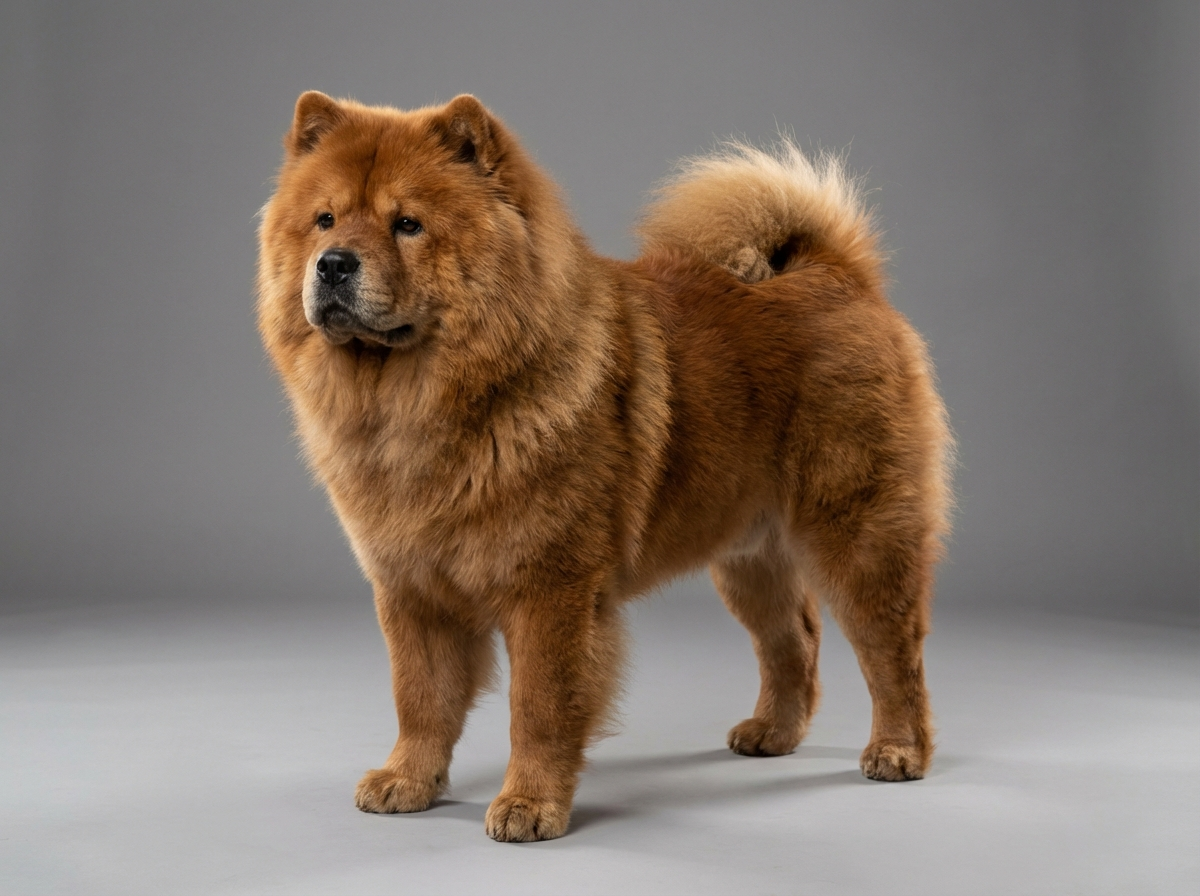
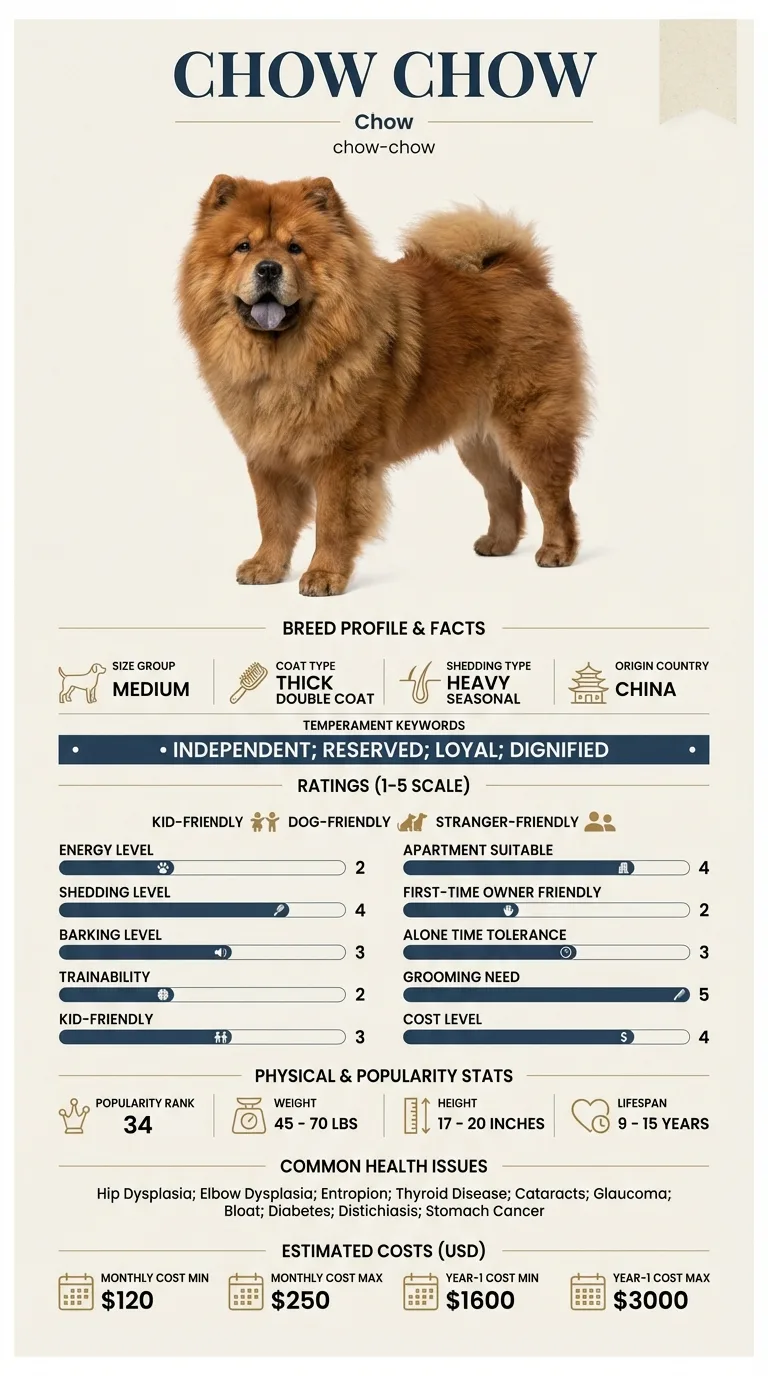
Run your hands over a short-coated dog during a hives episode and the welts are obvious. Do the same on a Chow Chow and your fingers stop at the guard hairs. This breed carries a thick double coat with a dense undercoat that sheds heavily on a seasonal cycle, and its grooming demand sits at the very top of the scale - there is a great deal of hair between your hand and the skin.
The second obstacle is pigment. That same blue-black colouring commonly extends across the gums and inner lips, which makes the standard press-the-gum perfusion check unreadable. The practical fix is to learn, on a calm and healthy day, which spot in your own dog's mouth is least pigmented, and use that same spot every time.
Third is temperament. Chows are independent, reserved and dignified rather than demonstrative. A needy breed leans on you when something feels wrong; a Chow walks off, settles somewhere cool and goes quiet. Withdrawal reads as ordinary aloofness, and that misread costs time.

Because the coat blocks the visual check, build your assessment around the areas it does not cover and around behaviour rather than appearance.
Bao, a five-year-old Chow Chow, spent ten minutes in the garden on an August evening and came back in without any fuss. His owner, Priya, noticed only that he lay on the kitchen tiles instead of his usual rug, which she put down to the heat. Forty minutes later he brought up his dinner. Kneeling beside him, Priya thought his muzzle looked wider than it should, though she was second-guessing herself, and pressing his gums told her nothing because they were solid black. She phoned the practice anyway and described the timing rather than the appearance: fine at six, off his feet at six-fifteen, vomiting at six-fifty. The nurse told her to come straight in. Bao had been stung on the lip. He was treated, observed for three hours and went home the same night, and the reaction never reached his breathing.
Key takeaway: In a heavily coated, heavily pigmented breed, the timeline is better evidence than the appearance. If the sequence of the last hour looks wrong, make the call rather than waiting for a visual sign the coat may never let you see.
Find the least pigmented patch of gum or inner lip while your dog is calm and well, and treat that spot as your baseline. Photograph it. During a suspected reaction, press that same spot. If your dog is uniformly pigmented, say so on the phone so your vet relies on other findings instead.
Usually within minutes to an hour of exposure, which is what separates it from the slow, chronic itchiness of ongoing allergies. The speed is the diagnostic clue. If your Chow was fine an hour ago and is now vomiting, swelling or wobbly, treat it as acute.
Facial swelling always warrants a same-day call. It becomes an immediate emergency when paired with any change in breathing, collapse, repeated vomiting or a dog that will not stand. A short, broad muzzle has less room to expand into before swelling starts affecting the airway.
Reactions to vaccines happen in dogs of any breed, which is why clinics ask you to stay nearby afterwards. Book earlier in the day rather than as the last slot, wait twenty minutes before driving off, and make sure any previous reaction is written in the file.
For a reserved, self-contained breed, a genuine change in mood is meaningful information. It is not a reason to panic, but it is a reason to start a clock, keep the dog in sight, and phone if anything else changes within the hour.
Stripping a Chow Chow's double coat is a poor trade. That coat is part of how the dog handles temperature, and this breed already copes badly with heat. Thorough weekly brushing serves you better, because it puts your hands on the skin and teaches you what normal feels like.
Look at the face, not the body. The muzzle and eye area carry the least coat, so shape changes register there before anywhere else.
No. Phone your vet and follow their instruction. Several common human allergy tablets contain extra ingredients that are unsafe for dogs.
Somewhere cool, flat and indoors with air moving. Heat stacks badly on top of a reaction in a heavy-coated, heat-sensitive breed.
An after-hours visit with injectable treatment and observation is a common unplanned cost for Chow owners, and it sits well above a routine consultation.
A one-page prep sheet for this condition: the signs, the questions to ask, what to get priced. Unlocks here.
You get: Vet visit prep sheet
No spam. One-click unsubscribe. See our privacy policy.
Preview page 1 before you decide.