Health
Which cancer is documented in this breed?
Stomach cancer appears on the Chow Chow's documented condition list, which is why persistent vomiting warrants earlier investigation here.

Quick answer
Which cancer is documented in this breed?
Stomach cancer appears on the Chow Chow's documented condition list, which is why persistent vomiting warrants earlier investigation here.
A middle-aged Chow that vomits occasionally, eats a little less and has become slightly picky is the classic presentation, and it is also the presentation that gets treated with a bland diet three times before anyone images the abdomen. The intermittency is the trap: the dog keeps having good weeks.
Owners of Chows from about six years onwards, particularly anyone who has been managing recurring digestive upset for months. It is also relevant to owners who cannot see their dog's body condition because of the coat, which describes almost everyone with this breed.
This guide is not medical advice. If your dog shows pain, sudden behavior change, or worsening symptoms, consult a licensed veterinarian.
Some links may be affiliate links. We may earn a commission at no extra cost to you. We only suggest products we believe are helpful for dog owners.
We research and check what we publish, but we do not warrant that any figure, date, price, or statement is accurate, complete, or current, and we accept no liability for any loss, cost, injury, or other harm arising from the use of this site. Use it as one reference among several. You remain responsible for your own decisions and for your dog's care - confirm anything that matters with a licensed veterinarian or another qualified professional before you act on it. Full disclaimer.
Cancer covers many different diseases with different behaviours and outlooks. For the Chow Chow the specific documented concern is stomach cancer, which typically presents as intermittent vomiting, reduced appetite and gradual weight loss in a middle-aged or older dog. The breed's dense coat and undemonstrative temperament both delay recognition, which is why routine measurement matters more here than observation.
Cancer of some form is among the leading causes of death in older dogs across all breeds. Within that general picture, gastric tumours are relatively uncommon overall but appear specifically on the Chow Chow's documented list, which raises the index of suspicion for recurring vomiting in this breed compared with a dog with no such association.
The predisposition to stomach cancer in this breed is inherited rather than caused by anything an owner does, and it is the reason gastric signs deserve a lower threshold for investigation here. The breed's other contributions are to detection rather than causation. A thick double coat conceals the gradual weight loss that is often the earliest measurable sign. The independent, dignified temperament means a Chow that feels unwell withdraws quietly rather than seeking attention. And heavy pigmentation of the gums makes the pallor of chronic blood loss difficult to assess visually.
Environment plays a smaller and less certain role than owners often hope. Age is the overwhelming factor and it cannot be modified. What can be influenced is body condition across the dog's life, and how quickly persistent signs are investigated - the latter is not a cause of cancer but is a genuine determinant of outcome. Households that respond to a third bout of vomiting with another bland diet rather than an appointment lose time that sometimes matters.
Book an appointment for vomiting that has recurred over more than two or three weeks, for a downward weight trend, for a new or growing lump, or for a dog that has become quietly less interested in food or activity. Ask about abdominal imaging rather than accepting a further symptomatic trial if the problem keeps returning. Seek urgent same-day care for vomit that looks like coffee grounds, black tarry stools, sudden collapse, weakness with pale gums where you can assess them, a visibly distended abdomen, or repeated retching that produces nothing - the last is a potential bloat emergency and takes priority over everything else.
See all Chow Chow health problems, which breeds are prone to cancer, or the full Chow Chow breed guide for temperament, exercise needs and ownership costs.
From first appointment to diagnosis typically takes one to three weeks, allowing for imaging, endoscopy and biopsy results. Treatment timelines vary enormously by tumour type. What is more predictable is the pre-diagnosis phase, which in this breed is often unnecessarily long, and which monthly weights and a symptom diary can shorten by months.
For some tumours success means removal and years of further life. For others it means good quality time with symptoms controlled, which is a real and worthwhile outcome rather than a consolation. What every owner can achieve, regardless of the eventual diagnosis, is catching the change early enough that the full range of options is still open and the decisions are unhurried.
Gradual weight loss is one of the most useful early cancer signals in any dog, and in a Chow Chow it is almost invisible. A thick double coat with a dense undercoat holds its shape regardless of what is happening underneath, so a dog can lose a meaningful proportion of its body mass while looking outwardly unchanged. Owners who rely on how the dog looks will find out months later than owners who use a scale.
This is the single most valuable habit for the second half of a Chow's life: weigh the dog every month on the same scale and write the number down. A steady downward trend across three or four months, in a dog whose food has not changed, is a finding worth an appointment on its own, even in the absence of any other sign.
The breed's temperament compounds the problem. Chows are described as independent, reserved and dignified, and a dog like that does not perform illness. It becomes slightly less interested in things. Owners commonly report afterwards that they had noticed the dog was quieter but had attributed it to age.

None of these prove cancer. What they do is mark the point at which a case has stopped being ordinary digestive upset and should be investigated with imaging and bloodwork.
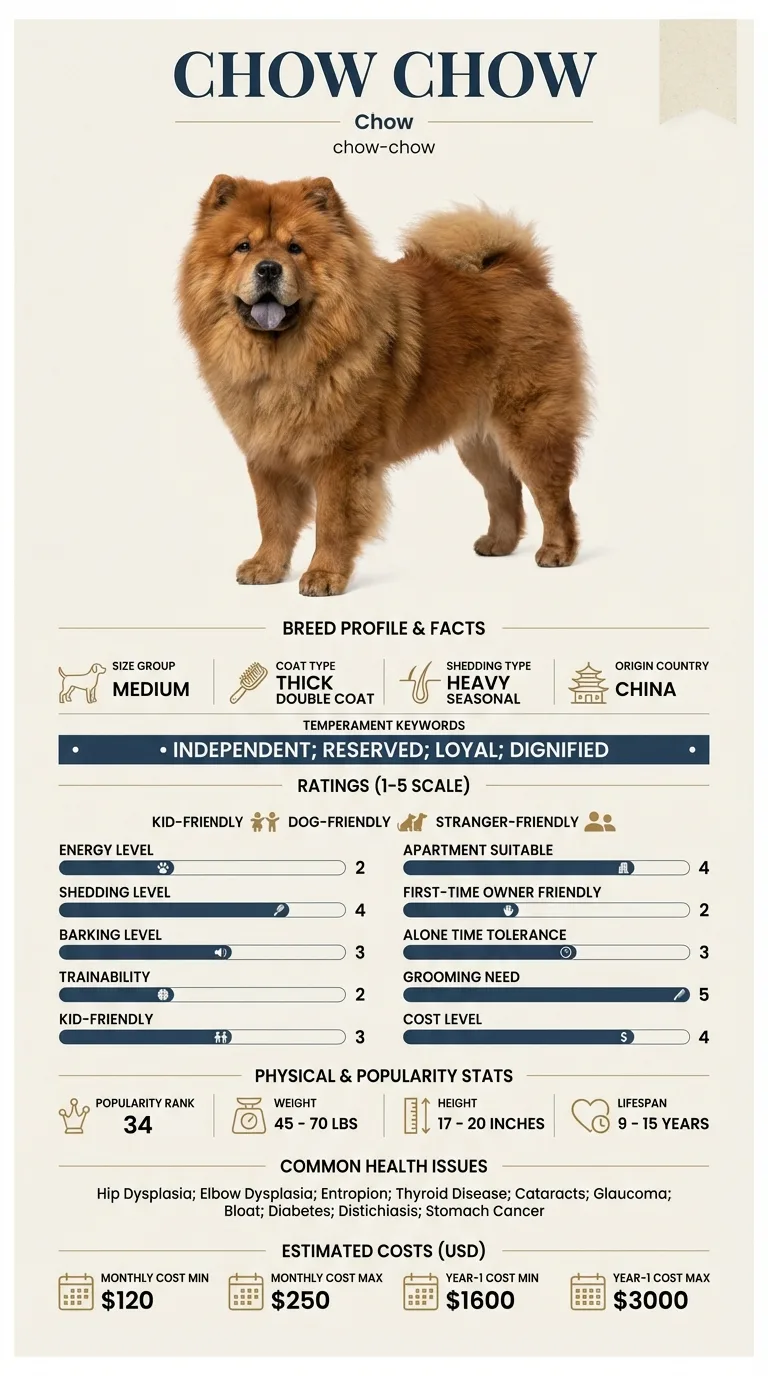
If you think your Chow has cancer, the plan is three steps: write down what you have seen and when it started, book a veterinary appointment rather than waiting for the next flare, and take video of the behaviour or symptom before you go — the thing you are worried about rarely happens in the consulting room. Screening in the parents covers hip dysplasia, elbow dysplasia, entropion.
What the vet visit should produce is a diagnosis and a written plan, not just reassurance: what is being ruled out, what the monitoring interval is, and which signs mean you come back sooner. Ask what the treatment costs across a year rather than per visit, because that is the number that decides whether you are managing this condition or reacting to it.
Between appointments, keep a short log — dates, what you saw, what changed. It is the single most useful thing an owner brings to a follow-up, and for cancer it is often what separates a clear pattern from a guess.
Duke was eight and had been vomiting on and off since the spring - never more than once or twice a week, usually in the evening, always bouncing back the next day. He had been prescribed a bland diet twice and it had seemed to help each time. What changed his owner Marta's mind was a number. She had started weighing him monthly the previous year, after reading that you cannot judge a Chow's condition by looking at one. Between March and July he had dropped from sixty-one pounds to fifty-five, without her noticing any difference in how he looked. She took the sheet of paper to the appointment. Her vet stopped treating symptomatically and referred Duke for an abdominal ultrasound that week, followed by endoscopy. The finding was a gastric mass, and the referral centre was clear that arriving with a documented four-month weight trend had moved things considerably faster than three more weeks of vomiting would have.
Key takeaway: In a coated breed, a scale is a diagnostic instrument. A recurring digestive problem that is not resolving deserves imaging rather than another symptomatic trial, and the weight record is what turns a vague worry into a case a vet can act on.
Gastric tumours appear among the Chow Chow's documented health conditions, and the breed is recognised as carrying more of this particular risk than dogs in general. That does not mean an individual Chow will develop it, but it does mean that persistent vomiting in a middle-aged Chow should be investigated more readily than it might be in another breed.
Usually through a combination of bloodwork, imaging of the abdomen with ultrasound, and endoscopy to see the stomach lining directly and take biopsies. Plain radiographs alone are often unrevealing, which is worth knowing if a first set of X-rays comes back normal and the dog is still unwell.
Middle age onwards, so roughly six or seven in this breed. That is also a sensible point to move from annual to twice-yearly veterinary check-ups, since the value of a routine examination rises sharply once age-related disease becomes plausible.
Yes, and grooming is the natural time to do it. Working through in sections with your fingers on the skin gives you a whole-body survey every week. Anything new should be measured, dated and photographed, because the growth rate is one of the most useful pieces of information you can give a vet.
There is no diet that reliably prevents cancer in dogs, and claims otherwise should be treated with real suspicion. Keeping a dog lean throughout life is associated with better outcomes generally, which is a reasonable goal for its own sake in a low-energy breed prone to weight gain.
That depends entirely on the tumour type, its stage and the individual dog, and it is a conversation to have honestly with your vet rather than a decision to prejudge. Options range from surgery through to palliative care focused purely on comfort, and the second is a legitimate choice rather than a failure.
Stomach cancer appears on the Chow Chow's documented condition list, which is why persistent vomiting warrants earlier investigation here.
A monthly weight on the same scale, recorded. A double coat makes visual assessment of weight loss unreliable.
Twice a year from about seven onwards, so that gradual changes are picked up by someone comparing against records.
Ultrasound plus endoscopy with biopsies runs into a substantial sum before any treatment is considered, which is worth planning for.
A one-page prep sheet for this condition: the signs, the questions to ask, what to get priced. Unlocks here.
You get: Vet visit prep sheet
No spam. One-click unsubscribe. See our privacy policy.
Preview page 1 before you decide.