Health
What's the biggest overlooked bloat risk for active dogs?
Feeding a full meal right before or right after hard exercise, which is exactly the pattern many field-dog routines fall into by default.

Quick answer
What's the biggest overlooked bloat risk for active dogs?
Feeding a full meal right before or right after hard exercise, which is exactly the pattern many field-dog routines fall into by default.
Most owners know bloat is dangerous. Fewer know that the exact routine many field-dog owners follow, hard exercise close to mealtime, is one of the more established risk factors for it.
This is most relevant to owners who exercise their Brittany hard, whether that's a training session, a hunt, or a long hike, and who feed on a schedule built around convenience rather than around what's actually known about bloat risk.
This guide is not medical advice. If your dog shows pain, sudden behavior change, or worsening symptoms, consult a licensed veterinarian.
Some links may be affiliate links. We may earn a commission at no extra cost to you. We only suggest products we believe are helpful for dog owners.
We research and check what we publish, but we do not warrant that any figure, date, price, or statement is accurate, complete, or current, and we accept no liability for any loss, cost, injury, or other harm arising from the use of this site. Use it as one reference among several. You remain responsible for your own decisions and for your dog's care - confirm anything that matters with a licensed veterinarian or another qualified professional before you act on it. Full disclaimer.
Bloat is a documented, life-threatening health concern for this breed, and prevention for an active Brittany comes down largely to managing the routine most field dogs fall into naturally: hard exercise paired closely with a full meal. Adjusting the timing between activity and feeding is one of the most practical, low-cost prevention steps available to owners.
Bloat is documented as a real concern for this breed, and while most Brittanys will never experience it, the consequences are severe enough, and the prevention steps simple enough, that every owner of an active dog in this breed should have a feeding and exercise routine built around reducing risk.
Bloat is listed among this breed's documented health concerns, meaning Brittanys carry a real, if individually variable, risk. Combined with a build and drive suited to sustained field activity, this breed's typical lifestyle creates more opportunities to fall into the exercise-and-feeding pattern associated with increased risk than a low-activity companion breed would encounter.
A single large daily meal, fast eating, exercise scheduled too close to feeding time, and rapid water consumption after exertion are all environmental and routine factors that raise risk regardless of breed, and they're especially relevant for a dog whose day naturally involves hard exercise followed by hunger and thirst.
Discuss feeding and exercise timing at a routine visit to build a plan proactively, rather than waiting for a scare. If your dog ever shows a distended, hard abdomen, unproductive retching, restlessness, or drooling, this is a bloat emergency: go to the nearest emergency vet immediately, it cannot wait for a callback or a next-day appointment.
See all Brittany health problems, which breeds are prone to bloat gastric dilatation volvulusgdv, or the full Brittany breed guide for temperament, exercise needs and ownership costs.
Feeding and exercise timing changes can be implemented immediately and don't require a transition period, though building a new routine into a hunting or training schedule usually takes a few outings to become habit for both dog and owner.
Success means a consistent routine that removes the highest-risk timing pattern from your dog's normal day, not a guarantee that bloat will never happen, since no prevention step offers that certainty.
Vigorous exercise on a full stomach, or a large meal immediately after hard exercise while a dog is still breathing heavily and gulping water, is associated with an increased bloat risk in susceptible dogs. The stomach is more prone to distending and, in the worst cases, twisting when it's full and the dog is active or rapidly rehydrating.
For a Brittany used for field work, this is a genuinely relevant risk pattern, since the whole rhythm of a hunting or training day often involves activity followed immediately by a hungry, thirsty dog and a full food bowl. Building in a deliberate cooldown window changes that pattern without requiring any special equipment or expense.
None of these steps eliminate risk entirely, but together they address the specific pattern that active field dogs are most likely to fall into.

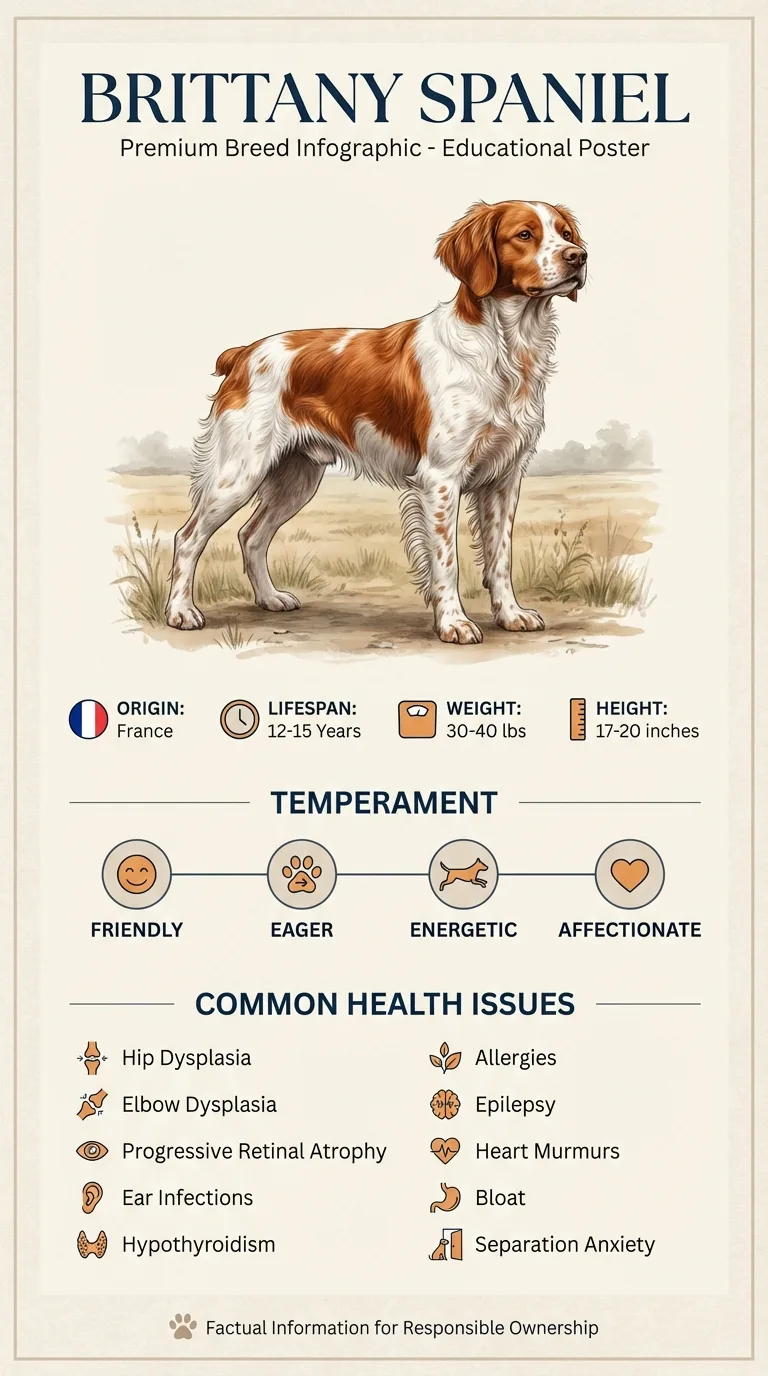
If you think your Brittany has bloat (gastric dilatation-volvulus/gdv), the plan is three steps: write down what you have seen and when it started, book a veterinary appointment rather than waiting for the next flare, and take video of the behaviour or symptom before you go — the thing you are worried about rarely happens in the consulting room. Screening in the parents covers hip dysplasia, elbow dysplasia, progressive retinal atrophy.
What the vet visit should produce is a diagnosis and a written plan, not just reassurance: what is being ruled out, what the monitoring interval is, and which signs mean you come back sooner. Ask what the treatment costs across a year rather than per visit, because that is the number that decides whether you are managing this condition or reacting to it.
Between appointments, keep a short log — dates, what you saw, what changed. It is the single most useful thing an owner brings to a follow-up, and for bloat (gastric dilatation-volvulus/gdv) it is often what separates a clear pattern from a guess.
Grace had always fed Ranger, her Brittany, right after their evening training sessions, since that was when it was most convenient and Ranger was clearly hungry. After reading about bloat risk factors at a vet visit for an unrelated issue, she realized her routine matched almost exactly the pattern her vet described as higher risk. She started letting Ranger fully cool down and settle for about an hour after training before offering his meal, and split his single evening portion into two smaller feedings across the day instead. It took a couple of weeks for Ranger to stop immediately pestering her for food the second training ended, but he adjusted. Grace also asked about a preventive gastropexy and decided to have it done during Ranger's upcoming dental procedure, reasoning that combining it with an already-planned anesthesia event made sense for her and for him.
Key takeaway: The convenient, default feeding routine for an active field dog is often exactly the pattern associated with higher bloat risk. A deliberate cooldown window before and after meals is a simple, free change worth making before a problem ever occurs.
Because the typical rhythm of field work, hard exercise followed by a hungry, thirsty dog and a full bowl, matches one of the more established risk patterns for bloat, making deliberate timing changes especially relevant for this breed's lifestyle.
A common general guideline is at least an hour after strenuous activity, allowing breathing and heart rate to settle first. Ask your vet for guidance specific to your dog's routine and health history.
This has been debated in veterinary research, and some studies have actually associated raised bowls with increased risk in certain breeds rather than reduced risk, so it shouldn't be relied on as a primary prevention strategy.
It's a surgical procedure that tacks the stomach to the body wall to prevent it from twisting, done proactively before bloat ever occurs. It's often discussed for dogs with other risk factors and can sometimes be combined with a spay or neuter procedure.
Many vets recommend two or more smaller meals a day over one large meal, since a less distended stomach at any given time is thought to reduce bloat risk, though it isn't a guarantee.
Rapid eating that leads to gulping air is considered a contributing factor. Slow-feed bowls or puzzle feeders can help a fast eater take in food more gradually.
Feeding a full meal right before or right after hard exercise, which is exactly the pattern many field-dog routines fall into by default.
A general guideline is at least an hour, allowing breathing and heart rate to return to normal, though your vet can tailor this to your dog.
It adds a moderate surgical cost, more affordable when combined with an already-planned spay or neuter procedure than as a standalone surgery later.
Yes, teaching a dog to eat calmly from a puzzle feeder or slow-feed bowl, alongside a relaxed feeding routine, can reduce the rapid gulping linked to increased risk.
It's considered a reasonable, low-cost precaution by many vets, since a less full stomach at any one time is part of the general risk picture, even though no single step eliminates risk entirely.
A one-page prep sheet for this condition: the signs, the questions to ask, what to get priced. Unlocks here.
You get: Vet visit prep sheet
No spam. One-click unsubscribe. See our privacy policy.
Preview page 1 before you decide.