Health
How do I tell if my Chow Chow is overweight?
By hand, not by eye. Press flat palms along the ribcage. If you have to push to find ribs, your dog is carrying excess weight the coat is hiding.

Quick answer
How do I tell if my Chow Chow is overweight?
By hand, not by eye. Press flat palms along the ribcage. If you have to push to find ribs, your dog is carrying excess weight the coat is hiding.
Every serious weight problem in this breed shares one origin: nobody could see it happening, and by the time they could, it was eight pounds in.
Owners who have just been told their Chow is overweight and are genuinely surprised, and anyone managing a documented joint or endocrine problem where weight is the main lever they control.
This guide is not medical advice. If your dog shows pain, sudden behavior change, or worsening symptoms, consult a licensed veterinarian.
Some links may be affiliate links. We may earn a commission at no extra cost to you. We only suggest products we believe are helpful for dog owners.
We research and check what we publish, but we do not warrant that any figure, date, price, or statement is accurate, complete, or current, and we accept no liability for any loss, cost, injury, or other harm arising from the use of this site. Use it as one reference among several. You remain responsible for your own decisions and for your dog's care - confirm anything that matters with a licensed veterinarian or another qualified professional before you act on it. Full disclaimer.
Obesity in the Chow Chow is a detection problem before it is a discipline problem. The breed's coat conceals the entire body outline, its calorie needs are genuinely low, and its documented health issues are disproportionately made worse by extra load. Most owners discover the problem at a veterinary weigh-in rather than at home, which is several months later than would have been useful.
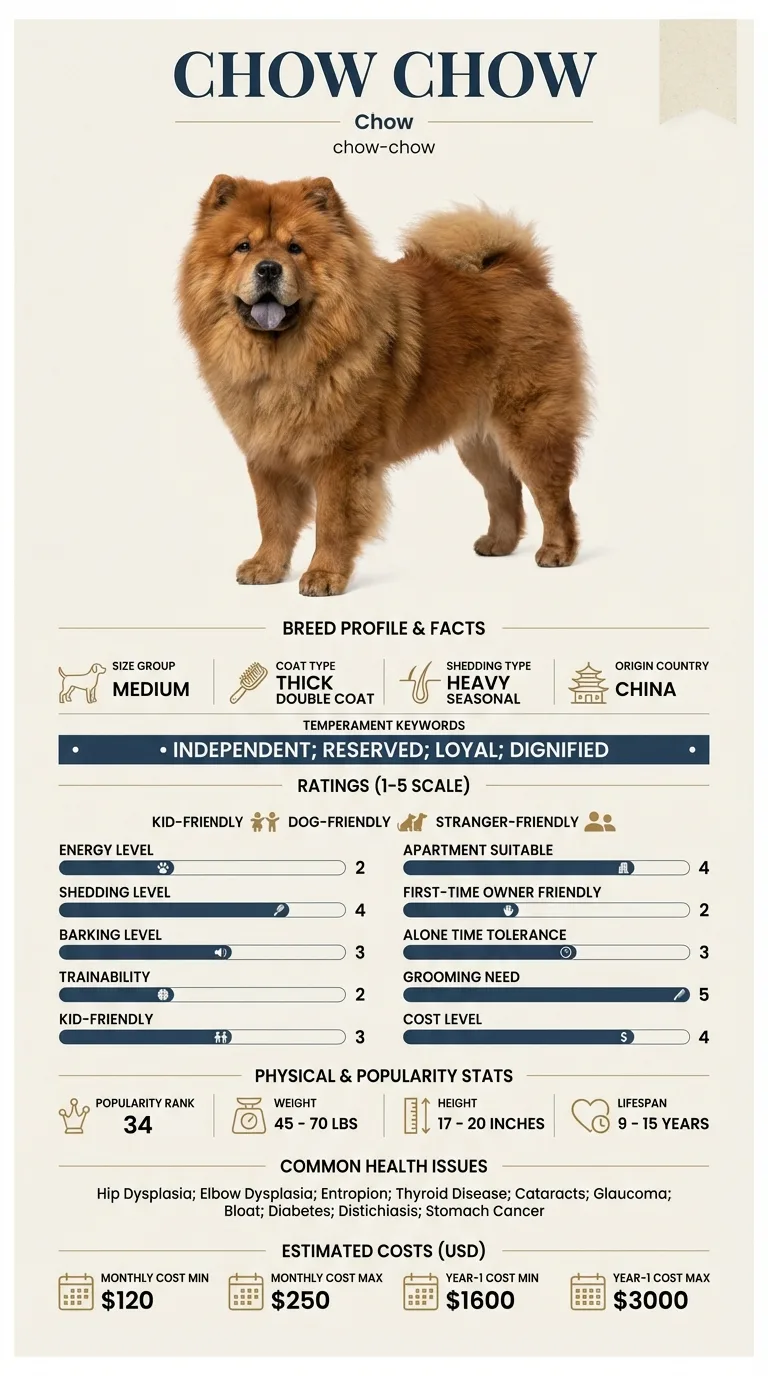
Excess weight is among the most common health problems in pet dogs generally, and the Chow carries specific risk factors: energy and exercise need both rated 2 out of 5, a coat that hides body condition, and an independent temperament that makes owners reluctant to push activity. Combined with documented joint and endocrine issues, it is one of the highest-impact modifiable problems in the breed.
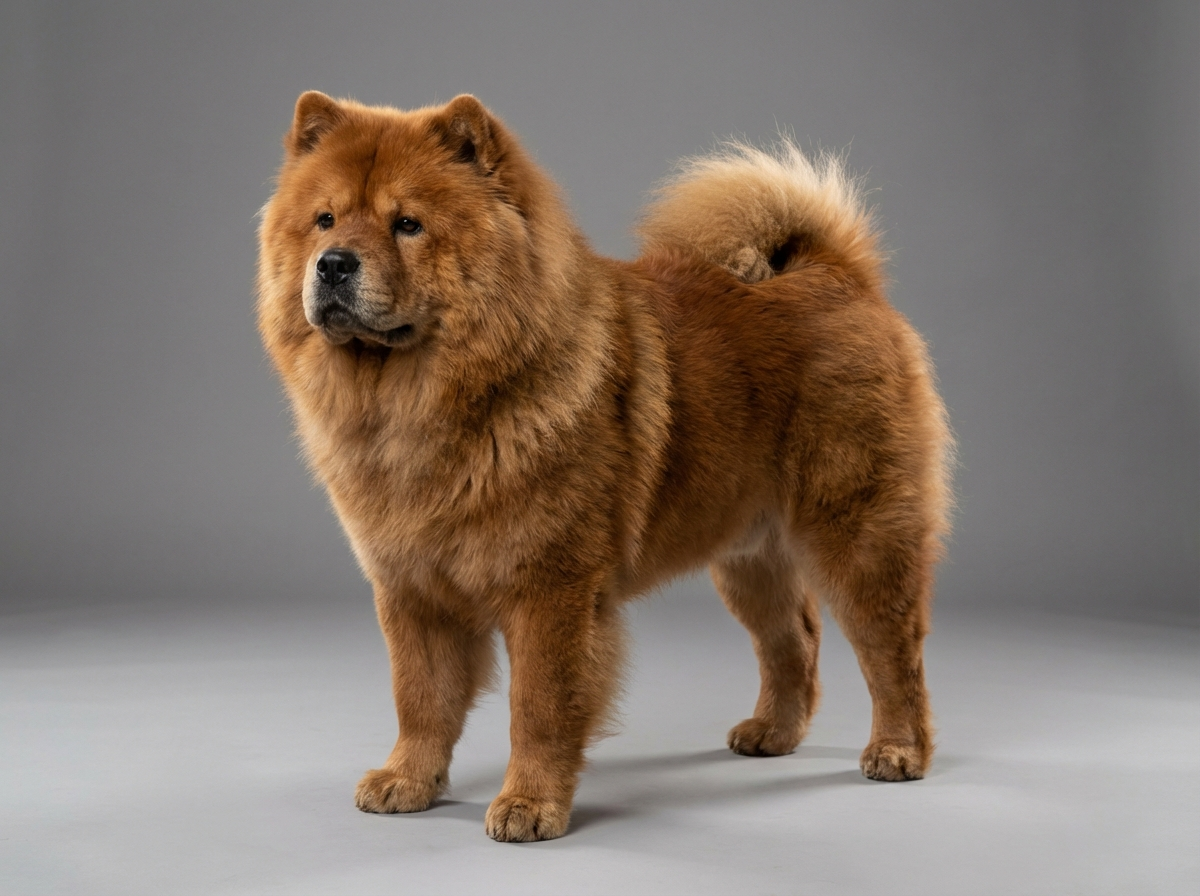
Three things stack. The first is genuine metabolic economy: a breed rated 2 out of 5 for energy and 2 out of 5 for exercise need burns considerably less than a working dog of the same 45 to 70 pound size, so ordinary portions overfeed. The second is invisibility, since a thick double coat with heavy seasonal shedding hides waist, tuck and rib coverage entirely, removing the daily visual feedback that prompts most owners to cut back. The third is temperament: an independent, dignified dog who declines to be jollied into extra exercise gives owners little leverage on the output side of the equation, which throws almost all of the burden onto portion control.
Climate quietly does a lot of damage. In hot regions, safe walking windows shrink to before dawn and after dark for months at a time, and total activity falls without anyone deciding it should. Multi-person households are the other common driver, because several people each giving one small extra thing produces a substantial daily surplus that no individual notices. Free feeding, and food bowls topped up rather than measured, remove the only reliable record of what the dog actually ate.
Book an appointment before starting any serious diet, both to set a target weight and to rule out a medical cause. Ask specifically for a thyroid panel if weight has climbed on unchanged food, particularly alongside coat thinning, skin changes or a heat-intolerant dog newly seeking warmth. Seek same-day care for a heat emergency in an overweight dog, since obesity substantially reduces the margin this breed already lacks: frantic panting that will not settle, unsteadiness, vomiting after warmth or collapse all need immediate cooling and a vet. Also treat sudden abdominal distension with unproductive retching as a surgical emergency, since bloat is documented in this breed. Never use human weight-loss products or appetite suppressants.
See all Chow Chow health problems, which breeds are prone to obesity, or the full Chow Chow breed guide for temperament, exercise needs and ownership costs.
Safe weight loss of one to two percent of body weight per week means a dog needing to lose ten pounds is on a four to six month programme, not a six week one. Expect the first month to show little change while portions are being properly controlled. Recheck weights every two to four weeks with the clinic to keep the plan honest.
Success is ribs findable with flat palms under a thin covering, a stable weight held for a year rather than a low weight touched once, and a dog whose walks have got longer because they have got easier. It is not a visibly slim silhouette, because you will never see one on this breed.
None of this works by eye. All of it takes about ninety seconds a month, and it is the entire early warning system for a breed whose shape is not observable.
Start with heat. This breed is already at the wrong end of the thermal scale, insulated by a double coat and limited by a shortened muzzle. Subcutaneous fat is another insulating layer added beneath a coat that is already excessive for most climates, and it also increases the metabolic heat the body must dump. An overweight Chow has less heat tolerance in a breed that had very little to begin with, and that shows up as summer collapse rather than as slow decline.
Then the joints. Hip dysplasia and elbow dysplasia are the first two entries on this breed's documented health list, and both are diseases of load. Every additional pound is transmitted through joints that already fit poorly, at every step, for the rest of the dog's life. Weight is the single variable an owner fully controls in the management of both.
Then the endocrine system. Diabetes is documented in the breed, and excess body fat drives insulin resistance. Thyroid disease is also documented, and it works in the opposite direction, causing weight gain rather than resulting from it, which is why an unexplained gain in this breed deserves a blood test rather than only a diet.
Finally the practical: a heavier dog with a heavier coat is harder to groom, harder to dry, more prone to matting and skin problems in the folds, and harder for a vet to examine. Weight in this breed compounds everything.

If you think your Chow has obesity, the plan is three steps: write down what you have seen and when it started, book a veterinary appointment rather than waiting for the next flare, and take video of the behaviour or symptom before you go — the thing you are worried about rarely happens in the consulting room. Screening in the parents covers hip dysplasia, elbow dysplasia, entropion.
What the vet visit should produce is a diagnosis and a written plan, not just reassurance: what is being ruled out, what the monitoring interval is, and which signs mean you come back sooner. Ask what the treatment costs across a year rather than per visit, because that is the number that decides whether you are managing this condition or reacting to it.
Between appointments, keep a short log — dates, what you saw, what changed. It is the single most useful thing an owner brings to a follow-up, and for obesity it is often what separates a clear pattern from a guess.
Guo-Guo went in for a booster at six years old. His owner Elif had never thought of him as overweight, and genuinely had not seen any change, because he looked exactly as magnificent as ever. The scale said seventy-four pounds. His recorded weight at three had been sixty-three. The vet took Elif's hands and put them flat on his ribs. She could not feel them. That single demonstration did more than the number had. The plan was unremarkable: everything weighed into one morning container, treats taken from it, walks moved to six in the morning through the summer, and a monthly weigh-in. It took five months to reach sixty-four pounds. What Elif noticed most was not the weight. It was that he stopped stopping halfway through the evening walk, which she had spent two years attributing to his age.
Key takeaway: On a Chow, weight gain is felt rather than seen. Put your hands on the ribs monthly, because your eyes are being shown a coat, not a dog.
The breed range is 45 to 70 pounds at 17 to 20 inches, which is wide because it spans small females to large males. The useful target is not a number from that range but your own dog's lean weight, defined by ribs you can feel with flat hands under a thin covering.
Energy requirement scales with activity as much as size, and this breed is rated 2 out of 5 for both energy and exercise need. A Chow genuinely needs fewer calories than a similarly sized active dog, so portion guidance written for dogs in general routinely overfeeds them.
It can be, and in this breed it is worth checking. Thyroid disease is documented in Chow Chows and causes weight gain on unchanged food, along with coat thinning and heat-seeking behaviour. A blood panel before starting a strict diet is a reasonable ask.
Slowly. Roughly one to two percent of body weight per week is the usual veterinary target, meaning a sixty-five pound dog might lose half a pound to a pound weekly. Faster loss risks muscle rather than fat, and muscle is what a dysplastic joint depends on.
By changing when rather than how much. Several short flat walks at dawn and after dark, plus food-based enrichment indoors, achieves more than trying to increase distance. In this breed the calorie side of the equation does most of the work, because the exercise side has a low ceiling.
On a dog of this size with low energy needs, yes. Measure the daily food allowance in the morning, take training treats out of that same allowance, and count anything else that enters the dog. Household members feeding independently is the most common reason a diet plan quietly fails.
By hand, not by eye. Press flat palms along the ribcage. If you have to push to find ribs, your dog is carrying excess weight the coat is hiding.
Energy and exercise need are both rated 2 out of 5, so calorie requirements are genuinely low, and general feeding guidance overfeeds them.
Yes. Body fat adds insulation beneath an already heavy double coat and increases the heat the dog must dump. Overweight Chows overheat sooner.
About one to two percent of body weight, so roughly half a pound to a pound for a sixty-five pound dog. Faster loss costs muscle.
A one-page prep sheet for this condition: the signs, the questions to ask, what to get priced. Unlocks here.
You get: Vet visit prep sheet
No spam. One-click unsubscribe. See our privacy policy.
Preview page 1 before you decide.