Health
Does a positive thyroid antibody test mean my Chow is ill?
No. It means an autoimmune process is underway. Many dogs stay clinically normal for years, and some never progress to needing treatment.

Quick answer
Does a positive thyroid antibody test mean my Chow is ill?
No. It means an autoimmune process is underway. Many dogs stay clinically normal for years, and some never progress to needing treatment.
A positive antibody test is a forecast, not a diagnosis. Knowing the difference changes what you do next, and whether you do anything at all.
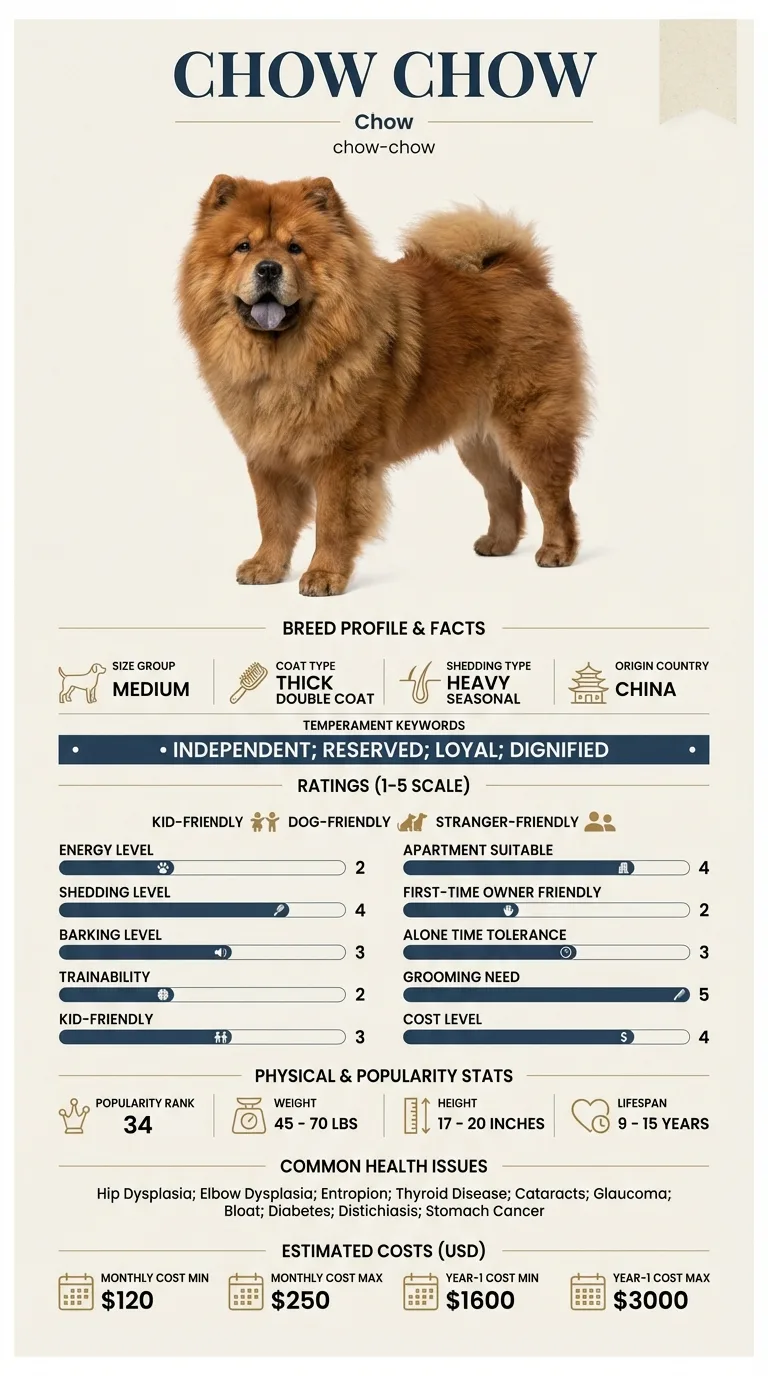
Breeders working through screening panels and trying to decide what a positive result means for a mating, and owners whose apparently well Chow returned an unexpected antibody result on a routine panel.
This guide is not medical advice. If your dog shows pain, sudden behavior change, or worsening symptoms, consult a licensed veterinarian.
Some links may be affiliate links. We may earn a commission at no extra cost to you. We only suggest products we believe are helpful for dog owners.
We research and check what we publish, but we do not warrant that any figure, date, price, or statement is accurate, complete, or current, and we accept no liability for any loss, cost, injury, or other harm arising from the use of this site. Use it as one reference among several. You remain responsible for your own decisions and for your dog's care - confirm anything that matters with a licensed veterinarian or another qualified professional before you act on it. Full disclaimer.
Immune-mediated thyroiditis is the slow autoimmune destruction of thyroid tissue that lies behind a large share of canine hypothyroidism. Because the gland has substantial spare capacity, the process runs silently for years. Owners usually encounter it either as an unexpected screening result in a well dog or as the retrospective explanation for a hypothyroidism diagnosis.
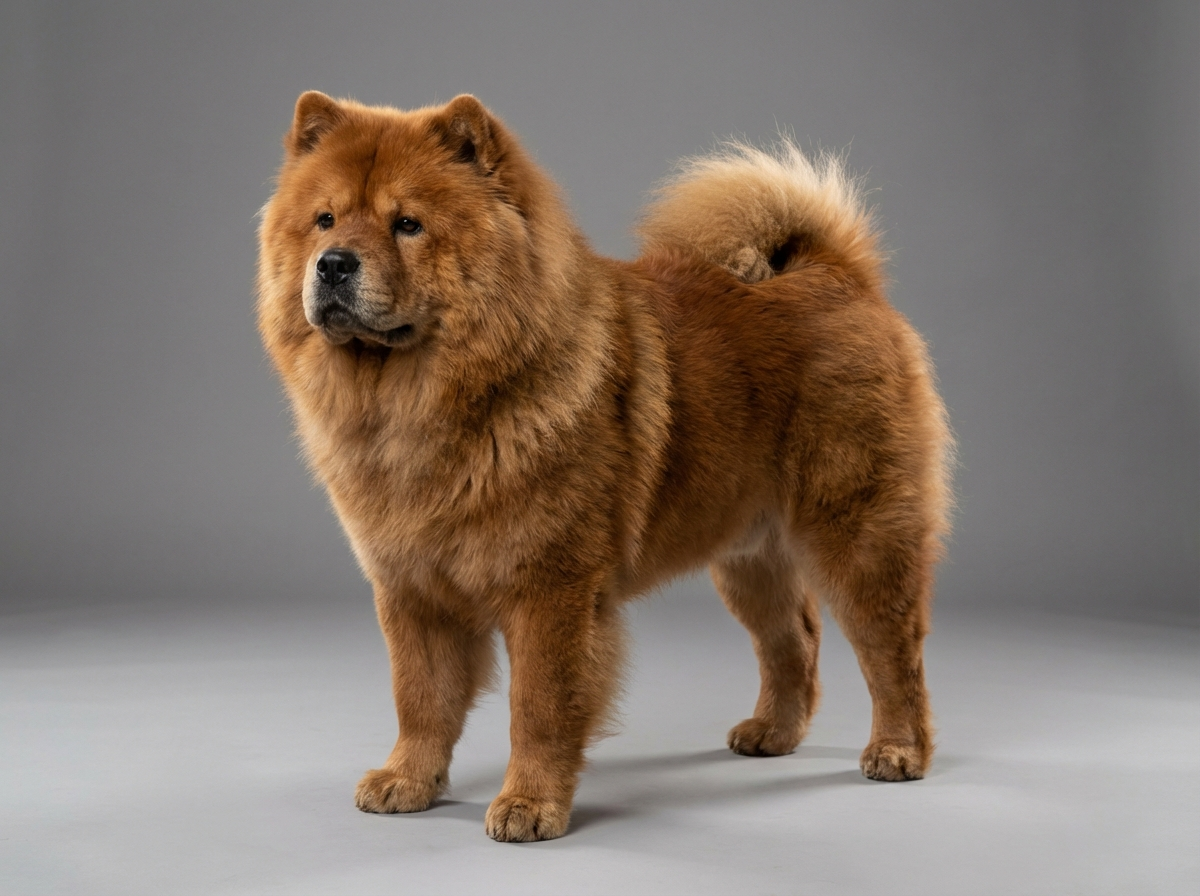
Thyroid disease is among the ten documented Chow Chow health issues, and autoimmune thyroiditis is a principal cause of it in dogs generally. Antibody positivity is more common than clinical disease, because many antibody-positive dogs never lose enough gland tissue to become symptomatic within their nine to fifteen year lifespan.
The Chow's contribution is genetic rather than anatomical. Thyroid disease is on the breed's documented list, and autoimmune thyroiditis is heritable, so the risk travels through pedigrees rather than through body shape. Breed structure matters as well: at popularity rank 34 the Chow has a moderate registered population, and closed studbooks in numerically smaller breeds concentrate whatever autoimmune alleles are present. There is also a detection factor unique to this dog. Because the earliest clinical consequence in a Chow shows up in a heavily groomed 5-out-of-5 coat rather than in behaviour, the transition from silent to clinical often gets noticed by a groomer before an owner.
No environmental cause has been established for canine autoimmune thyroiditis, and it is worth resisting confident claims that diet, vaccination schedules or household chemicals are responsible. What environment does determine is detection. Households that screen annually catch the transition on bloodwork; those that never test learn about it when the coat fails. Access to a lab that runs a full thyroid panel rather than a single T4 also shapes what an owner is able to find out.
This condition rarely produces emergencies, and the honest answer for a well antibody-positive dog is that a yearly appointment is enough. Book sooner if the coat thins or dulls, weight climbs on unchanged food, skin darkens and thickens in the groin or armpits, ear infections start recurring, or a heat-intolerant Chow begins seeking warm places. Separately, and regardless of thyroid status, treat collapse, severe weakness, laboured breathing, a distended painful abdomen or unproductive retching as same-day emergencies, since bloat is documented in this breed and has nothing to do with the thyroid. Do not start any hormone or supplement on the basis of an antibody result alone.
See all Chow Chow health problems, which breeds are prone to immune mediated thyroiditis, or the full Chow Chow breed guide for temperament, exercise needs and ownership costs.
The autoimmune process typically unfolds across two to five years or longer before hormone levels fall. Antibody status can change over that period in either direction, which is why annual testing beats a one-off. Once clinical hypothyroidism develops, treatment is daily and permanent.
For a pet, success is catching the transition on a scheduled blood test rather than on a failing coat. For a breeder, it is a set of honest, dated results that let the next generation be planned with real information instead of assumption.
Understanding which stage a result represents is the whole point of testing. The same antibody titre means something very different in a two-year-old breeding prospect and a nine-year-old pet.
Autoimmune thyroiditis is heritable, which is why breed screening programmes exist for it. The practical difficulty is that testing a young dog once tells you very little. Antibodies most commonly appear between about two and five years of age, so a clear result at fourteen months is close to meaningless and a clear result at four is worth having. Serial testing, roughly annually through the breeding years, is what makes the data usable.
A positive result in an otherwise healthy dog does not automatically end a breeding career, and treating it as a disqualification has a cost of its own. The Chow is a numerically modest breed at popularity rank 34, and removing every antibody-positive dog from a limited gene pool narrows it further, which risks concentrating other problems. The reasonable position most breed health committees land on is that positive dogs are bred selectively if at all, never to another positive, and that results are shared honestly.
For a pet owner the calculus is simpler. A positive antibody test in a well dog changes nothing today. It changes what you watch for: coat quality, weight, and a yearly panel so that the transition to genuine hypothyroidism is caught by a blood test rather than by a bald tail.

Wren was tested at three as part of a breeding panel and came back antibody positive with entirely normal hormone levels. Her breeder, Colette, had been ready to spay her and retire her from the programme that week. Her vet advised against a hasty decision and suggested annual panels. Wren was bred twice to antibody-negative dogs, and Colette disclosed the result to every puppy buyer in writing. Wren's hormone levels stayed normal for five more years. At eight her total T4 fell and her thyroid stimulating hormone rose, and she started replacement medication. Her coat had begun thinning at the tail about four months earlier, which Colette had already photographed and flagged.
Key takeaway: A positive antibody result predicts a future, not a present. Serial testing and honest disclosure did more good here than an immediate spay would have.
No. It is one of the main causes of it. Thyroiditis is the ongoing autoimmune destruction; hypothyroidism is the hormone deficiency that eventually results. A dog can have the first for years without the second.
For a pet, rarely. It will not change management, since there is no treatment that stops the process. For a breeding dog it is worth doing, repeated annually through the years when antibodies typically appear, because the information is for the next generation rather than for this dog.
There is no established treatment that halts thyroid destruction in dogs. Immune suppression is not used for this, because the gland's function can be replaced cheaply and safely with a daily hormone, which is a far better trade than long-term immunosuppression.
Most commonly between two and five years, which is why a single clear test on a young dog carries little weight. A dog tested only at one year has effectively not been screened.
Not in an older dog. Late in the process antibodies can fade as the target tissue disappears, so a hypothyroid senior with a negative titre may still have had an autoimmune cause all along.
Autoimmune conditions do sometimes cluster within individuals and families across breeds. What matters practically is that a dog with one confirmed autoimmune process deserves a lower threshold for investigating other unexplained signs, rather than an assumption they are unrelated.
No. It means an autoimmune process is underway. Many dogs stay clinically normal for years, and some never progress to needing treatment.
Nothing today, beyond scheduling a yearly thyroid panel and photographing the coat so change becomes measurable.
Annually from about two years through the breeding career, because antibodies most often appear between two and five and a single early clear test proves little.
No responsible programme does that. Positive to positive concentrates the heritable risk in exactly the direction breeders are trying to avoid.
A one-page prep sheet for this condition: the signs, the questions to ask, what to get priced. Unlocks here.
You get: Vet visit prep sheet
No spam. One-click unsubscribe. See our privacy policy.
Preview page 1 before you decide.