Health
Where does allergic itching show on a Chow Chow?
Feet, ear canals, muzzle and eyes, armpits, groin and belly. Track licking and scratching by location and time of day, since you cannot see the skin.

Quick answer
Where does allergic itching show on a Chow Chow?
Feet, ear canals, muzzle and eyes, armpits, groin and belly. Track licking and scratching by location and time of day, since you cannot see the skin.
You will not spot a red belly on a Chow. You will spot a dog licking one front paw every evening, and that is the same information.
Owners of Chows who chew their feet, shake their heads, or have had repeated ear infections, and anyone who has already tried three diets without a plan.
This guide is not medical advice. If your dog shows pain, sudden behavior change, or worsening symptoms, consult a licensed veterinarian.
Some links may be affiliate links. We may earn a commission at no extra cost to you. We only suggest products we believe are helpful for dog owners.
We research and check what we publish, but we do not warrant that any figure, date, price, or statement is accurate, complete, or current, and we accept no liability for any loss, cost, injury, or other harm arising from the use of this site. Use it as one reference among several. You remain responsible for your own decisions and for your dog's care - confirm anything that matters with a licensed veterinarian or another qualified professional before you act on it. Full disclaimer.
Allergic skin disease is an immune overreaction to environmental particles, flea saliva or food proteins, producing itch in a characteristic distribution across the feet, ears, face and underside. It is diagnosed by systematic exclusion rather than by a single test, and it is managed for life rather than cured. On a Chow Chow, the coat converts it from a visible problem into a behavioural one.
Allergy is not among the breed's ten documented health issues, so the Chow is not unusually predisposed. It is nonetheless one of the most common reasons any dog is presented for skin problems. What is breed-specific is the difficulty: dense coat delays detection, complicates topical treatment and makes flea infestation nearly impossible to see.
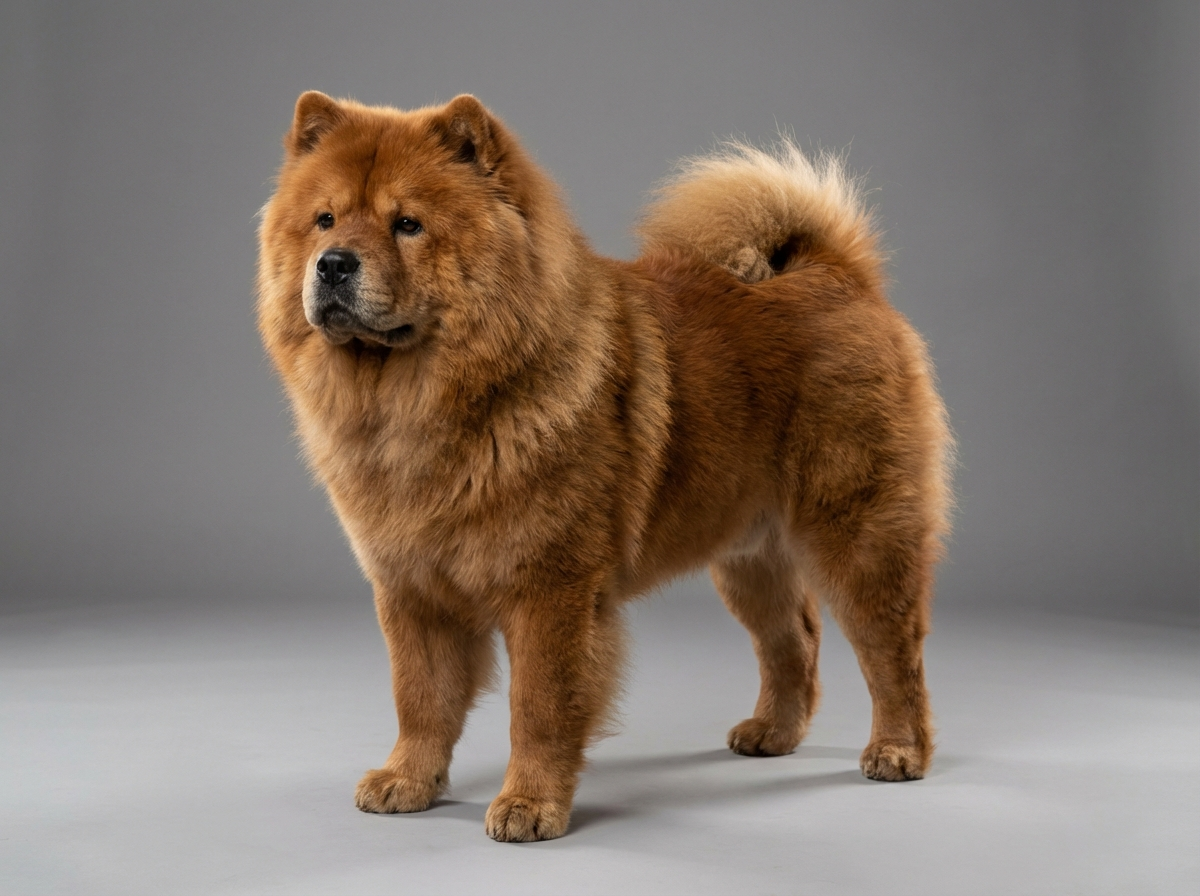
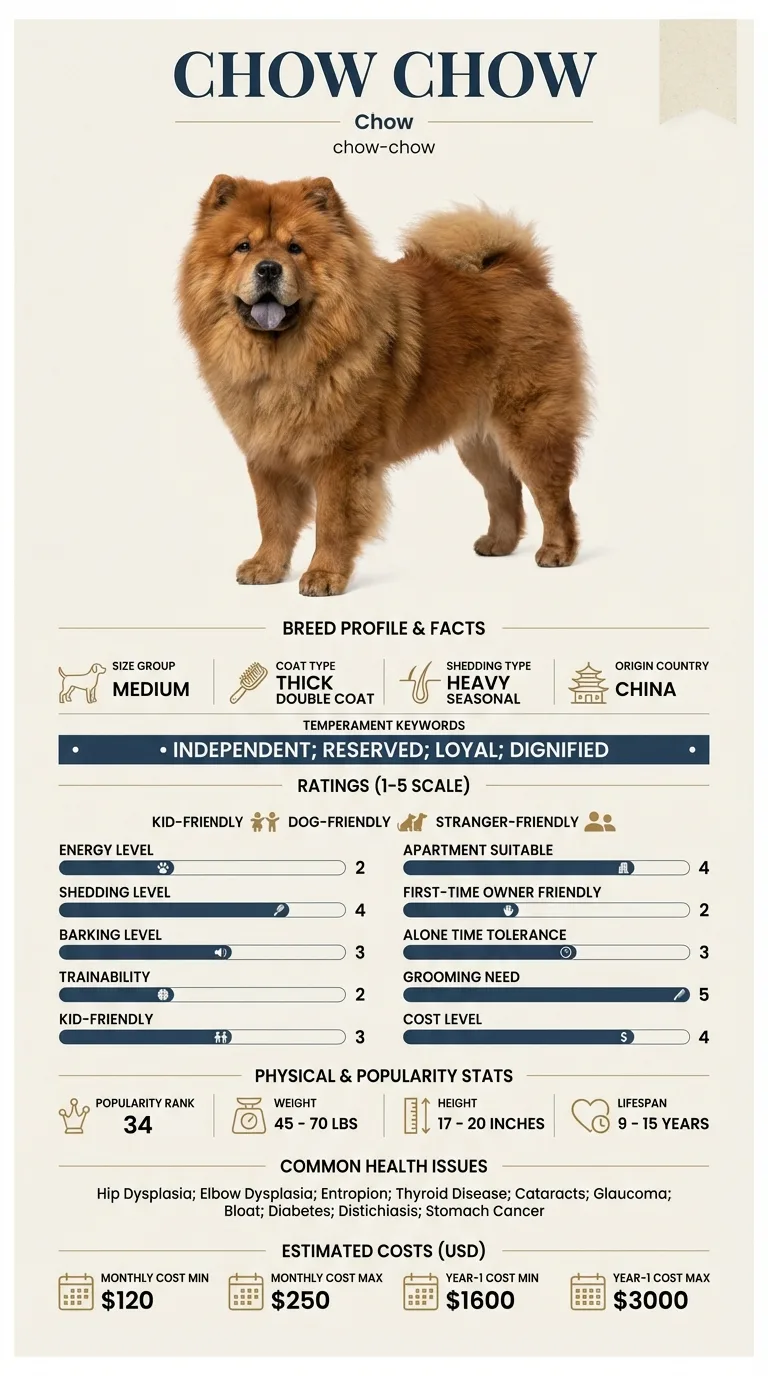
The Chow's immune system is not documented as unusually reactive, so the honest breed contribution here is practical rather than pathological. A coat rated 5 out of 5 for grooming demand hides every visual sign of allergy: redness, scaling, thinning and self-trauma are all concealed until they are severe. That same coat prevents topical treatment reaching skin unless it is worked in deliberately, and it makes fleas effectively invisible. An independent, dignified temperament means a Chow often licks and chews quietly and alone rather than making a scene, so the behaviour is noticed weeks later than it would be in a demonstrative breed. Documented thyroid disease provides an internal route to a very similar picture.
Season and geography drive most environmental allergy, with pollen loads determining when a dog flares. Indoor allergens matter year round, particularly house dust mites in carpeted, humid homes. Bathing practice cuts both ways: appropriate medicated bathing removes allergens from the coat and helps, while over-bathing with unsuitable products strips the skin barrier and makes things worse. Humidity contributes twice, by encouraging mould and by keeping a dense coat damp against inflamed skin.
Book an appointment for persistent licking, chewing or head shaking, for any ear that smells or discharges, or for hair loss and crusting you find while grooming, and ask for parasite control and secondary infection to be addressed before any diet trial begins. Seek same-day care for a rapidly enlarging moist painful patch, since hot spots escalate within hours on a double coat, and for facial swelling, hives, vomiting or difficulty breathing after a sting, vaccination or new food, which can indicate a severe acute allergic reaction and is an emergency. Never use human antihistamines or steroid creams without veterinary direction, and never apply a leftover ear preparation, since some are harmful if the eardrum is damaged.
See all Chow Chow health problems, which breeds are prone to skin allergies, or the full Chow Chow breed guide for temperament, exercise needs and ownership costs.
Secondary infections clear in three to four weeks. A proper elimination diet trial takes eight to twelve weeks plus a challenge phase. Immunotherapy, where chosen, typically takes six to twelve months to show its full effect. This is a long process, and owners who expect answers in a fortnight abandon it before it can work.
Success is control, not cure. A good outcome is a dog who licks occasionally rather than nightly, whose ears stay clear between routine cleans, and who has flares that are shorter and milder than they used to be. Expecting the allergy to disappear leads to endless diet changes and no progress.
Track behaviour and location rather than appearance. Write down which body part and roughly what time of day, for two weeks, and the pattern usually declares itself.
Food allergy accounts for a minority of allergic skin disease in dogs, and it is worth investigating properly rather than repeatedly and badly. A meaningful elimination trial uses a single novel protein the dog has genuinely never eaten, or a hydrolysed diet where the protein has been broken down small enough that the immune system no longer recognises it. It runs for eight to twelve weeks, and during that period the dog eats nothing else at all. No treats, no chews, no flavoured medication, no scraps, no toothpaste.
The reason most attempts fail is the exclusivity, not the diet. A single dental chew or one child feeding a crust invalidates the whole trial, and the owner concludes food is not the problem when in fact the question was never asked. Multi-person households need explicit agreement before day one.
The second reason is duration. Skin takes weeks to settle even after the trigger is removed, so a two-week trial tells you nothing. The third is the challenge phase, which is skipped almost universally: reintroducing the original food to see whether signs return is what actually confirms the diagnosis, and without it you have a suspicion rather than an answer.
One breed-specific practicality: this is a dog with heavy grooming demands and a dense coat, and topical treatments and medicated shampoos are considerably harder to apply effectively. Reaching skin under that coat requires working the product right down rather than lathering the surface, which takes time most owners are not warned about.

Peony had been through four different foods in fourteen months, each abandoned after three or four weeks when her paw licking did not stop. Her owner Marcus was convinced she was allergic to everything. Her vet asked one question: what else was she eating. The answer included a daily dental chew, training treats from a bag in the hall, and whatever Marcus's father gave her on Sunday visits. None of the four trials had ever been an elimination trial. The fifth attempt was different. A hydrolysed diet, twelve weeks, the same food used as training treats, the dental chew stopped, and a phone call to Marcus's father before day one. Peony's paw licking stopped in week seven. The challenge phase in week thirteen brought it back within four days, which is what finally made the diagnosis real.
Key takeaway: A food trial is not a food. It is twelve weeks of complete exclusivity, agreed by everyone who might feed the dog, followed by a deliberate challenge. Anything less answers no question at all.
Allergic skin disease is not among the ten documented Chow Chow health issues, so it is not a breed hallmark in the way hip dysplasia or entropion are. Allergies are common across dogs generally, and what is distinctive here is how much harder the dense coat makes both detection and treatment.
Environmental allergy typically begins between about one and three years of age. A dog whose itching starts at eight is more likely to have something else going on, including thyroid disease, which is documented in this breed and impairs skin barrier function.
Frequently, yes. The ear canal is skin, and in many allergic dogs it is the earliest affected site. A pattern of infections that clear on treatment and return within weeks should prompt an allergy workup rather than another course of drops.
Slowly and deliberately. Medicated shampoo has to reach skin, which means working it through the undercoat in sections rather than lathering the outer coat, leaving it in contact for the stated time, rinsing thoroughly, and then drying completely. An incompletely dried double coat causes its own skin problems.
Enormously, and you would not see them in this coat regardless. Flea allergy dermatitis is driven by a reaction to saliva, so a small number of bites causes intense itching. Rigorous year-round parasite prevention is the first step of any allergy workup, not an afterthought.
Ruling out parasites and infection first, then a properly conducted elimination diet trial, then investigation of environmental allergy if signs are seasonal or persist. Allergy testing is used to select immunotherapy, not to diagnose, which is a common misunderstanding worth clearing up with your vet.
Feet, ear canals, muzzle and eyes, armpits, groin and belly. Track licking and scratching by location and time of day, since you cannot see the skin.
Eight to twelve weeks with absolutely nothing else eaten. One treat or one flavoured chew invalidates the whole thing.
Often. The ear canal is skin and is a common first site. Repeated infections warrant an allergy workup rather than repeated drops.
Usually because it never reached skin. On a double coat it has to be worked down in sections and left in contact, then rinsed and dried completely.
A one-page prep sheet for this condition: the signs, the questions to ask, what to get priced. Unlocks here.
You get: Vet visit prep sheet
No spam. One-click unsubscribe. See our privacy policy.
Preview page 1 before you decide.