Health
What is the classic sign?
Repeated unproductive retching - the dog tries to vomit and nothing comes up - with a hard, swelling abdomen and rising distress. Go immediately.

Quick answer
What is the classic sign?
Repeated unproductive retching - the dog tries to vomit and nothing comes up - with a hard, swelling abdomen and rising distress. Go immediately.
Nobody makes a good financial decision at two in the morning with a dying dog on a consulting table. The preparation that matters happens years earlier.
Owners weighing pet insurance and not sure what it is really for, people who have just been handed an estimate in an emergency room, and anyone who wants to know how seriously a small brachycephalic breed needs to take this particular risk.
This guide is not medical advice. If your dog shows pain, sudden behavior change, or worsening symptoms, consult a licensed veterinarian.
Some links may be affiliate links. We may earn a commission at no extra cost to you. We only suggest products we believe are helpful for dog owners.
We research and check what we publish, but we do not warrant that any figure, date, price, or statement is accurate, complete, or current, and we accept no liability for any loss, cost, injury, or other harm arising from the use of this site. Use it as one reference among several. You remain responsible for your own decisions and for your dog's care - confirm anything that matters with a licensed veterinarian or another qualified professional before you act on it. Full disclaimer.
GDV is a surgical emergency in which the stomach distends and twists, cutting off its own blood supply and obstructing the return of blood to the heart. It is rare in Boston Terriers, whose compact build places them well outside the classic risk group, but it is fatal without prompt surgery and expensive to treat. For most Boston owners the practical value of this page is knowing what the emergency looks like and what the financial decision involves before they are standing in front of it.
Rare in this breed. GDV incidence rises sharply with chest depth and body size, and a 12 to 25 pound Boston sits at the low end of both. Swollen abdomens in Bostons are far more often gas from swallowed air, dietary indiscretion or reflux than true volvulus - but the two cannot be told apart without examination.
The anatomy that drives GDV - a deep, narrow chest giving the stomach room to swing - is not the Boston Terrier's anatomy. What this breed does bring is aerophagia: a dog working air past a narrowed airway swallows a large volume of it, and a comical, food-motivated dog that inhales dinner in twenty seconds swallows more still. The result is a genuinely distended abdomen that mimics the early stage of the emergency.
Feeding routine is the main lever - one large daily meal, competitive eating alongside another dog, or a bowl emptied in seconds all increase gas load. Heat and excitement drive faster, deeper breathing and therefore more air swallowing. Households where a dog is fed and then immediately taken out to play compress everything into the same short window.
Go immediately, at any hour, for repeated unproductive retching, a visibly distended or hard abdomen, restlessness and inability to settle, drooling, pale gums, or collapse. Do not wait to see whether it passes and do not attempt anything at home first - this is the one abdominal presentation where minutes genuinely matter. Phone the hospital while you are getting into the car so they can prepare. For a less dramatic swollen belly in a dog that is otherwise bright and comfortable, a same-day appointment is still the right call rather than watchful waiting.
See all Boston Terrier health problems, which breeds are prone to bloat gastric dilatation volvulusgdv, or the full Boston Terrier breed guide for temperament, exercise needs and ownership costs.
GDV is a matter of hours from first sign to a life-threatening state. Dogs that reach surgery early are usually hospitalised for two to four days and back to normal within two to three weeks. Financially, the whole event resolves inside a week, which is precisely why it defeats owners who have not planned in advance.
For nearly every Boston owner, success is never using any of this - and instead being the person who took a swollen belly to the clinic at 11pm, was told it was gas, and paid for a consultation rather than a funeral.
GDV estimates look alarming partly because owners cannot see what is inside them. Understanding the components makes the conversation with the emergency team a great deal easier.
It is worth being straight about this rather than frightening people for engagement. GDV is overwhelmingly a disease of large, deep and narrow-chested dogs - Great Danes, Weimaraners, Standard Poodles, Setters. The shape of the chest allows the stomach room to rotate.
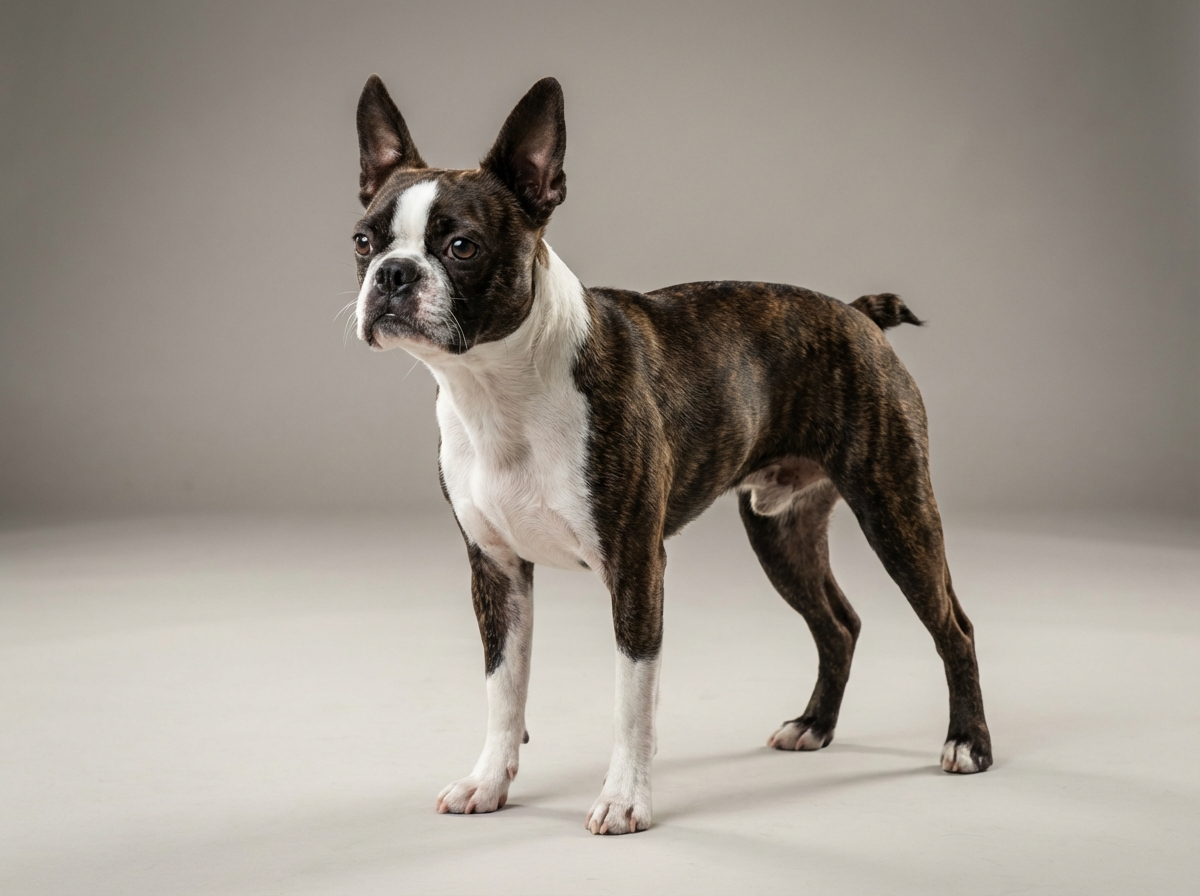
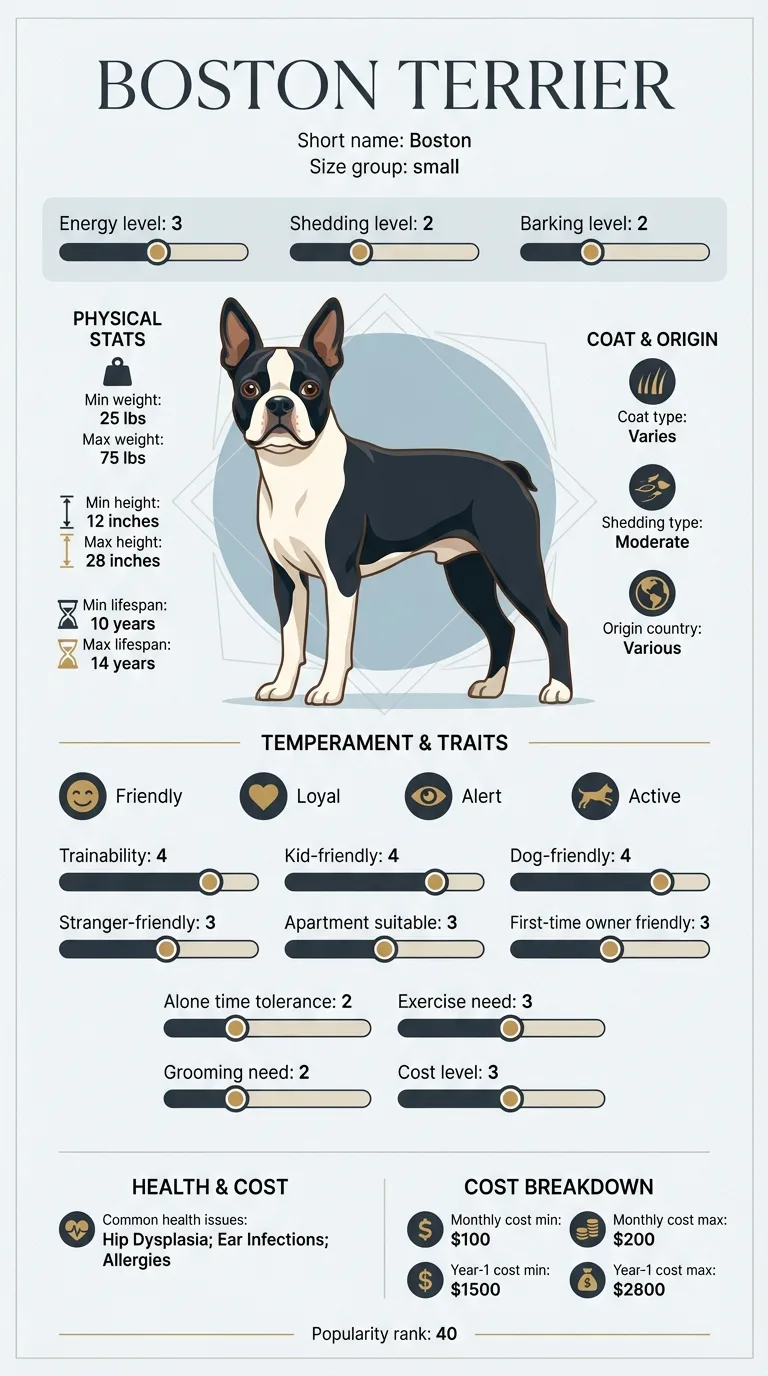
A Boston Terrier is 12 to 25 pounds and 15 to 17 inches, with a compact, comparatively broad body. It is not in the classic risk group, and GDV is not on the breed's documented health list, which centres on brachycephalic airway syndrome, patellar luxation, cataracts, corneal ulcers and deafness.
What Bostons do get, and frequently, is a distended, uncomfortable abdomen from swallowed air. A dog that breathes against a restricted airway swallows a great deal of it, particularly when it eats fast or has been excited. That looks like bloat, worries owners badly, and is a different problem with a different answer.
The practical position is this: your Boston is unlikely to have true GDV, but you cannot tell the difference from the sofa, and the consequence of being wrong is fatal. Get it looked at, and let the fact that it is usually air and not torsion be a relief you receive at the clinic rather than a bet you make at home.

If you think your Boston has bloat (gastric dilatation-volvulus/gdv), the plan is three steps: write down what you have seen and when it started, book a veterinary appointment rather than waiting for the next flare, and take video of the behaviour or symptom before you go — the thing you are worried about rarely happens in the consulting room. Screening in the parents covers brachycephalic airway syndrome (boas), patellar luxation, cataracts.
What the vet visit should produce is a diagnosis and a written plan, not just reassurance: what is being ruled out, what the monitoring interval is, and which signs mean you come back sooner. Ask what the treatment costs across a year rather than per visit, because that is the number that decides whether you are managing this condition or reacting to it.
Between appointments, keep a short log — dates, what you saw, what changed. It is the single most useful thing an owner brings to a follow-up, and for bloat (gastric dilatation-volvulus/gdv) it is often what separates a clear pattern from a guess.
Renata's Boston, Bruno, had bolted his dinner and then spent an hour trying to be sick without producing anything. His belly looked tight. She had read about bloat and drove to the emergency hospital rather than waiting for morning. He was triaged within five minutes and X-rayed within twenty. The stomach was distended but had not rotated. The diagnosis was gastric dilatation from swallowed air on top of a meal eaten far too fast, and Bruno went home the same night on a much smaller bill than the one Renata had braced for. What changed afterward was the bowl. Bruno now eats from a puzzle feeder in three sittings, and takes four minutes over a meal he used to finish in twenty seconds.
Key takeaway: The consultation fee for a false alarm is the cheapest part of this entire subject. Go, and let the good news be delivered by someone with an X-ray machine.
Hours. There is no version of this condition that safely waits until morning. Survival rates are strongly linked to how fast the dog reaches a hospital that can operate.
Most lifetime policies cover emergency surgery for a condition that was not pre-existing, but exclusions, annual limits and waiting periods vary enormously. Read what your policy pays per condition per year, not just the headline figure.
Many hospitals offer third-party financing and some offer deposits with staged payment. Ask at the point of the estimate rather than after, and ask what the difference in outcome is between the options offered.
Say so immediately and plainly. The emergency team can only work with the information they have, and they may know of charitable funds, lower-cost options or a referral route. Silence removes choices that might exist.
If a Boston genuinely has GDV, surgery is the only treatment that works, and dogs that reach surgery early have good survival rates. The uncomfortable part of the question is honestly whether the diagnosis is GDV at all, which is why assessment comes before any financial decision.
Recurrence is uncommon once the stomach has been tacked to the body wall during surgery, which is why that step is standard rather than optional.
Budget for emergencies generally rather than for GDV specifically. For a Boston, an airway crisis, an eye emergency or a spinal event are all more probable calls on the same fund.
The early signs are set out in the sections above, and they are the reason to book a veterinary appointment rather than wait. Bloat (gastric Dilatation-volvulus/gdv) in Bostons is diagnosed by a vet, not from a symptom list, and the sooner it is on record the more options remain open.
The early signs are set out in the sections above, and they are the reason to book a veterinary appointment rather than wait. Bloat (Gastric Dilatation-Volvulus/GDV) in Boston Terriers is diagnosed by a vet, not from a symptom list, and the sooner it is on record the more options remain open.
Repeated unproductive retching - the dog tries to vomit and nothing comes up - with a hard, swelling abdomen and rising distress. Go immediately.
Commonly quoted between roughly fifteen hundred and seventy-five hundred dollars depending on severity, region and how much tissue damage there is by the time surgery starts.
No. GDV is a disease of large, deep-chested dogs. It is not on the Boston's documented health list, though it is not impossible either.
The address of the nearest 24-hour hospital, your policy number, and a rough idea of what you could authorise without needing to phone anyone.
A one-page prep sheet for this condition: the signs, the questions to ask, what to get priced. Unlocks here.
You get: Vet visit prep sheet
No spam. One-click unsubscribe. See our privacy policy.
Preview page 1 before you decide.