Costs
What's the typical cost range for GDV surgery?
Commonly somewhere between $1,500 and $7,500, depending on how early treatment started, whether tissue was damaged, and where the surgery was performed.

Quick answer
What's the typical cost range for GDV surgery?
Commonly somewhere between $1,500 and $7,500, depending on how early treatment started, whether tissue was damaged, and where the surgery was performed.
GDV surgery bills for a dog this size commonly land somewhere between $1,500 and $7,500, and the exact number depends on how fast you got to the vet and how complicated the surgery turns out to be.
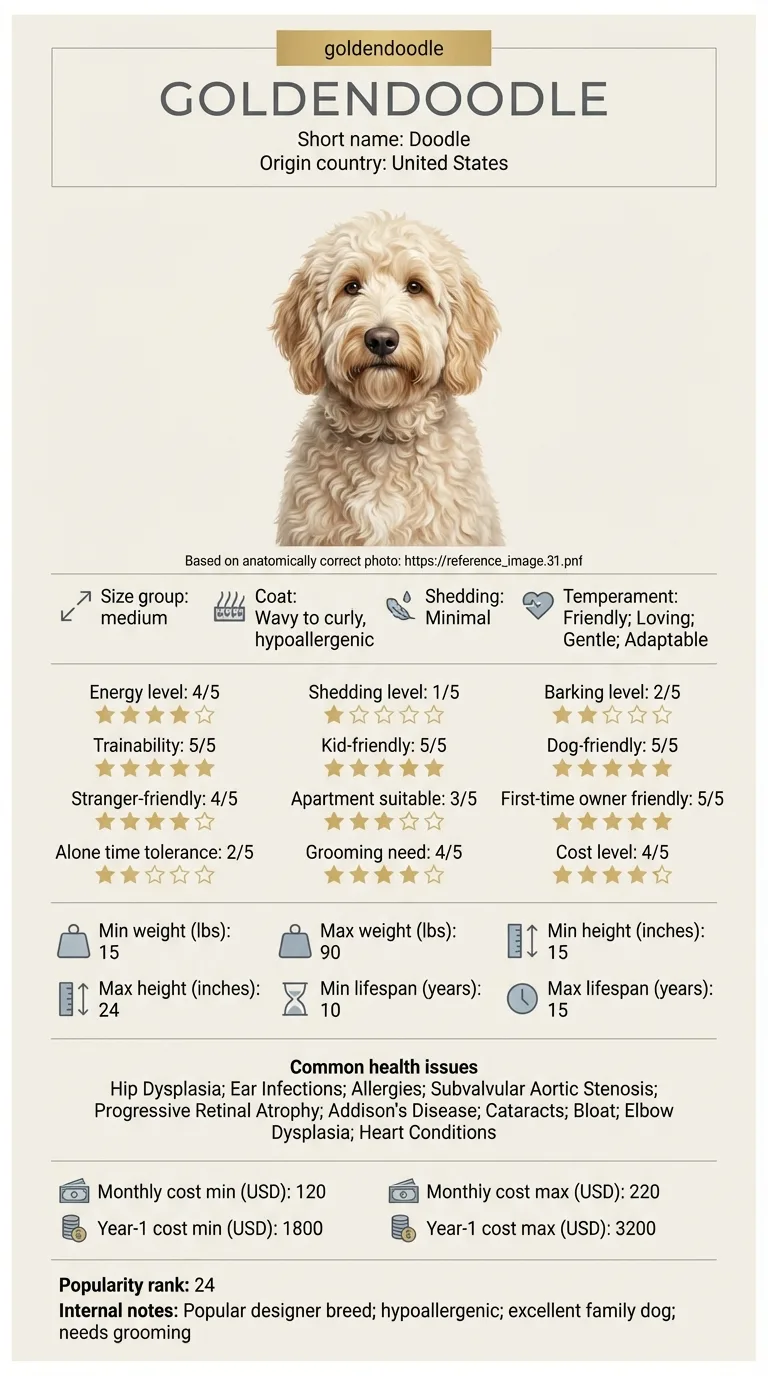
This hits owners of larger, standard-size Goldendoodles hardest, since body size is a real factor in GDV risk, and it's especially stressful for owners without an emergency fund or pet insurance who have to make a fast financial decision under pressure.
This guide is not medical advice. If your dog shows pain, sudden behavior change, or worsening symptoms, consult a licensed veterinarian.
Some links may be affiliate links. We may earn a commission at no extra cost to you. We only suggest products we believe are helpful for dog owners.
We research and check what we publish, but we do not warrant that any figure, date, price, or statement is accurate, complete, or current, and we accept no liability for any loss, cost, injury, or other harm arising from the use of this site. Use it as one reference among several. You remain responsible for your own decisions and for your dog's care - confirm anything that matters with a licensed veterinarian or another qualified professional before you act on it. Full disclaimer.
Check this first
There's no version of GDV that waits until morning. A distended, hard, drum-tight abdomen, unproductive retching, restlessness, drooling, and a rapid decline in energy are the signs, and every one of them means going to an emergency vet immediately, regardless of what time it is or what it costs. Delaying treatment to 'see if it passes' doesn't just risk your dog's life — it also typically increases the eventual bill, since a longer delay usually means more tissue damage and a more complicated surgery.
Being financially prepared before an emergency happens is the realistic way to handle this cost, not deciding in the moment. That can mean a dedicated emergency fund, pet insurance with an active policy well before any symptoms appear, or a pre-arranged plan with your vet or clinic like CareCredit. Clinics can usually give you a rough estimate range before you commit, and it's reasonable to ask for one even in an urgent situation — most emergency vets are used to this conversation.
If cost is a genuine barrier in the moment, ask the clinic directly about payment plans, care credit options, or whether a nearby veterinary school or nonprofit clinic could help; don't assume there's no path forward before asking.
If any of these apply, call your vet or an emergency clinic now. The rest of this page is for the cases that are not an emergency.
Gastric dilatation-volvulus is a life-threatening emergency where the stomach fills with gas and twists on itself, cutting off blood supply. Treatment is always surgical once the stomach has twisted, and the total bill — commonly ranging from around $1,500 to over $7,500 — depends heavily on how quickly the dog was brought in and how much tissue damage had already occurred.
Bloat is a documented health concern for this breed, with larger, deeper-chested standard-size dogs generally considered at higher relative risk than smaller mixes, though any Goldendoodle can be affected.
Bloat is listed among this breed's documented health issues, and body size plays a meaningful role — a larger standard-size Goldendoodle has more physical space for the stomach to distend and rotate than a smaller mini variant, though the condition isn't exclusive to any one size within the breed.
Fast eating, large single meals, exercise too close to mealtime, and feeding-related stress or excitement are the environmental and behavioral factors most strongly associated with triggering an episode.
This is always an emergency, not a scheduled-visit situation — any distended, hard abdomen with unproductive retching and restlessness needs an emergency vet immediately. Talk to your regular vet in advance, before any emergency, about whether preventive gastropexy makes sense for your specific dog.
See all Goldendoodle health problems, which breeds are prone to bloat gastric dilatation volvulusgdv, or the full Goldendoodle breed guide for temperament, exercise needs and ownership costs.
Emergency surgery and initial hospitalization typically span one to several days depending on complications, with a full recovery at home generally taking two to four weeks before returning to normal activity.
Success looks like a dog that survives the emergency, recovers from surgery without complications, and — with a gastropexy in place — has a substantially reduced risk of this happening again, rather than a guarantee it will never recur in any form.
The bill for a GDV emergency varies enormously based on a handful of specific factors.
When Marcus's standard Goldendoodle, Bear, suddenly started retching without producing anything and pacing restlessly, Marcus rushed him to the emergency vet. An X-ray confirmed GDV, and the initial estimate for surgery was around $3,000. During surgery, the vet found a section of stomach wall with compromised blood supply that needed to be removed, and Bear needed two extra nights of hospitalization for heart rhythm monitoring, a known complication after GDV. The final bill came to just over $6,500. Marcus had pet insurance in place from Bear's puppy year, which covered a large portion, and he later added a gastropexy note to Bear's file so it would be discussed for any future abdominal surgery.
Key takeaway: The cost of a GDV emergency can shift dramatically once surgery is underway, which is exactly why financial preparation — insurance or savings — needs to happen before symptoms ever start, not during the emergency itself.
It depends heavily on how early the dog was treated, whether the stomach had already twisted, whether any stomach tissue had to be removed, and whether the treatment happened at an emergency facility versus a regular clinic.
Many policies do cover GDV as an unexpected illness, provided the policy was active before symptoms started and bloat isn't excluded as a pre-existing condition for your specific dog. Check your policy's details before you need it.
A gastropexy surgically attaches the stomach to the abdominal wall to prevent it from twisting. It significantly reduces the risk of the life-threatening twist (volvulus) but doesn't eliminate the possibility of stomach dilatation occurring.
It's a reasonable conversation to have with your vet, particularly for a larger, standard-size dog or one with a family history of bloat, and it's sometimes done at the same time as a spay or neuter to avoid a second anesthesia event.
A standalone preventive gastropexy is a fraction of the cost of emergency GDV surgery, since it's a planned procedure without the complications of shock, tissue damage, or after-hours emergency pricing.
Ask the clinic directly about payment plans, financing options like CareCredit, or nearby veterinary schools and nonprofit clinics. Being upfront about budget constraints lets the vet team help you find options rather than assuming there are none.
Without a gastropexy, recurrence is a real risk. With a gastropexy performed during the emergency surgery, the risk of the stomach twisting again drops substantially, which is why many vets recommend it be done at the same time.
Commonly somewhere between $1,500 and $7,500, depending on how early treatment started, whether tissue was damaged, and where the surgery was performed.
Yes — insurance needs to be active before symptoms appear to cover a GDV emergency, so earlier enrollment gives more financial protection.
Untreated GDV is commonly fatal within hours, which is why it's treated as an absolute emergency regardless of cost or timing.
Feeding smaller, more frequent meals and avoiding vigorous exercise right before or after eating are commonly recommended habits, though they don't eliminate risk entirely.
Yes, this is a reasonable question to raise in advance, since combining the procedures avoids a second anesthesia event for your dog.
A one-page prep sheet for this condition: the signs, the questions to ask, what to get priced. Unlocks here.
You get: Vet visit prep sheet
No spam. One-click unsubscribe. See our privacy policy.
Preview page 1 before you decide.