Health
Why does my Chow skip a step then walk normally?
That hitch is typically a kneecap slipping out of its groove and popping back. Have both knees graded by a vet even though the dog seems fine afterwards.

Quick answer
Why does my Chow skip a step then walk normally?
That hitch is typically a kneecap slipping out of its groove and popping back. Have both knees graded by a vet even though the dog seems fine afterwards.
Owners describe it as a skip, a hitch or a hop, and almost always add that it goes away immediately. That is the sign, not a reason to dismiss it.
Owners who have seen their Chow hitch a hind leg mid-walk and shake it out, and anyone told their dog has a grade II patella who wants to know whether that means surgery.
This guide is not medical advice. If your dog shows pain, sudden behavior change, or worsening symptoms, consult a licensed veterinarian.
Some links may be affiliate links. We may earn a commission at no extra cost to you. We only suggest products we believe are helpful for dog owners.
We research and check what we publish, but we do not warrant that any figure, date, price, or statement is accurate, complete, or current, and we accept no liability for any loss, cost, injury, or other harm arising from the use of this site. Use it as one reference among several. You remain responsible for your own decisions and for your dog's care - confirm anything that matters with a licensed veterinarian or another qualified professional before you act on it. Full disclaimer.
A luxating patella is a kneecap that leaves its groove during movement. The immediate sign is a brief skipping or hopping stride that resolves on its own, which is why owners often watch it for months before mentioning it. The long-term issue is not the skip but the abnormal wear it causes and the ligament failure it can precipitate in a heavy dog.
Patellar luxation is not on the Chow Chow's documented health list, and it is most strongly associated with small breeds. Within this breed it should be regarded as an occasional finding rather than an expectation, but one that carries more weight than usual because of the dog's mass and rear construction.
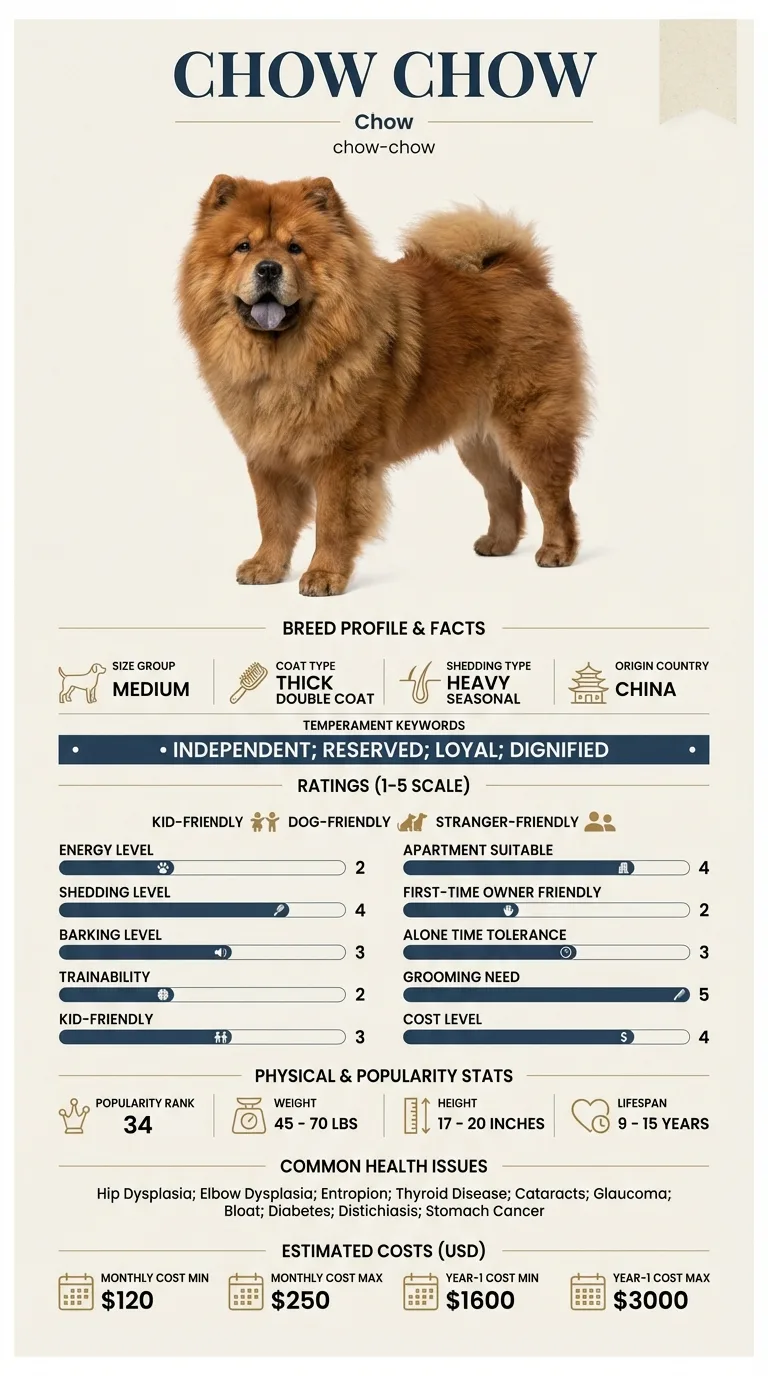
Two Chow characteristics matter. The first is the breed's comparatively straight stifle and hock, which gives the distinctive stilted rear action and alters the line along which the quadriceps pulls the kneecap. Any deviation in that pull is what allows a patella to track medially out of its groove. The second is body mass: 45 to 70 pounds on a 17 to 20 inch frame means the joint absorbs substantially more force per step than in the small breeds where this condition is usually described. Add a dense coat that hides thigh muscle wastage, and an independent temperament that discourages complaining, and the condition is easy to underestimate.
Flooring is the daily variable. Laminate, tile and polished wood allow the hind feet to slide outward on turns, which is precisely the movement that levers a kneecap sideways. Furniture access adds repeated landings. Body condition sits in the middle of everything, since a heavier dog both loads the joint harder and tends to move less, losing the muscle that would have stabilised it. Cold, damp weather increases stiffness and makes episodes more noticeable, though it does not cause them.
Book an appointment for any repeated skipping stride, even if your dog seems entirely comfortable afterwards, and ask specifically for both knees to be graded and written down. Seek same-day care if your Chow suddenly cannot bear weight on a hind leg, holds it up persistently, or the knee is swollen and hot, because sudden non-weight-bearing lameness in a dog this size often means a cruciate ligament rupture rather than a patella. Also treat a leg that is locked in a bent position and cannot be straightened as urgent. Do not attempt to manipulate the kneecap back yourself, and never give human anti-inflammatory medication, which is toxic to dogs.
See all Chow Chow health problems, which breeds are prone to luxating patellas, or the full Chow Chow breed guide for temperament, exercise needs and ownership costs.
Conservative management shows results over three to four months as hind-end muscle builds and weight comes down. Grades do not improve with exercise, but clinical signs frequently do. If the grade progresses over serial examinations six to twelve months apart, that trend is what usually prompts a surgical conversation.
Success at grade I or II is a dog who skips rarely or not at all, holds good thigh muscle, and shows no lameness between episodes. It is not a normally tracking kneecap, because the groove and the alignment do not change without surgery.
Grading is done by hand during an orthopaedic examination and takes under a minute per knee. It predicts management far better than any description of how often the dog skips.
The Chow Chow is unusual among dogs for the straightness of its rear assembly. Where most breeds carry pronounced angulation at the stifle and hock, the Chow's hind leg is comparatively straight, which produces the breed's distinctive short-strided, stilted gait. A straighter stifle changes the angle at which the quadriceps pulls across the knee, and any deviation in that line of pull is what encourages a kneecap to track off-centre.
The second factor is mass. Patellar luxation is most associated with small breeds, where a slipping kneecap is carrying five or ten pounds. A Chow is carrying 45 to 70 pounds through the same joint. The same grade of luxation therefore does more cartilage damage per year and is more likely to be genuinely painful rather than merely mechanical.
The third factor is what it leads to. A knee whose kneecap tracks abnormally distributes force abnormally through the whole joint, and that raises the risk of cranial cruciate ligament failure over time. In a heavy dog, a ruptured cruciate is a far bigger problem than the patella that helped cause it. This is the main reason grade II luxation in a Chow deserves more attention than the same finding in a small terrier.

Juno was three and skipped on her left hind leg roughly twice a day, always in the hallway, always as she turned toward the kitchen. Her owner Halvard filmed it after his vet asked him to and it turned out to be a textbook medial luxation, graded II on that side and I on the right. The recommendation was not surgery. Juno was sixty-six pounds and the target was fifty-eight. She started a twelve-week rehabilitation programme focused on hind-end strength, and Halvard carpeted the hallway. The hallway change alone cut the visible episodes by more than half within a fortnight, because the turn had been happening on bare wood. Eight months later Juno was fifty-nine pounds, had visibly better thigh muscle, and skipped perhaps once a month. Her grade at the next exam was unchanged, which was the expected result.
Key takeaway: The grade rarely improves, but the symptoms often do. Look at the surface your dog turns on before you look at the surgical estimate.
It is not among the ten documented health issues for the breed, which are led by hip and elbow dysplasia. It does occur, and the breed's straight rear construction and substantial body weight make it more consequential when it does than the same finding in a toy breed.
The moment of luxation is usually more startling than painful, which is why dogs carry on immediately afterwards. The pain comes later, from cartilage wear in a joint whose surfaces are being loaded abnormally over years.
No. Many grade II dogs are managed with weight control, muscle-building rehabilitation and activity modification for years. Surgery becomes the clear choice when the dog is lame between episodes, when the grade progresses, or when a cruciate ligament starts to fail.
It raises the risk, because abnormal patellar tracking loads the joint asymmetrically. In a 45 to 70 pound dog a cruciate rupture is a substantially larger surgical problem than the patella itself, which is a strong argument for taking the patella seriously early.
Controlled walking on level ground and swimming build the quadriceps and gluteal muscle that stabilise the knee. Repeated jumping, sharp turning on slick floors, and ball chasing with sudden stops all load the joint in exactly the way it cannot tolerate.
A heritable component is well recognised across breeds, since the underlying features are conformational: groove depth, limb alignment and muscle attachment points. That is why affected dogs should not be bred, and why an orthopaedic exam belongs in any breeding assessment.
That hitch is typically a kneecap slipping out of its groove and popping back. Have both knees graded by a vet even though the dog seems fine afterwards.
Grades III and IV usually do. Grade II is a judgement call based on lameness between episodes, progression, and whether the cruciate ligament is at risk.
Enormously. A 45 to 70 pound Chow loads a slipping kneecap far harder than a small breed does, so keeping to the leaner end of the range is the highest-value change.
Yes, it builds stabilising muscle without impact. Budget serious drying time afterwards, because a wet double coat invites skin problems.
A one-page prep sheet for this condition: the signs, the questions to ask, what to get priced. Unlocks here.
You get: Vet visit prep sheet
No spam. One-click unsubscribe. See our privacy policy.
Preview page 1 before you decide.