Costs
How much does bloat surgery cost for a Bernese?
Roughly $1,500 to $7,500, driven mainly by how sick the dog is on arrival. Early cases sit at the low end; cases needing tissue removal and intensive care sit at the top.

Quick answer
How much does bloat surgery cost for a Bernese?
Roughly $1,500 to $7,500, driven mainly by how sick the dog is on arrival. Early cases sit at the low end; cases needing tissue removal and intensive care sit at the top.
The bill for bloat is written in the first hour, not in the operating theatre.
Owners of a deep-chested Berner who have read that this can happen and want to know, concretely, what they would be agreeing to at two in the morning and how to be ready for it.
This guide is not medical advice. If your dog shows pain, sudden behavior change, or worsening symptoms, consult a licensed veterinarian.
Some links may be affiliate links. We may earn a commission at no extra cost to you. We only suggest products we believe are helpful for dog owners.
We research and check what we publish, but we do not warrant that any figure, date, price, or statement is accurate, complete, or current, and we accept no liability for any loss, cost, injury, or other harm arising from the use of this site. Use it as one reference among several. You remain responsible for your own decisions and for your dog's care - confirm anything that matters with a licensed veterinarian or another qualified professional before you act on it. Full disclaimer.
Gastric dilatation-volvulus is a stomach that fills with gas and then rotates, sealing both ends. Pressure builds, blood flow to the stomach wall and spleen is cut off, and circulation collapses. It is fatal without surgery, and how quickly the dog reaches theatre determines both survival and cost.
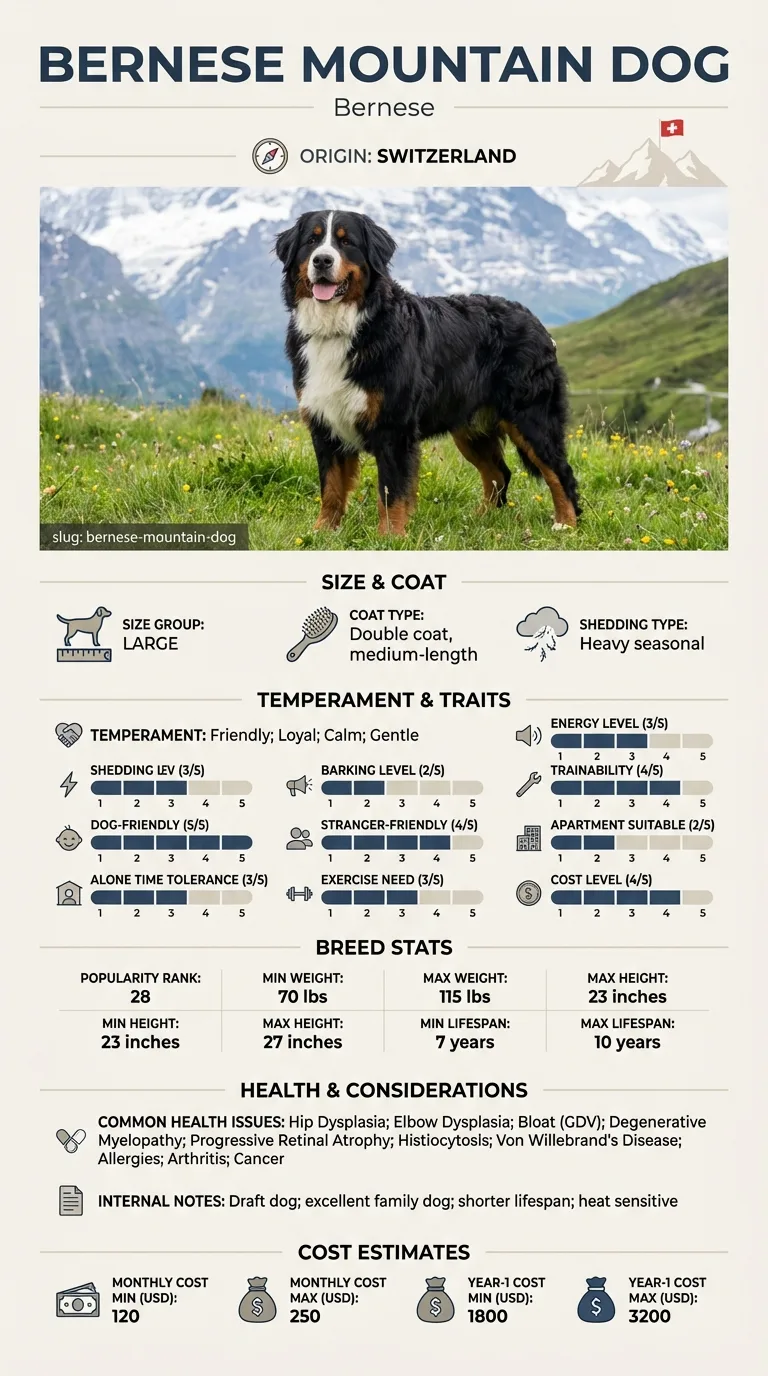
Bloat sits on the Bernese Mountain Dog's documented health list, and deep-chested large breeds carry the highest risk of any group. Most individual Berners never experience it, but the consequences when it happens are severe enough that every owner of the breed should be prepared.
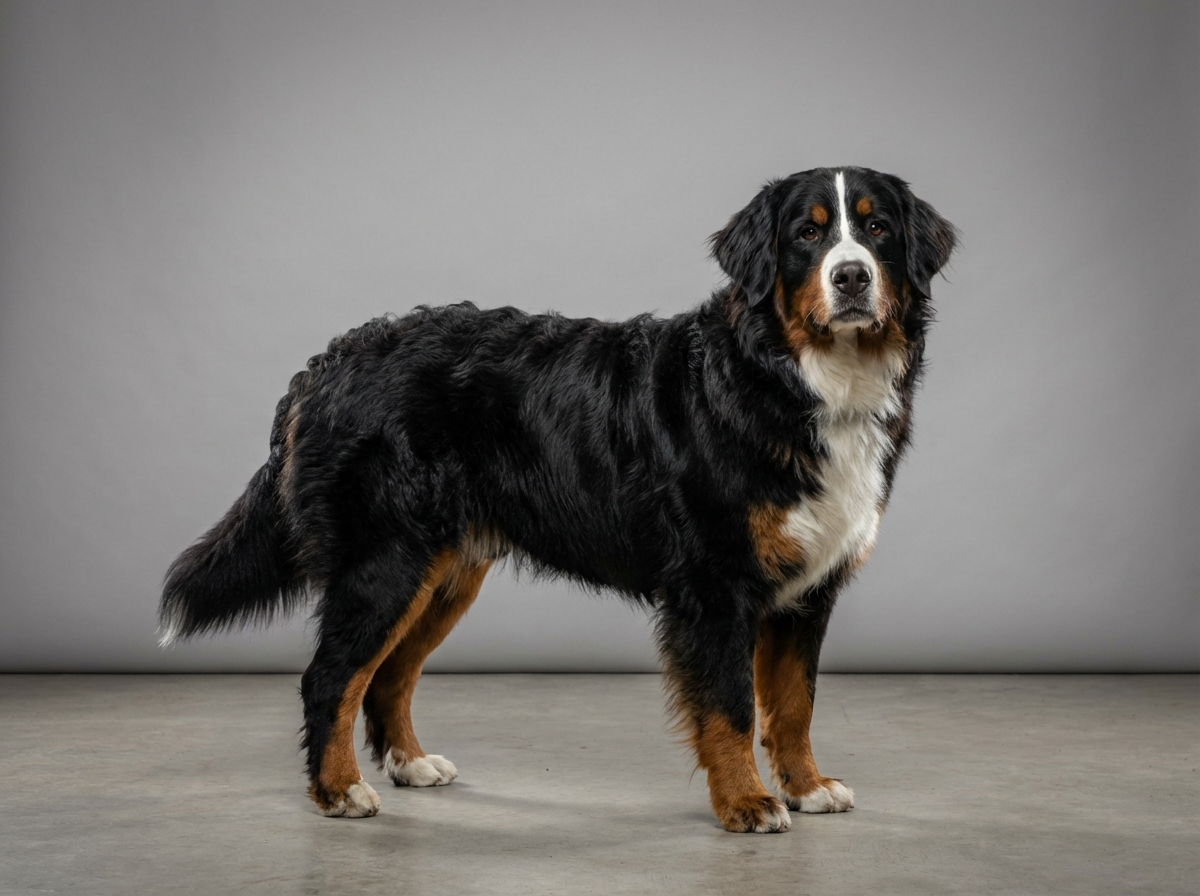
Chest shape is the driver. A Bernese stands 23 to 27 inches at the shoulder with a deep, comparatively narrow ribcage, and that conformation gives the stomach room to move and rotate on its axis. Body weight of 70 to 115 pounds means a large stomach with a correspondingly heavy content. Bloat is listed among the breed's documented conditions for exactly these structural reasons.
Feeding routine and household schedule shape the risk. One large evening meal after a day alone, eaten fast by a hungry dog, followed by activity, is the pattern most often described. Stressful events such as boarding or a house move are also commonly reported around episodes.
This is an emergency without qualification. Go immediately, phoning en route, for a swollen or hard abdomen, repeated retching that brings nothing up, restlessness and inability to settle, drooling, or a dog standing with its elbows out and back arched. Do not wait to see whether it passes, do not give anything by mouth, and do not delay to arrange money first: tell the clinic your situation on arrival. Survival and cost both worsen with every hour, and a dog can go from uncomfortable to critical inside two.
Cost and survival move together in this condition. Both are decided before you reach the clinic.
Start here: Bernese Mountain Dog Most Common Genetic Disorders
See all Bernese Mountain DOG health problems, which breeds are prone to bloat gastric dilatation volvulusgdv, or the full Bernese Mountain DOG breed guide for temperament, exercise needs and ownership costs.
Surgery is immediate once the diagnosis is made. Hospitalisation runs two to seven days depending on complications, and home recovery with restricted activity takes two to four weeks.
A dog that reaches surgery early enough to avoid tissue removal, comes home within days, and carries a gastropexy that makes a repeat rotation unlikely.
At the low end, a dog arrives early, is stable, has its stomach decompressed and untwisted, needs no other repair, and goes home within a day or two. That case sits nearer the bottom of the range.
Most of the cost above that is the consequence of time. A twisted stomach cuts off its own blood supply and traps the spleen with it. Tissue that has been starved of blood for hours may have to be removed, which turns one procedure into two, adds theatre time, and adds days of intensive care. Shock treatment, plasma or blood products, continuous monitoring for the heart rhythm disturbances that commonly follow, and a stay in a critical care ward all stack on top.
The gastropexy, in which the stomach is tacked to the body wall so it cannot rotate again, is a small part of the total and is routinely performed during the emergency surgery. It is the reason recurrence becomes unlikely afterwards.
The hard part is that this decision arrives at the worst hour with no warning. What makes it manageable is having had the conversation in advance: what your ceiling is, whether you have insurance and what it covers, whether the clinic offers payment plans, and who in the household can authorise treatment. Emergency clinics are used to this conversation and will give you an estimate range before proceeding.

When Priya brought her Berner puppy Nala home, her breeder gave her one piece of advice she thought was excessive: write the emergency clinic's number on the fridge and agree with your husband now what you would spend. Four years later Nala started pacing and retching without producing anything at half past ten at night. Priya's husband was alone with her. He read the fridge, phoned, and drove. Nala was in theatre inside ninety minutes, needed no tissue removed, and was home in two days at the lower end of the cost range. The surgeon told them another two hours would have been a different operation.
Key takeaway: The preparation cost nothing and did more than any product. Knowing where to go and what you would spend removes the two delays that make this condition so expensive.
Because it covers two very different patients. A dog caught early needing decompression, untwisting and a gastropexy is a shorter procedure with a short stay. A dog whose stomach or spleen has lost blood supply needs tissue removed, blood products and days of intensive care, which multiplies the bill.
Many accident and illness policies do, but the specifics matter: waiting periods, annual limits, per-condition caps and whether a pre-existing note has been made. Read your own policy now rather than at the clinic, and ask the insurer directly if anything is ambiguous.
Discuss it with your vet, especially if a spay or another abdominal procedure is already planned. The added cost when the abdomen is already open is a fraction of emergency surgery, and it addresses the twisting component specifically. It does not prevent the stomach from distending.
Tell the clinic immediately and honestly rather than delaying the visit. They can discuss payment plans, charity funding where available in your country, and what the realistic options are. A dog with untreated GDV will not survive, so this conversation cannot be postponed.
An uncomplicated case is often two to three days. Dogs needing tissue removal or developing rhythm disturbances stay longer, sometimes a week. Cost tracks the stay closely, which is another reason arriving early matters financially as well as medically.
Simple distension can still occur, but a properly performed gastropexy makes rotation very unlikely. That is why the procedure is included in the emergency surgery rather than being an optional extra, and why owners rarely face this bill twice.
The early signs are set out in the sections above, and they are the reason to book a veterinary appointment rather than wait. Bloat (gastric Dilatation-volvulus/gdv) in Berneses is diagnosed by a vet, not from a symptom list, and the sooner it is on record the more options remain open.
The early signs are set out in the sections above, and they are the reason to book a veterinary appointment rather than wait. Bloat (Gastric Dilatation-Volvulus/GDV) in Bernese Mountain Dogs is diagnosed by a vet, not from a symptom list, and the sooner it is on record the more options remain open.
Roughly $1,500 to $7,500, driven mainly by how sick the dog is on arrival. Early cases sit at the low end; cases needing tissue removal and intensive care sit at the top.
Phone the nearest 24-hour clinic and drive. Do not wait, do not attempt home treatment, and do not wait for a partner to get home.
Check your insurance terms, save the nearest emergency clinic's number and address, and agree a spending ceiling with everyone in the household in advance.
On the fridge and in every household phone: clinic address, phone number, your dog's weight, and any current medications.
Only indirectly. A dog taught to eat calmly from a slow feeder rather than bolting food is easier to manage, though feeding style is not the whole story.
A one-page prep sheet for this condition: the signs, the questions to ask, what to get priced. Unlocks here.
You get: Vet visit prep sheet
No spam. One-click unsubscribe. See our privacy policy.
Preview page 1 before you decide.