Health
Are Chihuahuas at risk of bloat?
Much less than large deep-chested breeds. Bloat risk tracks chest depth relative to width, and this compact toy breed sits at the low-risk end.

Quick answer
Are Chihuahuas at risk of bloat?
Much less than large deep-chested breeds. Bloat risk tracks chest depth relative to width, and this compact toy breed sits at the low-risk end.
Every serious study of bloat risk lands on the same measurement: the depth of the chest relative to its width. Great Danes sit at the dangerous end of that ratio. A 4-pound Chihuahua sits at the other end.
Chihuahua owners who have read a large-breed bloat article at midnight and are now frightened, owners deciding whether prophylactic surgery is worth discussing, and owners trying to work out where a limited health budget for this breed is actually best spent.
This guide is not medical advice. If your dog shows pain, sudden behavior change, or worsening symptoms, consult a licensed veterinarian.
Some links may be affiliate links. We may earn a commission at no extra cost to you. We only suggest products we believe are helpful for dog owners.
We research and check what we publish, but we do not warrant that any figure, date, price, or statement is accurate, complete, or current, and we accept no liability for any loss, cost, injury, or other harm arising from the use of this site. Use it as one reference among several. You remain responsible for your own decisions and for your dog's care - confirm anything that matters with a licensed veterinarian or another qualified professional before you act on it. Full disclaimer.
Gastric dilatation-volvulus is a rapidly fatal emergency in which the stomach distends with gas and rotates, cutting off its own blood supply. Treatment is immediate surgery costing roughly fifteen hundred to seventy-five hundred dollars. It is overwhelmingly a disease of large, deep-chested breeds. For Chihuahua owners the useful content of this topic is not prevention but proportion: knowing the emergency signs, knowing that a swollen Chihuahua abdomen usually means something else, and redirecting budget and attention to the problems this breed genuinely has.
Uncommon in Chihuahuas and absent from the breed's documented health profile, which centres instead on dental disease, collapsing trachea, heart disease, patellar luxation and hypoglycemia. In Great Danes and other giant deep-chested breeds lifetime risk is high enough to justify preventive surgery; in a compact two-to-six-pound dog it is a rarity that clinicians see as case reports rather than as a routine presentation.
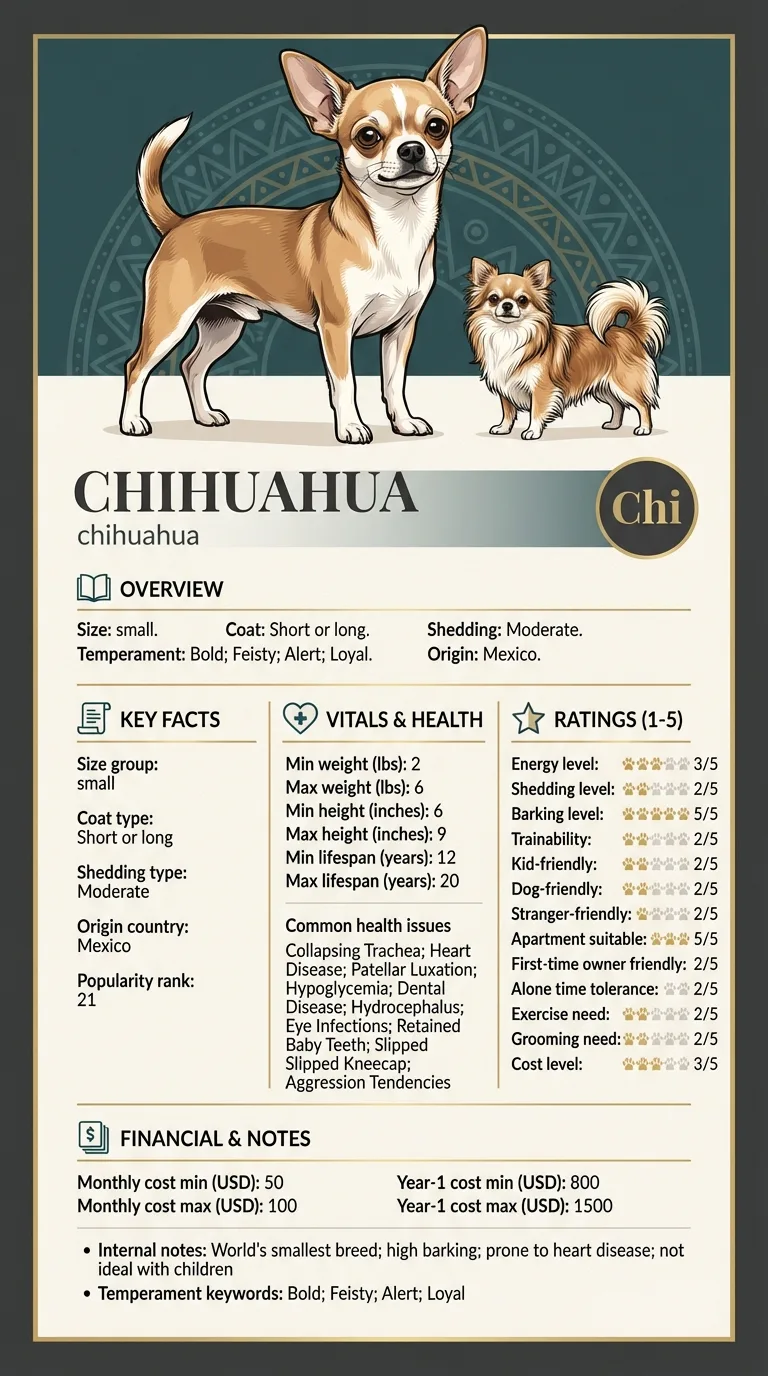
The reason this section is short is that the honest answer is protective rather than alarming. GDV requires a stomach with enough room and enough leash to rotate, and that requirement is met by tall, narrow, deep-chested anatomy. The Chihuahua, at six to nine inches tall and two to six pounds with a compact frame, does not provide those conditions. Nothing on the breed's documented health list - teeth, trachea, heart, kneecaps, blood sugar, hydrocephalus, eyes - relates to gastric torsion. Where this breed does carry real digestive vulnerability, it is around choking, regurgitation and the speed at which a small dog becomes hypoglycemic when it stops eating.
The environmental factors that matter for bloat in susceptible breeds - one enormous meal a day, gulping, exercise straight after eating - are worth avoiding in any dog but do not turn a Chihuahua into a high-risk animal. What genuinely shapes this breed's abdominal emergencies is different: access to rich food or bin raids that a tiny stomach cannot cope with, an unspayed female developing a uterine infection, and undiagnosed heart or liver disease allowing fluid to accumulate. Those are the environmental and management factors worth acting on.
Go to an emergency clinic immediately, whatever the suspected cause, for repeated unproductive retching, a hard distended abdomen, restless pacing with an inability to lie down, heavy drooling, pale gums or collapse. That combination is an emergency in any breed. Book a same-day appointment for a belly that has become gradually rounder over days or weeks, especially alongside a cough, increased breathing rate or reduced appetite, since gradual abdominal distension in a Chihuahua more often points to heart, liver or uterine disease. Discuss preventive gastropexy at a routine appointment if you want it addressed properly rather than in a crisis.
See all Chihuahua health problems, which breeds are prone to bloat gastric dilatation volvulusgdv, or the full Chihuahua breed guide for temperament, exercise needs and ownership costs.
For the rare Chihuahua that does develop GDV, the timeline is brutal and measured in hours from first retching to surgery, with the outcome largely decided by how quickly the dog reaches an operating table. For the overwhelming majority of Chihuahua owners, the realistic timeline attached to this topic is entirely different: reading this, recalibrating the risk, and putting the budget and the vet appointments where this breed's actual diseases are, which is a decision made in an afternoon.
Success here is calibrated worry. You can recognise a genuine abdominal emergency and would drive without hesitating, you know that a swollen Chihuahua belly is more likely heart, liver or uterine in origin, and you are not paying for preventive surgery aimed at a large-breed disease. Meanwhile the mouth is on a dental plan and there is money set aside for the orthopaedic or spinal emergency that is far more likely to arrive.
The strongest single predictor of GDV that anyone has found is thoracic shape. A tall, narrow, deep chest gives the stomach room to move and a long ligamentous leash to swing on. Breeds built that way, Great Danes above all, carry a lifetime risk high enough that many owners elect preventive surgery at the time of neutering.
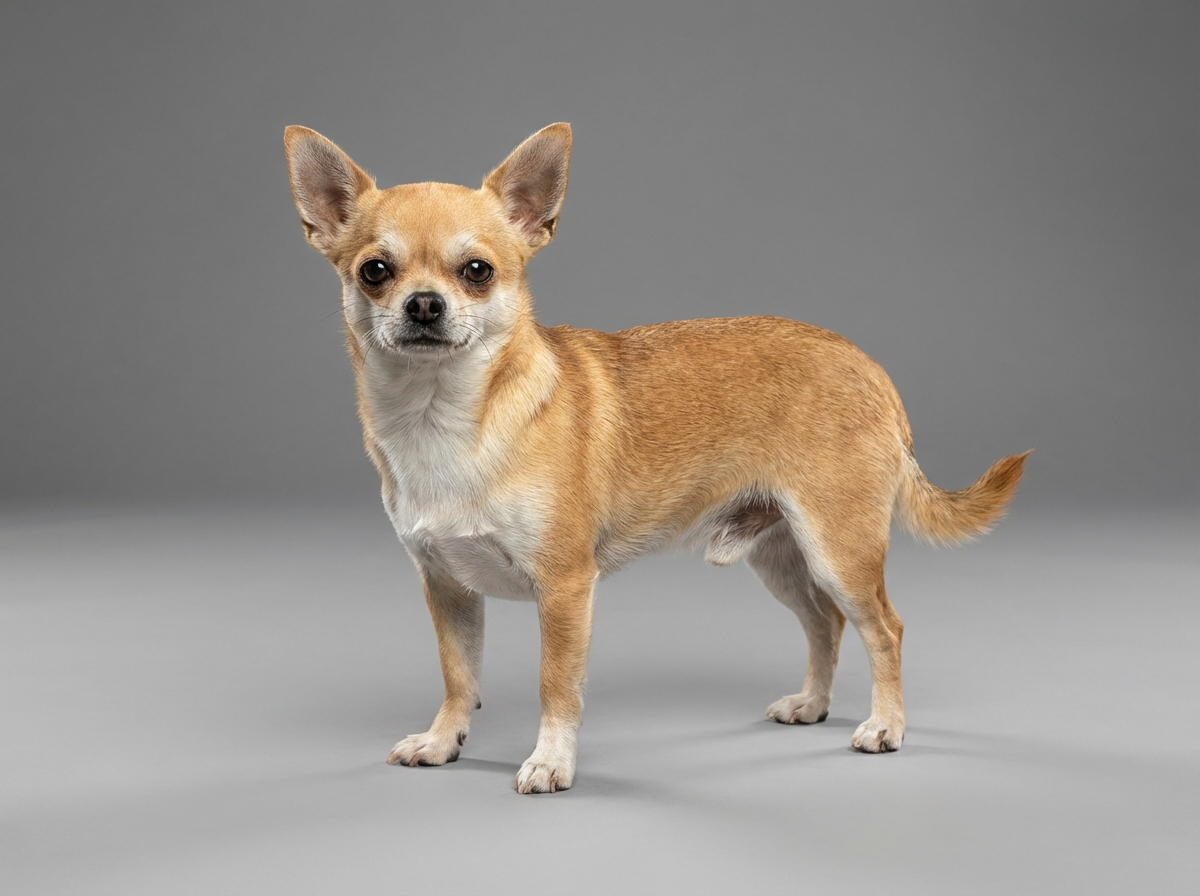
The Chihuahua is built the opposite way. It is a compact dog standing six to nine inches tall and weighing two to six pounds, with a chest that is proportionally shallow and short. Its stomach sits in a small abdomen with comparatively little room to rotate. GDV is not impossible in toy breeds, and case reports exist, but it is not among the problems this breed is documented as facing. The Chihuahua's actual health list runs to dental disease, collapsing trachea, heart disease, patellar luxation, hypoglycemia, hydrocephalus and eye problems, and bloat is nowhere on it.
This matters practically because worry is a finite resource and so is money. An owner spending mental energy on GDV in a Chihuahua is very likely not spending it on the mouth, which is where this breed's expensive, painful and near-universal problem actually lives.
None of that means ignoring an abdominal emergency. It means recognising that when a Chihuahua's belly swells, GDV should be somewhere down the list rather than at the top of it.

If the fifteen-hundred to seventy-five-hundred dollar figure has focused your mind on emergency budgeting, that instinct is right. The line items just differ for a Chihuahua.
If you think your Chi has bloat (gastric dilatation-volvulus/gdv), the plan is three steps: write down what you have seen and when it started, book a veterinary appointment rather than waiting for the next flare, and take video of the behaviour or symptom before you go — the thing you are worried about rarely happens in the consulting room. Screening in the parents covers collapsing trachea, heart disease, patellar luxation.
What the vet visit should produce is a diagnosis and a written plan, not just reassurance: what is being ruled out, what the monitoring interval is, and which signs mean you come back sooner. Ask what the treatment costs across a year rather than per visit, because that is the number that decides whether you are managing this condition or reacting to it.
Between appointments, keep a short log — dates, what you saw, what changed. It is the single most useful thing an owner brings to a follow-up, and for bloat (gastric dilatation-volvulus/gdv) it is often what separates a clear pattern from a guess.
Bruno is a 5-pound Chihuahua in Columbus whose owner Kate found him one evening standing rigid with a rounded belly, having stolen a substantial portion of a takeaway. She had read about bloat that week and drove to the emergency clinic convinced she was watching a twisted stomach. Radiographs showed exactly what had happened: a stomach hugely overfull of food, and no rotation at all. Bruno was given fluids and an anti-nausea injection, observed for four hours and discharged. The bill was a fraction of the figure Kate had been bracing for. The more useful part of the visit was the conversation afterwards. The vet ran a finger along Bruno's molars, showed Kate the recession and calculus on a five-year-old dog, and told her that the thing genuinely likely to cost her thousands over Bruno's life was the mouth she had never looked at. He had a dental six weeks later, with two extractions.
Key takeaway: Driving in was still the right call, because you cannot triage a hard swollen abdomen from your living room. But the money and the worry belonged somewhere else, and in this breed that somewhere is almost always the teeth.
It is possible but genuinely uncommon, and it is not one of the breed's documented health problems. Risk in this disease tracks a deep, narrow chest, and the Chihuahua's compact shallow-chested build sits at the safe end of that spectrum. Treat it as a rare event to recognise rather than a routine hazard to plan around.
You can ask, and a good vet will explain why it is not standard practice here. Prophylactic gastropexy is offered to breeds carrying a substantial lifetime GDV risk, chiefly giant and deep-chested ones. Performing extra abdominal surgery on a 4-pound dog to prevent a disease it is unlikely to develop trades a real anesthetic risk against a very small benefit.
In this breed, more likely a stomach simply overfull of food or gas from raiding something, or fluid in the abdomen from advanced heart or liver disease, or an infected uterus in an unspayed female. All of those need veterinary attention, and none of them is treated the way GDV is, which is precisely why the assessment has to happen at a clinic rather than in your kitchen.
Repeated retching that produces nothing, a hard drum-tight belly, obvious restlessness or pacing with an inability to settle, heavy drooling, pale gums, or collapse. Any of those in any breed means going to an emergency clinic immediately. In a Chihuahua the underlying cause will usually turn out to be something other than a twisted stomach, but the urgency of getting seen is identical.
The evidence on raised bowls in large breeds is mixed and, in some work, raised feeding was associated with more risk rather than less, so it is not a recommendation to copy across. Slow feeding is worth doing in a Chihuahua for a different and better reason: a small dog that inhales food is more prone to regurgitation and to choking on kibble it never chewed.
Often yes, though not because of bloat. The case rests on dental disease, which is close to inevitable, on spinal and orthopaedic emergencies, and on years of cardiac management in a breed that may live to twenty. Read the dental clauses carefully, because they are the ones that matter most for a Chihuahua and are frequently the most restricted.
Much less than large deep-chested breeds. Bloat risk tracks chest depth relative to width, and this compact toy breed sits at the low-risk end.
Almost certainly not. It is a large-breed procedure, and adding abdominal surgery to a 4-pound dog for a rare risk is a poor trade.
Dental work above all, then spinal and orthopaedic emergencies, then long-term cardiac management. Those are the costs this breed actually generates.
Unproductive retching, a hard swollen belly, pacing without settling, drooling, pale gums or collapse. Cause aside, that combination is an emergency.
Yes, though for choking and regurgitation rather than bloat. A tiny dog swallowing kibble whole has a genuine problem worth slowing down.
A one-page prep sheet for this condition: the signs, the questions to ask, what to get priced. Unlocks here.
You get: Vet visit prep sheet
No spam. One-click unsubscribe. See our privacy policy.
Preview page 1 before you decide.