Health
Do Chow Chows get liver shunts?
There is no documented breed predisposition. Congenital shunts cluster in specific small and large breeds. Test an individual dog on its signs, not on the breed.

Quick answer
Do Chow Chows get liver shunts?
There is no documented breed predisposition. Congenital shunts cluster in specific small and large breeds. Test an individual dog on its signs, not on the breed.
The giveaway is timing. A puppy that becomes dull, disoriented or head-pressing thirty to sixty minutes after eating is describing a shunt better than any blood test does.
Owners of a Chow puppy who is small for the litter, slow to grow, or behaving oddly after meals, and owners weighing up a rescue Chow with an unexplained history of seizures.
This guide is not medical advice. If your dog shows pain, sudden behavior change, or worsening symptoms, consult a licensed veterinarian.
Some links may be affiliate links. We may earn a commission at no extra cost to you. We only suggest products we believe are helpful for dog owners.
We research and check what we publish, but we do not warrant that any figure, date, price, or statement is accurate, complete, or current, and we accept no liability for any loss, cost, injury, or other harm arising from the use of this site. Use it as one reference among several. You remain responsible for your own decisions and for your dog's care - confirm anything that matters with a licensed veterinarian or another qualified professional before you act on it. Full disclaimer.
A portosystemic shunt is an abnormal blood vessel that routes blood from the digestive tract around the liver instead of through it. Toxins the liver should clear reach the brain, producing episodic neurological signs that follow meals. Congenital shunts are present from birth and usually declare themselves in the first year; acquired ones develop later as a consequence of established liver disease.
Congenital portosystemic shunts are uncommon overall and are concentrated in particular breeds, none of which is the Chow Chow. Liver shunts do not appear among the breed's ten documented health issues, so a Chow puppy with the classic picture is an individual case rather than a breed pattern.
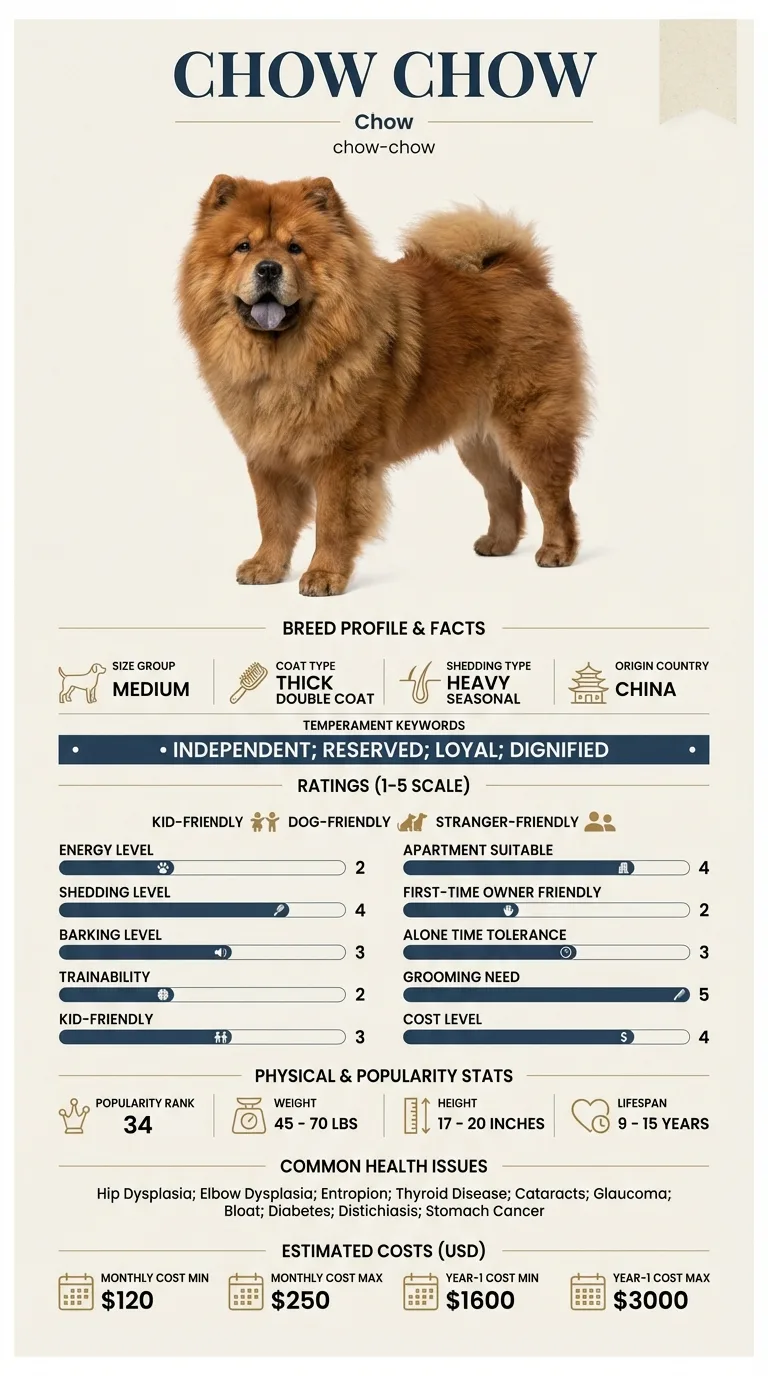
There is no described Chow Chow predisposition, and the honest breed-level answer is that this is a condition of other breeds. What is worth noting is where Chow biology intersects with the diagnosis rather than the disease. This is a reserved, independent dog rated 2 out of 5 for stranger friendliness and 2 out of 5 for trainability, and neurological episodes in such a dog are readily misread as temperament: staring into a corner, ignoring recall, seeming detached. In a Labrador the same behaviour would stand out immediately. In a Chow it can look like the breed being the breed, which delays the appointment that would find it.
Nothing in the household causes a congenital shunt, and it is important not to leave owners feeling they might have. Diet composition does affect how severe the signs are once a shunt exists, since protein load drives ammonia production, but that is management rather than cause. For acquired shunts, the environmental contributors are those of chronic liver disease generally, including toxin exposure and certain long-term medications, all of which belong in a conversation with a vet rather than in guesswork.
Some signs here need same-day attention: head pressing against a wall or furniture, seizures, collapse, unresponsiveness, apparent sudden blindness, or a puppy that cannot be roused normally. Those are neurological emergencies whatever the underlying cause. Book a prompt appointment for a puppy that is failing to grow, is repeatedly dull or disoriented after meals, drinks and urinates excessively, or vomits intermittently without explanation, and ask specifically whether paired bile acids are indicated. Mention any previous slow recovery from sedation. Never give human medication of any kind to a dog with suspected liver disease, since a compromised liver cannot clear it.
See all Chow Chow health problems, which breeds are prone to liver shunts, or the full Chow Chow breed guide for temperament, exercise needs and ownership costs.
Bile acid testing takes a single day with a fasting and post-meal sample. If abnormal, imaging and specialist referral usually follow within a few weeks. Surgical closure is often staged, with gradual occlusion over weeks to months to let the liver adapt, and medical management is continuous where surgery is not chosen.
For a surgically treated dog, success is normal growth, no post-meal episodes and eventual freedom from restrictive diets. For a medically managed dog, success is stable weight, episodes reduced to rare or absent, and a routine that the household can sustain indefinitely.
None of these individually confirms anything. The combination of small size, post-meal neurological signs and a slow anaesthetic recovery is what makes a vet order bile acids rather than an epilepsy workup.
Congenital shunts split by body type. Extrahepatic shunts, where the abnormal vessel sits outside the liver, cluster in small breeds such as Yorkshire Terriers, Maltese, Miniature Schnauzers and Cairn Terriers. Intrahepatic shunts, where the vessel runs within the liver itself, cluster in large breeds including Irish Wolfhounds, Labradors and Golden Retrievers. The Chow Chow sits in neither documented group, and liver shunts are absent from the breed's ten documented health issues, which are hip dysplasia, elbow dysplasia, entropion, distichiasis, thyroid disease, cataracts, glaucoma, bloat, diabetes and stomach cancer.
That does not make the workup pointless. Congenital shunts are described in many breeds and in mixed-breed dogs, so an individual Chow puppy with the classic picture deserves bile acid testing rather than a reassurance based on breed. What breed information does is shift the prior probability, which matters when a vet is deciding whether to test for one uncommon thing or several more likely ones.
Acquired shunts are a different animal entirely. These develop later in life when chronic liver disease raises pressure in the portal vein and the body opens up multiple small bypass vessels. They are a consequence of liver disease rather than a birth defect, and they are the version an older Chow is more plausibly going to encounter.

If you think your Chow has liver shunts, the plan is three steps: write down what you have seen and when it started, book a veterinary appointment rather than waiting for the next flare, and take video of the behaviour or symptom before you go — the thing you are worried about rarely happens in the consulting room. Screening in the parents covers hip dysplasia, elbow dysplasia, entropion.
What the vet visit should produce is a diagnosis and a written plan, not just reassurance: what is being ruled out, what the monitoring interval is, and which signs mean you come back sooner. Ask what the treatment costs across a year rather than per visit, because that is the number that decides whether you are managing this condition or reacting to it.
Between appointments, keep a short log — dates, what you saw, what changed. It is the single most useful thing an owner brings to a follow-up, and for liver shunts it is often what separates a clear pattern from a guess.
Pepper was five months old and, in her owner Yusuf's words, the most aloof puppy he had ever met. She would disengage completely after dinner, stand facing the kitchen cupboard, and ignore her name for ten or fifteen minutes. Everyone told him Chows were like that. What changed his mind was her weight. Pepper had gained almost nothing in three weeks while her littermates, whose photographs the breeder shared, had visibly grown. His vet asked one question about timing, heard that the staring always followed a meal, and ran paired bile acids. They were markedly elevated. CT angiography found a single extrahepatic shunt, and Pepper had it gradually occluded at a referral centre at seven months. She gained eleven pounds in the following four months. She is still, Yusuf reports, genuinely aloof.
Key takeaway: In a breed famous for detachment, a puppy that switches off after every meal is a medical observation, not a personality trait. Weigh the puppy and time the episodes.
No documented predisposition exists. Congenital shunts concentrate in specific small and large breeds, and liver shunts do not appear on the Chow Chow's documented health list. An individual Chow with the classic signs should still be tested, because uncommon is not the same as impossible.
Paired bile acid measurements, taken fasting and then two hours after a meal, are the standard screening test. Ammonia levels add information. Imaging, usually ultrasound and often CT angiography, is what locates the vessel and determines whether surgery is possible.
Many extrahepatic shunts can be closed surgically or gradually occluded, with good outcomes when done at a specialist centre. Intrahepatic shunts are technically harder. Some dogs are managed medically for life with diet and medication rather than surgery, and that is a legitimate path rather than a failure.
Small size alone is weak evidence. Worry when small size comes with poor growth over weeks, dullness after meals, unexplained neurological episodes, or excessive drinking. Ask your vet whether bile acids are worth running rather than watching another month.
Drugs are cleared by the liver, and a bypassed liver clears them slowly. A puppy who takes an unusually long time to wake from a routine neuter is giving real diagnostic information, and it is worth telling your vet if that has happened.
Low blood sugar in a young dog, some metabolic and electrolyte disturbances, and certain toxins can all do it. Epilepsy typically shows no relationship to feeding at all, which is why the timing question is asked so early in the consultation.
There is no documented breed predisposition. Congenital shunts cluster in specific small and large breeds. Test an individual dog on its signs, not on the breed.
Neurological dullness, staring or head pressing appearing thirty to ninety minutes after a meal and improving afterwards, usually in a puppy that is small for its age.
Paired bile acids, fasting and post-meal. Imaging follows only if those are abnormal.
Yes. A dog pressing its head into a wall or corner needs same-day veterinary assessment regardless of the suspected cause.
A one-page prep sheet for this condition: the signs, the questions to ask, what to get priced. Unlocks here.
You get: Vet visit prep sheet
No spam. One-click unsubscribe. See our privacy policy.
Preview page 1 before you decide.