Health
Is the Bernese Mountain Dog a chondrodystrophic breed?
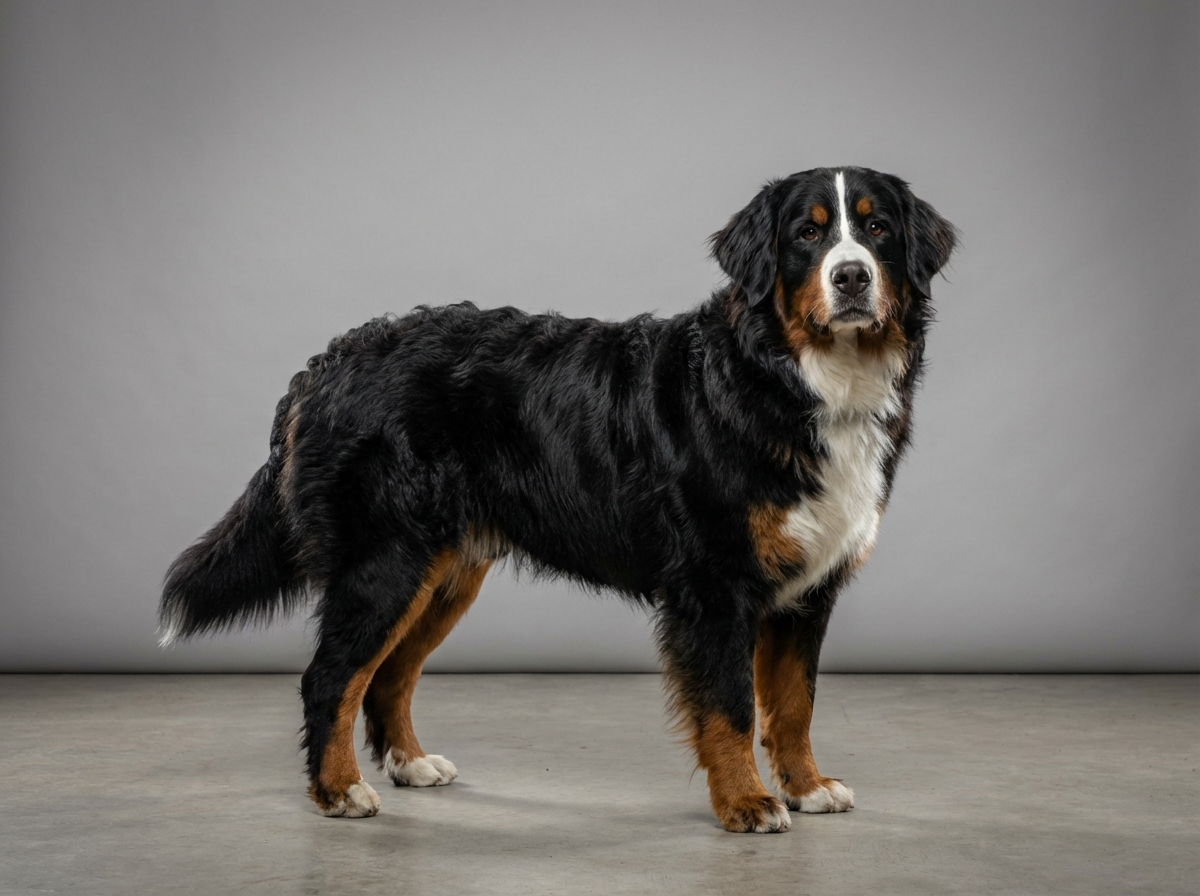
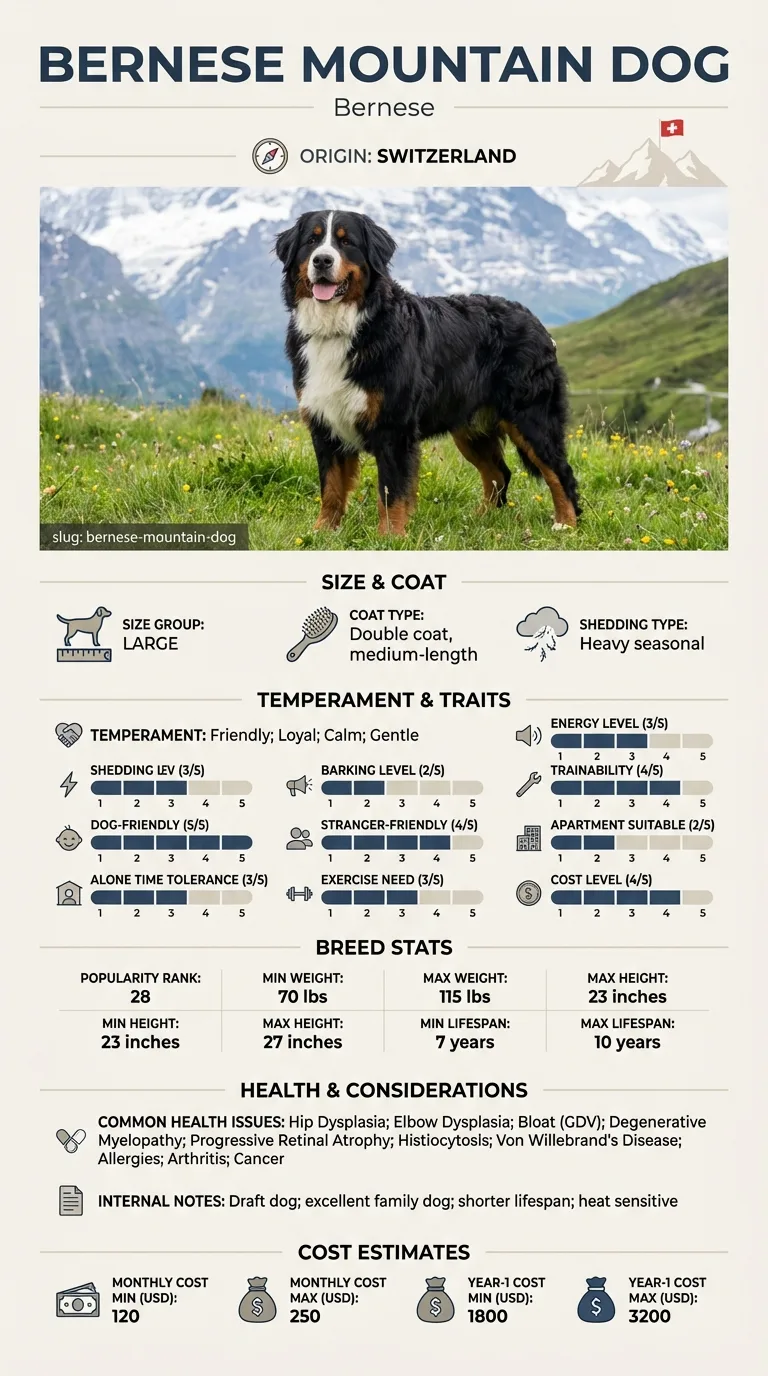
No. He has normal limb proportions for his height of 23 to 27 inches, which places him outside the group at highest risk for sudden explosive disc rupture.

Quick answer
Is the Bernese Mountain Dog a chondrodystrophic breed?
No. He has normal limb proportions for his height of 23 to 27 inches, which places him outside the group at highest risk for sudden explosive disc rupture.
If you searched for IVDD because your Bernese has gone wobbly behind, disc disease is probably not the first thing your vet will be thinking about.
Owners who have found generic IVDD advice written for dachshunds and cannot tell whether it applies, and owners of a Berner with back pain or hind limb weakness who need to know what the realistic list of causes is.
This guide is not medical advice. If your dog shows pain, sudden behavior change, or worsening symptoms, consult a licensed veterinarian.
Some links may be affiliate links. We may earn a commission at no extra cost to you. We only suggest products we believe are helpful for dog owners.
We research and check what we publish, but we do not warrant that any figure, date, price, or statement is accurate, complete, or current, and we accept no liability for any loss, cost, injury, or other harm arising from the use of this site. Use it as one reference among several. You remain responsible for your own decisions and for your dog's care - confirm anything that matters with a licensed veterinarian or another qualified professional before you act on it. Full disclaimer.
Intervertebral disc disease describes degeneration of the cushioning discs between vertebrae, leading to compression of the spinal cord. It exists in two forms: a sudden extrusion typical of short-legged breeds, and a gradual protrusion typical of large breeds in later life. Bernese Mountain Dogs, having normal limb proportions, fall into the second group, which makes their disc disease slower, later and less dramatic than the version most online guidance describes.
Disc disease is not among the Bernese Mountain Dog's documented common health issues, which list hip and elbow dysplasia, bloat, degenerative myelopathy, progressive retinal atrophy, histiocytosis, von Willebrand's disease, allergies, arthritis and cancer. That absence is informative. Owners investigating spinal signs in this breed are statistically much more likely to be dealing with degenerative myelopathy, arthritis or a cervical problem than with a disc.
The relevant breed fact here is a negative one. The Bernese is not built on the disproportionate dwarfed frame that drives early disc calcification, so the genetic mechanism behind classic explosive disc disease is largely absent. What the breed does contribute is weight and leverage: a 70 to 115 pound body loads a spine substantially, and where a disc does bulge, a large dog is harder to support, harder to rehabilitate and harder to nurse through a recovery than a fifteen pound one. Size changes the consequences rather than the odds.
Household layout affects spinal loading in a heavy breed more than owners appreciate. Slippery floors force sudden bracing movements through the back, high vehicle boots demand repeated impact landings, and furniture access adds a jump down onto hard flooring several times a day. None of these creates disc degeneration on its own, but all of them add mechanical stress to a spine already carrying a great deal, and all of them are cheap to change.
Treat sudden onset as urgent and gradual onset as prompt. Go the same day for a dog who cannot stand, whose hind legs gave way within hours, who has lost bladder or bowel control, who is dragging the tops of his feet, or who cries out when touched along the back or when picking up his head. Book a normal appointment for weakness, scuffing or unsteadiness developing over weeks, but do not defer it to the annual visit, because early neurological assessment shapes what is possible later.
Start here: Bernese Mountain Dog Most Common Genetic Disorders
See all Bernese Mountain DOG health problems, which breeds are prone to intervertebral disc disease ivdd, or the full Bernese Mountain DOG breed guide for temperament, exercise needs and ownership costs.
Gradual disc protrusion is a slow condition and management is measured in months and years rather than weeks. Conservative treatment with weight control, restricted high-impact activity and prescribed pain relief is usually given six to twelve weeks before it is judged. Surgical decompression, where indicated, involves several weeks of strict rest followed by a staged return to activity over three months. Improvement in large dogs is generally slower than in small ones simply because there is more animal to rehabilitate.
Success is a dog who remains comfortable and mobile rather than a spine that looks normal on imaging. In practice that means walking without scuffing, rising without struggle, no pain response on palpation, and a rate of change slow enough that equipment and household adaptations can stay ahead of it. For gradual disc disease in a breed averaging seven to ten years, holding a dog steady is often the realistic goal.
Discs sit between the vertebrae as shock absorbers, with a firm outer ring and a softer centre. They fail in two quite different ways, and lumping them together is what causes most of the confusion online.
The first pattern is the explosive one. In breeds bred for short legs, the disc centre calcifies early in life, and a calcified centre can burst through the outer ring suddenly, firing material into the spinal canal. It typically strikes young to middle-aged dogs and produces dramatic signs over hours. This is what most IVDD content describes, and it is not the Bernese pattern.
The second pattern is gradual. The outer ring of the disc thickens and bulges upward over years, slowly compressing the spinal cord rather than striking it. It affects large breeds, tends to appear in older dogs, and produces creeping weakness and unsteadiness rather than sudden collapse. Where a Bernese does have disc disease, this is usually the form.
The practical consequence is that a Bernese owner should be much less worried about a sudden ruptured disc than a dachshund owner, and much more attentive to slow changes in hind limb coordination. The urgency profile is inverted.
It also means that generic IVDD advice about ramps, no stairs and no jumping, while sensible for any heavy dog, is not addressing the actual mechanism in this breed. The things that protect a long-backed dog from an acute rupture do not do much for a gradual bulge.
This is roughly the order a veterinarian works through when a Bernese presents with hind limb trouble. Disc disease is on the list but rarely at the top of it.

Emil was nine and had become unsteady on his back end over about four months. His owners found detailed IVDD guidance online, banned him from stairs, bought a ramp, and waited for improvement, believing they were treating a disc problem. When nothing changed they took him in. The examination found no pain anywhere along his spine, which was the important clue: disc compression usually hurts, and Emil did not react at all. His hind feet were scuffing and he had lost conscious placement of them. The working diagnosis was degenerative myelopathy, a painless progressive cord disease that appears on this breed's documented issue list. The ramp and the flooring changes were still useful, but the plan they needed was a very different one, built around physiotherapy, mobility support and a realistic conversation about the coming year.
Key takeaway: Painless hind limb weakness in a large breed points away from disc disease, not toward it. The presence or absence of back pain is one of the most useful observations an owner can bring to the appointment.
Yes, but the risk profile is completely different from a dachshund or a corgi. Large non-chondrodystrophic breeds get the slow protrusion form rather than the sudden explosive form, generally in older age. It is a genuine possibility rather than a leading concern.
Look at where the reluctance is. Hip pain typically shows as difficulty rising, a bunny-hopping gait and discomfort when the hind legs are extended backwards. Spinal pain often shows as a hunched posture, reluctance to turn the head or lower it to the bowl, yelping when picked up, and tension along the back. Your vet distinguishes these by palpating each region separately.
It depends on speed. Weakness that has developed over weeks or months should be seen promptly but is not usually an emergency. Weakness that appeared over hours, or any dog who cannot stand, has lost bladder control, or is crying in pain, needs to be seen the same day, because a small number of causes have a narrow treatment window.
They help, but mostly for reasons other than discs. Reducing repetitive jumping down from vehicles and furniture protects the hips, elbows, knees and shoulders of a very heavy dog, and that is worth doing regardless. Do not expect stair rules to prevent the gradual disc protrusion that large breeds actually get.
Excess weight increases load through the whole spine and worsens every musculoskeletal problem this breed has. It is not established as a direct cause of disc protrusion, but a lean Bernese recovers better from any spinal problem, tolerates surgery better, and is far easier to support physically if mobility declines.
Plain radiographs show bone and can rule some things in or out, but they do not show the spinal cord or the discs well. Advanced imaging, usually MRI, is what actually visualises cord compression. That is a referral-level procedure requiring general anaesthesia, and cost and availability are real considerations in a large dog.
No. He has normal limb proportions for his height of 23 to 27 inches, which places him outside the group at highest risk for sudden explosive disc rupture.
Degenerative myelopathy or hip arthritis, both documented in this breed, are far more likely explanations than disc disease.
Inability to stand, loss of bladder or bowel control, dragging of the hind feet that appeared within hours, or persistent crying out in pain.
Managing stairs and car jumps is worthwhile for joints in a heavy breed, but do not expect it to prevent the type of disc disease large dogs get.
A one-page prep sheet for this condition: the signs, the questions to ask, what to get priced. Unlocks here.
You get: Vet visit prep sheet
No spam. One-click unsubscribe. See our privacy policy.
Preview page 1 before you decide.