Health
Is a grade two murmur in a Bernese puppy an emergency?
No. A soft murmur in a young puppy with normal energy, normal growth and no fainting is usually monitored at the next scheduled visit rather than investigated urgently.

Quick answer
Is a grade two murmur in a Bernese puppy an emergency?
No. A soft murmur in a young puppy with normal energy, normal growth and no fainting is usually monitored at the next scheduled visit rather than investigated urgently.
Your veterinarian said the words heart murmur and the rest of the appointment went past you in a blur. Here is what actually happens next.
Owners who have just had a murmur mentioned at a puppy visit, a pre-anesthetic exam, or a senior wellness check, and who need to know whether this is a wait, a referral, or a reason to cancel a procedure.
This guide is not medical advice. If your dog shows pain, sudden behavior change, or worsening symptoms, consult a licensed veterinarian.
Some links may be affiliate links. We may earn a commission at no extra cost to you. We only suggest products we believe are helpful for dog owners.
We research and check what we publish, but we do not warrant that any figure, date, price, or statement is accurate, complete, or current, and we accept no liability for any loss, cost, injury, or other harm arising from the use of this site. Use it as one reference among several. You remain responsible for your own decisions and for your dog's care - confirm anything that matters with a licensed veterinarian or another qualified professional before you act on it. Full disclaimer.
A heart murmur is the sound of blood moving turbulently through the heart, graded one to six by how loud it is. In Bernese Mountain Dogs murmurs arise from three broad situations: normal puppy circulation, a congenital valve or outflow defect, and acquired change in an older heart. The murmur itself causes no symptoms; what matters is which of the three is producing it.
Murmurs are found in dogs of every breed and most turn out to be either innocent or mild. In large working breeds like this one, the murmurs that matter most are congenital outflow defects picked up in puppyhood. Reputable Bernese breeders screen for them, so an owner buying from a health-tested line is starting from a lower base risk than the general population.
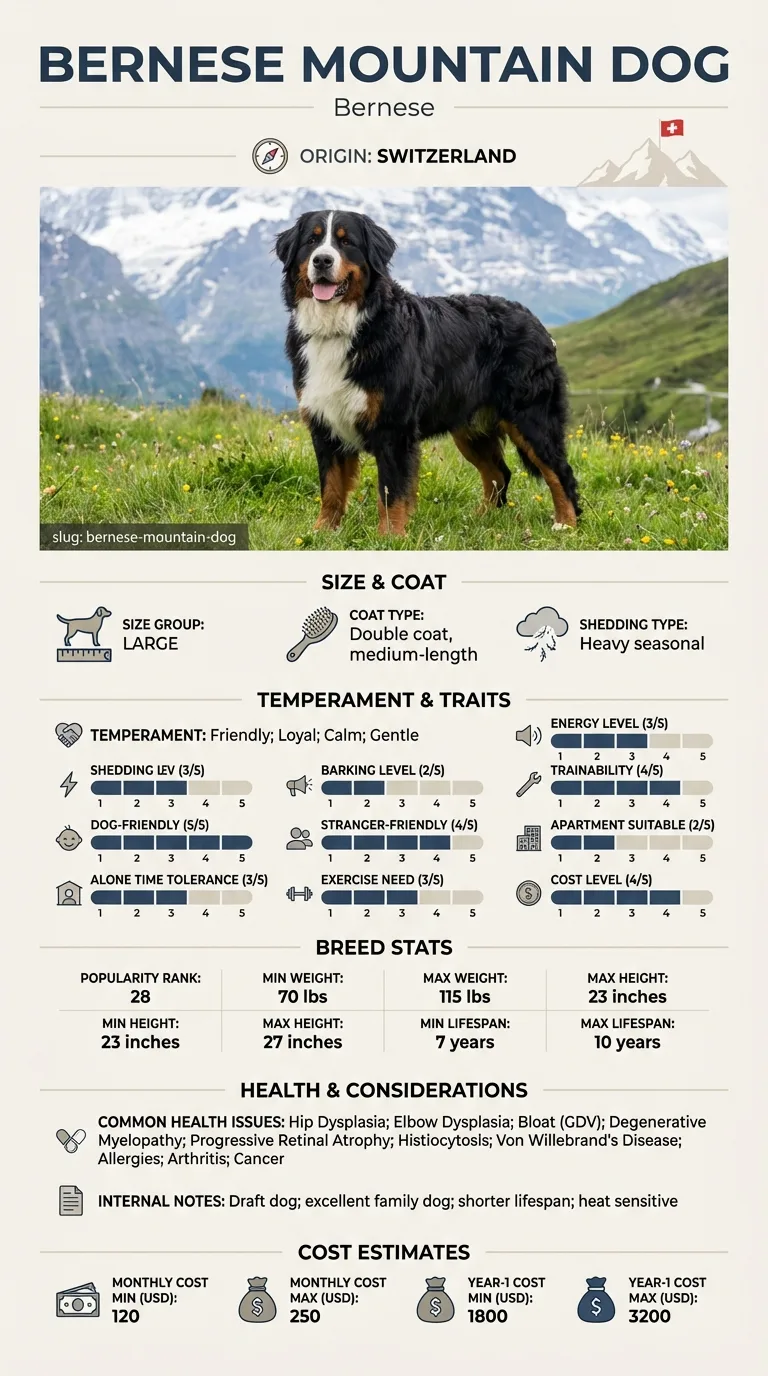
Two features of the breed shape how murmurs behave here. First, congenital narrowing of the outflow tract below the aortic valve occurs in large working breeds and produces exactly the kind of loud, early-life murmur that needs investigation, and it clusters in family lines rather than appearing randomly. Second, the Bernese chest is deep and heavily muscled for a draft breed built in Switzerland to pull carts, which physically distances the heart from the stethoscope and can make an important murmur sound softer than it is.
Environment does not create murmurs, but it changes what you hear. A hot examination room raises a heat-sensitive dog's heart rate and can make a mild murmur audible when it would not be on a cool morning. Excitement does the same. Severe anemia from parasites or blood loss, and high fever from an infection, both produce genuinely new murmurs that resolve once the underlying problem is treated, which is why bloodwork often accompanies the first murmur workup.
A murmur on its own is a scheduling matter, not an emergency. What turns it urgent is company: any dog with a murmur who faints, collapses, has bluish or very pale gums, breathes hard while resting, or becomes suddenly weak needs to be seen the same day. In a puppy, a loud murmur combined with poor growth, tiring far faster than littermates, or reluctance to play is also a same-week priority rather than something to raise at the next vaccine visit.
Start here: Bernese Mountain Dog Most Common Genetic Disorders
See all Bernese Mountain DOG health problems, which breeds are prone to heart murmurs, or the full Bernese Mountain DOG breed guide for temperament, exercise needs and ownership costs.
The uncertainty phase is short if you push it. Most owners can get an echocardiogram booked within two to four weeks of a referral, and the result is usually definitive on the day. After that the timeline splits: innocent murmurs need nothing, mild structural findings get a recheck in six to twelve months, and significant defects move into an ongoing management plan with its own schedule.
Success is knowing. A murmur with a name attached stops being frightening and becomes a number on a chart that either changes or does not. For most Bernese owners the successful outcome is a mild finding, a recheck interval, and a dog who lives an entirely normal life while carrying a sound that never means anything.
Murmurs are graded one to six by loudness. Ask which grade your dog was given and have it written in the record, because the trend between visits carries more information than any single number.
This is the most common way a Bernese murmur is discovered, and it is also the moment when owners feel most pressured to decide quickly. The honest position is that a newly discovered murmur is a good reason to pause an elective procedure, and not usually a reason to cancel it forever.
Anesthesia lowers blood pressure and changes how hard the heart has to work. A heart with a structural defect has less room to absorb that change. Knowing what the murmur represents lets the anesthesia protocol, the fluid rate and the monitoring be adjusted before rather than during the procedure.
For an elective surgery, most veterinarians will recommend imaging the heart first. For a genuinely urgent procedure, the calculation changes and the team may proceed with extra monitoring. What you should ask directly is whether the procedure can wait a few weeks, and whether the practice can perform or refer for a cardiac ultrasound.
One breed-specific note: Bernese Mountain Dogs are large enough that anesthetic drug volumes and recovery times already differ from what a general practice handles daily, and the breed's heat sensitivity makes a long warm recovery period less comfortable than it would be for a short-coated dog. Both are reasons to want the cardiac picture clear beforehand.

Hugo was seven months old, 78 pounds and booked for a routine neuter. At the pre-anesthetic exam the vet paused, listened again on both sides of the chest, and put a grade three next to his name. His owners had never been told about a murmur at any earlier visit. The practice recommended postponing and referred him for imaging. The cardiologist found a mild outflow narrowing, well within the range that needed no medication and no exercise restriction, but enough that the anesthetic protocol was adjusted and blood pressure monitored more closely. Hugo was neutered five weeks later without incident. He is four now, walks a normal amount, and has an annual recheck that has shown no change in three years.
Key takeaway: A murmur discovered before anesthesia is a piece of luck, not a disaster. The delay it causes is usually measured in weeks, and the information it buys shapes the safety of every procedure your dog has afterwards.
Some do. Innocent flow murmurs are common in growing puppies, usually soft, and typically gone by around four to six months as the chest and circulation mature. A murmur that persists past six months, or that gets louder rather than quieter across visits, is not being outgrown and should be imaged.
An echocardiogram, which is an ultrasound of the heart, usually performed by a cardiologist or a trained sonographer. It shows the valves, the chamber sizes and the direction of blood flow. Chest radiographs and blood tests add context but do not identify the cause of a murmur on their own.
Yes, and a new murmur in an adult or senior dog is generally more concerning than one found in a puppy. It suggests something has changed: a valve has begun leaking, a chamber has enlarged, or in some cases severe anemia or fever is producing turbulent flow. It deserves investigation rather than annual monitoring.
No. Plenty of dogs live full lives with a stable, mild murmur that never progresses. The murmur is a signal to find out what is underneath. Once you know that, your veterinarian can tell you whether the realistic path is monitoring, medication, or nothing at all.
Not without a cardiologist evaluation first. Congenital defects that cause murmurs in this size of dog have a heritable component, and passing them into a breed already carrying a short lifespan and a heavy health load is a real cost. Responsible Bernese breeders screen breeding stock for exactly this reason.
Not until you know what it is. Restricting a large growing dog's activity on the basis of an unexplained sound costs him muscle and joint conditioning that this breed genuinely needs. Get the imaging, then set the exercise plan from the finding rather than from the sound.
In most regions a specialist echocardiogram runs several hundred dollars, more in large metro areas or if sedation and radiographs are added. It is a one-time diagnostic in many cases, and it often prevents repeated uncertainty and repeated visits, which is worth weighing against the sticker price.
No. A soft murmur in a young puppy with normal energy, normal growth and no fainting is usually monitored at the next scheduled visit rather than investigated urgently.
Postpone rather than cancel, and ask for cardiac imaging first. An elective procedure can nearly always wait a few weeks for a clear answer.
Usually not. Only the loudest grades produce a vibration you can feel through the chest wall, and a Bernese double coat makes even that harder to detect than in a short-coated dog.
Three things: what grade is it, where on the chest is it loudest, and does it need imaging now or at the next visit. Get the answers written into the record.
It can. Once a murmur is documented, related cardiac conditions may be treated as pre-existing by a new policy, which is why insuring a Bernese in puppyhood is worth more than insuring one later.
A one-page prep sheet for this condition: the signs, the questions to ask, what to get priced. Unlocks here.
You get: Vet visit prep sheet
No spam. One-click unsubscribe. See our privacy policy.
Preview page 1 before you decide.