Health
How long is recovery after kneecap surgery in a large dog?
About twelve weeks to a controlled return to normal activity, with the first two weeks in strict confinement and physiotherapy through the middle stretch.

Quick answer
How long is recovery after kneecap surgery in a large dog?
About twelve weeks to a controlled return to normal activity, with the first two weeks in strict confinement and physiotherapy through the middle stretch.
In a fifteen pound dog the calculation leans toward waiting. In a ninety pound dog it does not, because the forces running through that joint are simply larger.
Owners who have been offered surgery for a Bernese and are weighing cost, recovery and benefit, and owners partway through a post-operative confinement wondering whether it is going well.
This guide is not medical advice. If your dog shows pain, sudden behavior change, or worsening symptoms, consult a licensed veterinarian.
Some links may be affiliate links. We may earn a commission at no extra cost to you. We only suggest products we believe are helpful for dog owners.
We research and check what we publish, but we do not warrant that any figure, date, price, or statement is accurate, complete, or current, and we accept no liability for any loss, cost, injury, or other harm arising from the use of this site. Use it as one reference among several. You remain responsible for your own decisions and for your dog's care - confirm anything that matters with a licensed veterinarian or another qualified professional before you act on it. Full disclaimer.
Patellar luxation surgery corrects the several anatomical faults that allow a kneecap to leave its groove: a groove that is too shallow, a tendon attachment sitting off centre, and unbalanced soft tissue tension on either side. The decision to operate rests on function and pain rather than on the grade alone, and in a large breed the threshold is lower because of the forces the joint carries. Recovery runs roughly twelve weeks.
Patellar luxation itself is far more prevalent in small breeds, and it does not appear on the Bernese Mountain Dog's documented health issue list. Surgery in this breed is correspondingly uncommon. Where it is undertaken, it is usually because a large dog with even a moderate grade is accumulating joint damage faster than a small dog with the same finding would, and because the alternative is arthritis in a breed already documented as prone to it.
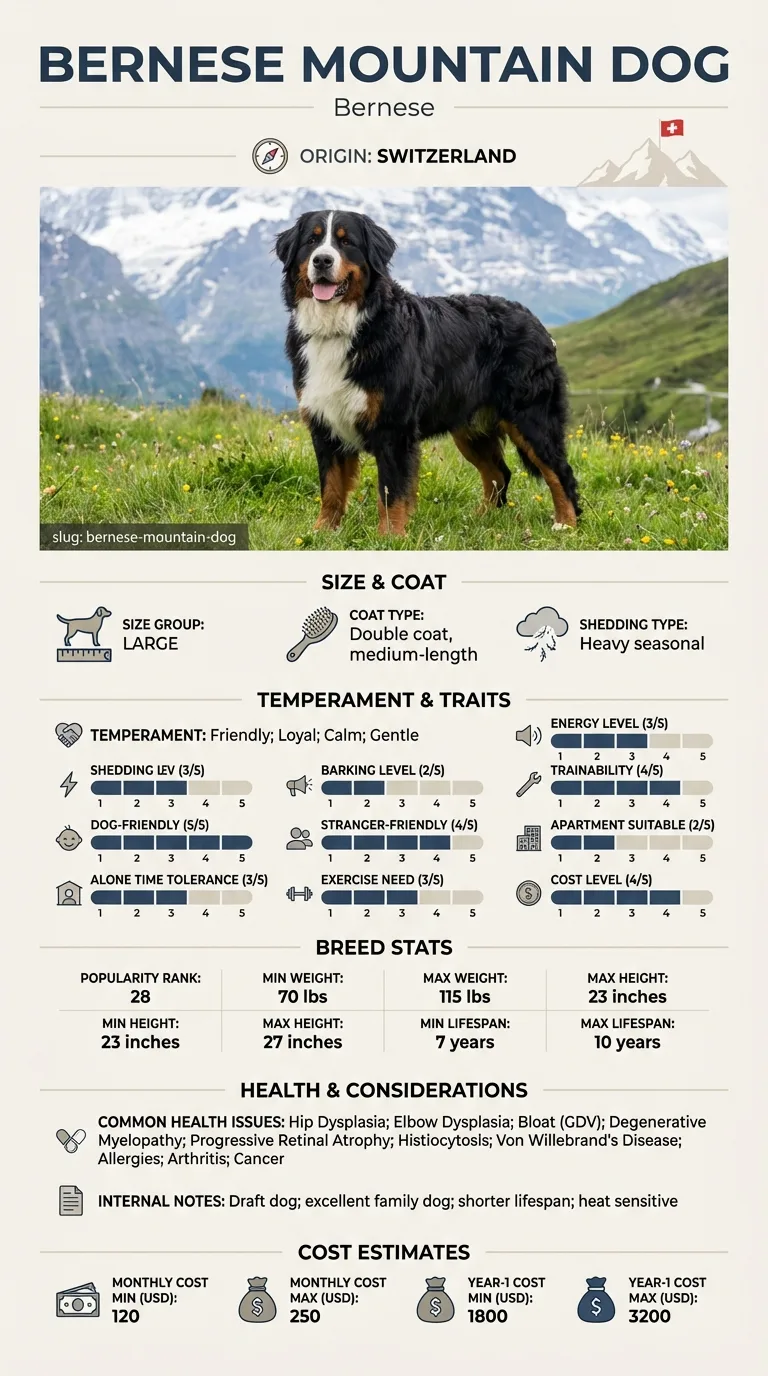
The surgical calculation in this breed turns on mass. A Bernese carrying 70 to 115 pounds transmits substantially more force through the stifle with every stride than a small dog does, which accelerates cartilage wear from an unstable kneecap and raises the stakes of leaving it alone. Size also complicates the repair itself, since implants and bone fragments must withstand greater loading during healing, and it makes post-operative complications more likely. The breed's documented tendency to arthritis is the long-term consequence being avoided.
The home environment determines how well a recovery goes more than most owners realise. A house with stairs between the dog's bed and the door makes strict confinement nearly impossible. Slippery flooring risks a sudden splay that can undo weeks of healing in a moment. Access to a hydrotherapy pool within reasonable driving distance changes what rehabilitation is realistically available. These practicalities are worth assessing before scheduling surgery rather than after.
During recovery, contact the surgical team the same day if the wound becomes swollen, hot, discharging or opens, if your dog suddenly cannot bear weight on the operated leg after having been using it, if he becomes lame again after a fall or a slip, or if he seems in pain despite the prescribed medication. Before surgery, seek prompt assessment for any sudden severe hind limb lameness in a large dog, since abrupt non-weight-bearing lameness raises the possibility of cruciate rupture rather than a luxating kneecap.
Start here: Bernese Mountain Dog Most Common Genetic Disorders
See all Bernese Mountain DOG health problems, which breeds are prone to patellar luxation, or the full Bernese Mountain DOG breed guide for temperament, exercise needs and ownership costs.
Twelve weeks is the working figure to a controlled return to normal activity, with the first two in strict confinement and a recheck radiograph around six to eight weeks where bone has been moved. Full remodelling and strength continue for several months beyond that. Where both knees need attention, the whole sequence repeats after a gap of several months, so a bilateral case is realistically a year-long project for the household.
Success is a dog who walks and trots without the hitch, bears weight evenly, has rebuilt the muscle on the operated side to match the other, and returns to normal walks without lameness the following day. It is not a knee that will never develop arthritis. In a breed already prone to joint disease, the honest goal is a stable joint that ages slowly rather than a joint restored to factory condition.
Surgery does not simply push the kneecap back and hold it there. It addresses the reasons it will not stay, and there are usually several, which is why the procedure is a combination rather than a single technique.
Deepening the groove is the most intuitive component. The channel at the end of the femur that the kneecap should run in is often too shallow, and a wedge or block of cartilage and bone is recessed to make it deeper without damaging the sliding surface.
Moving the attachment point is often necessary too. The tendon below the kneecap attaches to a bony prominence on the shin, and if that prominence sits off centre it drags the kneecap sideways with every step. Surgeons detach it, move it into alignment and pin it back. In a large dog this is the part that dictates much of the recovery, because a piece of bone has to heal.
Tightening or releasing the soft tissue on either side balances the pull across the joint.
A surgeon will select from these based on what they find. That is also why cost estimates vary and why an accurate quote often depends on assessment under anaesthetic.
Weight matters at every stage of this. A heavier dog puts more force through a repair that is healing, which is why post-operative restriction is stricter in a Bernese than the recovery advice written for small dogs would suggest, and why surgeons frequently want weight reduced before they operate rather than after.
The recovery is longer and physically harder than most owners expect, largely because confining and supporting a dog of 70 to 115 pounds is a genuine daily task rather than a matter of shutting a crate door.

If you think your Bernese has patellar luxation, the plan is three steps: write down what you have seen and when it started, book a veterinary appointment rather than waiting for the next flare, and take video of the behaviour or symptom before you go — the thing you are worried about rarely happens in the consulting room. Screening in the parents covers hip dysplasia, elbow dysplasia, bloat (gdv).
What the vet visit should produce is a diagnosis and a written plan, not just reassurance: what is being ruled out, what the monitoring interval is, and which signs mean you come back sooner. Ask what the treatment costs across a year rather than per visit, because that is the number that decides whether you are managing this condition or reacting to it.
Between appointments, keep a short log — dates, what you saw, what changed. It is the single most useful thing an owner brings to a follow-up, and for patellar luxation it is often what separates a clear pattern from a guess.
Rosa was four when she was assessed for persistent lameness that had not improved across three months of weight loss and hydrotherapy. Her surgeon found a grade three lateral luxation on the left and a grade two on the right, and recommended operating on the worse side first. Her family spent the fortnight before surgery preparing: they cleared a ground floor room, laid rubber matting, taught her to walk in a support harness, and bought four different puzzle feeders. The left knee was operated on in February. She was confined for two weeks, walked on a lead for six, and back to normal by mid-May. The right knee followed in October. What her owners describe as the hardest part was not the surgery or the cost. It was keeping a friendly ninety pound dog quiet in a small room while the rest of the household carried on around her.
Key takeaway: The surgical outcome is decided partly in the operating theatre and partly in a hallway at home. Households that prepare the space, the harness and the enrichment before the operation report far easier recoveries than those that improvise afterwards.
There is no fixed threshold, but the bar is generally lower than for a small dog. Persistent lameness, pain on examination, or a grade that has increased between assessments all push toward surgery in a heavy breed, because the cumulative cartilage wear from an unstable joint is greater when there is more weight travelling through it.
Expect a four-figure sum per knee in most regions, with the total influenced by which combination of techniques is needed, by imaging, and by whether a specialist orthopaedic surgeon is involved. Physiotherapy afterwards adds meaningfully. Confirm with your insurer beforehand whether both knees would count as one condition against your limit.
It is occasionally offered but is rarely advisable in a very large dog, because a Bernese recovering from bilateral stifle surgery cannot support himself adequately during the early weeks. Staged surgery, with a gap of several months, is the more usual recommendation and produces a more manageable recovery for the household.
The recognised complications include the pin or implant loosening, the moved bone fragment failing to heal properly, infection, and recurrence of the luxation. Complication rates are generally higher in large dogs than small ones, which is a reason to take the confinement instructions seriously rather than negotiating with them.
Most dogs return to comfortable normal activity, and that is a realistic goal. What surgery does not do is undo cartilage damage that has already accumulated, so a dog operated on late will usually carry more arthritis than one operated on early. That is the main argument against waiting to see how it goes for another year.
Yes for low grades and mild signs. Weight reduction to the lean end of the range, targeted building of the quadriceps and gluteal muscles through controlled exercise and hydrotherapy, non-slip flooring and prescribed pain relief can hold a mild case stable for years. It becomes inadequate when lameness persists despite genuine effort over a couple of months.
The early signs are set out in the sections above, and they are the reason to book a veterinary appointment rather than wait. Patellar Luxation in Berneses is diagnosed by a vet, not from a symptom list, and the sooner it is on record the more options remain open.
The early signs are set out in the sections above, and they are the reason to book a veterinary appointment rather than wait. Patellar Luxation in Bernese Mountain Dogs is diagnosed by a vet, not from a symptom list, and the sooner it is on record the more options remain open.
About twelve weeks to a controlled return to normal activity, with the first two weeks in strict confinement and physiotherapy through the middle stretch.
Usually not in a heavy breed. A Bernese cannot support himself well on two recovering hind legs, so staged surgery months apart is generally safer.
Considerably. Surgeons often ask for it first, because less weight means less force through a healing repair and a lower complication risk.
Confining a large, sociable, mentally under-occupied dog for weeks. Plan scent games and food puzzles before the surgery rather than improvising afterwards.
A one-page prep sheet for this condition: the signs, the questions to ask, what to get priced. Unlocks here.
You get: Vet visit prep sheet
No spam. One-click unsubscribe. See our privacy policy.
Preview page 1 before you decide.