Health
What is the earliest sign of allergies in a Bernese?
Foot licking with rust-coloured staining on the white paw markings. It usually appears months before anyone notices skin changes elsewhere.

Quick answer
What is the earliest sign of allergies in a Bernese?
Foot licking with rust-coloured staining on the white paw markings. It usually appears months before anyone notices skin changes elsewhere.
In a Berner, allergies are usually diagnosed from the ears and the feet, not from the back.
Owners of Berners between one and four years old, when atopic disease typically declares itself, and anyone who has already treated the same ear three times in a year and been told it is 'just an ear infection' each time.
This guide is not medical advice. If your dog shows pain, sudden behavior change, or worsening symptoms, consult a licensed veterinarian.
Some links may be affiliate links. We may earn a commission at no extra cost to you. We only suggest products we believe are helpful for dog owners.
We research and check what we publish, but we do not warrant that any figure, date, price, or statement is accurate, complete, or current, and we accept no liability for any loss, cost, injury, or other harm arising from the use of this site. Use it as one reference among several. You remain responsible for your own decisions and for your dog's care - confirm anything that matters with a licensed veterinarian or another qualified professional before you act on it. Full disclaimer.
Allergic skin disease in a Bernese is an inherited fault in the skin barrier plus an immune system that overreacts to ordinary proteins in the air and the diet. The visible result is itch. The expensive result is the infections that follow, because a dense double coat traps the warmth and moisture those organisms need.
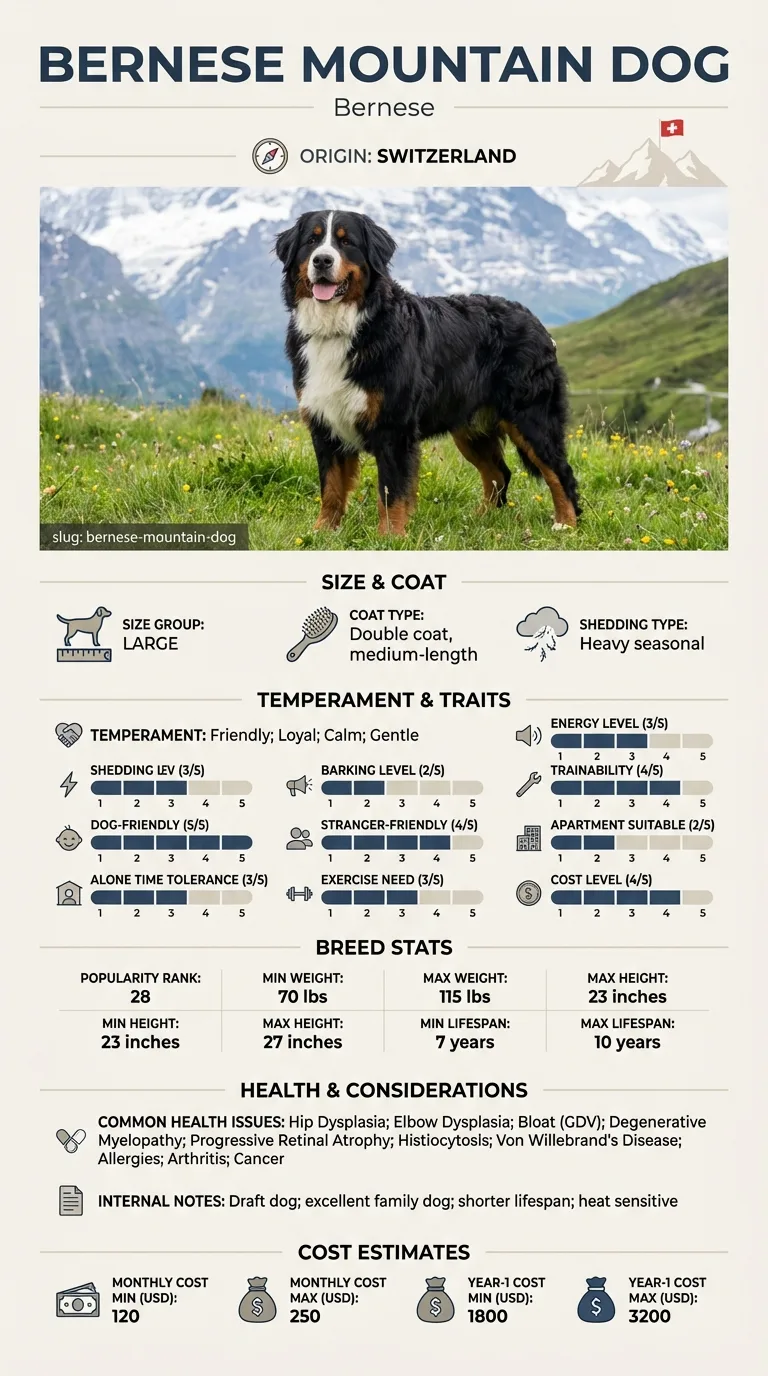
Allergies sit on the Bernese Mountain Dog's documented health issue list, and skin complaints are among the most frequent reasons any large breed is brought to a general practice. Most affected Berners fall into the mild-to-moderate band, where the disease is a management routine rather than a crisis.
Two breed traits combine badly. The first is the documented allergic tendency itself. The second is the coat: a double coat of medium length with a dense undercoat and heavy seasonal shedding holds moisture against the skin and hides early changes, so problems are found later and treated in a worse state.
Indoor heating raises dust mite exposure through winter. Rugs, dog beds that are not washed hot, and food scooped from a bag left open all add load. Because a Bernese is bred for cool climates and often given a shady, damp resting spot in summer, that favourite corner can itself become the moist microclimate the skin cannot cope with.
Book promptly if an ear is painful enough that your dog will not let you touch that side of the head, if there is discharge with a strong smell, or if you see a sudden head tilt, loss of balance or a change in how the dog hears you, which can mean the disease has moved deeper than the outer canal. Book the same day for skin that is raw, weeping or hot to the touch, since that is infection rather than itch. Any itchy dog who has stopped sleeping through the night needs a plan review, because sleep loss is the clearest sign that current control has failed.
Chronic itch is managed, not cured. These habits are the ones that quietly keep a Bernese stuck in the cycle.
Start here: Bernese Mountain Dog Most Common Genetic Disorders
See all Bernese Mountain DOG health problems, which breeds are prone to allergies, or the full Bernese Mountain DOG breed guide for temperament, exercise needs and ownership costs.
Secondary infections clear in two to four weeks with treatment. Judging whether the underlying plan works takes a full season, and a diet trial takes eight to twelve weeks before it means anything.
Fewer than two ear flares a year, a dog who sleeps through the night without scratching, and clean skin between the toes. Not zero itch.
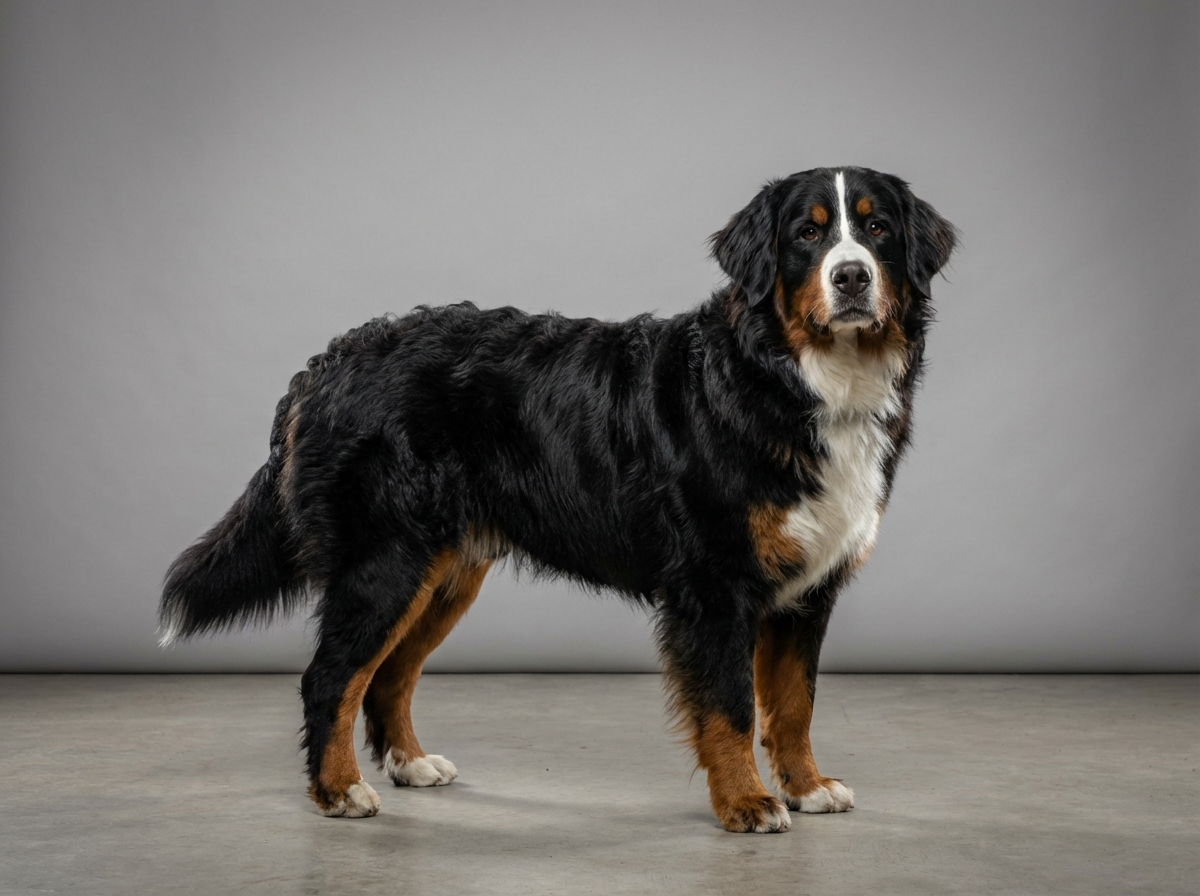
Atopic itch has a predictable geography in dogs, and on a Berner it lands in the places the coat is thinnest and the air moves least. The feet come first: licking between the toes, rust-coloured saliva staining on white paw markings, and a yeasty smell when you cup a paw and sniff. Because the front feet are white on most Berners, this staining is unusually easy to spot on this breed.
The ears come next. Berners carry drop ears with a good covering of hair, so the canal is warm, shaded and poorly ventilated. Allergic inflammation swells the canal lining, drainage stops, and organisms that live there harmlessly begin to multiply. Head shaking, a sour smell, or a dog who tilts away when you touch one side of the head are the signals.
The armpits, groin and belly are third, and these are where you should look with your eyes rather than your hands. Part the hair and look for pink skin, small raised bumps or dark thickened patches. Thickened, elephant-like skin means the process has been running for months.
The topline is usually last and least informative. A Bernese can be genuinely uncomfortable with almost nothing visible on the back, which is why owners often report the problem late.

Heidi, a two-year-old Berner, had been treated three times in fourteen months for the same left ear. Each course worked, and each time the ear came back within a few months. On the third visit her vet ran cytology, noted the pink webbing between her white front toes, and named the pattern: allergic otitis, not recurring bad luck. Her owner Marcus started year-round flea control, moved her food into a sealed bin, began drying her properly after wet walks, and taught her to rest her chin in his hand for ear cleaning. Heidi still itches in August. She has had one ear flare in the two years since.
Key takeaway: The turning point was reframing the ear as a symptom. Once the underlying allergy was managed, the ear stopped being a standalone problem to treat every few months.
Environmental atopy typically declares itself between six months and three years. A dog whose itch begins after six or seven years of age is more likely to have something else going on, so late-onset itch deserves a fuller workup rather than an assumption of allergy.
Environmental allergy is far more common in dogs. Food reactions are more likely when the itch runs all year at the same intensity, or when skin signs come with soft stool. The only way to tell is a strict eight to twelve week diet trial supervised by your vet.
Because the ear canal is skin, and it is allergic skin like the rest. Drop ears with hair coverage hold heat and moisture, so once inflammation narrows the canal, infection follows. Controlling the allergy is what stops the cycle; treating the ear alone only resets it.
No. The double coat insulates against heat as well as cold, and clipping it can leave the regrown coat patchy. If matting is trapping moisture, work with a groomer on thinning and thorough drying instead of taking the length off.
It varies with severity, but expect an ongoing rather than one-off expense: rechecks, ear cytology, medicated shampoo and prescription therapy. The Bernese is already a higher-cost breed to own, and chronic skin work is one of the reasons owners are advised to budget above the breed's baseline.
No. Atopic disease is lifelong and managed. What changes with good management is the frequency of flares, the number of secondary infections, and whether the dog sleeps through the night. Owners who accept that early do far better than those chasing a cure.
Foot licking with rust-coloured staining on the white paw markings. It usually appears months before anyone notices skin changes elsewhere.
Follow your vet's medicated shampoo schedule, often weekly during a flare. What matters as much as frequency is drying the undercoat completely afterwards.
In a dog with no swimming or foreign-body history, three or more ear infections in a year points strongly at underlying allergic disease.
No. Grain is an uncommon trigger, protein sources matter more, and grain-free formulations have their own concerns in large breeds. Change diet only with veterinary guidance.
Not directly, but teaching a calm, cued handling routine makes ear cleaning and foot soaks possible without a wrestling match, which is what keeps a plan sustainable.
A one-page prep sheet for this condition: the signs, the questions to ask, what to get priced. Unlocks here.
You get: Vet visit prep sheet
No spam. One-click unsubscribe. See our privacy policy.
Preview page 1 before you decide.