Health
How do I measure my dog's craniofacial ratio at home?
Measure the stop to the nose tip, then the stop to the back of the skull, and divide the first by the second. Do it on a calm, square-standing dog.

Quick answer
How do I measure my dog's craniofacial ratio at home?
Measure the stop to the nose tip, then the stop to the back of the skull, and divide the first by the second. Do it on a calm, square-standing dog.
You can settle this question in your own kitchen in about a minute, with a tape measure.
Owners who have noticed their Bernese has a shorter, blockier muzzle than others they have seen, and owners of a snoring Berner wondering whether the head shape explains it.
This guide is not medical advice. If your dog shows pain, sudden behavior change, or worsening symptoms, consult a licensed veterinarian.
Some links may be affiliate links. We may earn a commission at no extra cost to you. We only suggest products we believe are helpful for dog owners.
We research and check what we publish, but we do not warrant that any figure, date, price, or statement is accurate, complete, or current, and we accept no liability for any loss, cost, injury, or other harm arising from the use of this site. Use it as one reference among several. You remain responsible for your own decisions and for your dog's care - confirm anything that matters with a licensed veterinarian or another qualified professional before you act on it. Full disclaimer.
Brachycephaly means a shortened skull in which soft tissue is compressed into less space than it needs, crowding the airway. Assessing whether a dog has that shape is a matter of proportion, not appearance, and it can be estimated at home before any veterinary conversation begins.
Genuine brachycephalic conformation is essentially absent from this breed. Owner concern about it, on the other hand, is common, usually prompted by snoring or by the summer panting that this heavily coated breed does in any case.
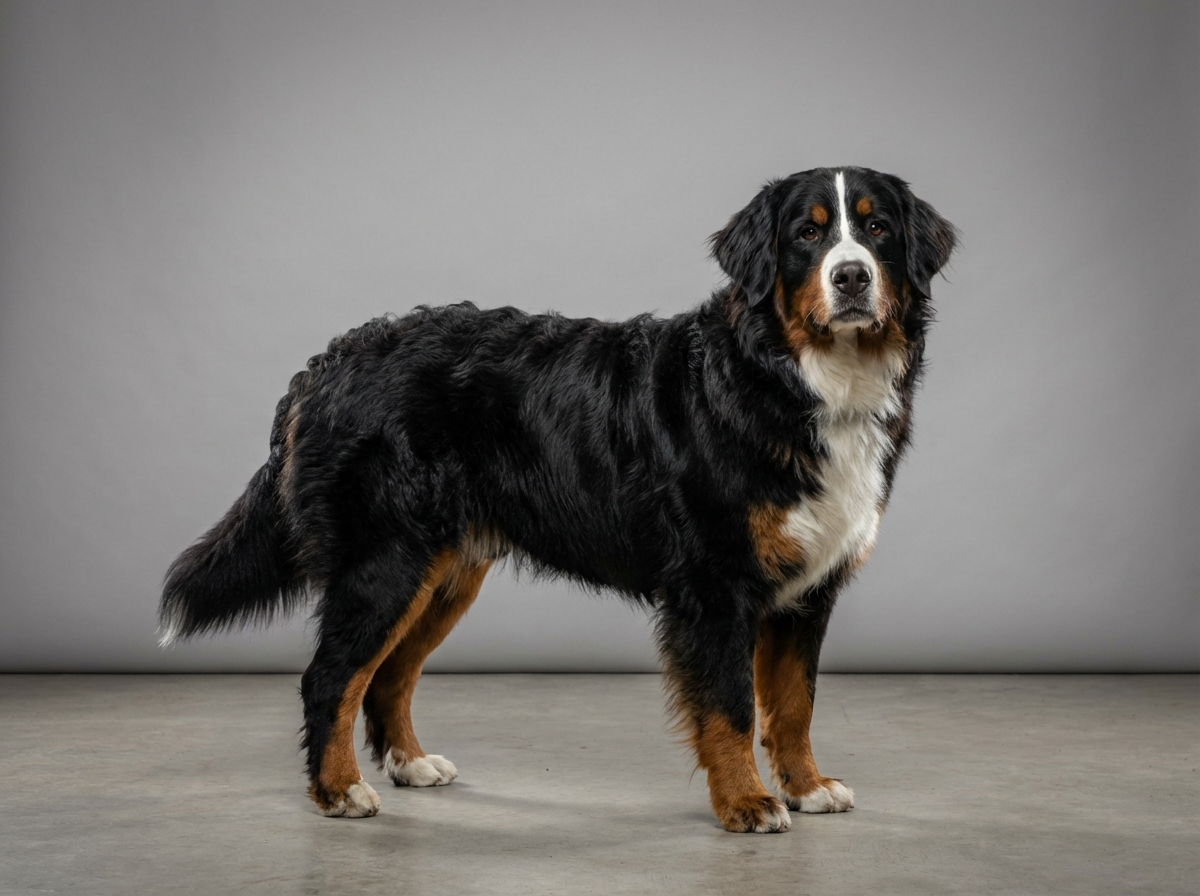
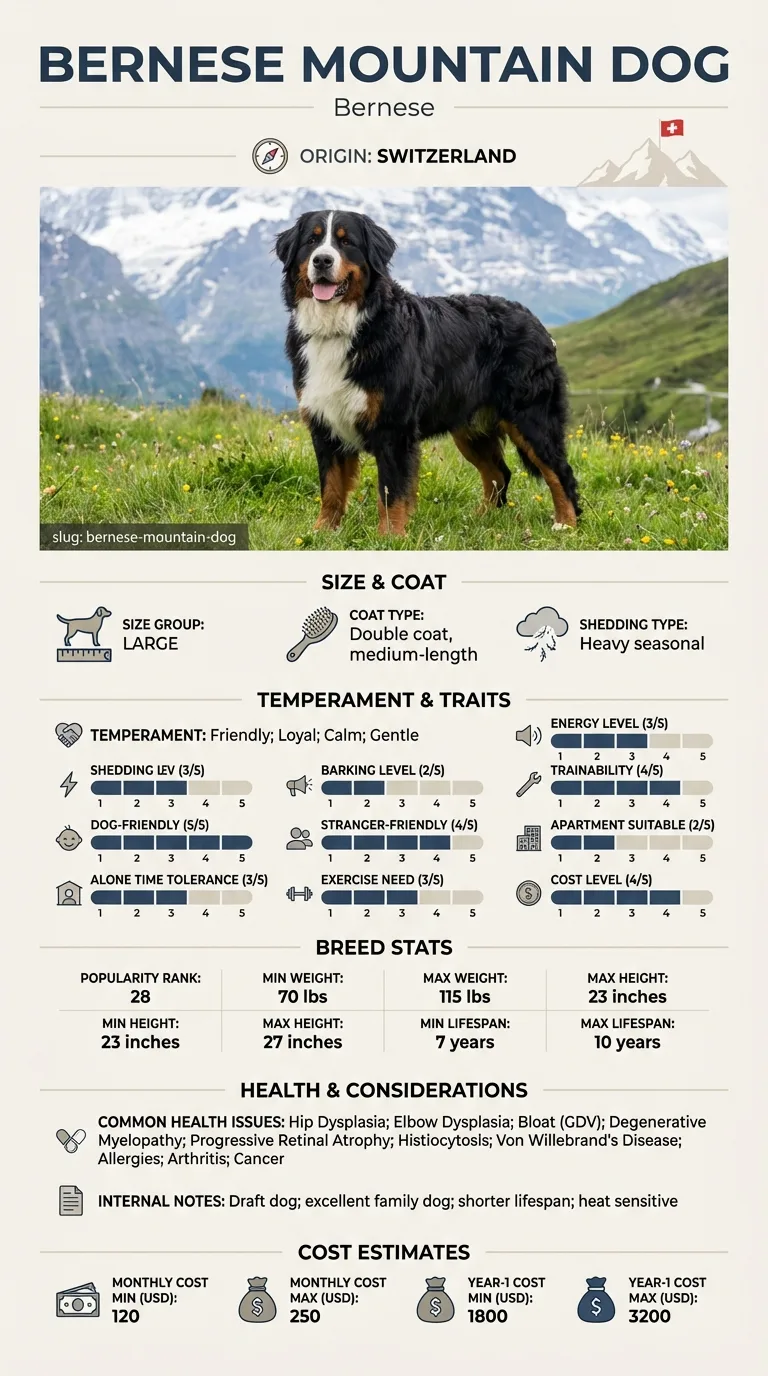
The Bernese was developed in Switzerland as a farm and draft dog, and its head reflects that history: a strong muzzle of good length with a moderate stop, sized for carrying and gripping rather than for appearance. Nothing in the breed's development selected for facial shortening, and no airway condition of that type appears on its documented health list.
What varies from home to home is weight and air quality. An overweight dog carries fat in the throat tissues and breathes more noisily. Dry indoor heating, dust and allergens inflame the nasal lining and change the sound of breathing. Both are frequently mistaken for structural problems.
Book urgently for breathing that is noisy while the dog is awake and at rest, for any blue or grey tinge to the gums or tongue, for a change in the sound of the bark, or for a dog that panics or collapses while trying to breathe. Those signs point to the larynx or the windpipe and can escalate quickly, particularly in warm weather. Book a routine appointment if your home measurement is unusual, if nostrils appear pinched or collapse on inhalation, or if snoring is new or clearly worsening month by month. Bring your video.
This is one of the few structural questions an owner can partly assess at home, provided the assessment is done properly.
Start here: Bernese Mountain Dog Most Common Genetic Disorders
See all Bernese Mountain DOG health problems, which breeds are prone to brachycephalic features, or the full Bernese Mountain DOG breed guide for temperament, exercise needs and ownership costs.
The measurement takes minutes. If it prompts a veterinary examination, an airway assessment is generally a single appointment, with sedated examination only if findings justify it.
A clear answer about your own individual dog rather than a general breed statement, and a decision about whether anything further is needed.
The measure researchers use is the craniofacial ratio: the length of the muzzle from the stop, the step between the forehead and the bridge of the nose, to the tip, divided by the length of the skull from the stop to the back of the head. Long-nosed breeds sit high on this ratio. Flat-faced breeds sit very low, often below a fifth. Working breeds of moderate proportion cluster in between.
To take it at home, stand your dog square with its head level. Find the stop with a fingertip. Measure forward to the tip of the nose, then backward along the top of the skull to the bony ridge at the rear. Write both numbers down and divide. Take the measurement twice on different days, since your technique will improve.
The Bernese Mountain Dog is described as having a strong muzzle of good length with only a moderate stop. This is not a shortened-face breed and never has been. The head was bred for a farm dog that pulled carts, guarded and worked outdoors in Switzerland, and none of those jobs favoured a compressed skull.
What is worth checking regardless of ratio is the nostrils. Look at your dog's nose head-on in good light. The openings should be visibly open ovals rather than narrow slits, and they should not collapse inward when the dog inhales sharply. Pinched nostrils increase the work of breathing in any dog. If your dog's are narrow, or if you hear noise at rest, take a photograph and a short video and raise it at your next appointment.

Fritzi's owner Danielle had convinced herself, from photographs on a forum, that her Berner's muzzle was unusually short and that this explained his snoring. She measured him on a quiet Sunday: stop to nose, stop to occiput, and worked out the ratio. The number was entirely ordinary for a moderate working breed. What she did notice while doing it was that Fritzi had gained weight over the winter and that his snoring had started around the same time. Her vet agreed, put him on a measured diet, and the snoring reduced markedly over three months without any airway investigation at all.
Key takeaway: Measuring turned a vague anxiety into a specific finding, and the specific finding pointed somewhere completely different from where Danielle had been looking.
No. It is a moderately proportioned breed with a strong muzzle of good length, developed for outdoor working use in Switzerland. Airway obstruction from skull shape is not among its documented health issues, which concern joints, bloat, neurological and eye disease, bleeding disorder, allergies, arthritis and cancer.
Measure it properly rather than judging by eye, and check the nostrils at the same time. Individual variation exists in every breed. If the measurement is unusual for the breed, or if your dog makes noise at rest, that is worth a veterinary examination rather than online comparison.
Snoring can come from soft tissue vibrating anywhere along the upper airway, from sleeping position, from excess weight, or from nasal inflammation. It is common and often harmless in large breeds, but noise that is new, that occurs while the dog is awake, or that has been worsening deserves examination.
Not meaningfully. The Bernese struggles in heat because of its size and its dense double coat, not because of its skull. A long-muzzled dog with the same coat and body mass would have the same difficulty, which is why cooling management matters more than any anatomical question.
Surgical widening of the nostrils exists and is performed routinely in flat-faced breeds. Whether it would benefit a particular Bernese is entirely a matter for veterinary assessment, and it would be a very unusual recommendation in this breed.
Choose on health testing first: hip and elbow scores, eye examination, and honest discussion of family history for bloat and cancer, which matter far more in this breed. A moderate, well-proportioned head is what the breed already produces, so it is rarely the deciding factor.
Measure the stop to the nose tip, then the stop to the back of the skull, and divide the first by the second. Do it on a calm, square-standing dog.
Open ovals that stay open on a sharp inhale. Narrow slits, or nostrils that collapse inward when the dog sniffs, are worth showing your vet.
Often, especially in a dog sleeping on its back or carrying extra weight. New, worsening or awake noise is the version that needs a veterinary opinion.
Skull-shape conditions are a known cost driver in flat-faced breeds, but not in this one. Budget instead for the joint, cancer and emergency risks documented for the Bernese.
Teach a chin rest with rewards over a few short sessions. It makes measuring, ear cleaning and veterinary examinations easier for years afterwards.
A one-page prep sheet for this condition: the signs, the questions to ask, what to get priced. Unlocks here.
You get: Vet visit prep sheet
No spam. One-click unsubscribe. See our privacy policy.
Preview page 1 before you decide.