Living
Which is the smaller breed?
The Shetland Sheepdog by a wide margin, at 15-25 lbs versus 70-115 lbs.

Quick answer
Which is the smaller breed?
The Shetland Sheepdog by a wide margin, at 15-25 lbs versus 70-115 lbs.
Bernese Mountain Dog or Shetland Sheepdog? On paper they differ most on barking, and on the scales Bernese Mountain Dog is the heavier at 70–115 lbs. Here is how the two compare on everything that shapes an ordinary week.
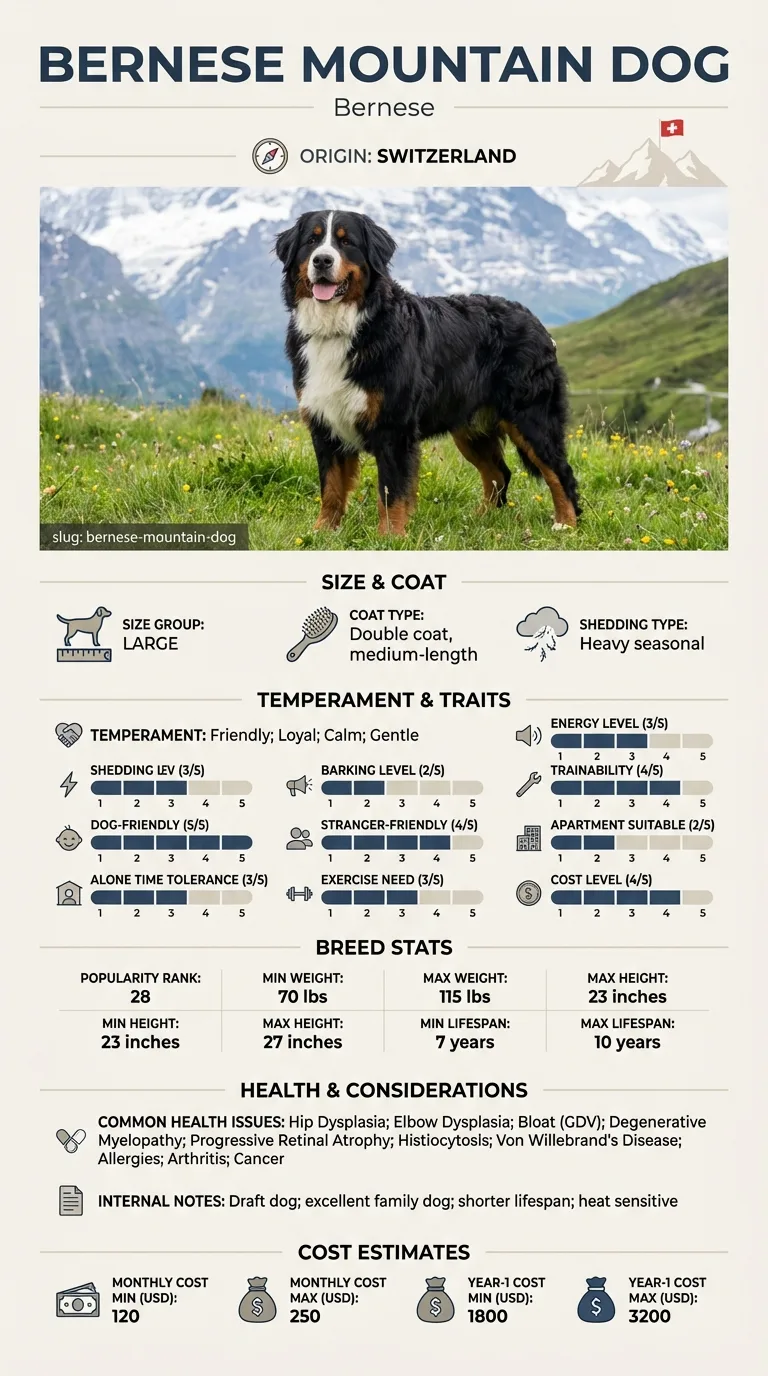
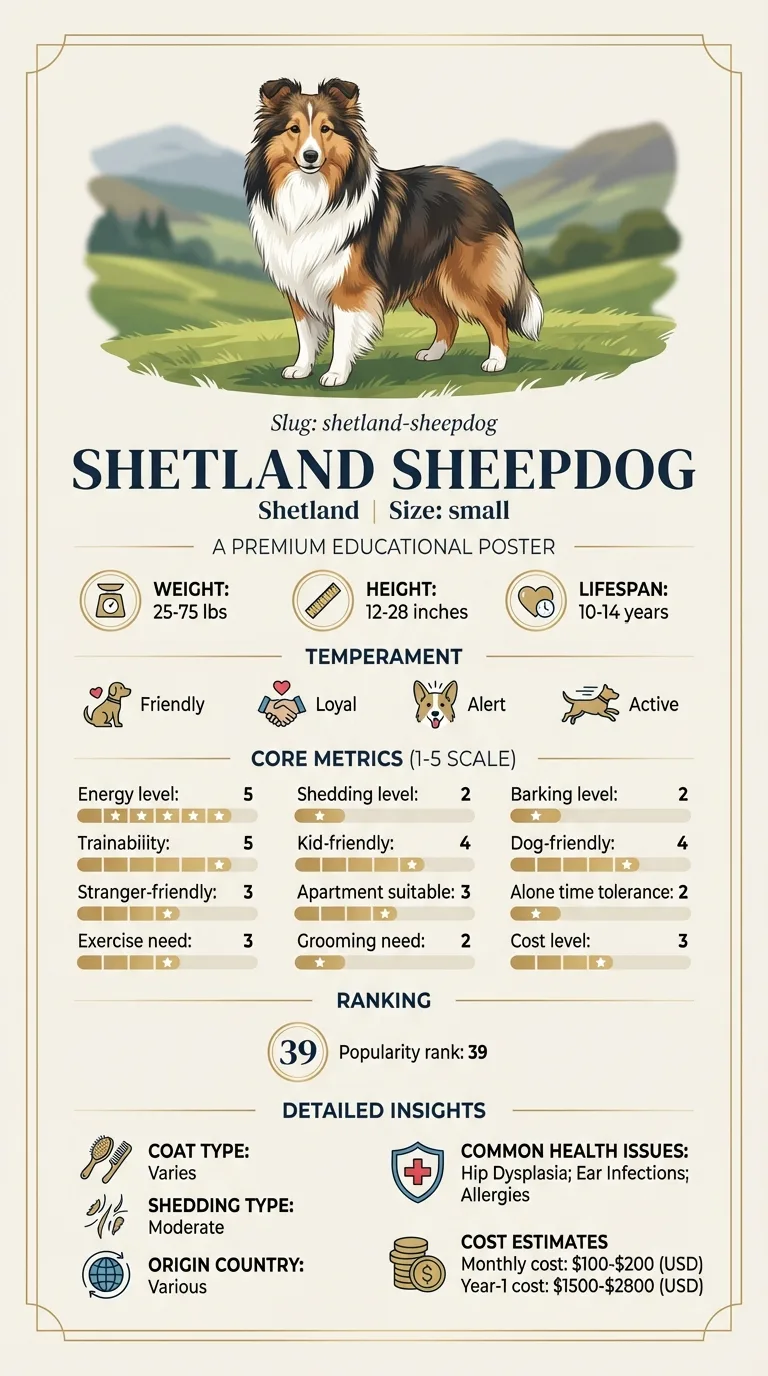
This is for someone already down to Bernese Mountain Dog and Shetland Sheepdog and deciding between them. For this pair the decision usually turns on barking and friendly to strangers, so those are covered first and in most detail. Anyone choosing from a flat has a clear answer here: Shetland Sheepdog rates 3/5 against 2/5. The focus throughout is on daily consequences rather than breed background.
Between Bernese Mountain Dog and Shetland Sheepdog, barking is what separates them, and Bernese Mountain Dog is the lower-effort dog of the two to keep.
Choose Bernese Mountain Dog if you do not want a standing grooming appointment, your walking routine is modest and the dog will be alone during the working day.
Choose Shetland Sheepdog if you are in a flat or a smaller home, you want a dog that picks up training quickly and a smaller dog suits your car, your home or your back.
| Feature | bernese mountain dog | shetland sheepdog | Winner |
|---|---|---|---|
| Size class | large | small | Equal |
| Weight | 70–115 lbs | 15–25 lbs | Equal |
| Height | 23–27 in | 13–16 in | Equal |
| Lifespan | 7–10 years | 12–14 years | shetland sheepdog |
| Exercise need | Moderate (3/5) | High (4/5) | bernese mountain dog |
| Grooming need | Moderate (3/5) | High (4/5) | bernese mountain dog |
| Shedding | High (4/5) | High (4/5) | Equal |
| Energy level | Moderate (3/5) | High (4/5) | Equal |
| Barking | Low (2/5) | Very high (5/5) | bernese mountain dog |
| Apartment suitability | Low (2/5) | Moderate (3/5) | shetland sheepdog |
| Good for first-time owners | High (4/5) | High (4/5) | Equal |
| Tolerates being alone | Moderate (3/5) | Low (2/5) | bernese mountain dog |
| Trainability | High (4/5) | Very high (5/5) | shetland sheepdog |
| Good with kids | Very high (5/5) | High (4/5) | bernese mountain dog |
| Good with other dogs | Very high (5/5) | High (4/5) | bernese mountain dog |
| Friendly to strangers | High (4/5) | Low (2/5) | bernese mountain dog |
| Cost level | High (4/5) | Moderate (3/5) | shetland sheepdog |
| Coat | Double coat, medium-length | Long, dense double coat | Equal |
| Origin | Switzerland | Various | Equal |
| Typical monthly cost | $120–$250 | $80–$150 | Equal |
| Typical first-year cost | $1,800–$3,200 | $1,100–$2,300 | Equal |
15 to 25 lbs. That is the entire weight range of a Shetland Sheepdog — smaller than one of the Bernese Mountain Dog's legs might suggest, given the Bernese runs 70 to 115 lbs and stands 23 to 27 in against the Sheltie's 13 to 16 in. This is one of the largest size gaps in any comparison: a full-grown Bernese can outweigh a Sheltie fivefold. That difference shapes nearly everything else about daily life with either dog, from how much floor space they need to how much force is behind an enthusiastic greeting at the door.
Despite its small frame, the Sheltie is the higher-energy dog of this pair, rated High (4/5) for both exercise need and energy level against the Bernese's Moderate (3/5) on each measure. Bred as a herding dog, the bright, devoted Sheltie wants purposeful daily activity — fetch, agility-style games, or brisk walks — not just a stroll around the block. The calmer Bernese asks for less. Owners assuming a small dog automatically means low exercise needs should reconsider with this particular breed, since the Sheltie's herding instincts keep it wanting to move.
Grooming demands run higher for the Sheltie too, rated High (4/5) against the Bernese's Moderate (3/5), owing to its long, dense double coat that mats easily without regular brushing. Shedding ties at High (4/5) for both breeds, so neither is a low-hair-around-the-house option despite the size difference. Anyone picturing a small dog as a lower-maintenance coat choice should know the Sheltie actually demands more consistent brushing sessions than the larger Bernese, even though the volume of hair it sheds is comparable.
Apartment suitability tips toward the Sheltie, Moderate (3/5) versus the Bernese's Low (2/5), but barking is where the Sheltie really stands out — rated Very high (5/5), the top score in this data set, against the Bernese's Low (2/5). A vocal, sensitive breed in a shared building can create real friction with neighbors regardless of its smaller footprint. The Bernese also tolerates being alone better, Moderate (3/5) versus the Sheltie's Low (2/5), making it the steadier choice for owners with unpredictable work schedules.
Both breeds are rated High (4/5) or better for first-time owners and score well on trainability, with the Sheltie reaching Very high (5/5) against the Bernese's High (4/5) — reflecting its herding-dog intelligence and devoted, bright temperament. The Bernese, though, ties the Sheltie at High (4/5) for first-timers, essentially matching it on beginner-friendliness. The practical difference is that the Sheltie's sensitivity means harsh corrections backfire quickly, while the Bernese's calm, friendly nature is more forgiving of an inconsistent training routine.
The Bernese edges ahead with kids and strangers, rated Very high (5/5) and High (4/5) respectively against the Sheltie's High (4/5) and Low (2/5) — that last figure reflecting the Sheltie's more reserved, watchful streak around unfamiliar people. Both score High (4/5) with other dogs. Families that host a lot of visitors or want a dog that warms quickly to guests will likely prefer the Bernese, while the Sheltie's more selective friendliness suits a quieter household that is not looking for an instant greeter at the door.
The Sheltie lives notably longer, 12 to 14 years against the Bernese's 7 to 10 — roughly a four-year edge. Health-wise, the Bernese's list is twice as long at ten conditions, including Bloat (GDV), Degenerative Myelopathy, and Histiocytosis, while the Sheltie's five flagged concerns include Collie Eye Anomaly, MDR1 Drug Sensitivity, and Dermatomyositis, conditions tied closely to its herding-breed ancestry. Sheltie owners should specifically ask breeders about MDR1 status before administering certain medications, since that sensitivity can affect drug safety in ways unrelated to anything on the Bernese's list.
The Sheltie is meaningfully cheaper to keep, rated Moderate (3/5) for cost against the Bernese's High (4/5), with monthly costs of $80-$150 versus $120-$250 and first-year costs of $1,100-$2,300 compared to $1,800-$3,200. Smaller body size means less food and typically smaller medication doses, and that gap compounds over a Sheltie's longer 12-14 year lifespan. Budget-conscious buyers who still want a coated, alert companion will find the Sheltie the more economical choice across nearly every cost category in this data.
Bernese Mountain Dog weighs 70–115 lbs and lives 7–10 years; Shetland Sheepdog weighs 15–25 lbs and lives 12–14 years. The two diverge most on barking and friendly to strangers. They are level on good for first-time owners and shedding, so those cannot decide it. The table below marks a winner only where one breed is genuinely easier for a typical owner; size and origin are facts rather than merits and stay level. Ratings come from one source applied to both breeds, so they are meaningful against each other rather than as absolute scores.

Dramatically smaller — the Sheltie's 15-25 lb weight range is a fraction of the Bernese's 70-115 lbs, and it stands just 13-16 in tall versus 23-27 in.
The Sheltie, rated Very high (5/5) for barking, the highest score in this comparison, versus Low (2/5) for the Bernese.
The Sheltie — rated High (4/5) for exercise need versus Moderate (3/5) for the larger Bernese, thanks to its herding-dog drive.
The Sheltie, typically 12-14 years compared to 7-10 years for the Bernese.
The Bernese Mountain Dog, rated High (4/5) versus Low (2/5) for the more reserved Sheltie.
The Sheltie, at $80-$150 monthly and $1,100-$2,300 in year one, versus $120-$250 and $1,800-$3,200 for the Bernese.
Yes, rated High (4/5), just below the Bernese's Very high (5/5) — both are solid family choices.
The Shetland Sheepdog by a wide margin, at 15-25 lbs versus 70-115 lbs.
The Bernese, rated Moderate (3/5) versus Low (2/5) for the Sheltie.
Neither — both are rated High (4/5) for shedding.
The Sheltie, rated Very high (5/5) versus High (4/5) for the Bernese.
Secure checkout on Stripe. We never see your card.
7-day money-back guarantee. Instant access.
Health information here is general and is not veterinary advice. If your dog shows pain, sudden behaviour change, or worsening symptoms, consult a licensed veterinarian.
Some links on this site are affiliate links. We may earn a commission at no extra cost to you, and we only suggest products we believe are helpful for dog owners.
We research and check what we publish, but we do not warrant that any figure, date, price, or statement is accurate, complete, or current, and we accept no liability for any loss, cost, injury, or other harm arising from the use of this site. Use it as one reference among several. You remain responsible for your own decisions and for your dog's care - confirm anything that matters with a licensed veterinarian or another qualified professional before you act on it. Full disclaimer.
Match your lifestyle to the right dog.
Take quizNot sure which breed is right for you? Take our 2-minute quiz to find out.
Take the quiz