Health
Can I judge a Bernese's weight by looking?
No. The double coat conceals the waist and abdominal tuck almost entirely. Assess by running your hands over the ribs and flank instead.

Quick answer
Can I judge a Bernese's weight by looking?
No. The double coat conceals the waist and abdominal tuck almost entirely. Assess by running your hands over the ribs and flank instead.
Nobody sets out to let their dog get fat. In this breed it happens because the two signals owners normally rely on, the outline and the energy level, are both unreliable.
Owners whose vet has mentioned weight and who cannot see it themselves, and owners of a Bernese whose activity has been cut for a joint problem, a heart problem or a hot summer and who now cannot get the weight back off.
This guide is not medical advice. If your dog shows pain, sudden behavior change, or worsening symptoms, consult a licensed veterinarian.
Some links may be affiliate links. We may earn a commission at no extra cost to you. We only suggest products we believe are helpful for dog owners.
We research and check what we publish, but we do not warrant that any figure, date, price, or statement is accurate, complete, or current, and we accept no liability for any loss, cost, injury, or other harm arising from the use of this site. Use it as one reference among several. You remain responsible for your own decisions and for your dog's care - confirm anything that matters with a licensed veterinarian or another qualified professional before you act on it. Full disclaimer.
Obesity in a Bernese Mountain Dog is excess body fat sufficient to affect health, and it is unusually easy to miss in this breed. The coat conceals body shape, the wide breed weight range absorbs a great deal of gain without looking abnormal, and the calm temperament means a heavy dog does not appear obviously restricted. The consequences fall on joints, heart, heat tolerance and anaesthetic safety.
Excess weight is among the most widespread problems in companion dogs generally, and this breed carries several specific factors that make it more likely rather than less. Unlike cancer or dysplasia, it is entirely reversible and entirely within an owner's control, which makes it the single most productive health issue to address in a Bernese Mountain Dog.
Four breed traits combine. The coat is a medium-length double coat with a dense undercoat, which hides the waist and tuck that owners of short-coated breeds use as a daily gauge. The energy level is moderate rather than high, so a Berner is content with less activity than a working line dog and does not demand it. The temperament is calm and gentle, meaning a heavy dog looks like a placid dog. And the breed weight range spans forty-five pounds, so substantial gain still leaves a dog nominally within normal limits.
Climate is the largest environmental factor. In any warm region, a heat-sensitive double-coated dog loses several months of normal exercise every year, and households rarely reduce food to match. Household structure matters too: a large gentle dog who asks politely gets fed by several people, and nobody has the total. Flooring and stairs affect willingness to move in a heavy older dog. Finally, calorie-dense chews and dental products, often bought in large sizes for a large dog, contribute far more than owners expect.
Book an appointment before starting any significant weight programme in a large breed, both to rule out medical causes and to set a target weight and a safe rate of loss. Ask for thyroid bloodwork if the gain was unexplained or rapid. Seek prompt veterinary attention if a heavy Bernese becomes suddenly breathless, collapses, cannot rise, or shows severe heat distress, because excess weight substantially increases the risk of all of these. Never attempt an aggressive crash diet in a dog this size without supervision.
Start here: Bernese Mountain Dog Most Common Genetic Disorders
See all Bernese Mountain DOG health problems, which breeds are prone to obesity, or the full Bernese Mountain DOG breed guide for temperament, exercise needs and ownership costs.
Plan for months, not weeks. At a safe rate of one to two percent of body weight weekly, a dog needing to lose fifteen pounds is on a programme for roughly four to six months. Expect the first four weeks to show little visible change while the routine is established, and expect a plateau somewhere in the middle that requires a portion adjustment rather than abandonment. Recheck weights every four weeks so drift is corrected early.
Success is a Bernese whose ribs you can find with light pressure, who has a waist you can feel behind the last rib, who rises easily and walks without shortening his route, and whose weight then stays within a few pounds year after year. The maintenance phase is the harder half, and success is really defined at eighteen months rather than at the end of the diet.
Understanding why this breed in particular gains weight is what makes the solution obvious, because almost every reason on this list has a specific counter.
Body condition scoring is done with hands, not eyes, and in this breed that distinction is the whole game. There are three checks and they take under a minute.
First, run your fingertips along the ribcage with light pressure, the amount you would use to feel the knuckles on the back of your own hand. In a dog at a healthy weight the ribs are easy to find under a thin covering. If you have to press to locate them, the dog is carrying too much.
Second, feel for the waist. Place both hands on the dog's sides just behind the last rib and see whether the body narrows there. On an overweight Bernese the line runs straight from ribcage to hip.
Third, look from the side at the abdominal tuck, which should rise from the ribcage toward the hind legs rather than running level. This one is partially visible even through coat.
Then weigh him, monthly, on the same scale, and write it down. Practices will almost always let you use their scales without an appointment, and a run of numbers over six months tells you something no single weighing can.
The number to aim for is not a breed average. It is the weight at which your particular dog passes the three hand checks, and for a large-framed Berner that might be a hundred pounds while for a smaller-framed one it might be seventy-five.

If you think your Bernese has obesity, the plan is three steps: write down what you have seen and when it started, book a veterinary appointment rather than waiting for the next flare, and take video of the behaviour or symptom before you go — the thing you are worried about rarely happens in the consulting room. Screening in the parents covers hip dysplasia, elbow dysplasia, bloat (gdv).
What the vet visit should produce is a diagnosis and a written plan, not just reassurance: what is being ruled out, what the monitoring interval is, and which signs mean you come back sooner. Ask what the treatment costs across a year rather than per visit, because that is the number that decides whether you are managing this condition or reacting to it.
Between appointments, keep a short log — dates, what you saw, what changed. It is the single most useful thing an owner brings to a follow-up, and for obesity it is often what separates a clear pattern from a guess.
Fenja was five and looked, to her family, exactly as she always had. At her annual visit the vet weighed her at 108 pounds against 96 the previous year and asked how the summer had gone. It had gone badly. They had moved to a hotter area, her walks had shrunk to ten minutes at dawn, and her food had not changed. Three household members were giving her chews. Nobody had felt her ribs in a year because there was no reason to; she looked fine under all that coat. Bloodwork ruled out a thyroid cause. Her vet set a target of 94 pounds, put her on a measured weight management diet, and told the family to put every treat inside the daily allowance. It took five months. Fenja reached 95 pounds by the following spring, and her family now weighs her every four weeks at the practice on the way home from the park.
Key takeaway: In a heavily coated breed, the scale is the only honest witness. A dog who looks unchanged can be twelve pounds heavier, and the gain is usually explained by a season rather than by a habit.
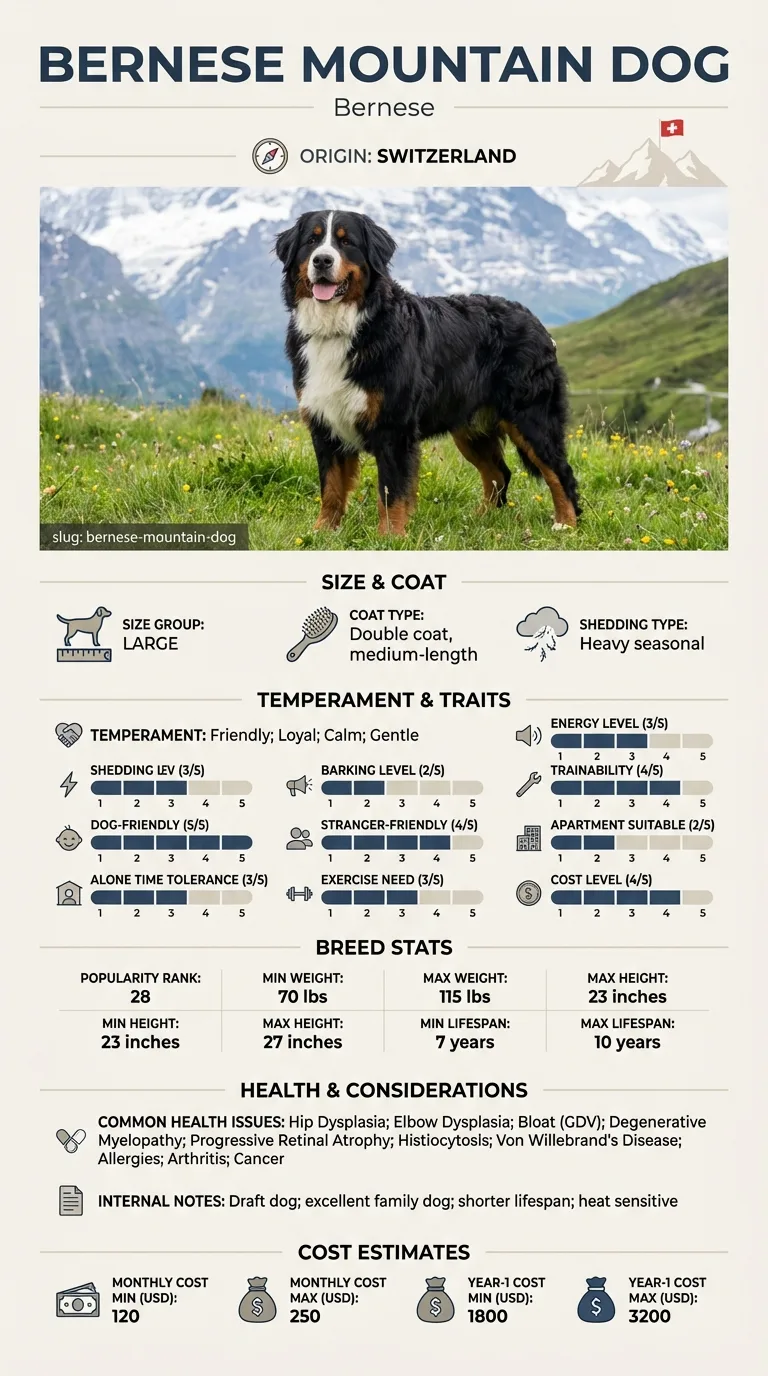
The breed range is roughly 70 to 115 pounds, which is wide because frame size varies considerably. That range is not a target. The right weight for an individual dog is the one at which his ribs are easily felt, he has a visible waist from above and a tuck from the side, and your veterinarian scores his body condition as ideal.
Reduce the input rather than trying to increase the output. Summer is the wrong season to add exercise to a heat-sensitive breed, so weight loss in warm months has to come almost entirely from measured feeding. Add mental work through scent games and puzzle feeders, which tire a dog without generating body heat.
Yes, and in this breed the effect compounds. Excess weight accelerates the joint disease that is already documented here, increases the workload on the heart, worsens heat intolerance in a dog who already struggles, raises anaesthetic risk for any procedure, and reduces exercise tolerance, which then makes the weight harder to shift.
Slowly. Roughly one to two percent of body weight per week is the usual veterinary guide, which for a hundred pound dog is one to two pounds. Faster loss risks muscle rather than fat, and muscle is exactly what a dysplastic Bernese needs to keep. Expect a genuine weight programme to take four to six months.
For a dog with a significant amount to lose, usually yes. Simply feeding less of a normal food risks leaving the dog short on protein and micronutrients while still hungry. A veterinary weight management formulation is designed to reduce calories while maintaining protein, which protects muscle. Discuss it rather than choosing from a shelf.
A degree of food motivation is normal and is not a reason to feed more. Genuinely dramatic appetite change, particularly alongside increased drinking, weight gain despite normal food, or lethargy, warrants bloodwork to rule out hormonal causes including low thyroid, which is worth checking before assuming a behavioural explanation.
Enormously, and they are the most commonly overlooked source. A single large chew can carry a meaningful fraction of a day's calories. The practical fix is to measure the day's food into one container each morning, take training treats from it, and accept that when the container is empty the day is done.
No. The double coat conceals the waist and abdominal tuck almost entirely. Assess by running your hands over the ribs and flank instead.
About one to two percent of body weight a week. For a hundred pound Berner that is one to two pounds, and a full programme runs four to six months.
Measure the whole day's food, treats included, into one container each morning. When it is empty, feeding stops.
Substantially. Hip and elbow dysplasia and arthritis are all documented in this breed, and every extra pound loads joints that are already compromised.
If the gain is unexplained, yes. Low thyroid is a common and inexpensive thing to rule out with a blood test before assuming overfeeding.
A one-page prep sheet for this condition: the signs, the questions to ask, what to get priced. Unlocks here.
You get: Vet visit prep sheet
No spam. One-click unsubscribe. See our privacy policy.
Preview page 1 before you decide.