Health
Is anaesthesia riskier for a Bernese Mountain Dog?
Not because of drug sensitivity. Risk rises with undiagnosed heart disease, inherited bleeding disorders and excess body weight, all of which are screenable beforehand.

Quick answer
Is anaesthesia riskier for a Bernese Mountain Dog?
Not because of drug sensitivity. Risk rises with undiagnosed heart disease, inherited bleeding disorders and excess body weight, all of which are screenable beforehand.
The Bernese anaesthetic risk is not the drug. It is what nobody has screened for yet.
Owners scheduling a spay, neuter, dental or orthopaedic procedure, and owners of older Berners facing a mass removal who want to know what tests are worth paying for beforehand.
This guide is not medical advice. If your dog shows pain, sudden behavior change, or worsening symptoms, consult a licensed veterinarian.
Some links may be affiliate links. We may earn a commission at no extra cost to you. We only suggest products we believe are helpful for dog owners.
We research and check what we publish, but we do not warrant that any figure, date, price, or statement is accurate, complete, or current, and we accept no liability for any loss, cost, injury, or other harm arising from the use of this site. Use it as one reference among several. You remain responsible for your own decisions and for your dog's care - confirm anything that matters with a licensed veterinarian or another qualified professional before you act on it. Full disclaimer.
Anaesthetic risk in a Bernese is mostly inherited risk that has not been looked for. The breed's documented conditions include a bleeding disorder and a range of cardiac and orthopaedic problems, any of which can complicate a procedure that would otherwise be routine. Screening turns unknown risk into managed risk.
Serious anaesthetic complications are rare in healthy dogs at properly equipped practices. The risk is concentrated in patients with undetected disease and in emergency cases, which is exactly why elective procedures are the right time to do the screening a Bernese benefits from.
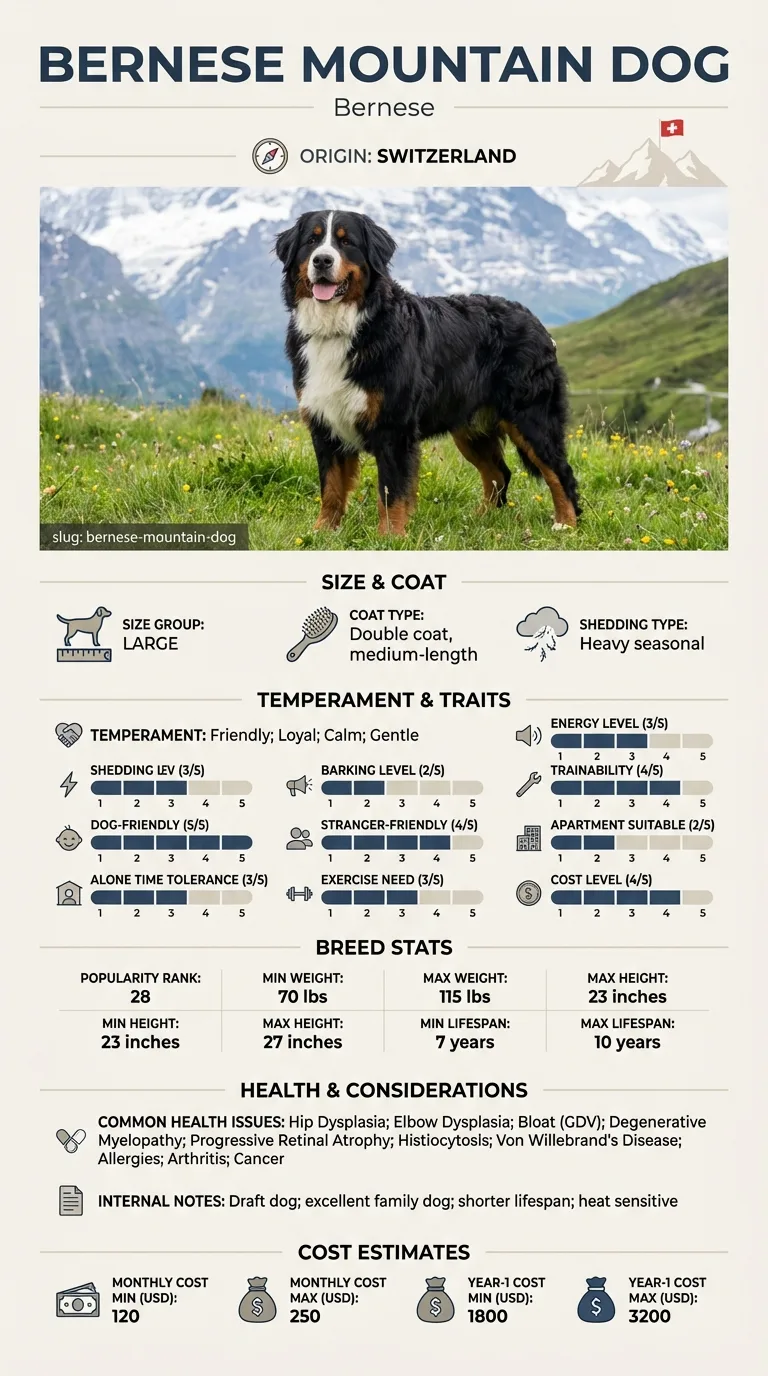
The Bernese carries von Willebrand's disease, cancer and a range of cardiac and joint conditions on its documented health list, so the pool of things that could complicate anaesthesia is larger than in a breed with a short problem list. Its seven to ten year lifespan also means a Berner reaches senior status early, and senior physiology handles anaesthesia differently.
Weight is the environmental factor owners control. An overweight Berner is dosed on a body that is partly fat, which does not take up drugs the way lean tissue does, and carries more work for the heart and lungs. Ward temperature is the second: a heat-intolerant, double-coated dog recovering in a warm room is harder to keep comfortable.
Before surgery, raise any history of bleeding, fainting, exercise intolerance or coughing, all of which change the plan. After surgery, call immediately for pale gums, fresh bleeding through a dressing, a swelling that grows at the incision, laboured or noisy breathing, or a dog who cannot rise several hours after coming home. Persistent vomiting, a hard distended abdomen or unproductive retching after any abdominal procedure is an emergency in a deep-chested breed and needs to be seen at once, not in the morning.
Nearly all avoidable anaesthetic trouble in this breed traces to information the team did not have. These are the gaps.
Start here: Bernese Mountain Dog Most Common Genetic Disorders
See all Bernese Mountain DOG health problems, which breeds are prone to anesthesia sensitivity, or the full Bernese Mountain DOG breed guide for temperament, exercise needs and ownership costs.
Most dogs are alert the evening of a routine procedure and themselves within two days. Orthopaedic and abdominal surgery involves weeks of restricted activity, which for a large breed means a genuinely managed household rather than good intentions.
A procedure with no surprises, because the bloodwork, cardiac check and bleeding history were done first, and a recovery where the dog is comfortable and nobody hurt their back lifting.
The first is bleeding. Von Willebrand's disease is on the breed's documented health list, and it is a clotting problem, not an anaesthetic one, but it turns an ordinary procedure into a transfusion conversation. A DNA test or a clotting screen before elective surgery is the standard answer, and it only needs doing once.
The second is the heart. Large breeds develop cardiac disease that stays silent until the dog is stressed, and general anaesthesia is a stress test the dog did not consent to. A stethoscope check costs nothing; an echocardiogram before major surgery in an older Berner is money well spent if anything unusual is heard.
The third is body size, which is a dosing and logistics problem rather than a sensitivity one. Drugs are calculated on lean body mass, so an overweight Berner dosed on scale weight receives more than intended. An honest body condition assessment at the pre-op appointment is worth more than most owners realise.
The fourth is recovery. This is the underrated one. Big dogs take longer to get up, are harder to reposition, and are at more risk of pressure injury on a hard table during a long procedure. Padding, positioning and staffing matter, and they are fair questions to ask.

Otto's littermate sister Freya was booked for a routine spay at eleven months. Her breeder mentioned that a dog two generations back had bled heavily after a dewclaw removal, and her owner passed that on at the pre-op consult. The vet added a clotting screen, which came back abnormal, and referred her for von Willebrand's testing. The spay went ahead six weeks later at a practice with blood products on site and a plan in place. It was uneventful. Without the offhand comment from the breeder, the first sign of trouble would have been on the table.
Key takeaway: Family history is the cheapest diagnostic available. In a breed with a documented bleeding disorder, one sentence from a breeder can be worth more than any pre-op panel.
Not in the documented way certain sighthounds are, where low body fat and a metabolic difference alter drug handling. The Bernese has no equivalent breed-specific drug quirk on record. Its anaesthetic risk comes from concurrent disease, body mass and recovery management instead.
A physical exam with a careful cardiac listen, pre-anaesthetic bloodwork, and a discussion about von Willebrand's testing given it appears on the breed's health list. Your vet may also suggest a clotting time depending on your dog's history and pedigree.
It matters for temperature in both directions. Anaesthetised dogs lose heat because they cannot shiver, so warming is routine. But a heavy double coat then makes overheating easy in recovery, and this is a breed noted for poor heat tolerance, so ward temperature deserves attention.
Deep-chested breeds are at risk of gastric dilatation-volvulus and the breed carries it on its documented list. This is why many owners of large breeds discuss a preventive gastropexy at the time of a spay, when the abdomen is already open. Ask about it before the day.
Age is not a disease. What matters is organ function, cardiac status and what the procedure is for. Given the breed's seven to ten year lifespan, a seven-year-old Berner is a senior patient and should be worked up as one, but many undergo anaesthesia safely.
Expect grogginess for the rest of the day and normal appetite within twenty-four hours. Plan the practical side in advance: non-slip flooring, a ground-floor resting spot, and a second person available for lifting a dog who may weigh more than you do.
Not because of drug sensitivity. Risk rises with undiagnosed heart disease, inherited bleeding disorders and excess body weight, all of which are screenable beforehand.
Pre-anaesthetic bloodwork paired with a proper cardiac exam. Between them they catch most of what would otherwise be discovered on the table.
Rugs over slick floors, a bed on the ground floor, and a plan for who helps lift. A groggy hundred-pound dog cannot manage stairs.
They add meaningfully to a routine procedure's cost, but far less than managing a complication. Ask for an itemised estimate at booking rather than on the day.
Yes. Short, treat-based visits with no procedure attached teach a calm association, and this breed's steady temperament makes that work quickly.
A one-page prep sheet for this condition: the signs, the questions to ask, what to get priced. Unlocks here.
You get: Vet visit prep sheet
No spam. One-click unsubscribe. See our privacy policy.
Preview page 1 before you decide.