Behavior
Which breed needs more exercise?
The German Wirehaired Pointer, rated Very high (5/5) versus the Bernese's Moderate (3/5).

Quick answer
Which breed needs more exercise?
The German Wirehaired Pointer, rated Very high (5/5) versus the Bernese's Moderate (3/5).
Bernese Mountain Dog or German Wirehaired Pointer? On paper they differ most on exercise need, and on the scales Bernese Mountain Dog is the heavier at 70–115 lbs. Here is how the two compare on everything that shapes an ordinary week.
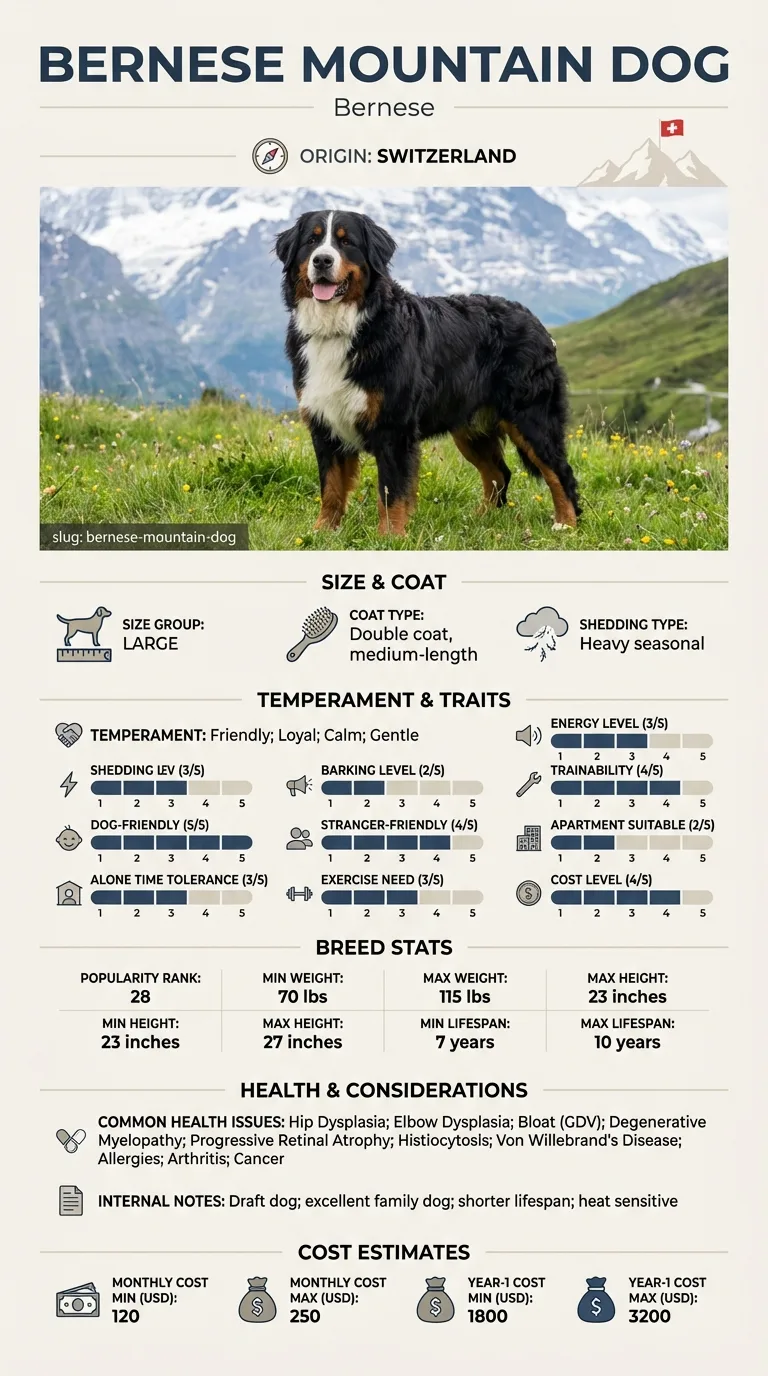
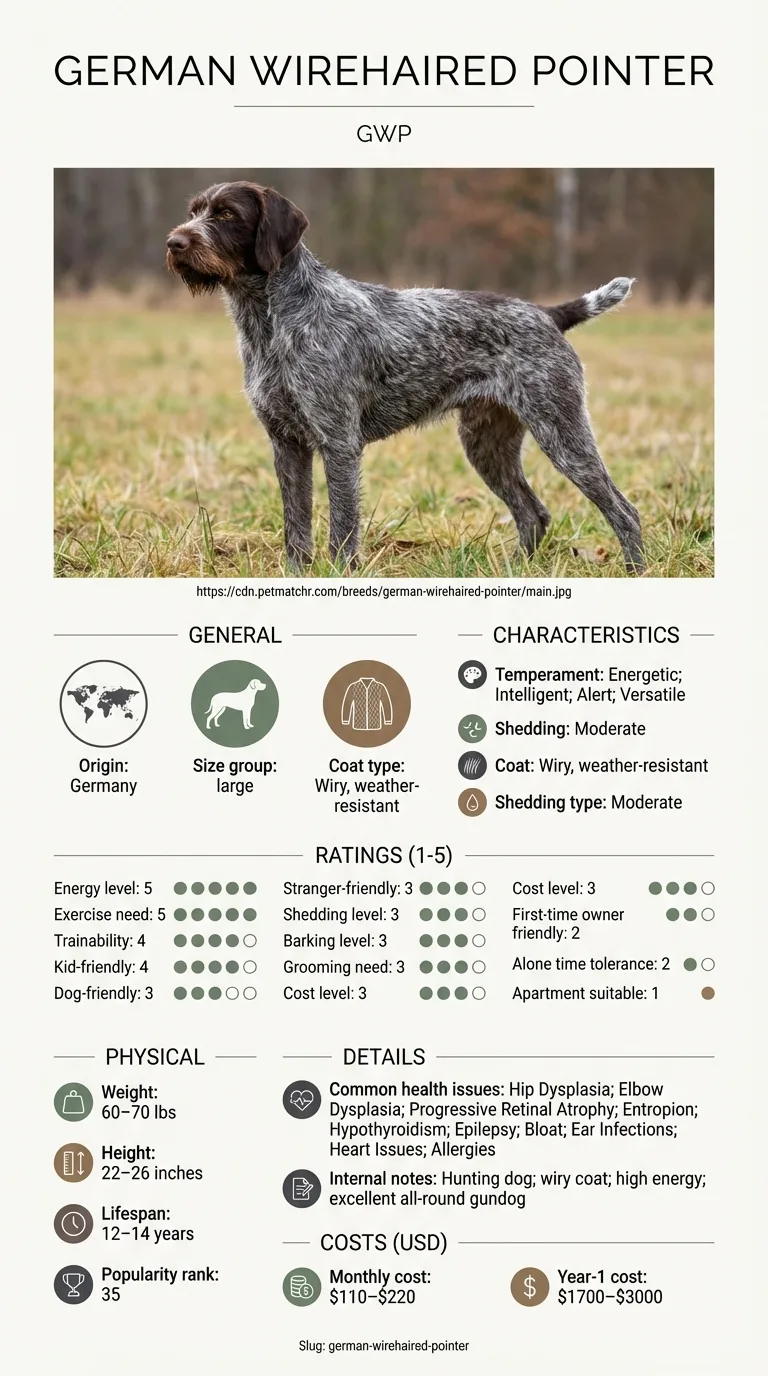
This is for someone already down to Bernese Mountain Dog and German Wirehaired Pointer and deciding between them. For this pair the decision usually turns on exercise need and energy level, so those are covered first and in most detail. Anyone choosing from a flat has a clear answer here: Bernese Mountain Dog rates 2/5 against 1/5. The focus throughout is on daily consequences rather than breed background.
Between Bernese Mountain Dog and German Wirehaired Pointer, exercise need is what separates them, and Bernese Mountain Dog is the lower-effort dog of the two to keep.
Choose Bernese Mountain Dog if this is your first dog, your walking routine is modest and the dog will be alone during the working day.
Choose German Wirehaired Pointer if shedding is a problem in your house, a smaller dog suits your car, your home or your back and you want a dog that can keep up with an active routine.
| Feature | bernese mountain dog | german wirehaired pointer | Winner |
|---|---|---|---|
| Size class | large | large | Equal |
| Weight | 70–115 lbs | 60–70 lbs | Equal |
| Height | 23–27 in | 22–26 in | Equal |
| Lifespan | 7–10 years | 12–14 years | german wirehaired pointer |
| Exercise need | Moderate (3/5) | Very high (5/5) | bernese mountain dog |
| Grooming need | Moderate (3/5) | Moderate (3/5) | Equal |
| Shedding | High (4/5) | Moderate (3/5) | german wirehaired pointer |
| Energy level | Moderate (3/5) | Very high (5/5) | Equal |
| Barking | Low (2/5) | Moderate (3/5) | bernese mountain dog |
| Apartment suitability | Low (2/5) | Very low (1/5) | bernese mountain dog |
| Good for first-time owners | High (4/5) | Low (2/5) | bernese mountain dog |
| Tolerates being alone | Moderate (3/5) | Low (2/5) | bernese mountain dog |
| Trainability | High (4/5) | High (4/5) | Equal |
| Good with kids | Very high (5/5) | High (4/5) | bernese mountain dog |
| Good with other dogs | Very high (5/5) | Moderate (3/5) | bernese mountain dog |
| Friendly to strangers | High (4/5) | Moderate (3/5) | bernese mountain dog |
| Cost level | High (4/5) | Moderate (3/5) | german wirehaired pointer |
| Coat | Double coat, medium-length | Wiry, weather-resistant | Equal |
| Origin | Switzerland | Germany | Equal |
| Typical monthly cost | $120–$250 | $110–$220 | Equal |
| Typical first-year cost | $1,800–$3,200 | $1,700–$3,000 | Equal |
Both breeds are classified as large, and their weights actually overlap meaningfully — a 60–70 lb German Wirehaired Pointer sits well within the lower half of the Bernese Mountain Dog's broader 70–115 lb range, with height nearly matching too, 22–26 inches versus 23–27. Despite the similar numbers, the two builds serve opposite purposes: the Pointer's wiry, weather-resistant coat covers a lean, athletic frame designed for all-day hunting in rough terrain, while the Bernese's heavier bone structure and thick double coat were built for hauling and cold-weather farm work. This is one of the closer size matchups in this batch, making temperament and energy the real differentiators.
The gap here is dramatic: Very high (5/5) exercise need for the German Wirehaired Pointer against Moderate (3/5) for the Bernese, with the Pointer's Energetic, Alert, Versatile temperament reflecting its history as an all-purpose hunting dog bred to point, track, and retrieve across varied terrain for hours. The Bernese's Calm, Gentle nature keeps it content with a moderate daily walk. A German Wirehaired Pointer under-exercised will likely become restless or destructive, consistent with breeds developed for continuous field work, while the Bernese is one of the rare large breeds that doesn't demand marathon exercise sessions to stay balanced.
Grooming ties at Moderate (3/5), though the routines differ — the Bernese's double coat needs regular brushing to manage its High (4/5) shedding, while the Pointer's wiry coat needs occasional hand-stripping or clipping to maintain its weather-resistant texture, even though its shedding is a more manageable Moderate (3/5). The Pointer's coat is genuinely functional, developed to protect against brush and cold water during hunts, which is part of why it doesn't shed as heavily as a plush double coat like the Bernese's despite requiring its own specialized maintenance.
Neither breed suits apartment life, but the Pointer rates even lower, Very low (1/5) against the Bernese's already-low Low (2/5), reflecting the Pointer's Very high exercise need on top of its large size. Barking favors the Bernese, Low (2/5) versus Moderate (3/5) for the Pointer, whose Alert temperament makes it quicker to vocalize at movement or noise outside. Tolerating time alone also favors the Bernese, Moderate (3/5) against Low (2/5) for the Pointer, whose Versatile working drive doesn't translate into contentment sitting home alone for long stretches.
Trainability ties at High (4/5), both breeds responding well to structured lessons, but first-time-owner suitability diverges sharply: High (4/5) for the Bernese versus Low (2/5) for the German Wirehaired Pointer. The Pointer's Intelligent, Versatile mind needs a job, hunting, tracking, agility, or serious daily exercise, and an inexperienced owner who can't provide that outlet often ends up with a bored, hard-to-manage dog despite its trainability on paper. The Bernese's Friendly, Loyal temperament and more modest exercise needs make it the far more forgiving choice for someone new to dog ownership.
The Bernese outperforms the Pointer across every social metric here: Very high (5/5) with kids versus High (4/5), Very high (5/5) with other dogs versus Moderate (3/5), and High (4/5) with strangers versus Moderate (3/5). This isn't a knock on the Pointer's character, its Alert, Versatile temperament was built for focused work with a single handler rather than broad sociability, but it does mean the Bernese is the more naturally outgoing, easygoing family dog of the two, especially in households with frequent visitors or other pets already in the mix.
The Pointer significantly outlives the Bernese, 12–14 years against just 7–10, one of the larger lifespan gaps in this batch relative to how similar the two breeds' sizes actually are. The Pointer's ten-item health list includes Entropion, Hypothyroidism, and Heart Issues alongside shared risks like Hip Dysplasia, Elbow Dysplasia, Bloat, and Allergies that also appear on the Bernese's list. The overlap on Bloat is worth noting for both breeds given their large, deep-chested builds — slow-feed bowls and avoiding vigorous exercise right after meals are sensible precautions regardless of which one a household chooses.
Costs run close given the similar sizes: $120–$250 monthly for the Bernese versus $110–$220 for the Pointer, and $1,800–$3,200 versus $1,700–$3,000 in year one, the smallest cost gap in this entire batch. Cost level is still rated High (4/5) for the Bernese against Moderate (3/5) for the Pointer, a distinction likely driven by the Bernese's higher-end weight range and grooming needs relative to activity gear and training costs for the Pointer's Very high exercise regimen. Either breed represents a real financial commitment; the choice here is more about temperament and lifestyle fit than budget.
Bernese Mountain Dog weighs 70–115 lbs and lives 7–10 years; German Wirehaired Pointer weighs 60–70 lbs and lives 12–14 years. The two diverge most on exercise need, energy level and good for first-time owners and 1 other rated axes. They are level on grooming need and trainability, so those cannot decide it. The table below marks a winner only where one breed is genuinely easier for a typical owner; size and origin are facts rather than merits and stay level. Ratings come from one source applied to both breeds, so they are meaningful against each other rather than as absolute scores.

Yes, more than most pairs on this site — both are large breeds, and the Pointer's 60–70 lbs and 22–26 inches fall well within the Bernese's broader 70–115 lb, 23–27 inch range.
The Bernese Mountain Dog by a wide margin, rated High (4/5) versus the Pointer's Low (2/5), since the Pointer's Very high exercise need requires an experienced, active handler.
Significantly longer — 12–14 years versus just 7–10 for the Bernese Mountain Dog.
It's rated Moderate (3/5), noticeably lower than the Bernese's Very high (5/5), reflecting its more independent, handler-focused working temperament.
The Bernese sheds more, rated High (4/5) versus Moderate (3/5) for the Pointer, whose wiry coat is more weather-resistant than plush.
The German Wirehaired Pointer, rated Moderate (3/5) versus the Bernese's Low (2/5), consistent with its Alert temperament.
Very close — this is the smallest cost gap in this batch, with first-year costs of $1,800–$3,200 for the Bernese versus $1,700–$3,000 for the Pointer.
The German Wirehaired Pointer, rated Very high (5/5) versus the Bernese's Moderate (3/5).
The German Wirehaired Pointer, typically 12–14 years versus 7–10 for the Bernese.
The Bernese Mountain Dog, rated Very high (5/5) versus the Pointer's High (4/5).
The Bernese Mountain Dog, rated High (4/5) versus the Pointer's Low (2/5).
Secure checkout on Stripe. We never see your card.
7-day money-back guarantee. Instant access.
Health information here is general and is not veterinary advice. If your dog shows pain, sudden behaviour change, or worsening symptoms, consult a licensed veterinarian.
Some links on this site are affiliate links. We may earn a commission at no extra cost to you, and we only suggest products we believe are helpful for dog owners.
We research and check what we publish, but we do not warrant that any figure, date, price, or statement is accurate, complete, or current, and we accept no liability for any loss, cost, injury, or other harm arising from the use of this site. Use it as one reference among several. You remain responsible for your own decisions and for your dog's care - confirm anything that matters with a licensed veterinarian or another qualified professional before you act on it. Full disclaimer.
Match your lifestyle to the right dog.
Take quizNot sure which breed is right for you? Take our 2-minute quiz to find out.
Take the quiz