Living
Which is smaller?
The Papillon, at just 5-10 lbs versus the Bernese's 70-115 lbs.

Quick answer
Which is smaller?
The Papillon, at just 5-10 lbs versus the Bernese's 70-115 lbs.
Bernese Mountain Dog or Papillon? On paper they differ most on apartment suitability, and on the scales Bernese Mountain Dog is the heavier at 70–115 lbs. Here is how the two compare on everything that shapes an ordinary week.
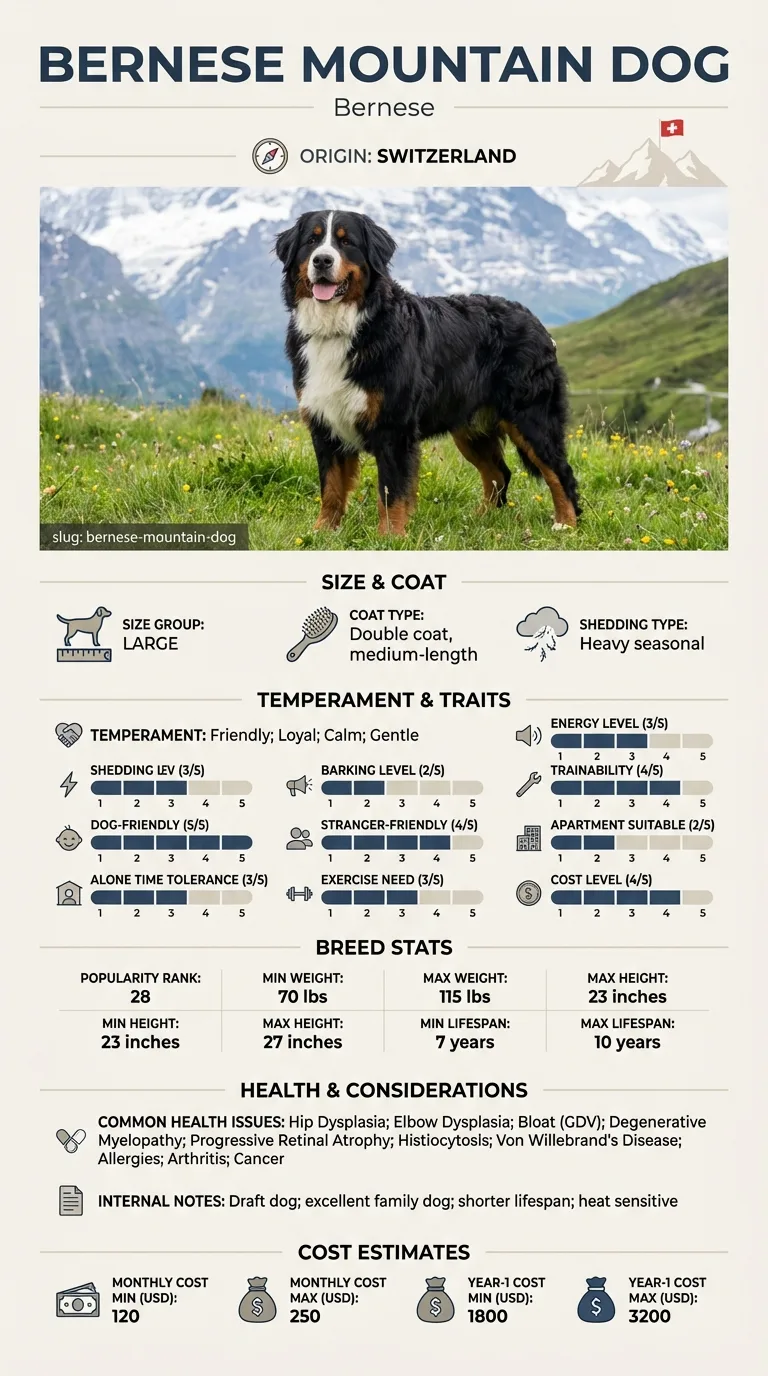
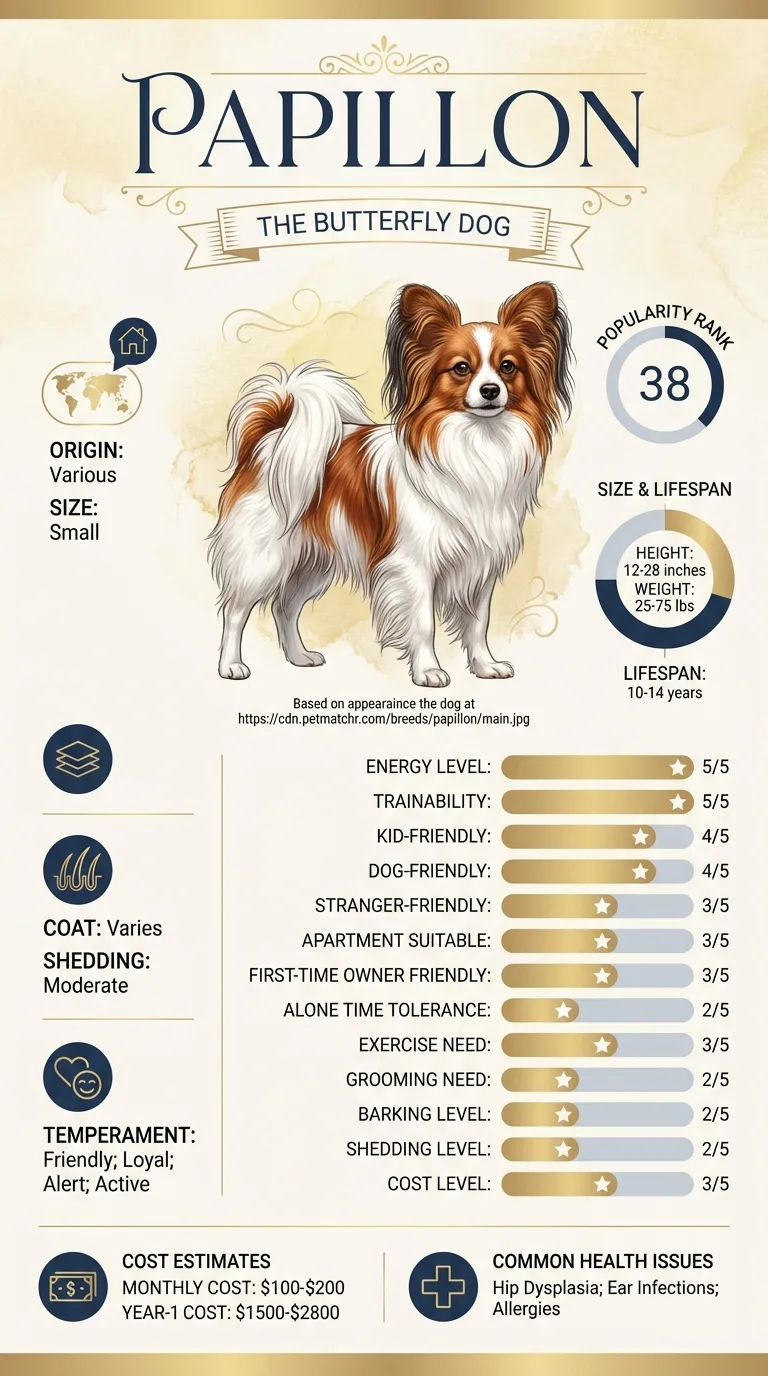
This is for someone already down to Bernese Mountain Dog and Papillon and deciding between them. For this pair the decision usually turns on apartment suitability and shedding, so those are covered first and in most detail. Anyone choosing from a flat has a clear answer here: Papillon rates 5/5 against 2/5. There is no origin story here — only what changes about your week.
Between Bernese Mountain Dog and Papillon, apartment suitability is what separates them, and Papillon is the lower-effort dog of the two to keep.
Choose Bernese Mountain Dog if the dog will be alone during the working day, there are young children at home and you already have another dog.
Choose Papillon if you are in a flat or a smaller home, you do not want a standing grooming appointment and shedding is a problem in your house.
| Feature | bernese mountain dog | papillon | Winner |
|---|---|---|---|
| Size class | large | small | Equal |
| Weight | 70–115 lbs | 5–10 lbs | Equal |
| Height | 23–27 in | 8–11 in | Equal |
| Lifespan | 7–10 years | 14–16 years | papillon |
| Exercise need | Moderate (3/5) | Moderate (3/5) | Equal |
| Grooming need | Moderate (3/5) | Low (2/5) | papillon |
| Shedding | High (4/5) | Low (2/5) | papillon |
| Energy level | Moderate (3/5) | High (4/5) | Equal |
| Barking | Low (2/5) | High (4/5) | bernese mountain dog |
| Apartment suitability | Low (2/5) | Very high (5/5) | papillon |
| Good for first-time owners | High (4/5) | High (4/5) | Equal |
| Tolerates being alone | Moderate (3/5) | Low (2/5) | bernese mountain dog |
| Trainability | High (4/5) | Very high (5/5) | papillon |
| Good with kids | Very high (5/5) | Moderate (3/5) | bernese mountain dog |
| Good with other dogs | Very high (5/5) | High (4/5) | bernese mountain dog |
| Friendly to strangers | High (4/5) | High (4/5) | Equal |
| Cost level | High (4/5) | Low (2/5) | papillon |
| Coat | Double coat, medium-length | Long, silky single coat | Equal |
| Origin | Switzerland | Various | Equal |
| Typical monthly cost | $120–$250 | $80–$150 | Equal |
| Typical first-year cost | $1,800–$3,200 | $1,100–$2,300 | Equal |
The gap between these two is enormous by the numbers: a Bernese Mountain Dog at 70-115 lbs and 23-27 in towers over a Papillon at 5-10 lbs and 8-11 in, so the Bernese can weigh more than ten times as much. The Papillon takes its name from its distinctive butterfly-shaped ears, a detail entirely disconnected from its tiny frame, while the Bernese's tricolor coat and stocky build reflect centuries of Swiss farm work hauling carts and driving cattle. Anyone comparing these two on paper alone should picture the practical reality, since one dog fits in a bag while the other needs a full-size crate and a strong leash arm.
Despite its size, the Papillon actually rates higher for energy level, high (4/5), than the Bernese's moderate (3/5), while exercise need is tied at moderate (3/5) for both. That's a notable pairing, a tiny toy breed with genuine energy to burn, matching its Alert and Quick-witted temperament tags, against a much larger dog that's comparatively laid-back. Owners expecting the smaller dog to automatically be the lower-energy one should recalibrate, since the Papillon wants mental stimulation and activity despite its size, while the Bernese, for all its bulk, is content with a calmer daily pace.
The Papillon is the clearly lower-maintenance coat here: low grooming need (2/5) and low shedding (2/5), against the Bernese's moderate grooming (3/5) and high shedding (4/5). Its long, silky single coat lacks the dense undercoat that drives the Bernese's heavier shedding, so despite looking elaborate, the Papillon's coat is comparatively easy to maintain with regular brushing. Anyone drawn to the Bernese's striking tricolor markings should budget real time for brushing and accept fur on furniture as a fact of life; the Papillon spares an owner most of that upkeep.
Apartment suitability strongly favors the Papillon, very high (5/5) against the Bernese's low (2/5), a straightforward result of its 5-10 lb size. But barking cuts the other way and matters just as much for apartment living, since the Papillon rates high (4/5) for barking against the Bernese's low (2/5), so noise-sensitive neighbors could be a bigger problem with the smaller dog. Both tolerate being alone poorly compared to some breeds, moderate (3/5) for the Bernese, low (2/5) for the Papillon, so neither is ideal for owners gone long hours.
The Papillon is rated very high (5/5) for trainability, edging out the Bernese's already-strong high (4/5), and both rate high (4/5) for first-time owners. That combination, small size, quick-witted intelligence, and very high trainability, makes the Papillon a surprisingly capable obedience and agility prospect for a toy breed, while the Bernese's trainability comes wrapped in a much larger, physically stronger package that needs consistent leash and handling work from puppyhood. First-time owners drawn to trick training and quick learning may find the Papillon especially rewarding despite its size.
The Bernese pulls ahead with kids, rated very high (5/5) against the Papillon's moderate (3/5), a meaningful gap, since a 5-10 lb Papillon is far more physically vulnerable to rough handling from young children than the sturdy Bernese. With other dogs, the Bernese also edges ahead, very high (5/5) versus the Papillon's high (4/5), though both rate high (4/5) with strangers. Families with boisterous young kids should lean toward the Bernese's durability; households without small children, or with older, gentler kids, can consider the Papillon's alert, confident personality without that physical-safety concern.
The Papillon's expected lifespan, 14-16 years, roughly doubles the Bernese's 7-10 years, and its health list is shorter and generally less severe, Patellar Luxation, Progressive Retinal Atrophy, Dental Disease, Open Fontanel and Collapsing Trachea, compared to the Bernese's ten-condition list that includes Bloat (GDV), Histiocytosis, Von Willebrand's Disease and Cancer. Neither list overlaps directly, reflecting how differently toy and large working breeds are built and bred. The Bernese's shorter lifespan and more serious conditions are consistently the top concern raised about the breed, while Papillon owners should ask breeders about Open Fontanel screening in puppies specifically.
The Papillon is markedly cheaper to keep: low cost rating (2/5) against the Bernese's high (4/5), a monthly range of $80-$150 versus $120-$250, and a first-year range of $1,100-$2,300 versus $1,800-$3,200. Most of that gap comes down to food volume and medication dosing, which scale with body weight far more than with breed rarity or coat type. Owners on a tighter budget who still want a trainable, friendly companion may find the Papillon delivers much of what draws people to the Bernese's temperament at a fraction of the ongoing cost.
Bernese Mountain Dog weighs 70–115 lbs and lives 7–10 years; Papillon weighs 5–10 lbs and lives 14–16 years. The two diverge most on apartment suitability, shedding and barking and 2 other rated axes. They are level on exercise need, good for first-time owners and friendly to strangers, so those cannot decide it. Where the table declares a winner it means less work for the owner, nothing more; descriptive rows are left as ties on purpose. The value here is in the differences between the two columns; treat any single score as approximate.

Yes, considerably. The Papillon rates low (2/5) on cost with a $1,100-$2,300 first-year range, against the Bernese's high (4/5) rating and $1,800-$3,200 range.
Surprisingly the Papillon, rated high (4/5) for energy level against the Bernese's moderate (3/5), despite its much smaller size.
Yes, they rate high (4/5) for barking, notably more than the Bernese's low (2/5).
The Papillon, by a wide margin, 14-16 years compared to the Bernese's 7-10 years.
It rates only moderate (3/5) with kids, lower than the Bernese's very high (5/5), largely due to its small, fragile 5-10 lb size.
The Papillon, rated very high (5/5) for trainability against the Bernese's high (4/5).
The Papillon, rated low (2/5) grooming versus the Bernese's moderate (3/5), and it also sheds less.
The Papillon, at just 5-10 lbs versus the Bernese's 70-115 lbs.
The Bernese Mountain Dog, rated low (2/5) barking against the Papillon's high (4/5).
The Papillon, rated very high (5/5) versus the Bernese's low (2/5).
Both rate moderate (3/5) for exercise need, so neither has a clear edge.
Secure checkout on Stripe. We never see your card.
7-day money-back guarantee. Instant access.
Health information here is general and is not veterinary advice. If your dog shows pain, sudden behaviour change, or worsening symptoms, consult a licensed veterinarian.
Some links on this site are affiliate links. We may earn a commission at no extra cost to you, and we only suggest products we believe are helpful for dog owners.
We research and check what we publish, but we do not warrant that any figure, date, price, or statement is accurate, complete, or current, and we accept no liability for any loss, cost, injury, or other harm arising from the use of this site. Use it as one reference among several. You remain responsible for your own decisions and for your dog's care - confirm anything that matters with a licensed veterinarian or another qualified professional before you act on it. Full disclaimer.
Match your lifestyle to the right dog.
Take quizNot sure which breed is right for you? Take our 2-minute quiz to find out.
Take the quiz