Health
What is contact skin allergy in dogs?
A reaction that occurs where skin directly touches an irritant, most often paws and belly, as opposed to airborne or food allergy affecting the whole body.

Quick answer
What is contact skin allergy in dogs?
A reaction that occurs where skin directly touches an irritant, most often paws and belly, as opposed to airborne or food allergy affecting the whole body.
Paw licking after every walk and a red belly after lying on the lawn are not the same problem as itchy ears, even though both get called 'skin allergies.'
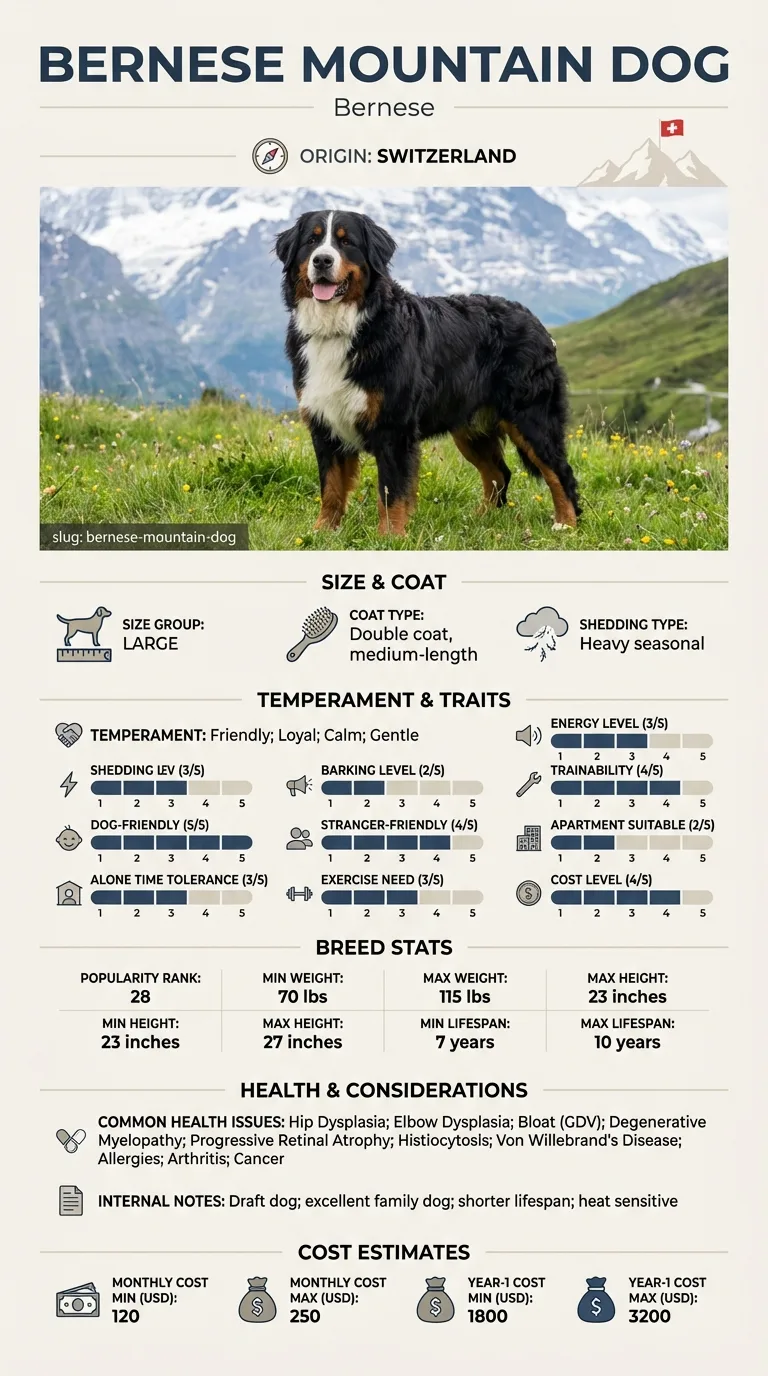
Owners of a Bernese that licks or chews at its paws specifically, or develops redness on the belly and inner legs after time outdoors, without the chronic ear infections that define the breed's more commonly discussed allergy picture.
This guide is not medical advice. If your dog shows pain, sudden behavior change, or worsening symptoms, consult a licensed veterinarian.
Some links may be affiliate links. We may earn a commission at no extra cost to you. We only suggest products we believe are helpful for dog owners.
We research and check what we publish, but we do not warrant that any figure, date, price, or statement is accurate, complete, or current, and we accept no liability for any loss, cost, injury, or other harm arising from the use of this site. Use it as one reference among several. You remain responsible for your own decisions and for your dog's care - confirm anything that matters with a licensed veterinarian or another qualified professional before you act on it. Full disclaimer.
Contact skin allergy is a reaction that occurs specifically where skin touches an irritant directly, most often the paws and belly, the two areas with the least coat protection and the most direct ground contact. It is a distinct mechanism from this breed's more widely discussed airborne and food allergy, which affects the whole body and drives the ear infection cycle documented elsewhere.
Contact allergy occurs across dog breeds generally rather than being specific to the Bernese, but the breed's dense double coat means paws and belly, the two least-protected areas, concentrate whatever contact exposure occurs, making a localised pattern more noticeable here than in a shorter-coated breed.
The medium-length double coat with a heavy undercoat covers and protects most of the body from direct ground contact, leaving the paw pads and belly as the two areas most exposed to whatever the dog walks or lies on. This concentrates contact risk into a smaller, more localised area than would be the case for a shorter-coated or less densely coated breed.
Lawn and garden chemical use, the specific grasses and ground cover on regular walking routes, cleaning products used on household floors, and bedding material are the main environmental triggers. Seasonal lawn treatment schedules often explain a pattern of flare-ups recurring at the same time each year.
See your vet if paw licking or belly redness is persistent, if the skin looks broken or infected, or if removing an obvious suspected trigger doesn't resolve the reaction within a couple of weeks. Treat any sudden, widespread swelling, hives or difficulty breathing as a medical emergency rather than a contact allergy, since that pattern points to a different and more urgent kind of reaction.
Contact allergy gets missed because it looks like a smaller, more localised version of a bigger problem this breed is already known for, and treatment for the wrong version doesn't help.
Start here: Bernese Mountain Dog Most Common Genetic Disorders
See all Bernese Mountain DOG health problems, which breeds are prone to skin allergies, or the full Bernese Mountain DOG breed guide for temperament, exercise needs and ownership costs.
Once the specific contact trigger is identified and removed, visible improvement often begins within days to a couple of weeks. Identifying the trigger itself, through pattern tracking, can take longer if multiple possible exposures exist.
Success is a specific, identified trigger that can be avoided going forward, with resolved redness and licking at the affected paws or belly. It is not a general allergy-free guarantee, since a different contact exposure could still trigger a similar reaction in the future.
A contact allergic reaction requires the trigger to actually touch skin, which immediately narrows down where symptoms appear. Paw pads are bare skin in direct contact with the ground on every walk, and the thin skin between the toes is especially reactive. The belly and inner thighs are the other main contact zone, since a dog lying down on grass, decking, or a treated lawn presses that area directly against whatever is there. This is a different mechanism entirely from the airborne allergens and food sensitivities that drive this breed's more familiar chronic itch-and-ear-infection cycle, where the trigger is inhaled or ingested rather than touched.
Common triggers include lawn chemicals such as fertiliser or herbicide residue, certain grasses and weeds directly, cleaning products used on floors the dog lies on, and in some cases the materials in bedding or flooring itself. Because the reaction depends on physical contact, symptoms are often strikingly one-sided or localised: a dog might lick only its front paws, or develop redness only along the belly line where it presses against the ground, while the rest of the coat and skin looks entirely normal.
The breed's coat plays an indirect role here too. The dense double coat protects most of the body from direct ground contact, which is partly why paws and belly, the two areas without that protection, take the brunt of contact exposure. A dog with a shorter or sparser coat would have more skin exposed to the same triggers and might show a broader pattern; the Bernese effectively concentrates its contact risk into these two spots.
Diagnosis usually starts with a pattern review: where exactly the reaction shows up, when it started relative to a change in walking routes, lawn treatment, flooring or bedding, and whether it resolves when that specific exposure is removed. Elimination of the suspected contact source is often more informative here than the broader diet and environmental testing used for airborne allergy.

If you think your Bernese has skin allergies, the plan is three steps: write down what you have seen and when it started, book a veterinary appointment rather than waiting for the next flare, and take video of the behaviour or symptom before you go — the thing you are worried about rarely happens in the consulting room. Screening in the parents covers hip dysplasia, elbow dysplasia, bloat (gdv).
What the vet visit should produce is a diagnosis and a written plan, not just reassurance: what is being ruled out, what the monitoring interval is, and which signs mean you come back sooner. Ask what the treatment costs across a year rather than per visit, because that is the number that decides whether you are managing this condition or reacting to it.
Between appointments, keep a short log — dates, what you saw, what changed. It is the single most useful thing an owner brings to a follow-up, and for skin allergies it is often what separates a clear pattern from a guess.
Colm noticed his Berner Elin licking her front paws obsessively every evening, but her ears stayed clear and the rest of her coat looked fine, which didn't match what he'd read about allergies in the breed. He started writing down which walking routes preceded the worst evenings. A pattern emerged around a park with a recently reseeded, heavily treated lawn. Once he rerouted their evening walk away from that field and rinsed her paws after any unavoidable contact with treated grass elsewhere, the licking dropped off within two weeks.
Key takeaway: A reaction confined to the paws or belly, without the wider itch and ear trouble this breed is known for, points to something the dog touched directly rather than something in the air or the food bowl. Tracking the pattern is usually more useful than testing broadly.
Contact allergy requires the trigger to physically touch skin, so it shows up wherever bare skin makes contact: paws and belly. Airborne and food allergy is inhaled or ingested and tends to produce more widespread itch with recurring ear infections, which contact allergy often does not.
Focused, one-sided or paw-specific licking often points to a contact trigger encountered on walks, such as a particular grass, treated lawn, or ground surface, rather than a systemic allergy affecting the whole body.
Yes. Fertiliser and herbicide residue on grass is a recognised contact irritant, and a dog lying directly on treated lawn exposes its belly and inner legs to it directly. Following the product's pet-safety guidance on re-entry time reduces this risk.
Track the pattern: which walks, surfaces or products preceded a flare-up, and whether removing one specific exposure resolves it. This kind of elimination process is often more useful for contact allergy than broader allergy testing.
A plain water rinse of paws after walks in areas with unknown lawn treatments or dense weeds is reasonable. Avoid scented soaps unless recommended by your vet, since they can introduce a second irritant.
Not necessarily less serious, but often more localised and, once the trigger is identified, more straightforwardly managed by avoidance rather than ongoing systemic treatment.
Yes, if a dog licks or chews the affected area enough to break the skin. Persistent paw licking in particular can lead to secondary infection between the toes, which then needs its own treatment alongside removing the original trigger.
A reaction that occurs where skin directly touches an irritant, most often paws and belly, as opposed to airborne or food allergy affecting the whole body.
These are the areas with the least coat protection and the most direct ground contact, so they take the brunt of any contact trigger a dog walks or lies on.
Yes. Fertiliser and herbicide residue is a recognised contact irritant, particularly for the belly and inner legs of a dog that lies directly on treated grass.
Identify and avoid the specific trigger through pattern tracking, rinse paws after exposure to unknown surfaces, and avoid scented products on already-irritated skin.
Often less than airborne allergy does, since removing the identified contact trigger frequently resolves symptoms without long-term medication, though secondary infections may need their own short course of treatment.
A one-page prep sheet for this condition: the signs, the questions to ask, what to get priced. Unlocks here.
You get: Vet visit prep sheet
No spam. One-click unsubscribe. See our privacy policy.
Preview page 1 before you decide.
Early access list
The free prep sheet covers the same-day warning signs, a symptom log and the questions to ask. We are considering a fuller kit that adds a cost worksheet for the usual tests and treatments (US price ranges with their sources) and a plain-English guide to ways of covering the bill. It is not built yet; this list tells us whether it is worth building.
One email, no spam, unsubscribe anytime. Information only, not veterinary advice.