Health
What is the single most urgent sign?
A dog who cannot stand or move his hind legs and cannot urinate. That combination means going to an emergency facility now, not booking an appointment.

Quick answer
What is the single most urgent sign?
A dog who cannot stand or move his hind legs and cannot urinate. That combination means going to an emergency facility now, not booking an appointment.
This is the version of disc disease where the clock matters. A dog who loses hind limb function today has a very different outlook from one who lost it three days ago.
Owners facing an abrupt collapse of the back end in a Bernese and trying to work out whether this is an emergency, and owners who want to know in advance where the nearest facility with a surgical neurologist is.
This guide is not medical advice. If your dog shows pain, sudden behavior change, or worsening symptoms, consult a licensed veterinarian.
Some links may be affiliate links. We may earn a commission at no extra cost to you. We only suggest products we believe are helpful for dog owners.
We research and check what we publish, but we do not warrant that any figure, date, price, or statement is accurate, complete, or current, and we accept no liability for any loss, cost, injury, or other harm arising from the use of this site. Use it as one reference among several. You remain responsible for your own decisions and for your dog's care - confirm anything that matters with a licensed veterinarian or another qualified professional before you act on it. Full disclaimer.
Type I intervertebral disc herniation is the acute form of disc disease, in which hardened disc material bursts through the outer ring and strikes the spinal cord. Signs appear over hours and range from severe back pain to complete paralysis with loss of bladder control. It is a surgical emergency in its severe grades, and the interval between loss of function and treatment strongly influences the outcome.
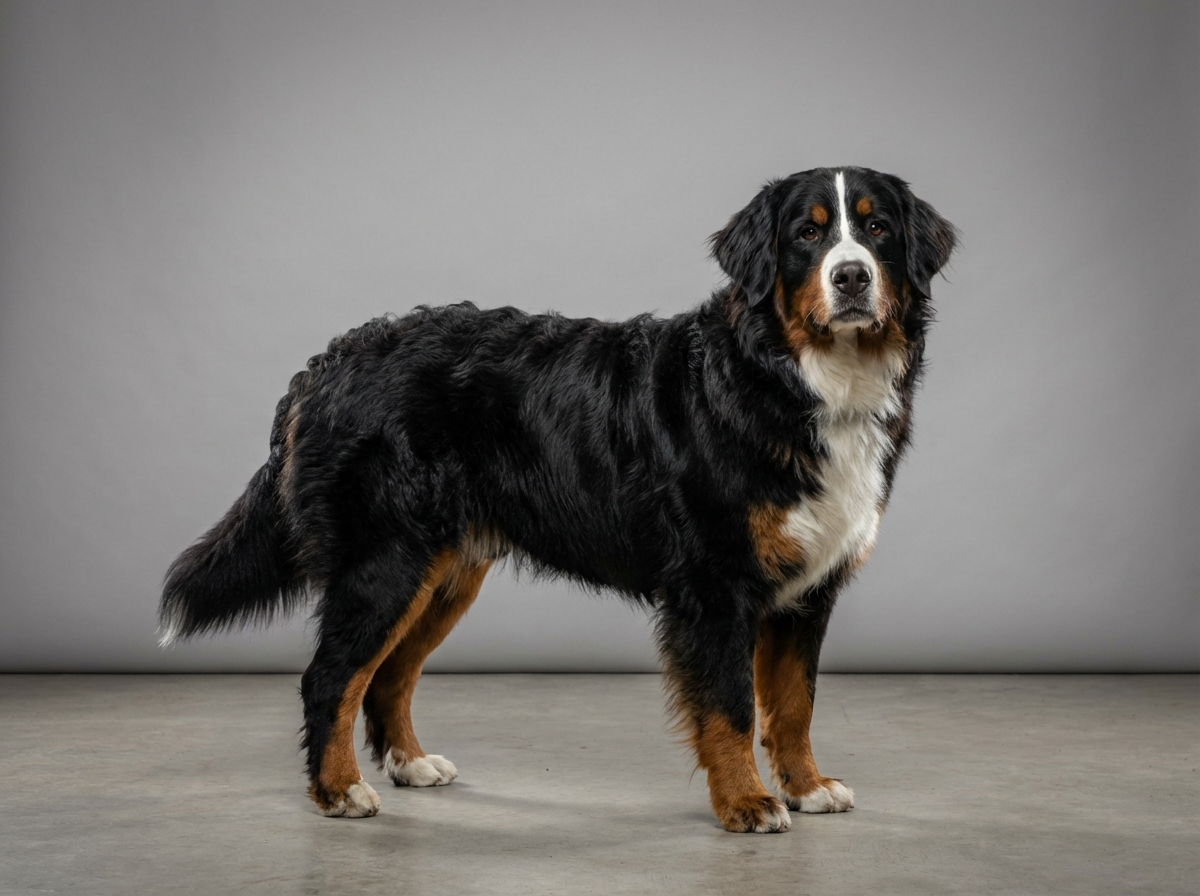
Acute type I herniation is strongly concentrated in short-legged, long-backed breeds and is uncommon in Bernese Mountain Dogs, who are not built on that frame. Disc disease does not appear on this breed's documented health issue list. When a Berner does present with sudden hind limb collapse, a veterinarian will be considering vascular cord events, trauma and spinal tumours alongside disc herniation rather than assuming it.
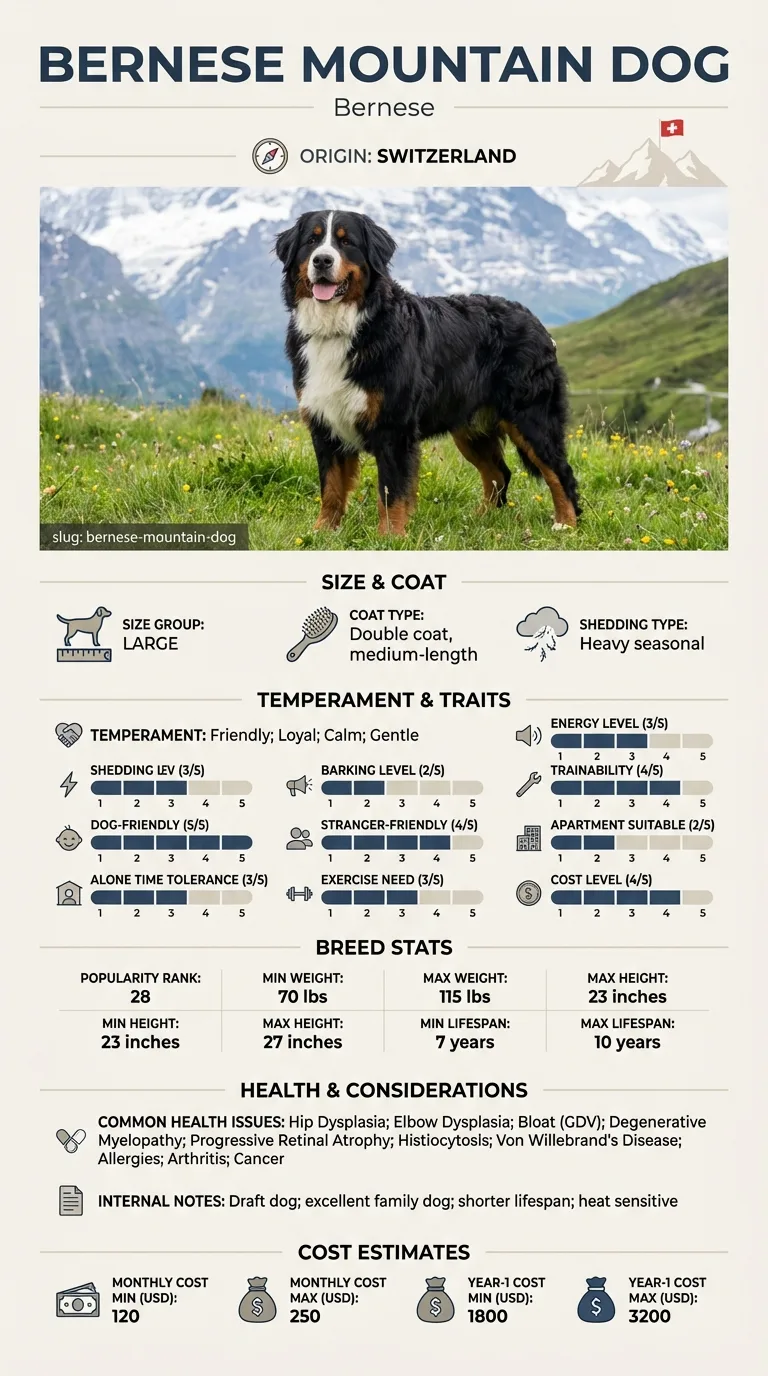
The mechanism behind classic type I herniation is early calcification of the disc centre, a change tied to the genetics of disproportionate dwarfism. Bernese Mountain Dogs do not carry that build, standing 23 to 27 inches on proportionate limbs, which places them well outside the highest risk group. Where the breed does raise the stakes is in consequence rather than incidence: a paralysed dog weighing 70 to 115 pounds is far harder to transport, nurse, rehabilitate and support than a small one, and that shapes every decision that follows.
Falls and impacts matter most. Ice, wet decking, polished floors and high vehicle boots all create moments where a heavy dog lands awkwardly with his full weight travelling through the spine. Households where the dog leaps from a raised bed or a truck bed daily accumulate far more of these moments than those using a ramp. Rough play with other large dogs, which this notably dog-friendly breed enjoys, is another setting where sudden twisting loads occur.
This condition in its serious form is an emergency, not an appointment. Go now, to an emergency facility rather than waiting for your regular practice to open, if your Bernese suddenly cannot stand or use his hind legs, is dragging his feet, has lost bladder or bowel control, is screaming or crying when moved, or has gone from walking to not walking within a day. Do not wait to see whether he improves overnight, and do not administer any medication before you go. If he is painful but still walking, he still needs same-day veterinary attention because these cases can deteriorate quickly.
Start here: Bernese Mountain Dog Most Common Genetic Disorders
See all Bernese Mountain DOG health problems, which breeds are prone to intervertebral disc disease ivdd type i, or the full Bernese Mountain DOG breed guide for temperament, exercise needs and ownership costs.
The decisive period is the first day. After treatment, dogs who retain some function often begin improving within one to three weeks, while severe cases can take two to three months to show meaningful return, and some never do. Strict confinement typically runs four to six weeks, with a graded return to activity over a further two to three months. For a dog of this size, expect the physical demands on the household to peak in the first fortnight.
Full return to normal walking is the best outcome and is realistic for less severe grades treated quickly. A good outcome short of that is a dog who walks with some wobble, controls his bladder, and is not in pain. Honesty matters here: a large dog with permanent hind limb paralysis requires a level of daily physical care that not every household can provide, and that limitation should be discussed openly rather than discovered later.
Veterinary neurologists grade these cases by function rather than by imaging, and the grade drives everything: whether to refer, whether to operate, and how quickly.
In a dachshund, sudden hind limb paralysis is a disc until proven otherwise. In a Bernese Mountain Dog it is not, because the breed lacks the disproportionate build that drives early disc calcification. That widens the list of things a vet has to consider, and it changes what the owner should be watching for.
Fibrocartilaginous embolism is a leading alternative in large breeds. A fragment of disc material enters a blood vessel and blocks the supply to part of the spinal cord, producing sudden, often one-sided weakness. It classically occurs during exercise, the dog may yelp once at the moment it happens, and crucially it is usually not painful afterwards. It does not need surgery, and many dogs improve substantially with time and physiotherapy.
Trauma is the second alternative and is easy to miss when it happened out of sight. Spinal fracture and luxation in a heavy dog can produce identical signs.
Spinal tumours matter more in this breed than in most, because the Bernese carries an elevated cancer risk and histiocytic disease is documented in the breed. A mass can occasionally produce an apparently sudden collapse when it reaches a critical point.
Pain is the most useful thing an owner can report. A dog who screams when moved and holds his back rigid is presenting differently from a dog who dropped mid-run and now lies calmly with a floppy back end. Neither is good, but the second is much less likely to be a disc.
Size also affects logistics. Getting a hundred pound dog into a car without twisting his spine takes two people and a flat board or a firm blanket, and it is worth thinking about that before you ever need to.

Anton was seven, playing hard with another dog in a field, when he yelped once and went down. Within a minute he was lying on his side, unable to use his left hind leg and barely using the right. His owner expected him to be in agony, but he lay quietly and let himself be examined without any pain response at all. Two people carried him on a folded picnic blanket to the car and drove to the emergency hospital. The neurologist's assessment noted the abrupt onset during exercise, the asymmetry and the complete absence of pain, and the working diagnosis was a vascular event in the spinal cord rather than a herniated disc. No surgery was performed. Anton spent four days hospitalised, then began weekly physiotherapy. He was walking unaided at six weeks with a slight drift to the left, which he still has at nine years old.
Key takeaway: The absence of pain was the most diagnostically valuable thing Anton's owner could report. In a large breed, sudden painless weakness during exercise points to a different disease and a different, often better, outcome than a painful disc herniation.
Immediately, for any dog who cannot walk. For severe grades, the interval between losing function and reaching surgery is one of the strongest predictors of recovery, and it is measured in hours rather than days. Call the emergency clinic while someone else prepares the car rather than making the decision by watching for another half hour.
Keep the spine as straight and still as you can. Two people, a rigid board, a stretcher or a firm blanket used as a sling under the body works better than carrying. Do not lift a Bernese under the chest and let the back end swing. If the dog is in pain he may bite despite temperament, so approach carefully even with a gentle breed.
No. Dogs who are painful but still walking are often managed conservatively with strict confinement and veterinary-prescribed pain control. Surgery becomes the recommendation as function is lost. In a large breed the decision also weighs the practicalities of nursing a hundred pound dog through either route, which is a legitimate part of the conversation.
Longer and more physically demanding than for a small dog. Weeks of confinement, assisted toileting, a support harness, and physiotherapy are typical. Owners frequently underestimate the sheer manual work involved in caring for a large paralysed dog, and it is worth discussing honestly with the surgical team before committing.
Another disc can herniate at a different site, though repeat events are less typical in breeds that are not predisposed to early disc calcification. Ongoing management focuses on keeping the dog lean, avoiding high-impact landings and maintaining core and hind limb strength through continued physiotherapy.
It may point toward a vascular event rather than a disc, which generally has a more favourable outlook and does not require surgery. It still needs immediate veterinary assessment, because you cannot distinguish these at home and because the treatments diverge completely.
A dog who cannot stand or move his hind legs and cannot urinate. That combination means going to an emergency facility now, not booking an appointment.
More likely. Severe back pain with weakness points toward disc compression. Sudden painless weakness after exercise points toward a vascular cord event instead.
No. Never give human medication to a dog, and do not use leftover prescriptions. Masking pain also removes information the veterinarian needs to grade the case.
The address and phone number of the nearest twenty-four hour facility with neurology capability, and a plan for lifting a very heavy dog with two people and a flat board.
A one-page prep sheet for this condition: the signs, the questions to ask, what to get priced. Unlocks here.
You get: Vet visit prep sheet
No spam. One-click unsubscribe. See our privacy policy.
Preview page 1 before you decide.