Living
Which is the bigger breed?
The Newfoundland, classed as giant against the Bernese's large.

Quick answer
Which is the bigger breed?
The Newfoundland, classed as giant against the Bernese's large.
Bernese Mountain Dog or Newfoundland? On paper they differ most on grooming need, and on the scales Newfoundland is the heavier at 100–150 lbs. Here is how the two compare on everything that shapes an ordinary week.
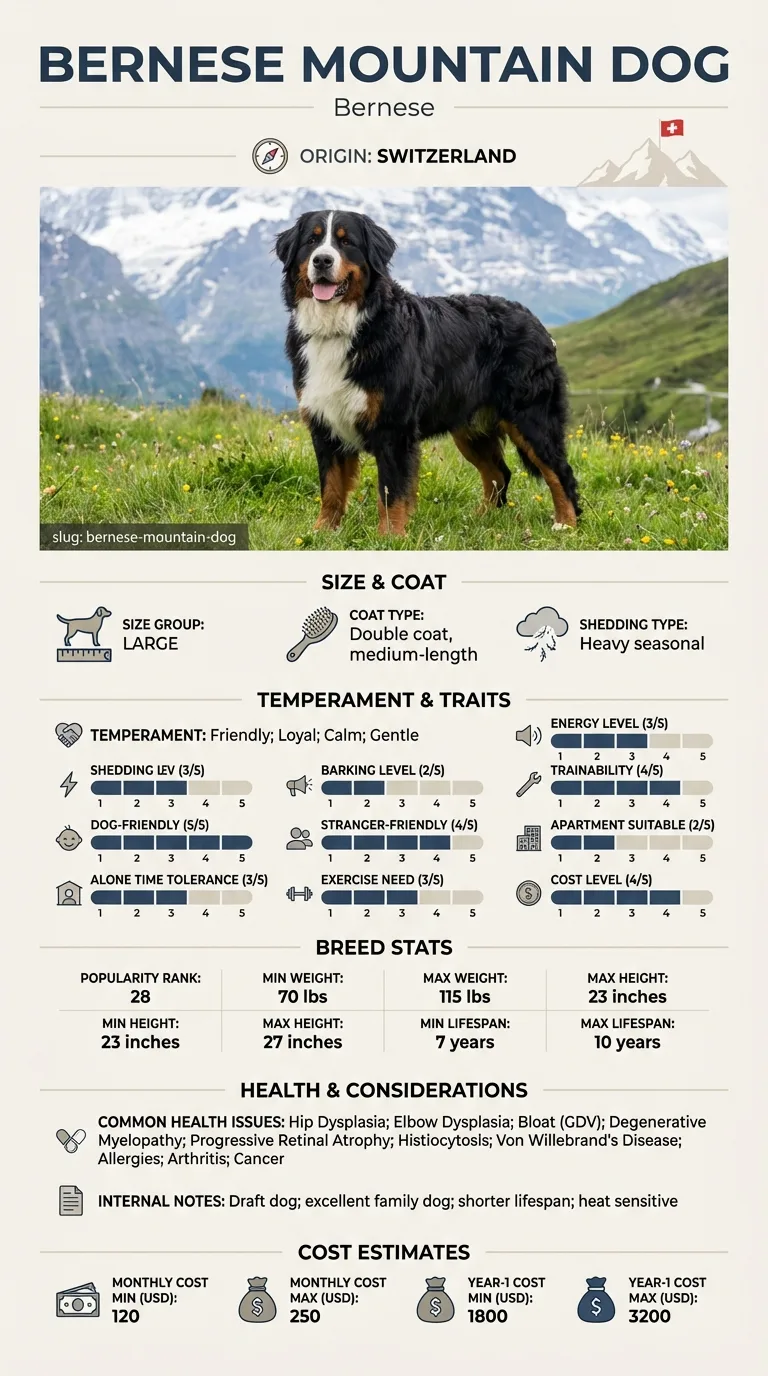
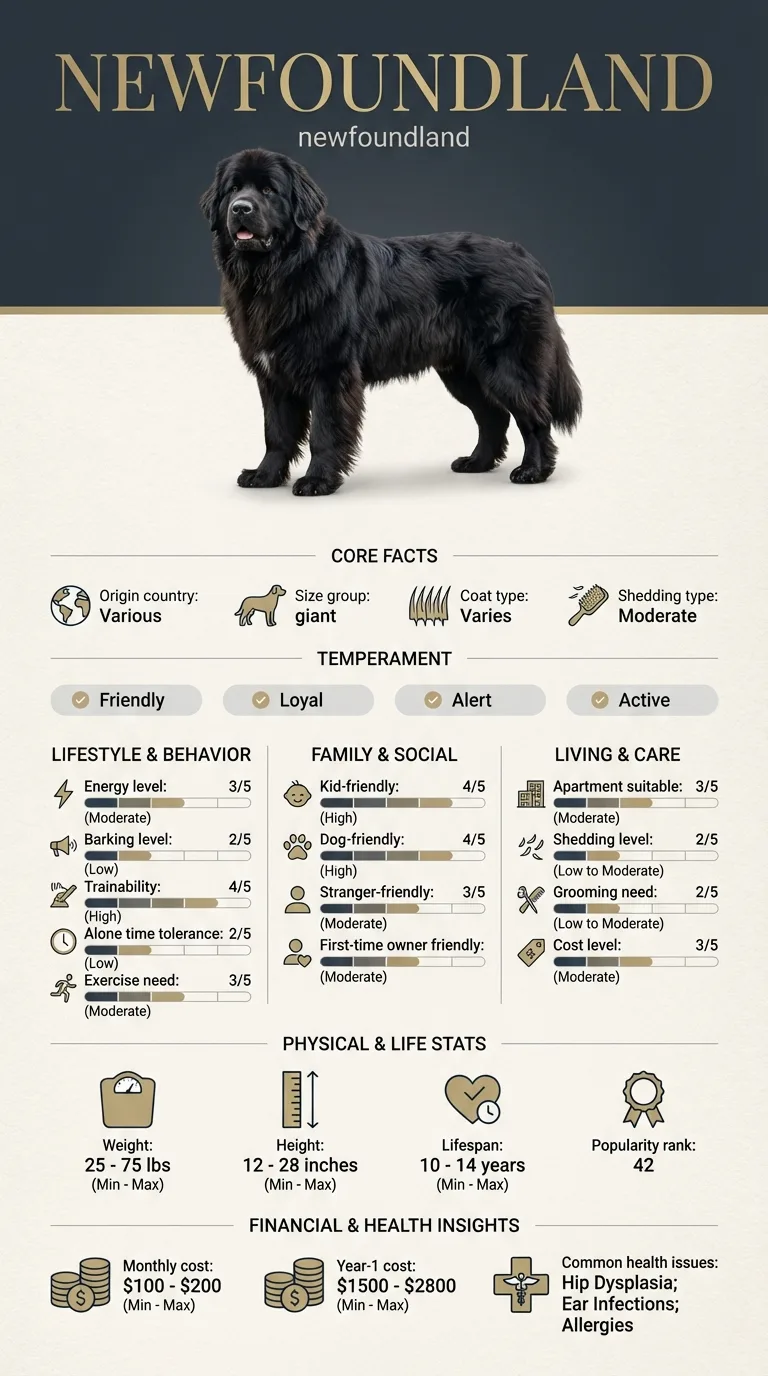
This is for someone already down to Bernese Mountain Dog and Newfoundland and deciding between them. Because the two are so evenly matched, the page works through every axis rather than leading with one. Anyone choosing from a flat has a clear answer here: Bernese Mountain Dog rates 2/5 against 1/5. The focus throughout is on daily consequences rather than breed background.
Between Bernese Mountain Dog and Newfoundland, they are closer than most pairings, and the choice comes down to temperament, and Bernese Mountain Dog is the lower-effort dog of the two to keep.
Choose Bernese Mountain Dog if this is your first dog, you do not want a standing grooming appointment and shedding is a problem in your house.
Choose Newfoundland if its temperament and look are what you want; on the measurable axes it gives up nothing to the other.
| Feature | bernese mountain dog | newfoundland | Winner |
|---|---|---|---|
| Size class | large | giant | Equal |
| Weight | 70–115 lbs | 100–150 lbs | Equal |
| Height | 23–27 in | 26–28 in | Equal |
| Lifespan | 7–10 years | 9–10 years | newfoundland |
| Exercise need | Moderate (3/5) | Moderate (3/5) | Equal |
| Grooming need | Moderate (3/5) | High (4/5) | bernese mountain dog |
| Shedding | High (4/5) | Very high (5/5) | bernese mountain dog |
| Energy level | Moderate (3/5) | Low (2/5) | Equal |
| Barking | Low (2/5) | Low (2/5) | Equal |
| Apartment suitability | Low (2/5) | Very low (1/5) | bernese mountain dog |
| Good for first-time owners | High (4/5) | Moderate (3/5) | bernese mountain dog |
| Tolerates being alone | Moderate (3/5) | Moderate (3/5) | Equal |
| Trainability | High (4/5) | High (4/5) | Equal |
| Good with kids | Very high (5/5) | Very high (5/5) | Equal |
| Good with other dogs | Very high (5/5) | High (4/5) | bernese mountain dog |
| Friendly to strangers | High (4/5) | High (4/5) | Equal |
| Cost level | High (4/5) | Very high (5/5) | bernese mountain dog |
| Coat | Double coat, medium-length | Heavy water-resistant double coat | Equal |
| Origin | Switzerland | Various | Equal |
| Typical monthly cost | $120–$250 | $150–$310 | Equal |
| Typical first-year cost | $1,800–$3,200 | $2,200–$4,200 | Equal |
Both of these are big dogs, but the Newfoundland outweighs the Bernese at the top end, running 100-150 lbs against the Bernese's 70-115 lbs, and edges it in height too, 26-28 in versus 23-27 in, enough that the Newfoundland is classed as giant while the Bernese is classed as large. That extra mass matters for logistics most large-dog owners don't anticipate, since doorways, car trunks, and furniture all need to accommodate a dog that can top 150 lbs. Anyone comparing these two should recognize this isn't really large-versus-large; it's large-versus-giant, and the giant category brings its own space and handling demands.
Exercise need is tied at moderate (3/5), but energy level actually favors the calmer Newfoundland at low (2/5) against the Bernese's moderate (3/5), a difference that lines up with the Newfoundland's temperament tags of Patient and Calm versus the Bernese's more generally Friendly profile. Neither breed needs intense daily exercise, and both are content with structured walks rather than vigorous activity, but the Newfoundland's lower energy level means it's the more likely of the two to spend most of the day napping. Owners picturing a mellow giant-breed companion will find the Newfoundland slightly closer to that ideal.
The Newfoundland demands more coat work across the board: high grooming need (4/5) versus the Bernese's moderate (3/5), and very high shedding (5/5) versus the Bernese's already-substantial high (4/5). Its heavy, water-resistant double coat was bred for cold-water rescue work, and that functional coat requires more frequent brushing to manage than the Bernese's medium-length double coat. Anyone sensitive to loose fur should expect the more demanding grooming routine here to come from the Newfoundland, not the Bernese, despite both being heavy-shedding double-coated breeds by any ordinary standard.
Neither breed suits apartment life, but the Newfoundland rates even lower, very low (1/5), than the Bernese's already-low (2/5), a predictable result of its giant size class and greater mass. Both are quiet dogs, tied at low (2/5) for barking, so noise complaints are unlikely to be the deciding factor either way. Alone-time tolerance is tied at moderate (3/5) too, meaning both can handle a workday alone reasonably well, but square footage and yard access should weigh far more heavily than barking tendencies when deciding between these two large housemates in anything smaller than a house.
The Bernese is rated a stronger fit for first-time owners, high (4/5) against the Newfoundland's moderate (3/5), even though the two share the same trainability score, high (4/5). That gap likely reflects the Newfoundland's sheer physical size and strength, since a giant-breed dog that pulls on a leash is harder for a novice to manage than a large-breed one, regardless of underlying trainability. Both breeds' temperament lists lean toward gentleness, Gentle for the Bernese, Sweet and Devoted for the Newfoundland, so once basic handling skills are in place, either responds well to consistent, patient training.
Both breeds rate very high (5/5) with kids, matching their shared reputation as gentle giants, and both rate high (4/5) for friendliness to strangers. The Bernese edges ahead with other dogs, very high (5/5) versus the Newfoundland's high (4/5), a small but real distinction for multi-dog households. Given the Newfoundland's greater size and lower first-time-owner rating, families with very young children should also factor in supervision needs simply due to the dog's mass, since even a gentle 150 lb dog can unintentionally knock over a toddler during normal play.
Lifespans sit close together, 7-10 years for the Bernese, 9-10 for the Newfoundland, both short relative to smaller breeds, a common pattern in giant and large working dogs. The two share Hip Dysplasia and Bloat (GDV) on their health lists, but otherwise diverge: the Bernese's list includes Histiocytosis, Von Willebrand's Disease, Degenerative Myelopathy and Cancer, while the Newfoundland's shorter list includes cardiac-specific concerns like Subaortic Stenosis and Dilated Cardiomyopathy, plus Cystinuria. Prospective owners of either breed should ask breeders directly about cardiac screening for the Newfoundland and cancer history for the Bernese given how each list is weighted.
The Newfoundland is the more expensive of the two by every measure here: very high cost rating (5/5) versus the Bernese's high (4/5), a monthly range of $150-$310 versus $120-$250, and a first-year range of $2,200-$4,200 versus $1,800-$3,200. That premium tracks directly with its giant size class, since more food, larger-capacity gear, and bigger vet-care costs all scale up with body weight. Anyone budgeting for a Newfoundland over a Bernese should plan for meaningfully higher food and supply costs across the dog's lifetime, not just a marginally larger price tag.
Bernese Mountain Dog weighs 70–115 lbs and lives 7–10 years; Newfoundland weighs 100–150 lbs and lives 9–10 years. No rated axis separates them by more than a single point, which makes this one of the closer pairings on the site. They are level on tolerates being alone, barking and exercise need, so those cannot decide it. The table below marks a winner only where one breed is genuinely easier for a typical owner; size and origin are facts rather than merits and stay level. Ratings come from one source applied to both breeds, so they are meaningful against each other rather than as absolute scores.

Yes, the Newfoundland is classed as giant at 100-150 lbs, while the Bernese is classed as large at 70-115 lbs.
The Newfoundland, rated low (2/5) for energy level against the Bernese's moderate (3/5).
The Newfoundland, rated very high (5/5) shedding versus the Bernese's high (4/5).
Less so than a Bernese. The Newfoundland rates moderate (3/5) for first-time owners against the Bernese's high (4/5), largely due to its greater size and strength.
The Newfoundland, rated very high (5/5) on cost with a first-year range of $2,200-$4,200 versus the Bernese's $1,800-$3,200.
Their health list includes Subaortic Stenosis and Dilated Cardiomyopathy, both cardiac conditions worth screening for with a breeder.
Both rate very high (5/5) with kids, though the Newfoundland's greater size means more supervision is wise around very young children.
The Newfoundland, classed as giant against the Bernese's large.
The Bernese Mountain Dog, rated moderate (3/5) versus the Newfoundland's high (4/5).
The Bernese Mountain Dog, with a lower cost rating (high, 4/5) versus the Newfoundland's very high (5/5).
Neither. The Bernese rates low (2/5) and the Newfoundland rates even lower, very low (1/5).
Secure checkout on Stripe. We never see your card.
7-day money-back guarantee. Instant access.
Health information here is general and is not veterinary advice. If your dog shows pain, sudden behaviour change, or worsening symptoms, consult a licensed veterinarian.
Some links on this site are affiliate links. We may earn a commission at no extra cost to you, and we only suggest products we believe are helpful for dog owners.
We research and check what we publish, but we do not warrant that any figure, date, price, or statement is accurate, complete, or current, and we accept no liability for any loss, cost, injury, or other harm arising from the use of this site. Use it as one reference among several. You remain responsible for your own decisions and for your dog's care - confirm anything that matters with a licensed veterinarian or another qualified professional before you act on it. Full disclaimer.
Match your lifestyle to the right dog.
Take quizNot sure which breed is right for you? Take our 2-minute quiz to find out.
Take the quiz