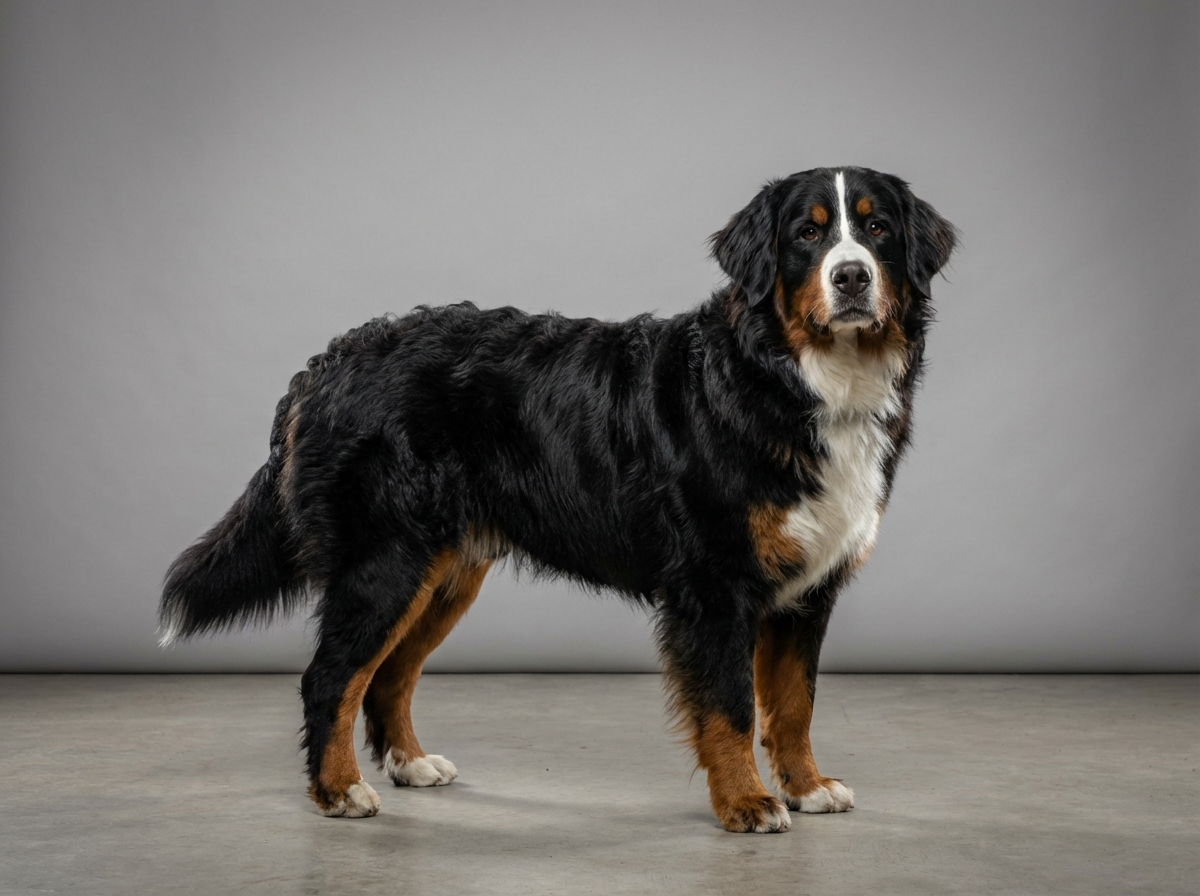
Health
What must be ruled out before assuming pancreatitis?
Bloat. It is documented in this breed, shares the early picture, and kills within hours. A large deep-chested dog with sudden abdominal pain goes to a vet immediately.

Quick answer
What must be ruled out before assuming pancreatitis?
Bloat. It is documented in this breed, shares the early picture, and kills within hours. A large deep-chested dog with sudden abdominal pain goes to a vet immediately.
It very often starts with something ordinary: the rind off a joint of meat, a bin raided on a Sunday, a barbecue where several people fed the dog without telling each other.
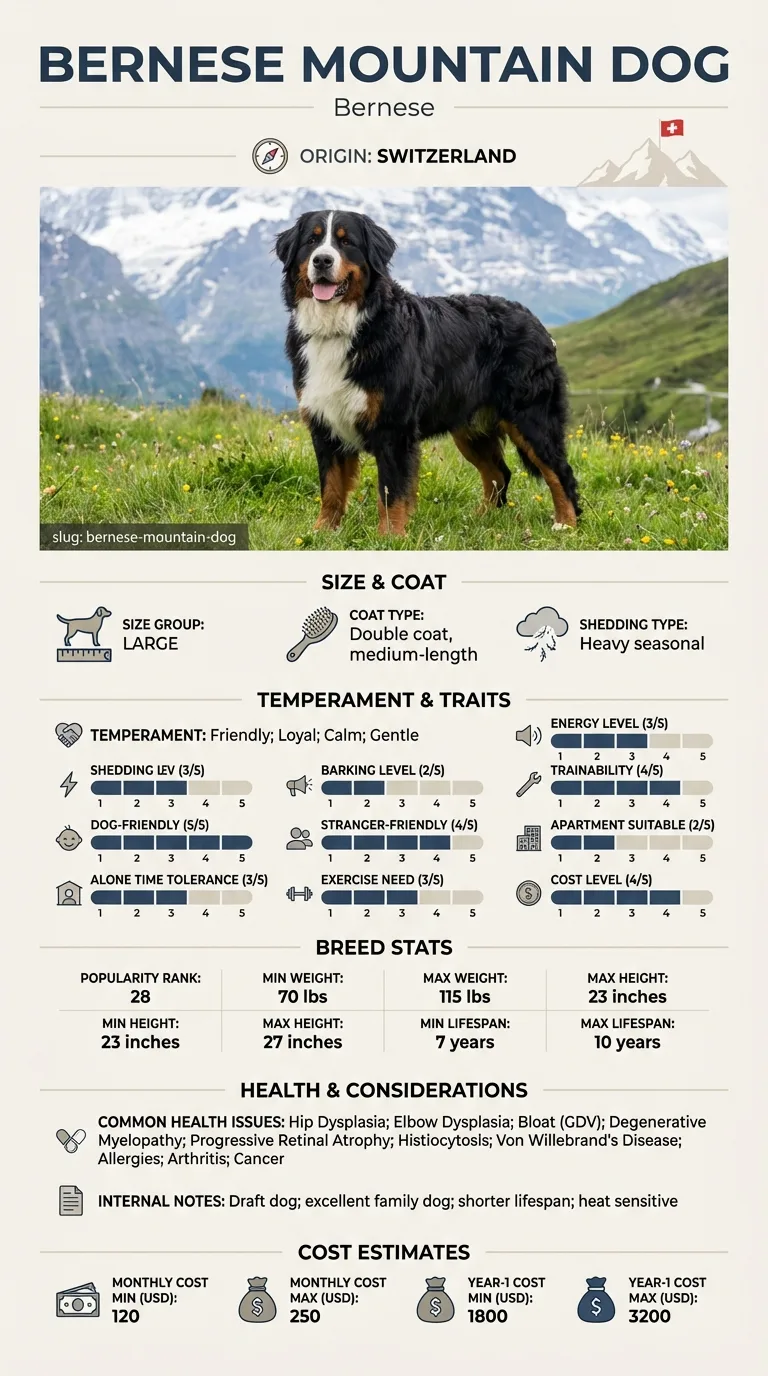
Owners whose Bernese has become suddenly unwell after a rich meal, and owners of a dog who has had one episode and want to know how to avoid a second.
This guide is not medical advice. If your dog shows pain, sudden behavior change, or worsening symptoms, consult a licensed veterinarian.
Some links may be affiliate links. We may earn a commission at no extra cost to you. We only suggest products we believe are helpful for dog owners.
We research and check what we publish, but we do not warrant that any figure, date, price, or statement is accurate, complete, or current, and we accept no liability for any loss, cost, injury, or other harm arising from the use of this site. Use it as one reference among several. You remain responsible for your own decisions and for your dog's care - confirm anything that matters with a licensed veterinarian or another qualified professional before you act on it. Full disclaimer.
Pancreatitis is inflammation of the pancreas caused by digestive enzymes activating within the organ rather than in the intestine. It produces vomiting, refusal to eat, severe upper abdominal pain and lethargy, often within a day of a fatty meal. Treatment is supportive, usually requiring hospitalisation with fluids, pain control and anti-nausea medication, followed by a long-term low fat diet to reduce the risk of recurrence.
Pancreatitis is a routine emergency presentation in general veterinary practice across all breeds, with a well recognised seasonal peak around holidays when human food is shared. It is not among the Bernese Mountain Dog's documented breed-specific health issues, so a Berner is at ordinary rather than elevated risk. What raises the stakes in this breed is the overlap with bloat, which is a documented concern here and which must be excluded urgently.
There is no established Bernese predisposition to pancreatitis, and it should not be presented as one. What the breed contributes is context. Height and reach make counter surfing and bin raiding easy for a dog standing 23 to 27 inches. A calm, sociable, family-oriented temperament means a Bernese is present at every gathering and is offered food by everyone there. And the breed's documented tendency toward bloat means that any episode of abdominal pain carries a much higher urgency than the same signs in a small dog.
Household food culture is the whole environmental story. Homes where scraps are shared, where the dog is present during meal preparation, and where several people feed independently produce most episodes. Waste management matters: a securely lidded bin behind a closed door removes the single most common scavenging route. Holiday periods concentrate all of these factors at once, which is why veterinary emergency services see a reliable seasonal increase in pancreatitis every year.
Go immediately, without delay, if your Bernese has a distended or painful abdomen, is retching repeatedly without bringing anything up, is restless and unable to settle, is collapsing or has pale gums. Those signs raise the possibility of bloat, which is a surgical emergency in this breed and kills within hours. Also seek same-day veterinary care for repeated vomiting, refusal to eat, obvious abdominal pain or the repeated bowing posture. Do not attempt to manage vomiting at home with fasting in a large deep-chested dog.
Start here: Bernese Mountain Dog Most Common Genetic Disorders
See all Bernese Mountain DOG health problems, which breeds are prone to pancreatitis, or the full Bernese Mountain DOG breed guide for temperament, exercise needs and ownership costs.
A mild episode typically means one to three days of hospitalisation and a gradual return to eating over a week. A severe episode can require five to seven days of intensive care and several weeks of convalescence. The diet change that follows is not a phase; it is usually permanent. Most dogs are eating normally within two weeks, and most owners underestimate how long it takes for the household habits to change to match.
Success is a single episode that never repeats. Concretely that means a dog back to normal appetite and energy within a fortnight, a household that has genuinely stopped sharing food, a secured bin, and a stable lean weight. Where a dog has developed the recurring form, success shifts to fewer and milder flare-ups, and to catching each one on day one rather than day three.
The classic presentation is repeated vomiting, refusal to eat, obvious abdominal pain, lethargy and sometimes diarrhoea. The pain often produces a distinctive posture, with the chest and forelegs dropped to the floor and the hindquarters raised, which owners describe as a stretch or a bow the dog holds and repeats.
Here is the part that matters specifically in a Bernese. Bloat, or gastric dilatation and volvulus, is on this breed's documented health issue list, and its early signs overlap almost exactly: a dog in obvious abdominal discomfort, restless, retching, unwilling to lie down. Bloat kills within hours and requires immediate surgery. Pancreatitis is serious but does not carry the same hour-by-hour clock.
An owner cannot reliably tell them apart, and should not try. The correct response to a large deep-chested dog with sudden abdominal pain and unproductive retching is to go to a veterinary facility immediately and let imaging make that distinction. A radiograph settles it in minutes.
One useful discriminator to report, though not to rely on, is what comes up. A dog with pancreatitis usually produces vomit. A dog with a twisted stomach retches repeatedly and brings up little or nothing, because nothing can pass. Mention which you have seen, and then go regardless.
Diagnosis of pancreatitis itself uses a specific blood test alongside general bloodwork and abdominal ultrasound, since the enzyme results alone can be ambiguous.
Most episodes have an identifiable trigger and most triggers are dietary, which is unusually good news: this is one of the more preventable serious illnesses a Bernese can have.

If you think your Bernese has pancreatitis, the plan is three steps: write down what you have seen and when it started, book a veterinary appointment rather than waiting for the next flare, and take video of the behaviour or symptom before you go — the thing you are worried about rarely happens in the consulting room. Screening in the parents covers hip dysplasia, elbow dysplasia, bloat (gdv).
What the vet visit should produce is a diagnosis and a written plan, not just reassurance: what is being ruled out, what the monitoring interval is, and which signs mean you come back sooner. Ask what the treatment costs across a year rather than per visit, because that is the number that decides whether you are managing this condition or reacting to it.
Between appointments, keep a short log — dates, what you saw, what changed. It is the single most useful thing an owner brings to a follow-up, and for pancreatitis it is often what separates a clear pattern from a guess.
Bruno was six and had never had a day of digestive trouble. At a family lunch in late December he worked the room, and afterwards it emerged that four different relatives had each given him a share of fatty meat, each believing they were the only one. By the following morning he had vomited five times, would not eat, and kept dropping his chest to the floor with his rear end up and holding the position. His owners, aware that this breed is prone to bloat, drove him straight to the emergency clinic rather than waiting. Radiographs excluded a twisted stomach within minutes. A pancreatic blood test and ultrasound confirmed pancreatitis. Bruno spent three days on fluids and pain relief and came home on a low fat prescription diet. His family now sends a message to every guest before a gathering, and Bruno is settled on a mat in another room during meals.
Key takeaway: Dietary indiscretion is usually a coordination failure rather than a single decision. When several people each give a large sociable dog a small amount, nobody has given him much and the dog has eaten a great deal.
It describes a dog with his chest and elbows on the floor and his rear end up, held repeatedly rather than as a normal stretch. It reflects pain in the upper abdomen and it is suggestive, not diagnostic. Other causes of severe abdominal pain, including bloat, can produce restlessness and abnormal posturing too.
Less than owners expect, and it varies enormously between dogs. Some dogs eat table scraps for years without trouble; others develop severe pancreatitis after a single fatty meal. Because you cannot know which kind of dog you have until it happens, the safe policy is to keep the diet consistent and to not share human food at all.
Supportively, in most cases with hospitalisation. Intravenous fluids, veterinary-prescribed pain relief and anti-nausea medication, and careful reintroduction of a low fat diet are the mainstays. Severe cases require intensive care over several days. There is no drug that reverses the inflammation directly; the treatment supports the dog while the pancreas recovers.
Usually yes after a significant episode. A low fat diet, fed in measured meals with no exceptions, is the main tool for preventing recurrence. The hardest part is not the food but the household discipline, because a single well-meant piece of fatty meat from a visitor can undo months of care.
Severe cases can be, particularly when complications develop involving clotting, kidney function or widespread inflammation. Most dogs treated promptly recover, which is precisely the argument for going to a veterinarian on the first day rather than waiting to see whether the vomiting settles.
It raises the risk, and some dogs go on to develop a chronic low-grade form with recurring flare-ups. Repeated inflammation can eventually damage the hormone-producing cells of the pancreas, which is the route by which some dogs later develop diabetes. That connection is the main reason prevention is taken seriously after a first episode.
The early signs are set out in the sections above, and they are the reason to book a veterinary appointment rather than wait. Pancreatitis in Berneses is diagnosed by a vet, not from a symptom list, and the sooner it is on record the more options remain open.
The early signs are set out in the sections above, and they are the reason to book a veterinary appointment rather than wait. Pancreatitis in Bernese Mountain Dogs is diagnosed by a vet, not from a symptom list, and the sooner it is on record the more options remain open.
Bloat. It is documented in this breed, shares the early picture, and kills within hours. A large deep-chested dog with sudden abdominal pain goes to a vet immediately.
A high-fat meal, often human food given as a treat or scavenged from a bin. Holiday periods produce a noticeable spike in cases.
Do not manage this at home. Repeated vomiting with abdominal pain in a large breed needs a same-day veterinary assessment, not a fasting experiment.
After a significant episode, usually yes. Recurrence risk is real, and the diet only works if treats and table scraps are included in the rule.
A one-page prep sheet for this condition: the signs, the questions to ask, what to get priced. Unlocks here.
You get: Vet visit prep sheet
No spam. One-click unsubscribe. See our privacy policy.
Preview page 1 before you decide.