Health
Why does a dog stay in hospital after bloat surgery even if it went well?
To monitor for abnormal heart rhythms, a documented complication in the first few days after this surgery caused by the tissue damage during the twisted period.

Quick answer
Why does a dog stay in hospital after bloat surgery even if it went well?
To monitor for abnormal heart rhythms, a documented complication in the first few days after this surgery caused by the tissue damage during the twisted period.
Surviving the surgery is not the same as being out of danger. The 72 hours afterward carry their own risks.
Owners whose Bernese has just come through emergency GDV surgery and who are now facing an unfamiliar recovery period, and anyone trying to understand what a permanent gastropexy actually changes going forward.
This guide is not medical advice. If your dog shows pain, sudden behavior change, or worsening symptoms, consult a licensed veterinarian.
Some links may be affiliate links. We may earn a commission at no extra cost to you. We only suggest products we believe are helpful for dog owners.
We research and check what we publish, but we do not warrant that any figure, date, price, or statement is accurate, complete, or current, and we accept no liability for any loss, cost, injury, or other harm arising from the use of this site. Use it as one reference among several. You remain responsible for your own decisions and for your dog's care - confirm anything that matters with a licensed veterinarian or another qualified professional before you act on it. Full disclaimer.
Recovery from GDV surgery covers the period after a Bernese has survived the emergency operation: the hospital days when heart rhythm complications are monitored, the fortnight of restricted activity while the gastropexy heals, and the long term once healing is complete. It is a distinct stage from the emergency itself, with its own risks and its own timeline.
Every dog that undergoes emergency GDV surgery goes through this recovery stage, so within the population of Bernese Mountain Dogs that have had the surgery, it is universal. The heart rhythm complication specifically affects a meaningful minority of post-surgical dogs, which is why hospital monitoring is standard rather than optional.
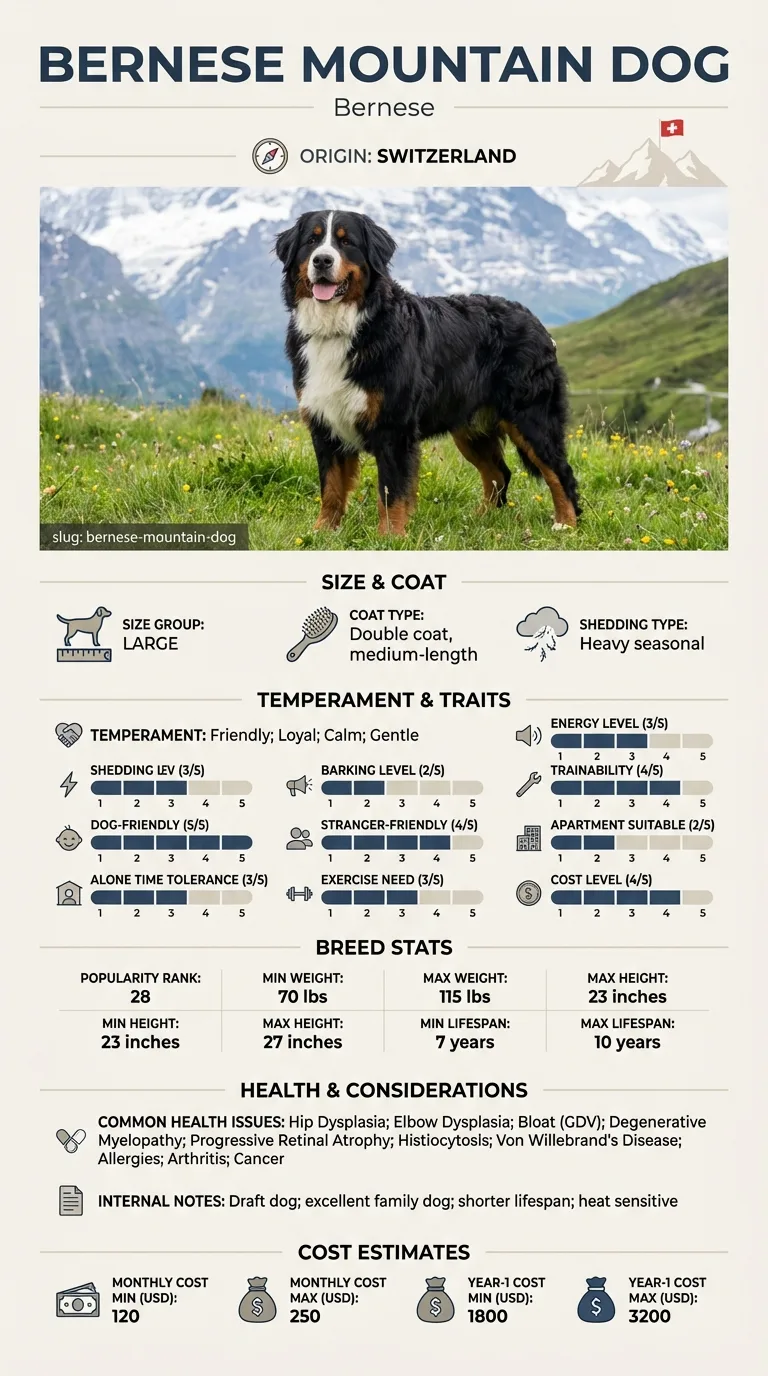
Body size shapes the recovery more than any genetic factor. A dog weighing 70 to 115 pounds carries a larger surgical incision, a longer anaesthetic exposure, and a bigger stomach and spleen that experienced more tissue strain during the rotated period, all of which lengthen the hospital stay compared with a smaller breed undergoing the same procedure. The breed's calm temperament is a practical advantage during the restricted-activity fortnight, since a Bernese generally tolerates lead-only walks better than a higher-drive dog would.
A busy household, other dogs at home, or an owner who needs the dog mobile for work or family reasons all make the two-week restriction harder to maintain in practice. Access to a veterinary hospital capable of overnight cardiac monitoring, rather than a same-day discharge practice, meaningfully affects how safely the first stage of recovery is managed.
Call promptly if you notice incision swelling, redness or discharge, if vomiting continues beyond the first day home, if your dog seems increasingly lethargic rather than steadily improving, or if the abdomen appears distended again. Any of these during the recovery period should be treated as urgent rather than saved for the next scheduled visit, given how recently your dog has been through a genuine emergency.
Owners understandably focus all their attention on getting through the surgery itself. The mistakes that follow tend to come from relief overtaking caution too early.
Start here: Bernese Mountain Dog Most Common Genetic Disorders
See all Bernese Mountain DOG health problems, which breeds are prone to gastric dilatation volvulus gdvbloat, or the full Bernese Mountain DOG breed guide for temperament, exercise needs and ownership costs.
Hospital stay runs one to three nights. Activity restriction at home lasts about two weeks. Full return to normal exercise and feeding typically follows within three to four weeks of the surgery date.
Success is a healed incision, a stable heart rhythm confirmed at recheck, and a dog back to full activity with no recurrence of rotation. It is not the absence of any future abdominal illness, since a gastropexy addresses one specific mechanism rather than every possible stomach problem.
The first stage is the hospital stay itself, typically one to three nights. This is not routine post-operative observation. A significant share of dogs that have undergone GDV surgery develop abnormal heart rhythms in the first 24 to 72 hours, a consequence of the tissue damage and altered blood flow the stomach and spleen experienced during the twisted period. This is why a dog is kept on cardiac monitoring rather than sent home the same day, even when the surgery itself went smoothly. Pain control, intravenous fluids and monitoring for signs that part of the stomach wall did not survive are the other focus of this stage.
The second stage is the first two weeks at home, and this is where a gastropexy is actually completing its job. The surgeon has attached part of the stomach wall to the abdominal wall, but that attachment needs time to adhere permanently, similar to any surgical healing. Activity is deliberately restricted: lead walks only, no running, jumping or rough play with other dogs, and a calm environment. Feeding restarts gradually, often with several small, bland meals a day before returning to a normal routine, because a stomach and intestines that have just been handled in surgery do not appreciate a sudden full meal.
The third stage is the long term, and this is genuinely reassuring. Once a gastropexy has healed, the specific mechanism that makes this condition fatal, the stomach twisting on its own axis, is very unlikely to recur. The dog can still develop simple gas distension, and other unrelated abdominal problems have not gone away, but the catastrophic rotation that turns a bloated stomach into an emergency has been addressed directly and durably. Most dogs that survive surgery and heal without complication go on to live a normal length of life for the breed.

Magnus's Berner Nils survived emergency GDV surgery on a Tuesday night, and Magnus assumed the worst was over. The surgeon explained it wasn't quite: Nils would stay two more nights on a cardiac monitor, because dogs recovering from this surgery commonly develop rhythm disturbances in the first few days. Nils came home on day three with a feeding plan, a cone, and strict instructions about lead walks only. Magnus found the two weeks of restriction harder than the hospital stay itself, mostly because Nils looked and acted fine within days. He stuck to the plan anyway. At the four-week recheck, the incision had healed cleanly and the gastropexy had taken. Nils has been back to full activity for over a year with no recurrence.
Key takeaway: Surviving the surgery is the midpoint, not the finish line. The days and weeks that follow have their own real risks, and sticking to the restricted routine even when your dog seems fine is what actually protects the healing.
Typically one to three nights, primarily for cardiac monitoring. Abnormal heart rhythms are a well-documented complication in the first 24 to 72 hours after this surgery, and catching them early is the main reason for the extended stay rather than a routine same-day discharge.
Restricted activity for about two weeks, lead-only walks, no running or rough play, and a gradual return to normal feeding starting with small, frequent, easily digested meals. The surgical site and the gastropexy attachment both need this quieter period to heal properly.
If the gastropexy has healed properly, the stomach can no longer rotate, which removes the mechanism that makes this condition fatal. Simple gas buildup without rotation can still occur and would be managed very differently, usually without emergency surgery.
Beyond the initial hospitalisation, expect a recheck appointment or two, any prescribed medication, and a recovery diet. This is a modest addition compared with the surgery itself, and complications requiring further treatment are the main thing that changes the total.
Very. Owners who have been through an emergency like this often watch their dog's abdomen and behaviour closely for months afterward. That vigilance is a reasonable response, though it is worth discussing with your vet what is actually still a risk versus what has been permanently addressed.
Yes. Once the incision and gastropexy have fully healed, usually around two weeks, most dogs return to their normal activity level. There is no reason to permanently restrict a dog whose gastropexy has healed cleanly.
Swelling, redness or discharge at the incision, ongoing vomiting or refusal to eat beyond the first day, lethargy that worsens rather than improves, or any return of a distended abdomen. Any of these warrants a call to your vet rather than waiting for the scheduled recheck.
To monitor for abnormal heart rhythms, a documented complication in the first few days after this surgery caused by the tissue damage during the twisted period.
Around two weeks of lead-only walks and no rough play, giving the surgical attachment time to heal fully before normal activity resumes.
It prevents the stomach from rotating, which is the mechanism that makes this condition fatal. Simple gas distension without rotation can still occur but is far less dangerous.
Small, frequent, easily digested meals, building back to a normal feeding routine gradually rather than resuming full-sized meals immediately.
Usually a modest amount for rechecks and medication. Complications that require extra treatment are what typically drive the total higher.
A one-page prep sheet for this condition: the signs, the questions to ask, what to get priced. Unlocks here.
You get: Vet visit prep sheet
No spam. One-click unsubscribe. See our privacy policy.
Preview page 1 before you decide.