Behavior
How do I know if it is anxiety or boredom?
Record the first thirty minutes. Distress starts fast and targets exits with drooling and panting. Boredom starts later and targets interesting objects.

Quick answer
How do I know if it is anxiety or boredom?
Record the first thirty minutes. Distress starts fast and targets exits with drooling and panting. Boredom starts later and targets interesting objects.
Separation anxiety is not a dog missing you. It is a panic response, and the difference determines whether training will help or make things worse.
Owners returning to office work after a period at home, owners of an adolescent Bernese who has started destroying doorframes, and anyone who has found urine or damage on returning and does not know whether it is distress or protest.
This guide is not medical advice. If your dog shows pain, sudden behavior change, or worsening symptoms, consult a licensed veterinarian.
Some links may be affiliate links. We may earn a commission at no extra cost to you. We only suggest products we believe are helpful for dog owners.
We research and check what we publish, but we do not warrant that any figure, date, price, or statement is accurate, complete, or current, and we accept no liability for any loss, cost, injury, or other harm arising from the use of this site. Use it as one reference among several. You remain responsible for your own decisions and for your dog's care - confirm anything that matters with a licensed veterinarian or another qualified professional before you act on it. Full disclaimer.
Separation anxiety is a panic response triggered by being left alone, not a behavioural protest. Affected dogs vocalise, destroy exit points, salivate heavily, pace and sometimes toilet indoors despite being reliably house-trained, and the signs begin within minutes of departure. Treatment works by keeping the dog below his panic threshold while gradually extending absences, sometimes supported by veterinary-prescribed anxiety medication.
Separation-related behaviour is one of the most frequently reported problems across companion dogs generally. In the Bernese Mountain Dog it is a plausible rather than inevitable problem: the breed's moderate tolerance for time alone and strongly people-oriented temperament raise the risk, while its calm disposition and good trainability make it comparatively responsive to a structured plan.
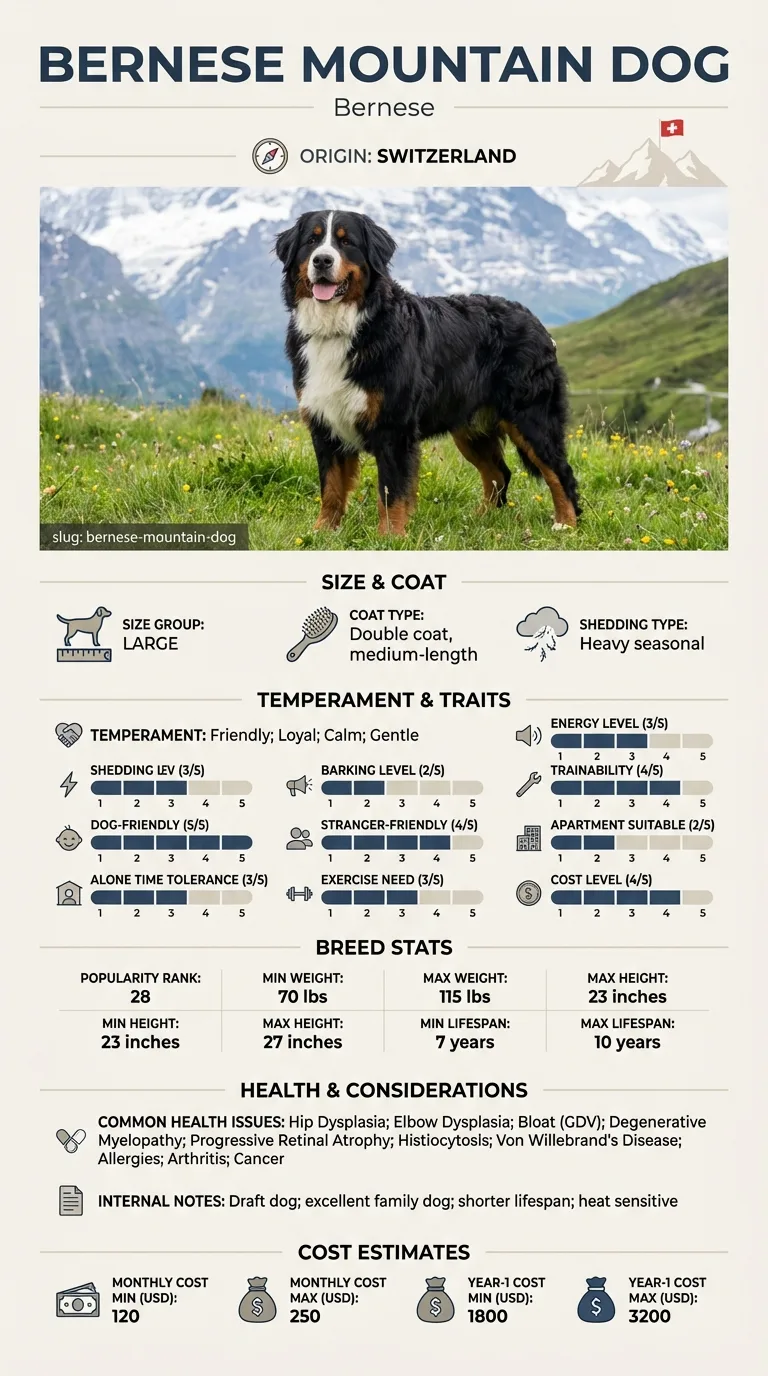
Temperament is the driver. This breed is described as friendly, loyal, calm and gentle, developed as a working farm dog that spent its days in company rather than patrolling independently. The result is a dog who orients strongly to his people and whose tolerance for solitude sits in the middle of the range rather than at the top. Size is a compounding factor rather than a cause: a distressed dog of 70 to 115 pounds inflicts damage and injures himself in ways a small anxious dog cannot, which raises the urgency of addressing it.
The pattern of the household is the main environmental factor. Dogs acquired during a period of constant human presence and then left abruptly are the classic case. Housing matters too, since a dog with access to a window onto a busy street has more to be aroused by than one in a quiet interior room. And in this breed temperature is a genuine environmental welfare issue: a Berner left in a warm house without cooling is uncomfortable as well as anxious, and the two feed each other.
Early, and for severe cases a qualified behaviourist rather than a general trainer. Separation anxiety is one of the behavioural problems where professional help most reliably shortens the process, because the threshold work is easy to get subtly wrong and each panic episode sets progress back. Look for someone who works with positive reinforcement and who will build a graduated absence plan around video evidence. In this breed the good trainability and calm temperament mean the work usually pays off, provided it is done consistently.
Speak to your veterinarian before assuming a behavioural cause if the problem appeared suddenly in an adult dog who was previously settled, since pain, cognitive decline in an older dog, and conditions causing increased urination can all produce what looks like separation anxiety. Seek prompt veterinary care if your dog has injured himself during an episode, has broken teeth or torn claws on a door, or is refusing food and losing weight. Medication for anxiety should be discussed with your vet rather than sourced independently, and human medications must never be used.
Start here: Bernese Mountain Dog Most Common Genetic Disorders
See all Bernese Mountain DOG health problems, which breeds are prone to separation anxiety, or the full Bernese Mountain DOG breed guide for temperament, exercise needs and ownership costs.
Mild cases typically improve noticeably within four to eight weeks of daily work. Moderate to severe cases run three to six months, and some dogs need ongoing management rather than reaching full independence. Progress is not linear; expect plateaus and setbacks, particularly after any occasion when the dog had to be left beyond his threshold. Where medication is used, allow several weeks for it to take effect before judging the training plan.
Success is a dog who settles within a few minutes of the door closing and sleeps for most of the absence, verified on camera rather than inferred from an undamaged hallway. For many households the honest endpoint is not unlimited independence but a reliable three or four hours, combined with a walker or daycare covering the rest. That is a legitimate outcome rather than a partial failure, and it matches what this breed's temperament realistically supports.
Camera footage from the first thirty minutes settles this question faster than anything else, and it costs nothing. Set a phone recording before you leave and watch it later.
The mechanism of a working plan is straightforward: keep the dog under the threshold at which he panics, and extend the duration slowly enough that he never crosses it. Everything else is detail.
Start by finding the actual threshold, which is often shorter than owners expect. Set the camera, walk out of the door, and note the exact moment the dog's behaviour changes. If that is forty seconds, forty seconds is your starting point, and pretending otherwise wastes months.
Then work in absences slightly shorter than the threshold, several times a day, returning calmly before any distress begins. Vary the duration rather than always increasing it, because a predictable escalation teaches the dog that every absence gets longer. Some sessions should be ten seconds even when he is managing five minutes.
Uncouple the departure cues in parallel. Pick up your keys and sit back down. Put on your coat and make coffee. Repeated dozens of times, these stop predicting anything.
Keep departures and returns undramatic. Greeting a Bernese enthusiastically after an absence makes your return the highlight of the day, which raises the value of your presence and the cost of your absence.
And do not stack progress on top of a bad day. If the dog was left too long on Tuesday, Wednesday is a consolidation day at shorter durations, not a longer attempt.
One breed-specific note: this dog is 70 to 115 pounds. A panicking Berner at a door does structural damage and can injure himself badly on frames and glass. The safety plan matters here in a way it does not with a small dog.

If you think your Bernese has separation anxiety, the plan is three steps: write down what you have seen and when it started, book a veterinary appointment rather than waiting for the next flare, and take video of the behaviour or symptom before you go — the thing you are worried about rarely happens in the consulting room. Screening in the parents covers hip dysplasia, elbow dysplasia, bloat (gdv).
What the vet visit should produce is a diagnosis and a written plan, not just reassurance: what is being ruled out, what the monitoring interval is, and which signs mean you come back sooner. Ask what the treatment costs across a year rather than per visit, because that is the number that decides whether you are managing this condition or reacting to it.
Between appointments, keep a short log — dates, what you saw, what changed. It is the single most useful thing an owner brings to a follow-up, and for separation anxiety it is often what separates a clear pattern from a guess.
Wilma was two when her family returned to office work after eighteen months at home. Within a fortnight she had scratched through the paint on the back door, and a neighbour reported howling that started almost immediately after the car left. Her owners had been practising absences of thirty minutes, believing they were building tolerance. The camera showed something different: Wilma began pacing at forty seconds and was at the door howling by ninety. Every one of those thirty-minute sessions had been half an hour of panic. They restarted at thirty seconds. For six weeks they did short varied absences several times a day, uncoupled the keys and the coat, and stopped greeting her at the door. A behaviourist reviewed the footage fortnightly. At four months Wilma settled and slept through a two-hour absence. Her family kept a dog walker for the middle of every working day and never tried to extend beyond four hours.
Key takeaway: Practising long absences with an anxious dog is not training; it is repeated panic. The threshold has to be measured on camera before any plan is built, and it is usually far shorter than the absences the household has already been doing.
The breed's tolerance for solitude is moderate rather than high, and most adults manage around four hours comfortably once properly trained. Puppies and dogs with existing anxiety need considerably less. Full working days without a midday break are a poor fit for this breed unless a walker, daycare or a household member covers part of the day.
Sometimes, and unpredictably. If the problem is isolation distress, meaning the dog panics at being alone rather than at your specific absence, another dog can genuinely help. If the attachment is to you specifically, a second dog changes nothing and you now have two dogs. It is an expensive experiment to run on a hypothesis.
Only if the dog is genuinely relaxed in a crate already. A panicking dog confined in a crate can injure himself severely, and dogs of this size do real damage to themselves and to the crate. For many anxious Berners a secure room with a bed and no exit points to attack is safer than confinement.
A well-exercised dog settles more easily, so yes, as a supporting measure. It is not a cure, because separation anxiety is a panic response rather than an energy surplus. Note also that in this heat-sensitive breed a hard walk on a warm morning leaves a dog struggling to cool down alone in a hot house, which makes things worse rather than better.
When distress is severe enough that the dog cannot stay below threshold for even the shortest absence, or when he is injuring himself. Anxiety medication prescribed by a veterinarian is not a shortcut or an admission of failure; it lowers the panic enough for training to work at all. That decision belongs with your vet, ideally alongside a behaviourist.
Longer than most people expect. Mild cases often improve substantially within four to eight weeks of consistent daily work. Severe cases take several months. The single biggest cause of failure is not the protocol but the reality that the dog has to be left occasionally during it, which sets progress back each time.
Record the first thirty minutes. Distress starts fast and targets exits with drooling and panting. Boredom starts later and targets interesting objects.
Around four hours suits most well-adjusted adults. The breed's tolerance for solitude is moderate, so full working days need a walker or daycare.
No. Keep both departures and returns undramatic. A joyful reunion raises the value of your presence and makes absence feel more costly.
Never. Damage done during a panic is not disobedience, and punishing a returning dog increases anxiety about departures rather than reducing it.
Behaviour changes often start with pain. The prep sheet for this page covers what to rule out, and what to ask.
You get: Vet visit prep sheet
No spam. One-click unsubscribe. See our privacy policy.
Preview page 1 before you decide.