Health
How much water is too much for a large dog?
Rather than a fixed threshold, watch for change. A Bernese who has clearly doubled his usual intake over a few weeks should have bloodwork and a urine test.

Quick answer
How much water is too much for a large dog?
Rather than a fixed threshold, watch for change. A Bernese who has clearly doubled his usual intake over a few weeks should have bloodwork and a urine test.
The first sign of kidney disease that most owners notice is a water bowl that needs refilling twice a day instead of once.
Owners of Bernese Mountain Dogs over about six who are deciding whether senior bloodwork is worth paying for, and owners who have just been given a kidney value slightly outside the normal range and do not know how worried to be.
This guide is not medical advice. If your dog shows pain, sudden behavior change, or worsening symptoms, consult a licensed veterinarian.
Some links may be affiliate links. We may earn a commission at no extra cost to you. We only suggest products we believe are helpful for dog owners.
We research and check what we publish, but we do not warrant that any figure, date, price, or statement is accurate, complete, or current, and we accept no liability for any loss, cost, injury, or other harm arising from the use of this site. Use it as one reference among several. You remain responsible for your own decisions and for your dog's care - confirm anything that matters with a licensed veterinarian or another qualified professional before you act on it. Full disclaimer.
Kidney disease means the kidneys have lost part of their ability to filter waste, retain protein and concentrate urine. The chronic form develops slowly, is not reversible, and is managed to slow progression and keep the dog comfortable. The acute form develops over hours to days, is frequently caused by a toxin or a severe systemic insult, and is a medical emergency in which fast treatment can sometimes save function.
Chronic kidney disease is one of the more common conditions of older dogs across all breeds, but it is not a recognised Bernese-specific concern. In a breed that averages seven to ten years, many dogs are lost to cancer or other conditions before kidney disease has time to become clinically significant, which makes it a real but comparatively low-ranking worry on this breed's list.
There is no documented breed predisposition here, and it is worth saying that plainly rather than manufacturing one. What the breed does contribute is indirect. Heat sensitivity creates a genuine pathway to kidney injury through severe overheating, and the drug and fluid volumes required to treat a 70 to 115 pound dog make errors and complications costlier. The breed's short lifespan also shortens the window in which age-related renal decline would otherwise become apparent.
The environmental risks are the ones in the garage and the kitchen. Antifreeze is sweet, dogs will drink it, and it causes rapid irreversible kidney failure without immediate treatment. Grapes and raisins appear in baked goods and lunchboxes. Human anti-inflammatory tablets left on a counter are within easy reach of a dog standing 23 to 27 inches tall, which is a genuine practical hazard specific to large breeds. Hot weather without shade and water is the fourth pathway.
Go immediately, to an emergency service, for a dog who is vomiting repeatedly and will not keep water down, who has become weak or collapsed, who is producing no urine or only tiny amounts, or who may have swallowed antifreeze, grapes, raisins or human painkillers. Do not wait for confirmation of an ingestion; go on suspicion. Book a prompt but routine appointment for gradually increased drinking and urination, slow weight loss, a dulling coat, bad breath with a chemical smell, or intermittent appetite in an older Bernese.
Start here: Bernese Mountain Dog Most Common Genetic Disorders
See all Bernese Mountain DOG health problems, which breeds are prone to kidney disease, or the full Bernese Mountain DOG breed guide for temperament, exercise needs and ownership costs.
Chronic kidney disease is a staged condition, and dogs frequently spend a long period in one stage before moving to the next. After a diet change, expect a recheck in four to eight weeks to see whether phosphorus and other values have responded. Thereafter monitoring typically settles into three to six month intervals, tightening as the disease advances. Nothing about this condition moves quickly except acute injury, which moves very quickly indeed.
Success is a stable dog with stable numbers. That means a Bernese who eats his prescription diet willingly, holds his weight, drinks more than he used to but not dramatically more each month, and whose creatinine and phosphorus stay flat across successive checks. Nobody should expect the values to return to normal. Slowing the slope and keeping the dog comfortable is the entire objective.
Kidney assessment is a panel of measurements rather than one number, and a urine sample is at least as informative as the blood. If a practice offers only blood, ask for urine as well.
Chronic kidney disease develops over months to years and is not reversible. Acute kidney injury develops over hours to days, is sometimes reversible with aggressive treatment, and is an emergency. Owners need to be able to tell them apart, because the response differs completely.
Acute injury usually presents with a dog who is suddenly and obviously unwell: vomiting repeatedly, refusing food, lethargic to the point of not rising, and sometimes producing very little urine or none. That combination in a Bernese who was normal last week needs same-day emergency care.
Several causes of acute injury are things around the house. Antifreeze is the classic and is rapidly fatal without immediate treatment. Grapes and raisins cause kidney failure in some dogs at unpredictable doses. Certain human anti-inflammatory medications, including common over-the-counter painkillers, are directly toxic to canine kidneys. Some lilies are dangerous, and severe dehydration or heatstroke can injure the kidneys as a secondary effect.
That last point connects to a genuine Bernese issue. This breed is heat sensitive by construction, and a severe heat episode can damage the kidneys in the following days even after the dog appears to have recovered. Follow-up bloodwork after any significant overheating is not excessive caution; it is standard practice.
Chronic disease, by contrast, announces itself quietly: more drinking, more urinating, gradual weight loss, a coat that looks poor, and reduced appetite that comes and goes. That warrants a prompt appointment rather than an emergency dash.

Marta noticed that her seven year old Bernese, Ruedi, had started emptying his water bowl twice a day instead of once. Nothing else had changed. He ate well, walked normally and looked fine. She mentioned it at his annual visit and her vet ran a full senior panel including a urine sample. His creatinine was within the normal range. His urine, however, was dilute, and his SDMA sat at the top end. The vet called it early and recommended a recheck in three months rather than treatment. By the second recheck the picture had firmed up enough to start a prescription renal diet and a blood pressure check. Ruedi was staged early, before he had lost a pound or vomited once. He is nine and a half now. His numbers have crept up slowly and his diet has not changed.
Key takeaway: The water bowl is the most sensitive kidney monitor most households own. A change in drinking with entirely normal blood values is still worth investigating, because urine concentration shifts before blood chemistry does.
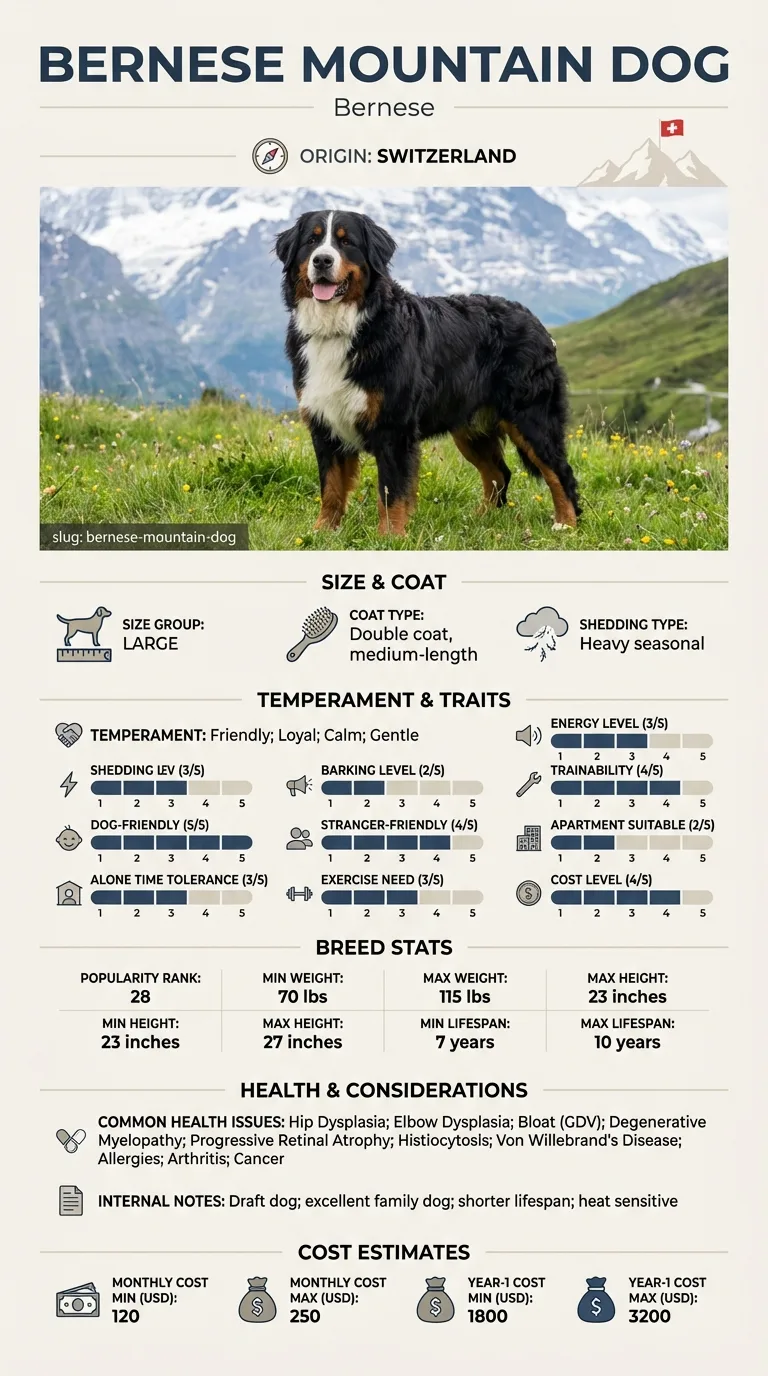
Kidney disease is not among the breed's documented common health issues, which centre on cancer, hip and elbow dysplasia, bloat, degenerative myelopathy, retinal atrophy, histiocytosis, von Willebrand's disease, allergies and arthritis. Chronic kidney disease is largely a condition of ageing that affects all breeds, so a Bernese is at ordinary rather than elevated risk.
Increased drinking and increased urination, usually in that order. In a large dog this is easy to overlook because the baseline intake is already high. Measuring what actually goes into the bowl over twenty-four hours, twice a year, turns a vague impression into a number you can bring to your vet.
Yes. Therapeutic renal diets are one of the few interventions with genuine evidence behind them for slowing chronic kidney disease and improving quality of life. They work by controlling phosphorus and adjusting protein quality rather than simply reducing protein. Use a diet prescribed by your veterinarian rather than a supermarket product labelled as kidney friendly.
Never. A dog with failing kidneys drinks more because he is losing more water in dilute urine, and restricting intake pushes him rapidly into dehydration. Water should be freely available at all times, in several bowls if that encourages drinking.
It depends heavily on the stage at diagnosis. Dogs caught early on routine screening, with diet and blood pressure managed, can live comfortably for years. Dogs diagnosed once they are already vomiting and losing weight generally have a shorter and more difficult course. This is precisely why senior bloodwork earns its cost.
Yes, and it is one of the specific reasons a heat episode should never be treated as resolved just because the dog cooled down. Kidney injury can develop over the following one to two days. Recheck bloodwork after any significant overheating, which in this heavily coated breed is not a remote scenario.
Rather than a fixed threshold, watch for change. A Bernese who has clearly doubled his usual intake over a few weeks should have bloodwork and a urine test.
Around six is reasonable in a breed averaging seven to ten years, and annually after that. Earlier if the dog has had a heat episode or a toxin exposure.
Antifreeze, grapes and raisins, human anti-inflammatory painkillers, and some lilies. Any suspected exposure is an immediate emergency, not a wait-and-see.
Yes. Urine concentration often changes before blood values do, and protein loss can only be assessed in urine. Blood alone misses early disease.
A one-page prep sheet for this condition: the signs, the questions to ask, what to get priced. Unlocks here.
You get: Vet visit prep sheet
No spam. One-click unsubscribe. See our privacy policy.
Preview page 1 before you decide.