Health
What is the first sign of an allergic reaction in a Bernese?
Puffiness around the eyes and muzzle, especially inflation of the rust-coloured eyebrow patches. It shows earlier and more clearly than hives do on a coated dog.

Quick answer
What is the first sign of an allergic reaction in a Bernese?
Puffiness around the eyes and muzzle, especially inflation of the rust-coloured eyebrow patches. It shows earlier and more clearly than hives do on a coated dog.
Hives on a Bernese are almost invisible. Facial swelling is not, and it is the sign worth memorising.
Owners who hike or keep their Berner on rural property, where ground-nesting wasps are part of the landscape, and owners home from a vaccine appointment watching a dog who suddenly looks puffy around the eyes.
This guide is not medical advice. If your dog shows pain, sudden behavior change, or worsening symptoms, consult a licensed veterinarian.
Some links may be affiliate links. We may earn a commission at no extra cost to you. We only suggest products we believe are helpful for dog owners.
We research and check what we publish, but we do not warrant that any figure, date, price, or statement is accurate, complete, or current, and we accept no liability for any loss, cost, injury, or other harm arising from the use of this site. Use it as one reference among several. You remain responsible for your own decisions and for your dog's care - confirm anything that matters with a licensed veterinarian or another qualified professional before you act on it. Full disclaimer.
Check this first
Anaphylaxis is a true emergency, and in dogs it does not look like the human version. Sudden vomiting, diarrhoea, pale gums, a wobbly back end or collapse within an hour of a sting or an injection means the reaction has moved past the skin. In dogs the liver is a shock organ, so gut signs often arrive before breathing signs. Do not wait for laboured breathing to decide it is serious. Go now.
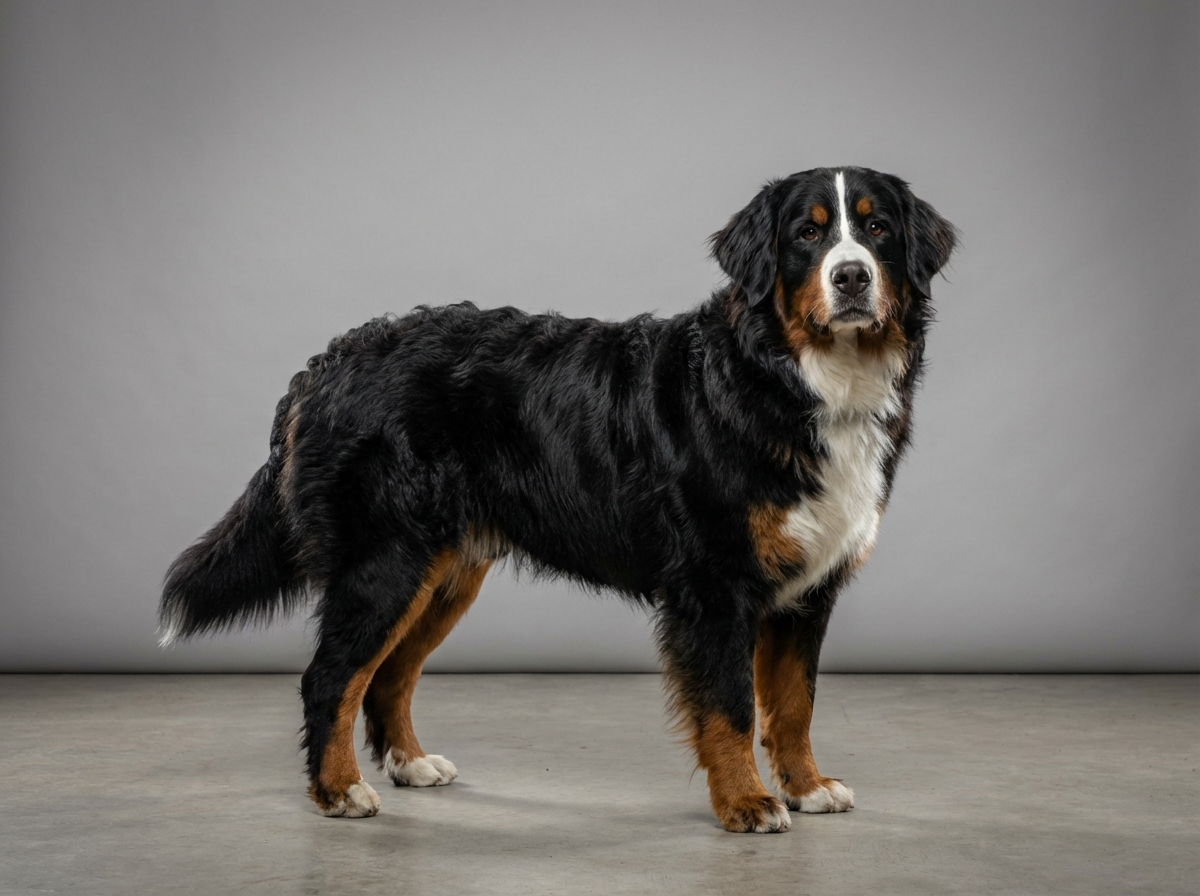
Swelling of the muzzle, eyelids or lips is the middle tier. Many dogs pass through it with an injection and an afternoon of monitoring, but it needs a same-day exam, because tissue that swells outside the mouth is continuous with tissue that swells inside the throat. On a Bernese the rust markings above the eyes are a built-in reference: if those tan eyebrow patches look inflated and the eye slits have narrowed, you are watching progression.
Raised welts alone, in a dog who is bright and eating, are the lowest tier. Photograph them, note the time, and phone for advice rather than driving in. On a heavily coated dog they show best on the groin and the bare strip under the front legs.
Call ahead in every tier above the lowest. A Berner in distress is a hundred pounds of dog you may need help lifting.
If any of these apply, call your vet or an emergency clinic now. The rest of this page is for the cases that are not an emergency.
An acute allergic reaction is the immune system firing hard and fast at something harmless. Vessels leak, tissue swells, and in the worst cases blood pressure drops. Owners notice a face that has changed shape, a dog rubbing its muzzle on the carpet, or vomiting out of nowhere.
Severe anaphylaxis is uncommon in any breed. Mild reactions are ordinary: clinics see hives and puffy faces regularly, especially in late summer when stinging insects are active. A Bernese who spends real time on grass meets more of these triggers than a dog who walks on pavement.
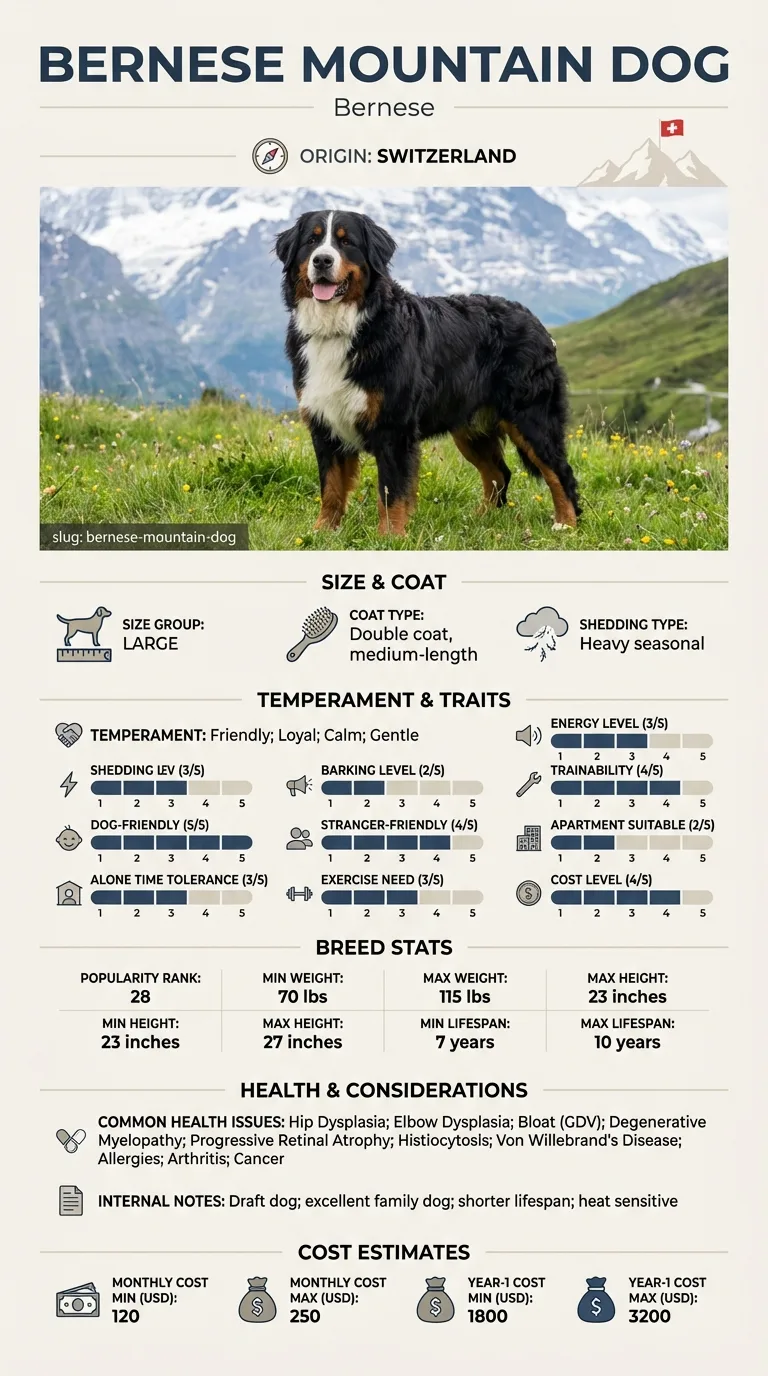
The Bernese carries documented allergy and immune-mediated conditions, including histiocytosis, so immune reactivity is part of the breed picture. The practical factor, though, is physical: a medium-length double coat conceals skin changes, and a 70 to 115 pound body is hard to lift into a car in a hurry.
This breed was built for outdoor work in cool alpine country and is happiest in the yard and in long grass, which is where ground-nesting wasps live. Rural homes, flowering shrubs and late-summer walks past hedgerows all raise sting exposure.
Go immediately, phoning en route, for collapse, weakness, pale or grey gums, vomiting with swelling, or any change in the sound or effort of breathing. That combination can be anaphylactic shock and it is life-threatening. Same-day for facial, eyelid or lip swelling in a dog who is otherwise bright. Next working day for isolated welts on a comfortable dog. Report every reaction, however mild, so the vaccination protocol can be adjusted.
Most of the damage in a sudden allergic reaction is done by delay. These are the specific missteps that cost Bernese owners time.
Start here: Bernese Mountain Dog Most Common Genetic Disorders
See all Bernese Mountain DOG health problems, which breeds are prone to allergic reactions, or the full Bernese Mountain DOG breed guide for temperament, exercise needs and ownership costs.
A treated mild reaction settles within a few hours, though a dog may be sleepy into the next day. Dogs treated for anaphylaxis are hospitalised twelve to twenty-four hours because a second wave can follow the first.
Not a dog who never reacts. An owner who spots swelling early, has the emergency number saved, and gets the dog through the event without a costly delay.
Bruno, a four-year-old Berner in rural Vermont, came in from the yard one August evening pawing at his face. His owner Deirdre could see nothing through the coat but noticed his eyebrow markings looked swollen and the skin around his lips had gone tight. She photographed him, phoned the clinic, and drove. By arrival his muzzle had visibly rounded out. He was treated, observed for the evening and home that night. A pest control visit found a yellowjacket nest six feet from where he had been lying.
Key takeaway: The photograph and the phone call did more for Bruno than anything else. On a coated breed the face is the dashboard, and progression over twenty minutes is what a vet actually needs.
Most begin within five to thirty minutes of the trigger, though a delayed wave can appear several hours later. That second wave is why vets often ask you to keep the dog quiet and observed for the rest of the day rather than treating and going straight back to a walk.
A medium-length double coat sits above the skin surface and hides raised welts almost completely. Part the hair on the belly and the inner thigh, where coverage is thinnest, or look for the coat standing up in irregular patches across the back, which is often the only clue on the topline.
Body mass gives some buffer against the venom dose, but it gives no protection at all against an immune overreaction, which is what anaphylaxis is. Large breeds do go into anaphylactic shock. Stings inside the mouth or on the throat are the highest risk because local swelling there sits directly on the airway.
Post-vaccine reactions happen in every breed and are usually mild facial swelling within a few hours. Report any reaction, because it changes the plan next time: appointments may be split across visits, or the dog premedicated and held for observation.
The breed carries documented immune-related conditions including allergies and histiocytosis, so immune dysregulation is part of the breed picture. That is background risk, not a prediction.
Not necessarily, but sensitisation is real: the immune system remembers. Note the date, the suspected trigger and the signs, and give that history to any vet who treats your dog.
Puffiness around the eyes and muzzle, especially inflation of the rust-coloured eyebrow patches. It shows earlier and more clearly than hives do on a coated dog.
Vomiting, pale gums, weakness, collapse or any change in breathing after a sting or injection means go to an emergency clinic immediately. Do not wait to see if it settles.
The belly, the groin and the thin-haired strip inside the front legs. The double coat over the back and shoulders hides welts almost entirely.
Costs vary widely by region and by whether hospitalisation is needed. Ask your clinic for their after-hours exam fee now, while it is not urgent, so the number is not a surprise at midnight.
Not reliably. A calm, well-cued recall that pulls the dog off a nest or a flowering hedge is more realistic than teaching avoidance of the insect itself.
A one-page prep sheet for this condition: the signs, the questions to ask, what to get priced. Unlocks here.
You get: Vet visit prep sheet
No spam. One-click unsubscribe. See our privacy policy.
Preview page 1 before you decide.