Living
Bigger dog?
The Bernese Mountain Dog, by a huge margin, 70-115 lbs versus the Maltese's 3-7 lbs.

Quick answer
Bigger dog?
The Bernese Mountain Dog, by a huge margin, 70-115 lbs versus the Maltese's 3-7 lbs.
Bernese Mountain Dog or Maltese? On paper they differ most on apartment suitability, and on the scales Bernese Mountain Dog is the heavier at 70–115 lbs. Here is how the two compare on everything that shapes an ordinary week.
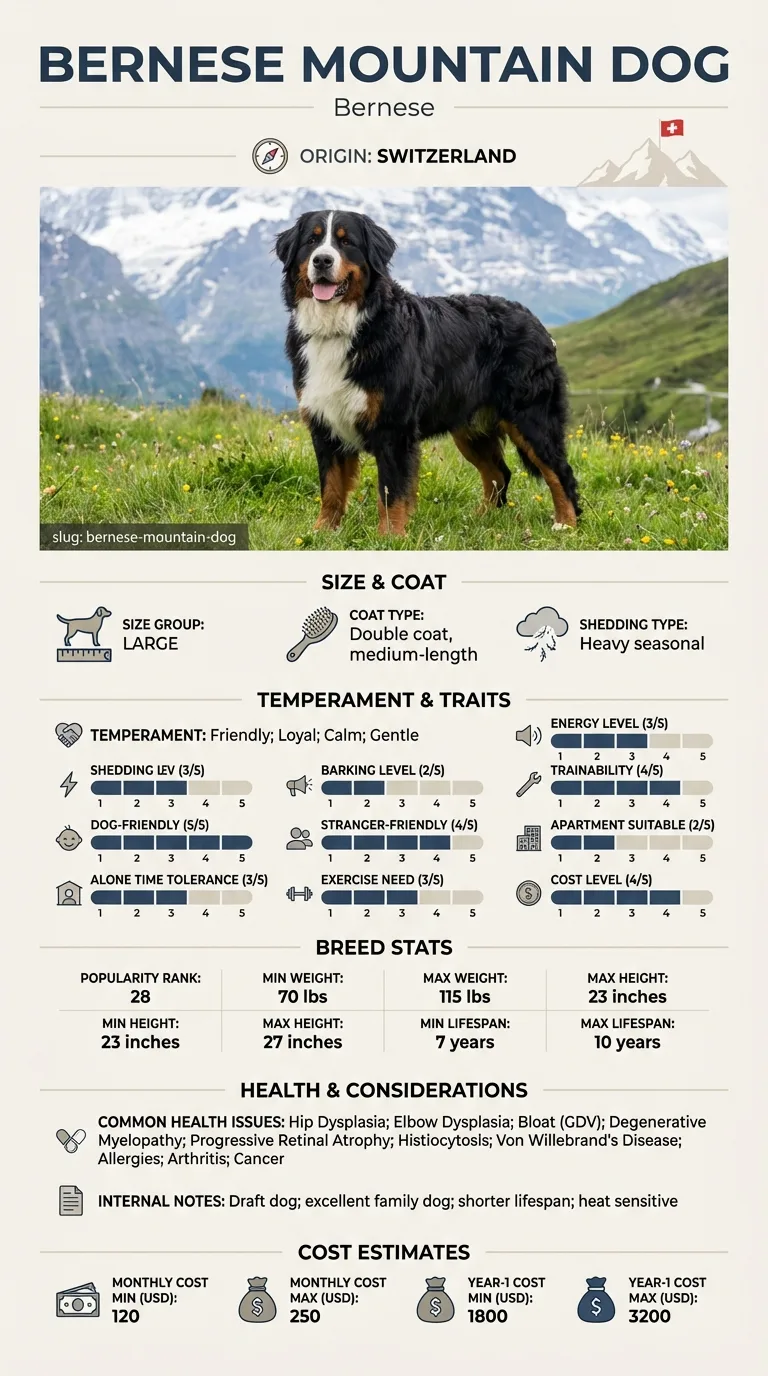
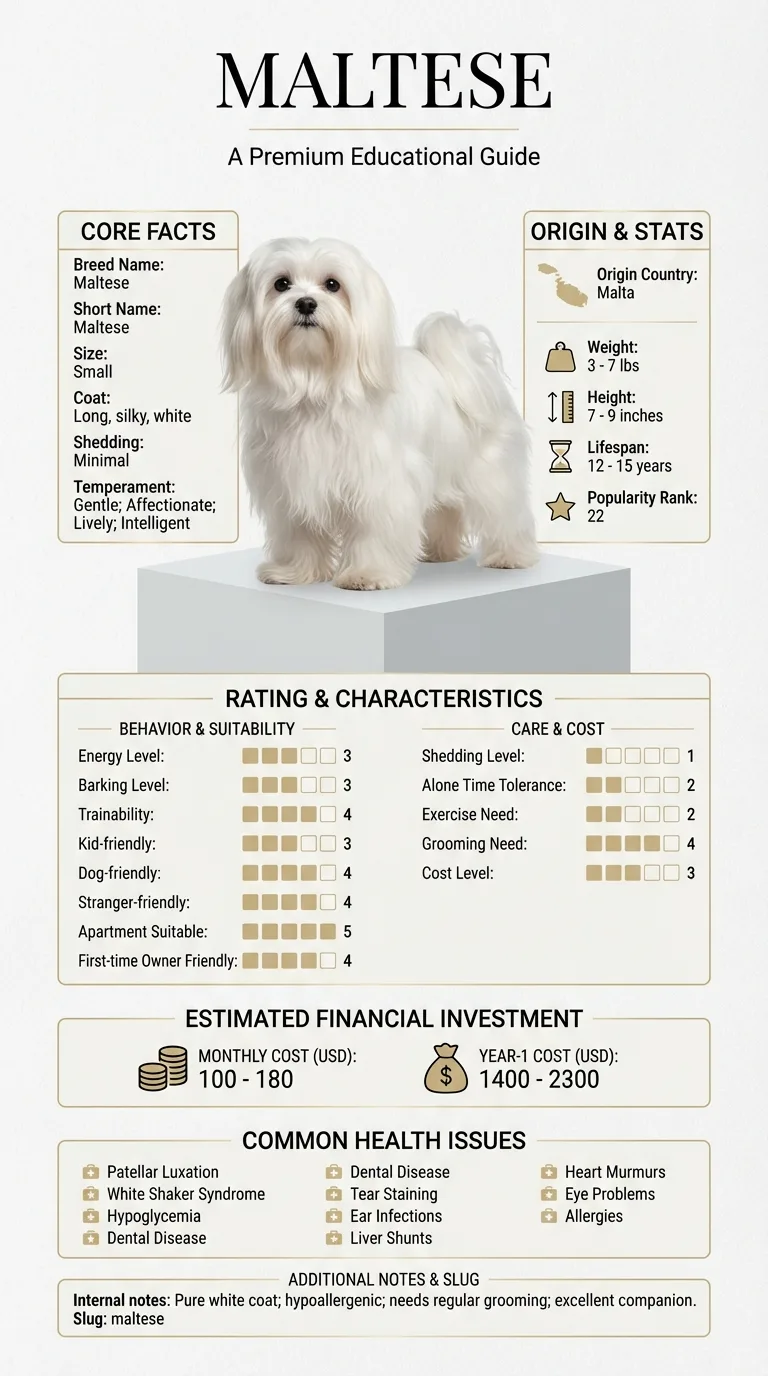
This is for someone already down to Bernese Mountain Dog and Maltese and deciding between them. For this pair the decision usually turns on apartment suitability and shedding, so those are covered first and in most detail. Anyone choosing from a flat has a clear answer here: Maltese rates 5/5 against 2/5. The focus throughout is on daily consequences rather than breed background.
Between Bernese Mountain Dog and Maltese, apartment suitability is what separates them, and Maltese is the lower-effort dog of the two to keep.
Choose Bernese Mountain Dog if you do not want a standing grooming appointment, the dog will be alone during the working day and there are young children at home.
Choose Maltese if you are in a flat or a smaller home, shedding is a problem in your house and your walking routine is modest.
| Feature | bernese mountain dog | maltese | Winner |
|---|---|---|---|
| Size class | large | small | Equal |
| Weight | 70–115 lbs | 3–7 lbs | Equal |
| Height | 23–27 in | 7–9 in | Equal |
| Lifespan | 7–10 years | 12–15 years | maltese |
| Exercise need | Moderate (3/5) | Low (2/5) | maltese |
| Grooming need | Moderate (3/5) | High (4/5) | bernese mountain dog |
| Shedding | High (4/5) | Very low (1/5) | maltese |
| Energy level | Moderate (3/5) | Moderate (3/5) | Equal |
| Barking | Low (2/5) | Moderate (3/5) | bernese mountain dog |
| Apartment suitability | Low (2/5) | Very high (5/5) | maltese |
| Good for first-time owners | High (4/5) | High (4/5) | Equal |
| Tolerates being alone | Moderate (3/5) | Low (2/5) | bernese mountain dog |
| Trainability | High (4/5) | High (4/5) | Equal |
| Good with kids | Very high (5/5) | Moderate (3/5) | bernese mountain dog |
| Good with other dogs | Very high (5/5) | High (4/5) | bernese mountain dog |
| Friendly to strangers | High (4/5) | High (4/5) | Equal |
| Cost level | High (4/5) | Moderate (3/5) | maltese |
| Coat | Double coat, medium-length | Long, silky, white | Equal |
| Origin | Switzerland | Malta | Equal |
| Typical monthly cost | $120–$250 | $100–$180 | Equal |
| Typical first-year cost | $1,800–$3,200 | $1,400–$2,300 | Equal |
Few comparisons on this site show as extreme a size gap as this one: the Bernese Mountain Dog weighs 70-115 lbs and stands 23-27 in, while the Maltese weighs a mere 3-7 lbs and stands just 7-9 in, so the Bernese can outweigh a Maltese by more than 30 times over. This isn't a case of picking a big dog versus a small dog so much as choosing between two entirely different daily-life logistics, since lifting, crating, car space and vet equipment all scale with the Bernese's mass, while the Maltese can be carried in one arm. Anyone torn between these two should picture both dogs in their actual living space before deciding.
The Maltese rates low (2/5) for exercise need against the Bernese's moderate (3/5), a modest gap that undersells how differently the two actually live day to day. A Maltese's exercise can be met largely indoors with short walks and play, fitting its Gentle and Affectionate temperament tags, while the Bernese, despite being only moderate itself, still needs real outdoor time given its working-breed size. Neither dog is a marathon companion, but owners hoping for a jogging partner should look elsewhere; this pairing suits people who want a relaxed pace, just at very different body sizes.
Grooming need actually favors the Bernese here, moderate (3/5) versus the Maltese's high (4/5), despite the Maltese's tiny frame, because its long, silky white coat mats and stains easily and needs frequent brushing plus attention to tear staining. Shedding runs the opposite direction: the Bernese sheds high (4/5) from its double coat, while the Maltese sheds very low (1/5). So a Maltese owner trades hair-on-the-couch problems for a near-daily brushing and facial-cleaning routine, while a Bernese owner accepts fur everywhere but a comparatively simpler coat-care schedule.
The Maltese is built for small spaces, rating very high (5/5) for apartment suitability against the Bernese's low (2/5), a direct consequence of its 3-7 lb frame and low exercise need. Barking cuts the other way: the Maltese rates moderate (3/5) while the Bernese rates low (2/5), so apartment dwellers weighing noise complaints from neighbors should factor that in. Alone-time tolerance also differs: the Bernese tolerates being alone at moderate (3/5) while the Maltese sits lower at low (2/5), making the Maltese the more attachment-prone of the pair despite its apartment-friendly size.
Both breeds rate high (4/5) for first-time owners and share the same trainability score, high (4/5), so neither has a clear edge in trainability alone. What differs is style: the Maltese's temperament list includes Intelligent and Lively, suggesting quick, food-and-praise-driven learning in short sessions suited to its small attention span, while the Bernese's Calm and Loyal nature responds well to steady, patient obedience work. A first-time owner set on a lap-sized dog that still trains reliably will do fine with the Maltese; one who wants a biddable large dog without hyperactivity should lean Bernese.
With kids, the Bernese pulls clearly ahead, rated very high (5/5) against the Maltese's moderate (3/5), a meaningful difference for families with younger, less gentle children, since a 4-7 lb Maltese can be injured by rough handling in ways a sturdy Bernese cannot. With other dogs the Bernese also edges ahead, very high (5/5) versus high (4/5), though both are rated high (4/5) for friendliness to strangers. Households with toddlers or boisterous kids should weigh the Bernese's durability seriously; households without young children can consider the Maltese's affectionate, lap-dog nature without that concern.
The Maltese is expected to live substantially longer, 12-15 years against the Bernese's 7-10, and its health list, while long, skews toward manageable conditions like Dental Disease, Tear Staining and Patellar Luxation rather than the more serious issues on the Bernese's list, which includes Bloat (GDV), Histiocytosis and Cancer. Both breeds share a susceptibility to Allergies. The Maltese's Liver Shunts and Heart Murmurs are worth screening for in a reputable breeder's health testing, but overall the size difference between these two breeds tracks closely with their differing health and longevity outlooks, as is common between large and toy breeds.
Despite its tiny size, the Maltese still carries a moderate cost rating (3/5), not far below the Bernese's high (4/5), with a monthly range of $100-$180 against the Bernese's $120-$250, and a first-year range of $1,400-$2,300 versus $1,800-$3,200. The Maltese's cost comes disproportionately from grooming, since its high (4/5) grooming need often means regular professional appointments, rather than food, while the Bernese's cost comes from sheer food volume and larger-breed vet care. Buyers expecting the smaller dog to be dramatically cheaper should recalculate around grooming bills before assuming so.
Bernese Mountain Dog weighs 70–115 lbs and lives 7–10 years; Maltese weighs 3–7 lbs and lives 12–15 years. The two diverge most on apartment suitability, shedding and good with kids. They are level on energy level, good for first-time owners and friendly to strangers, so those cannot decide it. The table below marks a winner only where one breed is genuinely easier for a typical owner; size and origin are facts rather than merits and stay level. Ratings come from one source applied to both breeds, so they are meaningful against each other rather than as absolute scores.

Not quite. The Maltese is cheaper overall ($1,400-$2,300 first year versus $1,800-$3,200) but still rates a moderate 3/5 on cost, mostly from its high 4/5 grooming need.
The Maltese, rated very high (5/5) for apartment suitability against the Bernese's low (2/5), thanks to its 3-7 lb size and low exercise need.
Yes, the Maltese rates moderate (3/5) for barking while the Bernese rates low (2/5).
The Maltese, typically 12-15 years compared to the Bernese's 7-10 years.
Generally yes. The Bernese rates very high (5/5) with kids versus the Maltese's moderate (3/5), and its size makes it far more durable around rough handling.
Not exactly. The Maltese actually rates higher (high, 4/5) than the Bernese (moderate, 3/5) despite its small size, due to its long silky coat and tear-staining upkeep.
The Bernese tolerates being alone better, rated moderate (3/5) versus the Maltese's low (2/5).
The Bernese Mountain Dog, by a huge margin, 70-115 lbs versus the Maltese's 3-7 lbs.
The Maltese, rated very low (1/5) shedding against the Bernese's high (4/5).
The Bernese Mountain Dog, since it rates low (2/5) for barking versus the Maltese's moderate (3/5).
The Maltese, with a first-year cost of $1,400-$2,300 versus the Bernese's $1,800-$3,200.
Secure checkout on Stripe. We never see your card.
7-day money-back guarantee. Instant access.
Health information here is general and is not veterinary advice. If your dog shows pain, sudden behaviour change, or worsening symptoms, consult a licensed veterinarian.
Some links on this site are affiliate links. We may earn a commission at no extra cost to you, and we only suggest products we believe are helpful for dog owners.
We research and check what we publish, but we do not warrant that any figure, date, price, or statement is accurate, complete, or current, and we accept no liability for any loss, cost, injury, or other harm arising from the use of this site. Use it as one reference among several. You remain responsible for your own decisions and for your dog's care - confirm anything that matters with a licensed veterinarian or another qualified professional before you act on it. Full disclaimer.
Match your lifestyle to the right dog.
Take quizNot sure which breed is right for you? Take our 2-minute quiz to find out.
Take the quiz