Living
Which breed should most people choose?
If longevity and apartment space matter most, the Basset wins; if you have room for a large dog and want higher trainability, the Bernese is the stronger pick despite its shorter lifespan.

Quick answer
Which breed should most people choose?
If longevity and apartment space matter most, the Basset wins; if you have room for a large dog and want higher trainability, the Bernese is the stronger pick despite its shorter lifespan.
Basset Hound or Bernese Mountain Dog? On paper they differ most on apartment suitability, and on the scales Bernese Mountain Dog is the heavier at 70–115 lbs. Here is how the two compare on everything that shapes an ordinary week.
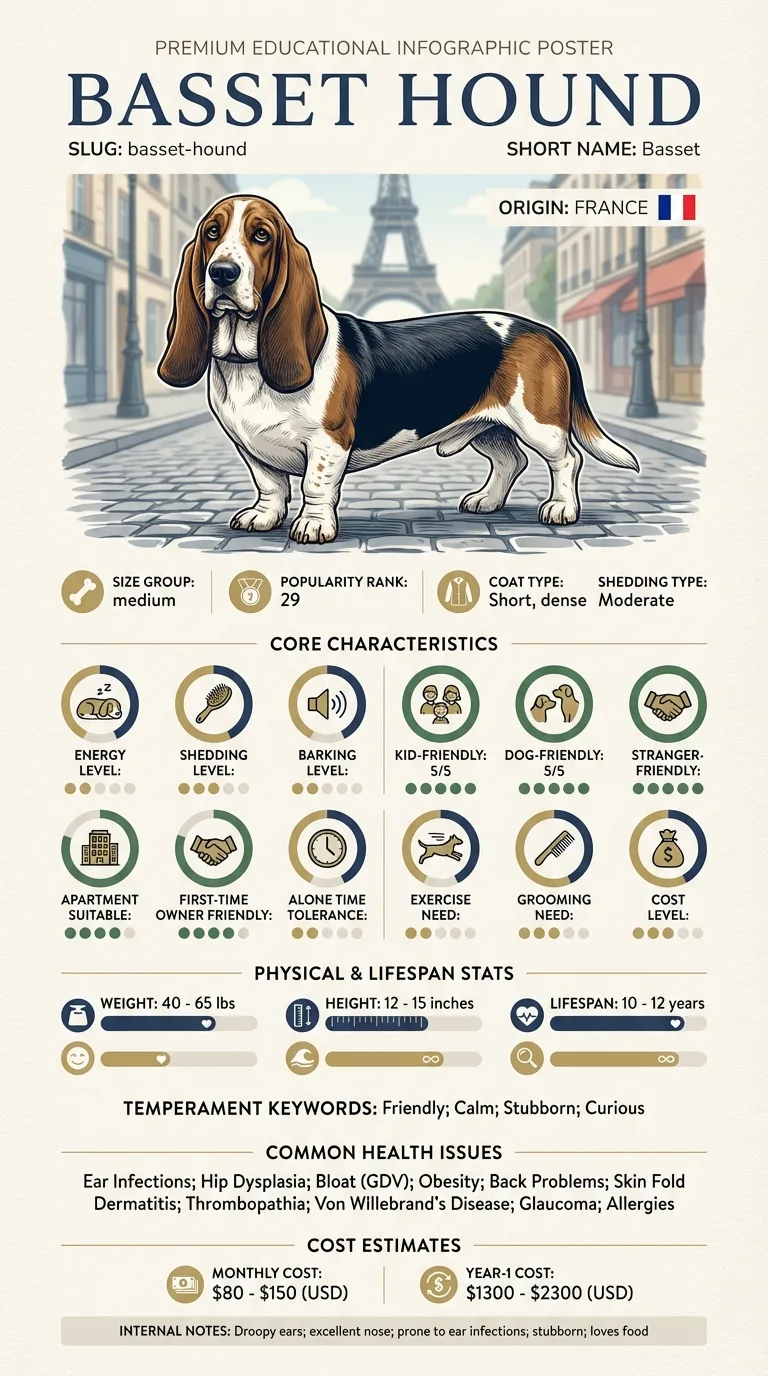
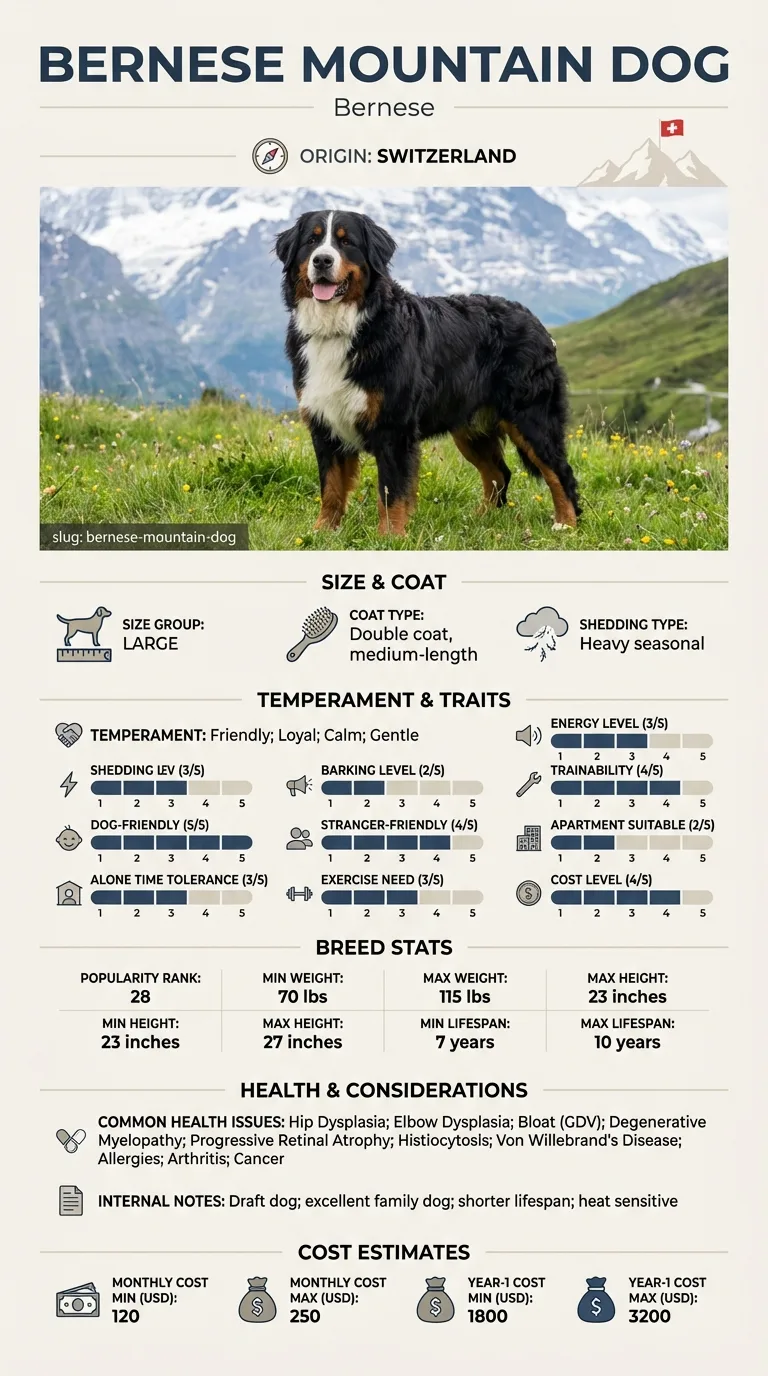
This is for someone already down to Basset Hound and Bernese Mountain Dog and deciding between them. For this pair the decision usually turns on apartment suitability and trainability, so those are covered first and in most detail. Anyone choosing from a flat has a clear answer here: Basset Hound rates 4/5 against 2/5. There is no origin story here — only what changes about your week.
Between Basset Hound and Bernese Mountain Dog, apartment suitability is what separates them, and Basset Hound is the lower-effort dog of the two to keep.
Choose Basset Hound if you are in a flat or a smaller home, shedding is a problem in your house and your walking routine is modest.
Choose Bernese Mountain Dog if the dog will be alone during the working day, you want a dog that picks up training quickly and you want a dog that can keep up with an active routine.
| Feature | basset hound | bernese mountain dog | Winner |
|---|---|---|---|
| Size class | medium | large | Equal |
| Weight | 40–65 lbs | 70–115 lbs | Equal |
| Height | 12–15 in | 23–27 in | Equal |
| Lifespan | 10–12 years | 7–10 years | basset hound |
| Exercise need | Low (2/5) | Moderate (3/5) | basset hound |
| Grooming need | Moderate (3/5) | Moderate (3/5) | Equal |
| Shedding | Moderate (3/5) | High (4/5) | basset hound |
| Energy level | Low (2/5) | Moderate (3/5) | Equal |
| Barking | Low (2/5) | Low (2/5) | Equal |
| Apartment suitability | High (4/5) | Low (2/5) | basset hound |
| Good for first-time owners | High (4/5) | High (4/5) | Equal |
| Tolerates being alone | Low (2/5) | Moderate (3/5) | bernese mountain dog |
| Trainability | Low (2/5) | High (4/5) | bernese mountain dog |
| Good with kids | Very high (5/5) | Very high (5/5) | Equal |
| Good with other dogs | Very high (5/5) | Very high (5/5) | Equal |
| Friendly to strangers | Very high (5/5) | High (4/5) | basset hound |
| Cost level | Moderate (3/5) | High (4/5) | basset hound |
| Coat | Short, dense | Double coat, medium-length | Equal |
| Origin | France | Switzerland | Equal |
| Typical monthly cost | $80–$150 | $120–$250 | Equal |
| Typical first-year cost | $1,300–$2,300 | $1,800–$3,200 | Equal |
The Bernese Mountain Dog dwarfs the Basset Hound - 70-115 lbs and up to 27 inches tall, against the Basset's 40-65 lbs and just 12-15 inches. These aren't close: the Bernese is a genuinely large dog while the Basset is a medium-weight breed carried on short legs. Doorways, car trunks and vet scales will all remind you of the difference.
Both are relatively low-key for their categories - the Basset at low (2/5), the Bernese a step up at moderate (3/5). Neither is a high-drive breed; the Bernese wants a solid daily walk and some play, while the Basset is content with less. This is a comparison between two comparatively relaxed breeds, unusual for a large-breed matchup.
Grooming need ties at moderate (3/5) for both, but the Bernese sheds noticeably more (4/5 vs 3/5) thanks to its thick double coat built for mountain winters. Expect more fur around the house with the Bernese, even though the weekly time commitment to brushing is similar between the two. A twice-yearly seasonal coat blow means a vacuum upgrade may be worth it if you go with the Bernese over the Basset.
The Basset is the better apartment fit (4/5 vs 2/5), simply a function of its smaller size and lower exercise needs - a 100 lb dog needs more room to just exist comfortably. Interestingly, the Bernese tolerates being alone slightly better (3/5 vs 2/5). Barking is tied at low (2/5) for both, so neither will be the noisy neighbor.
The Bernese trains notably better, high (4/5) against the Basset's low (2/5) - it's an eager-to-please breed bred for cooperative farm work. Despite that gap, both rate equally well for first-time owners (4/5 each), since the Bernese's gentle temperament and the Basset's low drive both forgive a beginner's learning curve in different ways. A new owner willing to put in consistent training reps will likely see faster results with the Bernese.
Kids and other dogs are exact ties, both breeds rated 5/5 on each - about as good as this data gets for family sociability. The Basset edges out strangers slightly (5/5 vs 4/5). Both are genuinely gentle, low-aggression breeds that do well in busy, social households, and either one should settle in fine at a backyard barbecue full of unfamiliar faces and other people's dogs.
This is the starkest gap in the whole comparison: the Bernese lives just 7-10 years against the Basset's 10-12, and the Bernese's health list includes cancer and histiocytosis, both serious concerns that contribute to that shortened lifespan. Both share bloat and von Willebrand's disease risk. If longevity weighs heavily in your decision, the numbers favor the Basset clearly.
The Bernese costs more across the board: $120-$250 monthly and $1,800-$3,200 in year one, versus the Basset's $80-$150 and $1,300-$2,300. A dog three times the Basset's weight simply eats, medicates and boards for more, and the Bernese's higher cost-level rating (4/5 vs 3/5) reflects that. Given its cancer risk, pet insurance premiums for a Bernese also tend to run higher than for a Basset of comparable age.
Basset Hound weighs 40–65 lbs and lives 10–12 years; Bernese Mountain Dog weighs 70–115 lbs and lives 7–10 years. The two diverge most on apartment suitability and trainability. They are level on barking, good with other dogs and good for first-time owners, so those cannot decide it. Where the table declares a winner it means less work for the owner, nothing more; descriptive rows are left as ties on purpose. The value here is in the differences between the two columns; treat any single score as approximate.

Substantially - 70-115 lbs and up to 27 inches tall, compared to the Basset's 40-65 lbs and just 12-15 inches. The Bernese is a true large breed; the Basset is medium-weight on short legs.
The Basset Hound, by a meaningful margin - 10-12 years versus the Bernese's 7-10. The Bernese's shorter lifespan is a known tradeoff of the breed, partly tied to cancer risk.
Yes, rated 5/5, tied with the Basset. Both breeds are known for gentle, patient temperaments around children.
The Bernese, rated moderate (3/5) against the Basset's low (2/5), though neither is a high-energy breed by large-dog standards.
The Bernese runs $120-$250 monthly and $1,800-$3,200 in year one, versus $80-$150 and $1,300-$2,300 for the Basset. Size drives most of that gap.
Cancer and histiocytosis are the most serious, alongside hip and elbow dysplasia, bloat and degenerative myelopathy. These contribute to its shorter average lifespan compared to the Basset.
The Bernese, rated high (4/5) against the Basset's low (2/5). Bernese Mountain Dogs were bred for cooperative farm work and tend to be eager to please.
If longevity and apartment space matter most, the Basset wins; if you have room for a large dog and want higher trainability, the Bernese is the stronger pick despite its shorter lifespan.
$80-$150 for the Basset, $120-$250 for the Bernese - size drives the gap.
Both are relatively low-key: 2/5 for the Basset, 3/5 for the Bernese.
The Basset Hound, at 10-12 years, well ahead of the Bernese's 7-10 year range.
Secure checkout on Stripe. We never see your card.
7-day money-back guarantee. Instant access.
Health information here is general and is not veterinary advice. If your dog shows pain, sudden behaviour change, or worsening symptoms, consult a licensed veterinarian.
Some links on this site are affiliate links. We may earn a commission at no extra cost to you, and we only suggest products we believe are helpful for dog owners.
We research and check what we publish, but we do not warrant that any figure, date, price, or statement is accurate, complete, or current, and we accept no liability for any loss, cost, injury, or other harm arising from the use of this site. Use it as one reference among several. You remain responsible for your own decisions and for your dog's care - confirm anything that matters with a licensed veterinarian or another qualified professional before you act on it. Full disclaimer.
Match your lifestyle to the right dog.
Take quizNot sure which breed is right for you? Take our 2-minute quiz to find out.
Take the quiz