Costs
Bernese Mountain Dog cost in Detroit
Roughly $115–$220/month, $1,700–$3,000 for year one — Detroit's auto-boom mansion districts pair surprisingly well with this draft-heritage breed's space needs.

See Bernese Mountain Dog price across all cities →
Quick answer
Bernese Mountain Dog cost in Detroit
Roughly $115–$220/month, $1,700–$3,000 for year one — Detroit's auto-boom mansion districts pair surprisingly well with this draft-heritage breed's space needs.
A Bernese Mountain Dog in Detroit costs about $115–$220 a month, with the first year around $1,700–$3,000 — a moderate budget in a city whose grand old auto-boom architecture happens to fit a draft-heritage breed unusually well.
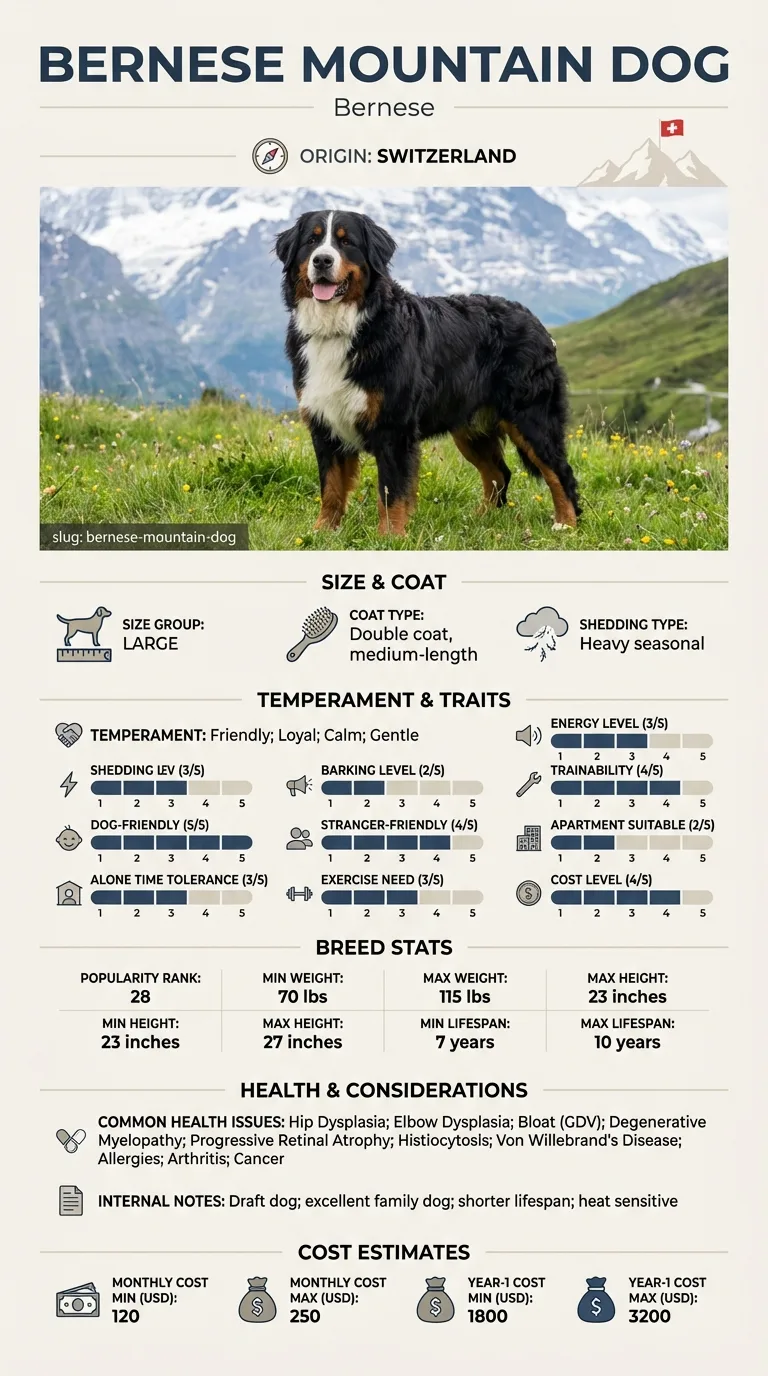
Hip and elbow dysplasia are common large-breed risks, but this breed's more consequential concern is its documented elevated cancer risk, including histiocytosis, contributing to a shorter typical lifespan than most large breeds. Bloat (GDV) is a separate, sudden true emergency this breed also carries elevated risk for.
These figures adjust the Bernese Mountain Dog's typical national cost range down for Detroit's below-average market, with Michigan's genuine winters suiting this breed's coat and a note on the city's unusually affordable larger homes.
Estimate · source: estimation · confidence: medium · updated 2026-09-05 · not a quote
| Item | Cost range |
|---|---|
One-time setup (initial vet visit, spay/neuter, large-breed gear) Covers the first exam, vaccinations, spay/neuter if needed, and gear sized for the breed's substantial adult weight — priced at Detroit's generally affordable rates. | $375 - $635 |
| Item | Cost range |
|---|---|
Food Below the national average for a large breed with substantial food needs, consistent with Detroit's generally lower price level. | $50 - $79 |
Grooming The heavy seasonal-shedding double coat needs regular brushing; most owners handle this at home rather than paying for professional grooming. | $13 - $25 |
Flea & tick prevention Clearly seasonal given Michigan's genuine four-season climate. | $10 - $20 |
Each range starts from a national baseline for this breed's size class and is then adjusted for local cost of living and veterinary pricing. The baselines, and the source each one came from, are listed on our sources page (dataset 2026.09). Two inputs, the purchase price and the emergency reserve, have no published national figure we could verify, so we leave them to you rather than invent them.
These are planning estimates, not quotes. Your own numbers will move with the individual dog, your vet and your insurer. Build a budget with your own figures.
For a Bernese Mountain Dog in Detroit, insurance is especially worth taking seriously given the breed's well-documented elevated cancer risk, even though the local vet market itself runs at a below-average, unremarkable level.
Given how commonly cancer, including histiocytosis, affects this breed, treatment is priced at specialist rates that don't discount the way routine care does in an affordable market like Detroit — insurance purchased while the dog is young and healthy remains one of the higher-value purchases here.
Owners who've built a genuinely large emergency fund, discussed a realistic financial plan with their vet given the breed's known risks, and are comfortable managing a serious case's cost themselves can reasonably self-insure instead.
Walk a neighborhood before you buy into it, and treat pet insurance as non-negotiable regardless of how far your dollar otherwise stretches here.
Walk through Boston-Edison or Palmer Woods and you'll notice something specific: these early-1900s neighborhoods, built when Detroit's auto barons were at the height of their wealth, were designed around carriage houses, mudrooms and side entrances scaled for horses, cars and the household staff who managed both. A century later, those same features happen to suit a Bernese Mountain Dog's practical needs — mud-tracking paws after a wet Michigan spring, a place to towel off a dog that can top 100 pounds, gear storage for a breed that came from actual working carts. Purchase prices in these historic districts run well below what comparable architectural grandeur costs in a coastal city, a byproduct of decades of population loss the city is only recently reversing.
The Detroit riverfront, redeveloped over the past two decades into a continuous walking path along the water, gives this moderately active breed a pleasant, flat, low-effort route that doesn't demand the kind of strenuous trail system a higher-drive breed would need. It's worth checking a specific block's condition before committing to any purchase, since revitalization has landed unevenly across the city rather than uniformly.
Michigan's real winters suit the coat well, and grooming, food and routine vet costs here track meaningfully under what a coastal or high-demand metro charges for identical care.

A couple restoring a century-old home in Boston-Edison worried their new Bernese puppy would track mud through the main house every wet Michigan spring. The property's original 1911 carriage house, intended for a Model T, turned out to be exactly the right size for a wash station, towels and the dog's gear — a feature the couple hadn't even considered when they bought the place.
Key takeaway: Detroit's century-old auto-era architecture wasn't built with dogs in mind, but its practical bones — carriage houses, mudrooms, wide service entrances — solve real problems for a large, working-heritage breed almost by accident.
Figure roughly $115–$220 monthly. Routine vet visits, food and grooming all price below what a coastal metro charges, which takes some of the sting out of this breed's naturally higher price tier.
Budget $1,700–$3,000 for year one, covering the initial exam, spay or neuter, and gear built for a dog that outgrows small-breed products fast.
Surprisingly well — mansion-district neighborhoods like Boston-Edison and Palmer Woods were built with carriage houses and mudrooms scaled for horses and staff, which today double as practical mud-and-gear space for a large, muddy-pawed dog.
Whichever one you choose, walk it in person and talk to a couple of current residents before signing anything — the city's comeback has reached some blocks faster than others, and a listing photo won't tell you which.
Yes, and buy it early. This breed's cancer statistics don't improve just because the city is affordable — specialist treatment prices the same here as anywhere else once it's needed.
$750 is a reasonable floor for a routine emergency visit in this market, though it won't stretch far if oncology or major orthopedic surgery enters the picture.
Roughly $115–$220/month, $1,700–$3,000 for year one — Detroit's auto-boom mansion districts pair surprisingly well with this draft-heritage breed's space needs.
This guide is not medical advice. If your dog shows pain, sudden behavior change, or worsening symptoms, consult a licensed veterinarian.
Some links may be affiliate links. We may earn a commission at no extra cost to you. We only suggest products we believe are helpful for dog owners.
We research and check what we publish, but we do not warrant that any figure, date, price, or statement is accurate, complete, or current, and we accept no liability for any loss, cost, injury, or other harm arising from the use of this site. Use it as one reference among several. You remain responsible for your own decisions and for your dog's care - confirm anything that matters with a licensed veterinarian or another qualified professional before you act on it. Full disclaimer.
One sheet with every line item, the emergency fund and when insurance pays off - unlocks on this page.
You get: 12-month budget sheet
No spam. One-click unsubscribe. See our privacy policy.
Preview page 1 before you decide.